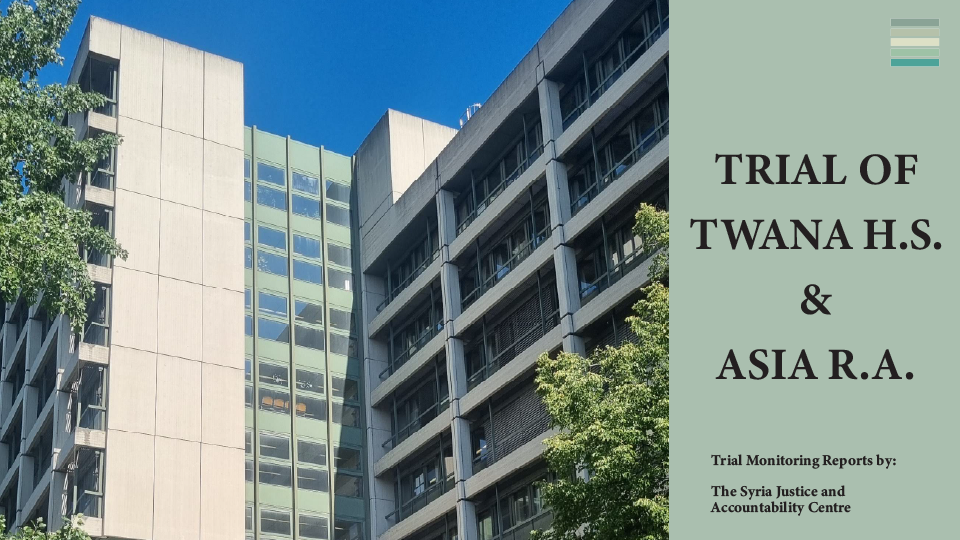
Inside the Twana H.S. and Asia R.A. Trial #33: The Closing Arguments of Asia R.A.’s Defense
TRIAL OF TWANA H.S. AND ASIA R.A.
Higher Regional Court – Munich, Germany
Trial Monitoring Summary #33
Hearing Date: June 22, 2026
CAUTION: Some testimony may include graphic descriptions of torture, rape or other violent acts.
Note that this summary is not a verbatim transcript of the trial; it is merely an unofficial summary of the proceedings.
Throughout this summary, [information located in brackets are notes from our trial monitor] and “information placed in quotes are statements made by the witness, judges or counsel.” The names and identifying information of witnesses have been redacted.
[Note: SJAC provides a summary of the proceedings while redacting certain details to protect witness privacy and to preserve the integrity of the trial.]
SJAC’s 33rd trial monitoring report details day 60 of the trial of Twana H.S. and Asia R.A. in Munich, Germany. This week, the Court heard the closing arguments of the Defense Team of the Accused Asia R.A. The Defense gave short accounts on Asia R.A.’s upbringing, her marriage to Twana H.S., and her treatment of the two Yazidi survivors. In total, it emphasized her remorse, questioned her genocidal intent, and argued for the applicability of juvenile law. Although the Defense agreed to a sentencing based on the charges of crimes against humanity and war crimes, the Defense argued for a “less serious case” and against the “particular severity of guilt.” All in all, it advocated for imprisonment of Asia R.A. of seven years, in accordance with juvenile law.
Day 60 – June 22, 2026
On this trial day, the Court heard the closing argument of the Defense Team of the Accused Asia R.A.
Ahead of the by 1,5 hours delayed start of the hearing, the Presiding Judge walked over to the Defense bench to inform Asia R.A.’s Defense Team of a letter Asia R.A. had sent to him directly. The Presiding Judge then discussed the logistics of the letter with the Defense [note: The monitor could not understand whether the content of the letter was mentioned. The Defense Team did not seem surprised by hearing about the letter’s existence.]
After logistical introductory remarks by the Presiding Judge, the two Defense Counsels of Asia R.A. began with their closing argument and presented them in an alternating manner. Immediately, the Defense pointed out that while this trial had been a difficult one, and although the Court deserves a lot of respect for having tried to bring light to a complex case in the context of war, violence, and trauma from a rather long time ago, there have been significant issues with the proceedings. First, when questioned regarding specific aspects of life under ISIS enslavement, most Yazidi witnesses simply replied “because it has just been like that.” According to the Defense, they often adopted the “assumed experiences of their peers” and did not state individual perceptions. Furthermore, the prosecution and punishment of ISIS members is the natural goal of all Yazidi witnesses, so these testimonies must be evaluated in that context of interest. Second, there have been plenty of interpretation and translation issues in this trial that already started with the many mistranslated UNITAD hearing protocols and made their way all the way into this courtroom. The UNITAD investigator [redacted name], W7, is Yazidi himself and does not have a specific education for this ultimately legal purpose, which is especially problematic since many witnesses stayed in contact with UNITAD after these one-on-one hearings. This has especially been an issue with the Yazidi witnesses who testified in this very trial, partially traveled to and stayed together in Germany and clearly consulted each other on their testimony contents, both before and after they served as witnesses.
The Defense then stated that the taking of evidence has clearly shown that [redacted name], P1, and [redacted name], P2, had been enslaved and held captive by both Accused. Asia R.A. and Twana H.S. claimed ownership rights on them, made them take care of the household, forced them to practice Islam, gave them new names and repeated insulting remarks towards them. It has also shown that Twana H.S. sexually abused P2 and that Asia R.A. aided him in the process. However, this cannot apply to P1 as there is not enough evidence to prove it. If the Court finds that Twana H.S. also sexually abused P1, it must establish that any knowledge or endorsement of his sexual action towards P1 cannot be proven with regards to Asia R.A.
Following this, the Defense presented a short biography of Asia R.A., which perfectly mirrored the expert testimony of the psychiatrist [redacted name], E1 [for further details of this testimony, see Trial Report #27]. The Defense specifically highlighted that the marriage to Twana H.S. was arranged and resulted from significant family pressure. Furthermore, the Defense stressed the point that Asia R.A. needs to be viewed different to “most other ISIS cases in front of German courts.” The female Accused grew up in Iraq and already experienced war there. She did not radicalize in another country and never traveled into ISIS territory with the personal intention to follow its ideology. In a clear moment of remorse, Asia R.A. did mention to E1 that she held P1 and P2 as Sabayas together with Twana H.S, the Defense specified and quoted Asia R.A., who had told E1 that “it all became normal there.” Already this comment hinted towards Asia R.A. non-existing intention behind the enslavement; she was just drawn into this by her new but unintended environment, her Defense argued. The fact that Asia R.A. asked P2 for forgiveness in this very trial on court day 40 [for the details of this testimony, see Trial Report #21], and that she did not principally reject any of the allegations against her, further speaks for her lacking intention behind the enslavement. The Defense then noted that expert witness [redacted name], E3, clearly stated that some women had important roles within ISIS [for the details of this testimony, see Trial Report #22]. With regards to Asia R.A., none of the Yazidi witnesses gave any evidence for such a role, however. The Accused only cared for the household and for her husband Twana H.S., through which she became an ISIS member “just by proxy.”
For the view of the Prosecution that Asia R.A. wished for a Sabiya as a bridal gift, there were no evidence. According to the Defense, former ISIS member [redacted name], F7, did not specifically mention this wish [for the details of this testimony, see Trial Report #5], and E1’s expert remarks clearly speak against it [for the details of this testimony, see Trial Report #27]. Here, the Defense additionally alluded to F7’s testimony on Asia R.A.’s father and noted that Asia R.A. did “not freely marry Twana H.S. and only accepted her cultural fate of an arrangement.””
The Defense continued that the sexual abuse of P1, which the Prosecution considered evident [for the details of this testimony, see Trial Report #31], the witness testimonies of the Yazidi women [redacted name], F29, [for the details of this testimony, see Trial Report #6], [redacted name], F32, [for the details of this testimony, see Trial Report #14], and [redacted name], F34, [for the details of this testimony, see Trial Report #7], in particular, contradict. According to the Defense, all three witnesses stated significantly different things in their UNITAD hearings. F34, for example, did not tell UNITAD of any sexual actions by the Accused towards P1, and suddenly, in front of this Court, testified that Twana H.S. had entered P1. Equally, the supposed punishment of P1 having had to stand naked in the snow, was presented with a lot of inherent contradictions, the Defense Team noted. Witness [redacted name], F35, did not even witness her sister P1 during her enslavement herself, but only repeated what F29 had told her during her testimony. And finally, P2, according to her own testimony, did not actively witness any sexual abuse of P1 in their household, but only testified on what P1 herself had told her about the alleged assault. In conclusion, the Defense stated, this all cannot be seen as evidence of any sexual abuse towards P1, especially not aided by Asia R.A.
Moreover, as the former German partners of Twana H.S. [redacted name], F2, and [redacted name], F4, had testified [for the details of these testimonies, see Trial Report #13], the Accused Twana H.S. easily fell for status symbols. And since so-called Sabayas were seen as important status symbols among ISIS men, and as Twana H.S. brought sufficient money from Germany and was paid good amounts by ISIS, his “purchase” of P1 and P2 just “falls into this logic,” the Defense explained. Clearly, Asia R.A. had nothing to do with it, her Defense concluded. On top of that, P1 had even been too young for any sexual contact according to ISIS’ own “pseudo-religious” statutes on Sabayas. This is why it seems unlikely that Twana H.S., who tried to carefully live according to ISIS’ ideology, resisted such norms by sexually exploiting P1. The fact that P1 told her sister F35 [redacted information] that Asia R.A. had “hit [her] with a stick so that her husband sleeps with [her]” cannot be taken as evidence for sexual abuse against her by any of the Accused, as F35 specifically prepared P1 by explaining that [redacted information] and that P1 “must state everything that happened” [for the details, see Trial Report #15]. The Defense of Asia R.A. then claimed that before this [redacted information], P1 had not talked about any sexual abuse against herself.
The Defense then repeated that Asia R.A. did at no point express an active wish to purchase Sabayas and that she cannot be seen as a true follower of ISIS’ Islamist ideology, not even when she was giving orders to P1 and P2. Thus, while Section 6 (1) (2, 5) CCAIL [genocide] can all in all be seen as objectively fulfilled with regards to Asia R.A.’s actions, the Accused did not have any genocidal intent. Before the Defense explained this in more detail, it argued that other than the Prosecution holds it, no. (2) (serious bodily or mental harm to a member of the group) can only apply with regards to Asia R.A.’s physical actions towards P2 - “serious mental harm” can only be assumed, but not causally attributed or psychologically evaluated with regards to P1. Expert witness [redacted name], E4, could not get any access to P1.
Although ISIS clearly had the intent for the Yazidi genocide as part of its ideology, “one does not automatically become a follower of this intent when just living within its day-to-day realities of Yazidi-enslavement," the Defense argued. The Accused still needed to hold and express the intent to contribute to the destruction and extermination of the Yazidi community. Just because one is in a situation to follow ISIS' strict rules and thus starts to accept enslavement, does not mean that one would automatically favor the Yazidi genocide. According to the Defense, this is especially true as Asia R.A. was trapped in the particular cultural context of being a household wife and had previously as well as after the time with Twana H.S. lived a very different, outgoing, and “liberal” life. Also, just having verbally repeated the propaganda of ISIS towards P1 and P2, cannot automatically prove the intent to commit the genocide as a personal goal. “What would have even happened if Asia R.A. had stated opposing opinions on the enslavement towards her husband?”, the Defense then asked rhetorically. To all of this comes the additional fact that Asia R.A. was not involved in the “initial” enslavement of P1 or P2, nor became a “proxy-member” of ISIS at the time of the 2014 Sinjar offensive, her Defense Team added. And Asia R.A. apologized for her actions. All in all, “genocidal intent cannot be proven,” the Defense summarized.
Besides, the Defense acknowledged, Section 7 (1) (3, 5, 6, 9, 10) were fully applicable to Asia R.A. No. (5) (torture) and no. (6) (sexual assault, sexual coercion, rape, enforced prostitution, sexual slavery or enforced sterilization) only become applicable with regards to P2 and not P1, and no. (6) only "in aid" in accordance with Section 27 GCC. According to the Defense, no. (8) (severe physical or mental harm) is not applicable at all, as P1 and P2 already experienced severe mental harm from other ISIS members through prior enslavement and abduction. With regards to no. (10) (persecution of an identifiable group or collectivity by removing or substantially restricting their fundamental human rights), only the count of "religion" can make sense. At the end of the day, the Defense specified, naming other counts like gender, ethnicity, age, and culture here, like the Prosecution and the Plaintiff Counsel requested [for the details of these testimonies, see Trial Report #31 and #32], would only serve the purpose of "accumulation that waters down the central point." According to ISIS, religion was the ultimate goal, under which any other count might have just served that very purpose. One should not distract from what is important, the Defense clearly emphasized. Furthermore, Section 8 (1) (2, 4) CCAIL are applicable with regards to Asia R.A., but no. (4) (sexual assault, sexual coercion, rape, enforced prostitution, sexual slavery or enforced sterilization) only with regards to P2 and only "in aid," in accordance with Section 27 GCC.
Because her Defense Team still considered Asia R.A. as an ISIS member “by proxy,” Section 129a (1) (1) GCC (forming of a terrorist organization), Section 129b (1) sentences 1 and 2 GCC (forming of a foreign terrorist organization), and Section 176 (1) GCC (sexual abuse of children, version from before July 2021) as well as Section 176a (2) (1) GCC (severe sexual abuse of children, version from before July 2021) are further applicable to her. Regarding the latter two offenses, Asia R.A. should only be sentenced “in aid” in accordance with Section 27 GCC and only with regards to P2 and not P1.
***
[65-minutes-break]
***
After the lunch break, the Defense argued for the existence of a “less serious case” in accordance with Section 6 (2), Section 7 (4) and Section 8 (5) when considering Asia R.A.’s involvement in the crimes. While the Defense stated that her young age and the fact that she at all times acted “jointly” with another person in in accordance with Section 25 (2) GCC, or even only “in aid” in accordance with Section 27 GCC, must be taken into account, it predominantly argued that the following central factors make her case “less serious”: Asia R.A. was not herself involved in the ISIS offensive, she was just a normal married housewife and did not have an official ISIS position. She did not herself enslave the Yazidi girls, was not radicalized from abroad but grew up in Iraq and – as very different to other “German ISIS proceedings” - kind of happened to be “in the wrong place at the wrong time.” She had no genocidal intent, provenly wished for a liberal life even during ISIS rule, and changed her daily routines drastically once coming to Germany. And finally, she had no prior criminal record and had already been in detention for quite some time under circumstances with significant language barriers. The apology to P2 was also noted in Asia R.A.’s favor.
According to the Defense, the application of juvenile law was also necessary and spoke for a “less serious case.” The Defense then turned to its arguments why juvenile law applied to Asia R.A. Once again, E1’s expert testimony was used as the central evidence and the Defense repeated many of the biographical accounts about Asia R.A., which E1 also presented to the Court. While E1 sat in various psychological sessions with Asia R.A. over the summer months of 2025, his colleague from the Juvenile Court Assistance, Mrs. Setz, did not. Moreover, Mrs. Setz applied the “Marburger and Mannheimer Criteria” to psychologically evaluate Asia R.A. having been mature or not, which were from the 1990s, “totally outdated” and “culturally insensitive” [for further details of this testimony, see Trial Report #26]. This is why an overall assessment of Asia R.A. would have been so important, according to the Defense, which the Juvenile Court Assistance, however, did not conduct. Mrs. Setz only stuck to her academic catalogue, while E1 wrote a comprehensive report, which went way deeper and only used the standard criteria as sole “orientation support.” The Defense then cited several recent journal articles that criticized the application of the Marburger and Mannheimer Criteria when dealing with “such culturally complex” cases [note: the trial monitor was unable to note of the author names and titles of these publications]. Taking this into account, the immediate rejection of E1’s report by the Prosecution does not make sense, according to Asia R.A.’s Defense Team [for the details of this testimony, see Trial Report #31], also because E1’s report included Asia R.A.’s current moral self-assessment and her remorseful view on her treatment of P1 and P2. The Defense agreed that today, Asia R.A. still appears “immature and often childish,” clearly post-matured during the last few years and has no fully developed ability to reflect on her actions. The early loss of her mother, her difficult relationship with her stepmother and her early “forced” marriage are certainly no factors that can speak for any kind of maturity in the years between 2015 and 2017, as the Prosecution claimed. In this courtroom, Asia R.A. further reacted overemotionally, whenever she was confronted with the difficult realities of the Yazidis and thus showed that her personality is still in a development stage. Whenever, she found herself in the situation to give orders to P1 and P2, this must be understood as “acting out her role” as an ISIS wife, which itself was new and uncertain to her, the Defense explained. This can also be shown by the fact that immediately when Asia R.A. arrived in Germany, her behavior changed and she experienced a personal liberation and freely texted with men, but also returned to childlike joys, like going to the playground or amusement parks. Her text messages remained “youthful” and “defiant” in style. If the Court finds that Asia R.A. actually wished for a second Sabiya, so that Twana H.S. would not find a second wife, this must also be seen as an immature overreaction of Asia R.A., who did not want to confront her own husband and “properly deal with the situation,” according to the Defense.” according to the Defense.
All in all, these factors speak for the application Section 105 (1) YCA, as until 2017, she acted as an adolescent and immaturely. Her ability to make moral judgements had not been fully developed until 2017, and the conditions of her family and cultural environment as well as her life under an Islamist terror regime made this process even more challenging. Since Asia R.A.’s entry into ISIS territory with her marriage to Twana H.S., her only option had been adaptation. Escaping such an environment was not possible, the Defense pointed out. Even if in doubt about all of this, the German legal principle of in dubio pro reo [English: the benefit of the doubt, i.e. if in doubt, it must be ruled in favor for the accused], needed to be applied by the Court in favor of the YCA. Furthermore, Asia R.A. offenses must be seen as a result of a longer development that already started with the “forced marriage” to Twana H.S. and her entry into ISIS territory. Her initially committed offenses clearly need to be seen as the height of her criminal actions, when evaluating Section 32 YCA, since everything else was just logically based on those.
Finally, the Defense explained that even though there is no apology that could ever justify her and Twana H.S.’s treatment of P1 and P2, Asia R.A. tried to apologize and showed respect to and acknowledgement of the mistreatment of the Yazidis by ISIS members like herself. Through that, Asia R.A. has taken on the exact responsibility that many Yazidi witnesses of this trial so strongly wished for.
As such, the Defense advocated for imprisonment of seven years.
Lastly, the Defense recognized that ff the Court holds that juvenile does not apply, then it must still not sentence Asia R.A. for life, because Section 106 (1) YCA will apply. According to the Defense, this would require the Court to establish that immaturity still has been a factor in the Accused’s criminal behavior, although not to the extent that juvenile law can be applied. Clearly, this is the case with Asia R.A., as has been argued with regards to Section 105 (1) YCA. Even more so, however, this qualification has only been rejected in comparable cases in front of German appellate and federal courts, when the Accused has shown no signs of remorse or rejection of the ideology that provided the moral basis for such severe crimes. Asia R.A. has shown both, however, as already established with strong evidence, her Defense Team concluded.
Regarding the question of particular severity of guilt [note: a specific judicial finding in German law that prevents a prisoner sentenced to life imprisonment from automatically being eligible for applying for parole after the standard maximum of 15 years, commonly resulting in having to serve prison time beyond this standard], the Defense stated that the affirming position of the Prosecution cannot be followed. This finding requires an evaluation of the actions and the guilt of the Accused being “infinitely large,” independent from any outside circumstances or contexts. For Asia R.A., the context of her offenses becomes more than relevant. However, only ISIS’ ideology behind the actions made them truly inhumane. Besides, Asia R.A. commented on herself as “guilty” [for further details of this testimony, see Trial Report #27] and showed remorse with regards to offenses that happened many years ago and all developed within a short time frame within a specific local and situational context; “a guilt beyond any regular guilt can thus not be established.”
Finally, the Defense Team of Asia R.A. thanked the Court for its respectful treatment of the Accused and “everyone else.”
The proceedings were adjourned at 1:30 PM.
The next trial day will be on June 30, 2026, at 10:00 AM.
___________________________
For more information or to provide feedback, please contact SJAC at [email protected] and follow us on Facebook and Twitter. Subscribe to SJAC’s newsletter for updates on our work