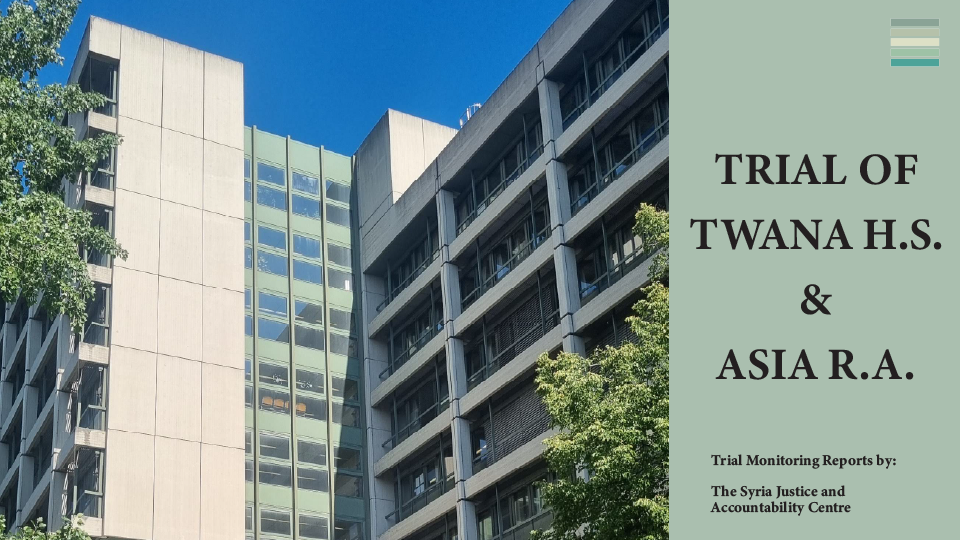
Inside the Twana H.S. and Asia R.A. Trial #22: Just A Regular ISIS Member?
TRIAL OF TWANA H.S. AND ASIA R.A.
Higher Regional Court – Munich, Germany
Trial Monitoring Summary #22
Hearing Date: January 19 & 20, 2026
CAUTION: Some testimony may include graphic descriptions of torture, rape or other violent acts.
Note that this summary is not a verbatim transcript of the trial; it is merely an unofficial summary of the proceedings.
Throughout this summary, [information located in brackets are notes from our trial monitor] and “information placed in quotes are statements made by the witness, judges or counsel.” The names and identifying information of witnesses have been redacted.
[Note: SJAC provides a summary of the proceedings while redacting certain details to protect witness privacy and to preserve the integrity of the trial.]
SJAC’s 22nd trial monitoring report details days 42 and 43 of the trial of Twana H.S. and Asia R.A. in Munich, Germany. On both trial days, the Court heard an expert witness, E3, on political Islam in North Africa and the Middle East, who testified on the history and organizational structure of ISIS and the treatment of the Yazidis as well as the specific role of women within ISIS. The expert witness concluded his report with his impressions of the Yazidi witnesses who testified in this trial and explained that most names of places and ISIS members and the logic of travel routes corresponded to his expert knowledge. Additionally, E3 testified that various circumstances might speak for Twana H.S.’s former belonging to a higher organizational ISIS unit. After the expert witness had been dismissed, the Defense of Twana H.S. issued a statement, arguing against the credibility of one of the Plaintiff’s December and January testimonies.
Day 42 – January 19, 2026
On this trial day, the Court heard [redacted name], E3, who already testified in front of this Court on May 26, 2025 [for the details of this testimony, see Trial Report #2], as an expert witness. E3 is a researcher at the German government-funded Institute for International and Security Affairs (SWP), [redacted information] years old, and an expert on political Islam in North Africa and the Middle East. Besides various posts in academia and think tanks, he worked for the Federal Chancellery and the Federal Intelligence Service and has written various expert reports on Al-Qaeda, ISIS, Hamas and Hezbollah for court proceedings worldwide since 2006. For this hearing day, E3 prepared an expert report on three aspects: (1) the structure and development of ISIS, (2) the role of women within ISIS, and (3) his impressions on the presented facts from the Yazidi witnesses’ testimonies from this trial. E3 explained that his testimony will be based on a report that was already created for another purpose on March 14, 2022.
The Presiding Judge prompted E3 to start with his expert testimony, which E3 subsequently did and first, freely testified on the historical development of ISIS. He started by explaining that today’s commonly known ISIS was founded as a caliphate by Abu Bakr al-Baghdadi, F130, in June 2014, and originally emerged from Iraqi Al-Qaeda structures from the early 2000s. E3 then uninterruptedly talked for two hours on ISIS’ history from 2011 until 2019.
***
[20-minutes-break]
***
Following this testimony on the history of ISIS, the expert witness turned to the ideologies and goals behind ISIS, before he explained that ISIS was structured into a central committee around the caliph himself, a committee of representatives to fulfil most political decision-making, and a committee of delegates as the most important executive organ. Additionally, ISIS was structured into 16 provinces, each led by a governor. The military, which until 2016 only consisted of said Katibas, was later structured into divisions, brigades, battalions and companies, each with their own specialization. A “secret police” was founded as an “internal intelligence service” to screen incoming ISIS fighters or ISIS enemies from within. According to E3, the secret police became more influential over the years and had its largest influence in 2017. As members of the secret police wore a particular uniform with two pistols and a vest, the expert witness showed so much interest in P2’s testimony on Abu Abdallah’s, aka Twana H.S., uniform, which, according to the Plaintiff, could hint to an affiliation of the Accused with a secret police unit. E3 then compared the secret police with the former Ministry of State Security of East Germany and explained that it was also responsible for the coordination of terror attacks abroad.
After E3 presented various markers indicating an ISIS membership, he specified that ISIS members received around 50 USD per month in compensation, and, until 2015, an additional 50 USD every month, if they actively fought in combat. On top of that, ISIS members were able to receive extra monthly allowances: 50 USD for every wife, 35 USD for every child and every family member living in the same household, 50 USD for every adult Sabiya [slave], and 35 USD for every child Sabiya. Most likely, Sabayas [slaves] were already considered adults with nine years old, according to the expert witness.
***
[68-minutes-break]
***
After the lunch break, the expert witness turned his testimony to the topic of ISIS’ views and mistreatment of the Yazidi community. According to him, Christians and Jews were tolerated within ISIS territory, as they were mentioned in the Quran, but had to pay high taxes. Yazidis, however, which lived in various Iraqi regions for centuries, were seen as nonbelievers, polytheists and devil worshippers, which led to their systematic killing, abduction, and enslavement by ISIS members. ISIS produced plenty of scholarly articles, mostly in its English-language magazine Dabiq, which justified and called for systematic action against the Yazidi community. This led to the killing of about 10.000 Yazidis, and the abduction of over 6.000, of which 2.000 are still considered missing, E3 testified. As plenty of Yazidi villages, all of which were named by the various witnesses of this trial, were situated around ISIS’ offensive axis, it “seemed logical” for ISIS to raid them. As Yazidis were usually not weaponized, and the Kurdish Peshmerga quickly fled, their communities remained defenseless when ISIS fighters started their offensive as a “military operation.” Places like Tal Afar or Mosul’s Galaxy Hall became the hot spots showcasing ISIS terror towards the Yazidi communities, the expert witness explained. Although it remains unclear why the Kurdish Peshmerga did not attempt to flee together with the civilian population, according to E3, their reason for capitulation lied in the relative insignificance of the Yazidi areas for Iraq as a whole, especially compared to cities like Erbil.
E3 then specifically testified about the topics of strategy, tactic, financing, communication, and foreign terror attacks, before the Court loosely started with questions. In response, E3 testified that ISIS followed the Sharia rule that all spoils of war should be equally distributed among the fighters to 80%, while 20% should remain with the “state.” Yazidi Sabayas were considered such “goods,” which is why institutionalized slave markets and online trading platforms were built up for the distribution of mostly Yazidi women, girls, and boys. Sabaya prices ranged from a few hundred USD to about 20.000 USD, depending on age, looks, virginity, childlessness, and other factors. Higher ranked ISIS members usually had to pay lower prices or had access to the more “sought after” Sabayas. Since P2 had testified that she was bought by Abu Abdallah for over “one binder” of money, the Court asked the expert what one binder referred to, which E3 answered with 10.000 USD. Furthermore, E3 testified that slave markets were often set up in close proximity to major oil fields, as this was where the wealthier and more influential ISIS members often worked and lived. One major ISIS oil trader was [redacted name], F47, who witness [redacted name], F29, already testified about to have bought and raped her and several other Sabayas. Furthermore, E3 explained that only higher ranked ISIS members were allowed to travel throughout Iraq and Syria without a permit.
***
[18-minutes-break]
***
After the break, the Defense of Asia R.A. wanted to know where the expert witness had all the information on the slave markets from. While E3 testified that most stems from good research, press coverage as well as other trials, one must be careful to imagine these as the markets one might know from books and movies on antiquity. Most of the places where Sabayas were sold, simply looked like large rooms and warehouses, in which spontaneous “deals” were made. In response to a second question, E3 added that ISIS mostly used the Surah “The Women”, verse 24, to justify the Yazidi slave trade, which mirrored what P2 had testified. The Accused Twana H.S. started to laugh loudly.
The Court then inquired about the places mentioned in the indictment and asked about the living situation in each of those throughout the years. E3 explained that the testimonies of the various Yazidi witnesses in this trial mostly corresponded to his knowledge on the travel routes, names of towns and places, and the due to the security situation continuously changing ISIS strongholds in both Iraq and Syria.
Subsequently, E3 turned to the second part of his expert report, which detailed the role of women within ISIS structures. He testified that, officially, women would not be part of the Jihad, as ISIS defines it, but naturally would take on household and family roles. Only when the organization was threatened in its existence, the caliph can declare that women are allowed to fight as well. While there have been plenty of cases, where women were used in suicide attacks abroad, most of their lives only existed within the household of the ISIS husband, who commonly permitted the women to leave the house to go shopping or to the mosque. Additionally, women had to wear full skin coverage, according to ISIS’ strict Sharia law interpretations. In rare cases, ISIS allowed women to work as doctors, nurses or teachers if they had special qualifications. It was, however, desired for women to become educated and take special Sharia classes, so that they can pass their knowledge onto their children, who were naturally envisoned to become well-trained ISIS members. According to the expert witness, around that time, women were also more frequently mentioned in membership lists, which pointed to an official role of those within ISIS structures. Next to doctors, nurses or teachers, women also appeared as propagandists with their own blogs or social media presences to spread ISIS ideology on the internet. Their status was connected to the status of their ISIS husbands, but often, Sabayas were seen as a symbol of wealth and influence among the ISIS women, according to E3. This would make sense, especially since Sabayas had most of their day-to-day contact with the wives of ISIS members, who then felt a special sense of ownership over them, E3 further testified. According to the expert witness, many women prepared the Sabayas for sex with their husbands or directly violently abused the Sabayas, whenever they made mistakes in the household. Later on, some ISIS women were able to engage in a special Sharia police force, but were only allowed to scold and arrest other women on the street for their misconduct. E3 then added that there were rumors that even female secret police members might have existed, although this was not proven. All in all, and compared to other Jihadist organizations, women had a more important role within ISIS structures and from late 2016 onwards, were even directly weapon-trained to participate in combat via a woman Katiba. Witnesses of other trials had specified that the woman Katiba, mostly consisting of foreign fighters, had up to 1.700 members.
With the announcement that E3 will testify as a witness on his impressions of the witnesses, who had already testified in this trial, tomorrow, the proceedings were adjourned at 4:30 PM.
The next trial day will be on January 20, 2026, at 9:30 AM.
Day 43 – January 20, 2026
The second trial day of this week started with the resumption of E3’s expert report. In this last part of his report, the expert witness focused on his impressions of the Yazidi witnesses’ testimonies from this trial and commented on the factual credibility of the places, names, travel routes, and specific experiences they testified about. E3 began his report by highlighting that, in summary, all the places that were so far named by witnesses in front of this Court were known and have commonly been attributed to the routes of ISIS’ influence in Iraq and Syria. E3 repeated the significance of various Yazidi towns, especially Tal Afar, Til Ezer, Kocho, and Ba’aj in Iraq and Raqqa, Abu Hamam and Abu Kamal in Syria, as well as the often as “wedding hall” labelled “Galaxy Hall” in Mosul, which the expert witness described as one of the centers of the slave trade. “No place was named by the witnesses that was not under ISIS control,” the expert stressed in that context. Additionally, all the flight routes made sense, according to E3.
Among the ISIS members that witnesses named during their testimonies, E3 was able to identify several formerly high-ranking officials. Especially Chechen Abu Omar, F131, who was described by one witness as a “white, long-bearded and fat” leader within Galaxy Hall, must have been an internationally known ISIS member, who had often been recognized as the leading ISIS commander between 2013 and 2016. Furthermore, E3 referred to [redacted name], also known under [redacted name], F132, and [redacted name], F47. F47 bought the Yazidi witness [redacted name], F29, and has most likely been a high-ranking ISIS member that oversaw ISIS’ oil reserves.
Also, the Yazidi witnesses’ testimonies on their mistreatment, on everyday life in captivity, their limited social life or on the occasional visits in each other’s households seemed plausible to the expert witness. When the witnesses testified on households where they sometimes got to meet other Yazidi girls and women, they often meant so-called Madafas or “women guest houses” that were common within ISIS structures. This would have occasionally been mixed up with private households, according to the expert witness. All in all, also the violence known by E3 that many Yazidi girls had to endure by both ISIS men and women corresponds to the testimonies of this trial, E3 concluded.
Immediately, the Court turned to questions, which left it unclear whether the expert witness had completed his report. The Presiding Judge was first interested in the weapons of Twana H.S., to which E3 again testified that the two pistols hint to a “higher organizational belonging” of the Accused. As a reaction to E3’s response, the Twana H.S. once again laughed loudly. The expert witness continued and explained that although it seemed unusual that Twana H.S. often wore his explosive belt, it might show his former role in active combat, and that he lived in a border place that was continuously exposed to danger from outside forces. In response to another question by the Court, E3 testified that it remains unclear whether the daughters of ISIS men immediately became members of the organization as well, or alternatively by marriage. However, the criminal potential of foreign women that joined ISIS was generally higher compared to Iraqi and Syrian ones, the expert witness added. It was also important not to classify every ISIS member as a Jihadist, he further commented. Since some women appeared “as numbers” in ISIS payrolls, often in the context of condolence payments, it does seem that ISIS gave them some type of relevance for their own organizational workings. The fact that ISIS had a youth organization for children aged four and above, might hint to ISIS’ view of their children as the next membership generation, at least in indirect terms. E3 was not able to factually prove this assumption, however.
Furthermore, the expert witness highlighted that Sabiya-ownership was not mandatory for ISIS members, and that a large majority was not interested in buying Sabayas in the first place. Additionally, ISIS women who did not follow or agree with certain practices of their husbands, were not immediately sanctioned. Institutional punishments usually only existed in cases of blasphemy or attempts to flee. Equally, ISIS members were advised to treat their Sabayas well enough, so that they don’t have to endure violence, hunger, and other physical issues, according to E3. Violence against Yazidis was permitted, but only in very narrow terms, and exclusively for the ISIS men in the household. Yet, the conversion of Yazidi women to Islam was a mandatory action.
Furthermore, the expert witness testified that the Accused’ final travel route from Mosul to Syria seemed uncommon, as most ISIS troops were precisely sent to Mosul to defend their weakening territory. Again, this might speak for Twana H.S.’s belonging to a special unit, according to E3. In response to various questions of the Court, E3 continued with his testimony and explained that women only received weapons if they had an active role within ISIS, that Yazidis were commonly freed with the involvement of a Sharia court, after which they were able to marry and move freely within ISIS territory, and that nasheeds [note: vocal Islamic songs or hymns, often including prayers and Quran excerpts] during sexual abuse were unheard of by E3 and in this trial’s case, seem to resemble a victory celebration. Generally, E3 continued responding to the Court, ISIS members were not allowed to leave the caliphate without permission until 2019. From 2017 onwards, it became common for ISIS families to get re-stationed to border-territory, so it often remained unclear whether flight activity by ISIS members was somewhat doable in combination with these movements. Equally, fleeing from the eastern to the western Euphrates shore by boat could have been possible. The Court’s final question referred to the common marriage age within ISIS families. E3 explained that women could have gotten married from the age of six, while intercourse was only allowed from the age of nine. Both was understood as Sunnah among ISIS members. As such, women often were already seen “adult” with nine years old. In response to a question by Twana H.S.’s Defense, E3 added that this was not a common practice in other countries where Islam is the state religion. Finally, the expert witness answered that pomegranate seeds, which Asia R.A. prepared for Twana H.S. in the context of P2’s rape, are throughout the region seen as aphrodisiacs.
After the Court’s questioning, the expert on child and adolescent psychiatry [redacted name], E1, continued with a special interest in the role of the daughter within ISIS structures. E3 testified that it was common to arrange early marriages for the daughters of Islamist families, but that one had to still differentiate between the individual cultural backgrounds. If someone had already been a member of ISIS before 2014, as likely had been the case with the father of Asia R.A., it was important to marry their daughter off to another high-ranking ISIS member, according to E3. Girls usually went to school for on average only three years, although it always depended on family finances and status. In the end, it always remained the decision of the father in the family. Divorces were legally accepted, but men had more options to “sanction” their wives, for example, by hitting them or marrying a second wife, which was often used as a threat.
Before the Defense continued with their questions, the Persecution asked if it was common to be a member in an Islamist organization like ISIS or Al-Qaeda and still wear traditional Kurdish clothes or remain unveiled. The expert witness quickly commented on this as “unusual and highly unlikely.” Subsequently, the Defense of Twana H.S. took over and asked if ISIS also had a system of civil marriages, which the expert witness ruled out. E3 then testified that only a few Sabayas were mentioned on ISIS payrolls, as they were usually not to be included, and that it was possible to relate specific payroll entries to particular ISIS Katibas in Iraq. For Syria, payrolls did not seem to be accessible. Although the Katiba with most Western ISIS members was stationed in Raqqa, E3 believed that the USA would never release such files, if they were available after all. Finally, the expert witness testified that while it is highly unlikely that “normal” ISIS members had Sabayas, since they cost so much money, it still could not be concluded that an ISIS member who owned Sabayas necessarily was in a high organizational position.
***
[53-minutes-break]
***
After the lunch break, E3 responded to a further questioning by Twana H.S.’s Defense on the common flight route, and testified that he never heard of anyone who fled from ISIS territory in the direction of the Iraqi or Syrian regime. Finally, the expert witness answered that until late 2017, there were no food supply issues within ISIS territory, and that “slushies or ice cream” were a very popular sweet treat, “just like Snickers.”
After the expert witness had been dismissed, the Defense Team of Twana H.S. issued a statement in accordance with Sect. 257 GCCP with regards to the testimony of Plaintiff [redacted name], P2. The Defense argued that her testimony was too contradictory for the Court to use as evidence, especially in comparison to her UNITAD hearing, but also regarding various inconsistencies she presented over her five hearing days. They cited various examples, among them, P2’s confusion if Twana H.S. used a condom when he raped her, her first having been unclear if Twana H.S. used his genitals to enter her, the timeline of the sexual abuse against her that P2 described in various differing ways over the hearing days, her confusion if the Accused spoke German or only Sorani, her illogical descriptions of Twana H.S.’s weapons and of his use of an explosive belt, her belief that [redacted name], P1, was never called “[redacted name]” but always “[redacted name]” by the Accused, and her allegedly wrong memory of the name of the Accused’ daughter. The Defense of Asia R.A. did not join this statement, nor presented an alternative one. The Persecutors did not issue a counterstatement that day, but announced to do so on a future hearing day.
Without a comment by the Court, the Presiding Judge started with the reading of a May 2019 FBI report on former ISIS member [redacted name], F133, who lived in Germany for many years and has likely been a partner of [redacted name], F7, who had also been tried in front of German courts and was a witness of this trial [for the details of this testimony, see Trial Report #5 ]. Although the Defense of Twana H.S. at first did not agree to the reading, the Presiding Judge ordered it as necessary, since F133 could not be summoned to Court from Syria. The reading mainly specified the various places F133 lived in during his time as an ISIS member, as well as the high-ranking ISIS members he worked under.
Finally, the Court presented a recording of F7’s testimony from her own trial [note: it remained unclear whether this testimony was in a court or in the investigating phase], in which she recalled to have once met an Iraqi woman with a German husband and a young nine-years-old Yazidi slave, “whose name was [redacted name] or [redacted name].” She described how she was shocked how the two ISIS members treated this “sweet young girl” and urged “the Iraqi woman” to let her go. Later on, the woman apologized to F7, but told her that she “could not free her Sabiya as she was a nonbeliever” and offered F7 to “gift” the girl to her, which F7 refused.
The viewing was left uncommented by the Court and the Defense.
The proceedings were adjourned at 2:35 PM.
The next trial day will be on January 29, 2026, at 9:30 AM.
___________________________
For more information or to provide feedback, please contact SJAC at [email protected] and follow us on Facebook and Twitter. Subscribe to SJAC’s newsletter for updates on our work