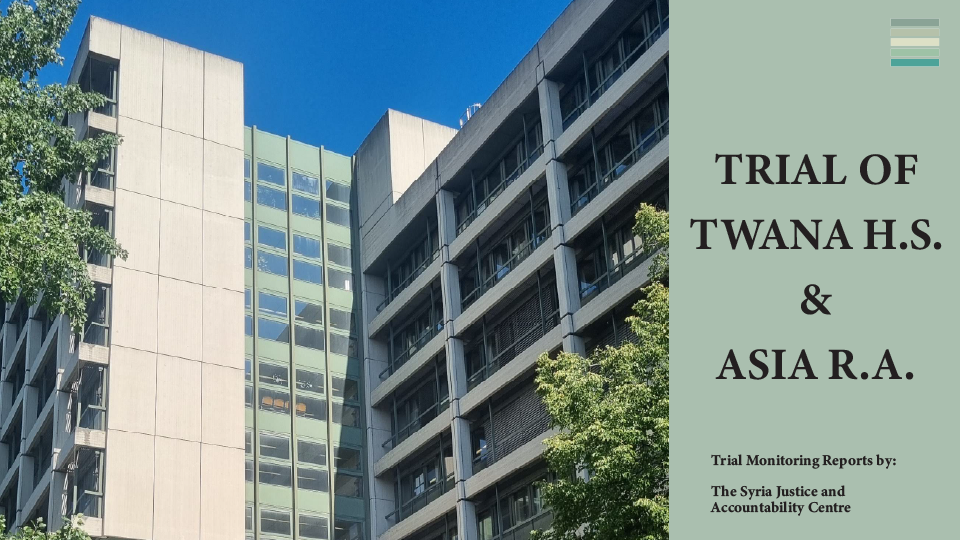
Inside the Twana H.S. and Asia R.A. Trial #31: The Prosecutor's Closing Arguments
TRIAL OF TWANA H.S. AND ASIA R.A.
Higher Regional Court – Munich, Germany
Trial Monitoring Summary #31
Hearing Date: May 12, 2026
CAUTION: Some testimony may include graphic descriptions of torture, rape or other violent acts.
Note that this summary is not a verbatim transcript of the trial; it is merely an unofficial summary of the proceedings.
Throughout this summary, [information located in brackets are notes from our trial monitor] and “information placed in quotes are statements made by the witness, judges or counsel.” The names and identifying information of witnesses have been redacted.
[Note: SJAC provides a summary of the proceedings while redacting certain details to protect witness privacy and to preserve the integrity of the trial.]
SJAC’s 31st trial monitoring report details day 57 of the trial of Twana H.S. and Asia R.A. in Munich, Germany. This week, the Court heard the closing arguments of the Federal Public Prosecutor General. The Prosecutor pleaded for six hours, providing a summary of all the facts, evaluating the evidence from all witnesses and expert reports of these proceedings, and presenting the legal assessment of the offenses as well as the penalty level. The Prosecution found that both Accused should be sentenced to life in prison and additionally requested that the particular severity of guilt should be established. With regards to Asia R.A., the Prosecutor argued that juvenile law was not applicable.
Day 57 – May 12, 2026
On this trial day, the Court heard the closing argument of the Federal Public Prosecutor General, represented by Senior Prosecutor Dr. Zabeck.
Before the Presiding Judge gave the word to the Prosecutor, he officially closed evidence-taking period, highlighting that no further statements or motions by any party to the proceeding will be heard or accepted. As pre-discussed with the Court, the Prosecution’s closing arguments will, including breaks, last up to eight hours, the Presiding Judge noted.
Following this introduction by the Court, the Prosecutor started with her preliminary remarks and an acknowledgement of the Yazidi genocide. While referring to the indictment and the various reports and expert opinions that were presented in this trial, she repeated the “gravity” of the crimes by ISIS members and honored the difficult situation not just the Plaintiffs and Yazidi witnesses, but also the Court and the two Accused found themselves in throughout the past year. In this context, the Prosecutor then thanked the 40 witnesses and six expert witnesses that testified in front of this Court and acknowledged that many had to travel from far abroad to – in some cases more than once - testify about the crimes, violence, and horror that they themselves traumatically experienced. Here, the Prosecutor stated that the Court “owes everything in this trial to the survivors.” The Prosecutor concluded her introductory remarks with stressing the importance of this trial for not just the German but the global rule of law and the promotion of international criminal law. Especially, she noted, since there were very limited ways for promoting such trials and the application of laws of international criminal law in Iraq and Syria. Still, the Prosecutor continued, the taking of evidence showed how “tedious” the application of this legal field still is for the German judiciary. This trial, however, has proven that “all these efforts are worth it,” especially since “there is little hope for proper criminal prosecution of the Yazidi case on the international stage.”
With the notice that the names of the Accused and witnesses of this trial will only be addressed with their first name for efficiency reasons, the Prosecutor continued with the findings from the evidence-taking phase of the trial. First, the Prosecutor briefly summarized the biographies of both Twana H.S. [for further details, see Trial Report #28] and Asia R.A. [for further details, see Trial Report #27] and provided a short history of ISIS’ founding, its 2014 Sinjar offensive, and the following killings, separations, enslavements, forced religious conversions, and sexual abuse as well as rape and torture of Yazidi by ISIS members, especially children and women, in Iraq and Syria until March 2019. Here, the Prosecution fully referred to the reports by expert witness [redacted name], E3, [for the details of this testimony, see Trial Report #2 and Trial Report #22] and noted that these facts had already been sufficiently established by other German courts.
In this context, the Prosecutor continued, the Accused’s crimes must also be assessed. In 2014, Twana H.S. stopped his consummation of drugs, “deepened” his interest in Islam, came in contact with radicalized members of a Munich mosque and eventually decided to travel to Iraq with [redacted name], F6, and [redacted name], F5, for the purpose of joining ISIS. According to the Prosecution, Twana H.S. knew that ISIS “was killing people.” When Twana H.S., F6 together with his wife [redacted name], F7, and F5 arrived in Raqqa, Iraq, the Accused first visited a Quran school and was shortly after transferred into a combat training camp. There, he changed his name to Abu Abdallah. The Prosecutor continued by recalling that Twana H.S. joined a fighting unit “together with many Kurdish people” in Mosul, where he also first got to know the female Accused Asia R.A. According to the Prosecution, Asia R.A. “involved herself in ISIS structures” already at that time. Twana H.S. married Asia R.A. and as a bridal gift, she “wished for a Yazidi girl.” Accordingly, they bought the “five to six years old [redacted name], P1, at a market.” After the “purchase,” Twana H.S. and Asia R.A. gained “equal ownership rights” of the girl, “exploited her sexually and economically, gave her a new name, taught her a new culture and religion and physically and mentally abused her,” the Prosecutor specified. Both Accused knew about ISIS’ enslavement practices and acted in “full accordance and knowledge of ISIS ideology.”
The Prosecutor then continued her closing argument with information on P1. P1 was born in [redacted location], Iraq, in “[redacted time] or [redacted time]” and had many siblings, of which all except for her brother were captured by ISIS. Her father got killed by ISIS fighters when P1’s family had first been captured on their way to seek shelter in the mountains. P1’s captivity then brought her to [redacted location], [redacted location], [redacted location], [redacted location], [redacted location] and [redacted location], all in Iraq. In [redacted location], P1 was separated from her sisters, and in [redacted location], from her mother who was later able to free herself. After [redacted location], P1 was brought back to [redacted location] to visit a “school,” and then to [redacted information], where she was bought by ISIS men. In the fall of 2015, Twana H.S. bought P1 and held her captive in [redacted location]. During P1’s time with the Accused, Twana H.S. and Asia R.A. kept contact with other ISIS families and their Yazidi slaves. Among them were also [redacted name], F32, and [redacted name], F30, who met P1 several times. In the late summer of 2016, the Accused moved to Syria together with P1, followed by a move to [redacted location], where they lived close to the Yazidi girl [redacted name], F34, who also testified as a witness in this trial. The Prosecution noted that at all times, P1 was forced by the Accused to do household work, especially to do the dishes for which she even received a stepping stool as she “was still so young and short.” Additionally, P1 took care of the Accused’s daughter. The Prosecutor added that sometimes, Asia R.A. threw household items at P1 and refused to give her food or let P1 wash herself. P1 was renamed to “[redacted name]” by Twana H.S. and Asia R.A., according to the closing argument. As a response to F7, who criticized Asia R.A.’s treatment of P1, the female Accused justified her actions with the Yazidi girl being a “Kāfir” [note: Arabic word for non-believers, usually used in a derogatory way for non-Muslims]. Because of that, Asia R.A.’s treatment of P1 would “ all be legitimate,” the Prosecutor quoted.
Then, the Prosecutor continued with her summary of the second Plaintiff’s, [redacted name]’s, P2’s life under ISIS and the Accused, but noted that since P2 is a Plaintiff to this trial, the detailed remarks will lie with the Plaintiff Counsel’s closing arguments. According to the Prosecution, P2, who also got captured by ISIS in 2014, was bought by Twana H.S. in [redacted location], Syria, from the ISIS member [redacted name], F110. The purchase was supported by Asia R.A., since she “wanted to prevent her husband from getting a second wife.” When Twana H.S. considered buying P2 from F110, he told P2 to remove her Hijab so that he could look at her hair. “F110 or someone else present” then commented to Twana H.S. that P2 “had not been raped yet.” Twana H.S. and Asia R.A. gave P2 the new name “[redacted name]” and - “just like with P1” - “took ownership rights of her and exploited her sexually and economically.” According to the Prosecutor, this happened in accordance with ISIS ideology and with full intent. Until [redacted time] 2017, both P1 and P2 were held captive by the two Accused and lived in a house with three other ISIS families. There, according to various witnesses, the Accused stored weapons and prevented the Yazidi girls from leaving the house. “An escape was impossible,” the Prosecutor cited from witness testimonies. Also, P2 was forced to take care of the household and the daughter of the Accused or massage the feet of Twana H.S., and whenever she got too exhausted from all the work or made mistakes, “she got abused.” Besides, Asia R.A. hit both Yazidi girls with her hands, and Twana H.S. used a wooden broom for the same purpose. Whenever P1 or P2 cried in response, Asia R.A. asked why they would cry since it was Twana H.S.’s “right to hit them.” It would also be “halal to hold them as slaves,” the Prosecutor quoted. Additionally, Asia R.A. mocked both girls on a regular basis, forbade any crying, called both nonbelievers, and forced them to memorize the Quran and pray several times per day, even early in the morning.
After the purchase, both P1 and P2 experienced sexual abuse by the Accused. Asia R.A. “endorsed it” and prepared P1 and P2 for it. According to the Prosecution, this had the clear purpose to exclude the two girls from their own Yazidi community. The Prosecutor then summarized that P1 had to experience “vaginal intercourse” at least once, while P2 equally endured one instance of “vaginal intercourse” and two additional instances of “sexual activity.” Right before P1 had been forced to intercourse, Asia R.A. hit her to make P1 compliant, and then washed and undressed her. Subsequently, Twana H.S. restrained P1 and “abused” her. In the first night with the Accused, P2 got woken up by Twana H.S. with wooden stick-strokes on her bare soles. Twana H.S. then wanted P2 to “come to him” and argued that he had “just been with P1, who is even younger than her,” the Prosecutor quoted. Finally, Twana H.S. rubbed his body on P2 “until ejaculation.” Two weeks later, Asia R.A. announced the “wedding” of Twana H.S., which in reality meant that she forced P2 to prepare the room in which Twana H.S. later had “coerced vaginal intercourse” with her. For this, Asia R.A. washed and dressed P2 and specifically did her makeup, before sending her up into the prepared room. “When P2 begged that she does not want to get raped”, the Prosecutor interpreted, “Asia R.A. did not react.” Shortly after, Twana H.S. entered the room, urged P2 to eat pomegranate seeds and told her that he could either “proceed with or without hitting her.” Although P2 cried out and urged Twana H.S. not to “do anything” to her, especially “as he also has a daughter,” Twana H.S. first stated that P2 is a “nonbeliever” and that it would be his “duty to do this.” He then fixated her and “vaginally had intercourse with her until ejaculation.” The closing arguments noted that Twana H.S. knew that “this was P2’s first time.” After the coerced intercourse, and although P2 was in pain and bled for several days, Asia R.A. only allowed her to change her clothes. She did not listen to P2’s request to get medical support. Instead, Asia R.A. told P2 how “idyllic” her very own wedding with Twana H.S. had been, but that she did not want her husband to look for a second wife.
Later on, the two Accused moved to a different house, where the tasks of P1 and P2 stayed the same, according to the Prosecutor. There, Asia R.A. burned P2 “on purpose” once, which the Yazidi girl F34, who also lived in the house, witnessed. When F34 confronted Asia R.A. about this, she just replied that since “P2 is our Sabiya, we can do whatever we want with her.” P1 also told F34 that she had been “raped” by Twana H.S., when F34 asked about the marks on P1’s back. Step by step, the Prosecution noted, P1 lost her ability to speak her mother tongue, which “further proves forced cultural alienation.”
When Twana H.S. and Asia R.A. started considering leaving for Germany, Asia R.A. offered P1 to get bought by other ISIS members, as she would have otherwise “just abandoned her.” In late 2017, P2 was eventually sold by Twana H.S. and Asia R.A. to ISIS member [redacted name], F111, who later allowed her to get free. From that point on until today, P2 lived in [redacted location], together with her grandmother, uncle, sister and brother. In [redacted location], her mental state has been critical, she has troubles to distract herself from the traumatic experiences from ISIS captivity, feels indifferent to her surrounding, does not go to school, has no social contacts and only plays on her smartphone the whole day, and suffers from a post-traumatic stress disorder (PTSD). “She is not able to live a normal life anymore,” the Prosecutor summed up. P1, on the other hand, still lives in a state of captivity, the Prosecution described. She was brought into the ISIS camp [redacted location] and stayed there until [redacted time]. Then, a man called [redacted name], F98, married P1 in the camp, had a child with her and renamed P1 to “[redacted name].” P1 [redacted information]. All of that, the Prosecutor concluded, makes it “impossible for P1 to live a normal life again.”
Together with their daughter, the two Accused traveled to Germany in 2018. On April 11, 2019, Twana H.S. was indicted for the first time and then imprisoned from October 2019 until February 2023. Right before his release, Asia R.A. broke up with him.
***
[15-minutes-break]
***
After the first break, the Prosecutor continued with the assessment of the evidence heard. The Prosecution’s information on the Accused’s personal data stem from the first trial of Twana H.S. as well as the statement on his personal circumstances by his Defense from trial day 42 on January 19, 2026 [for the details of this testimony, see Trial Report #22]. Additionally, his two former romantic partners, [redacted name], F2, and [redacted name], F4, testified as witnesses in front of this Court [for the details of these testimonies, see Trial Report #13]. The Accused Twana H.S. himself repeatedly made false statements about his persona in front of this Court, and previously deceived various German authorities about this. Most of Asia R.A.’s personal details stem from the testimony and expert opinion report of [redacted name], E1 [for further details of this testimony, see Trial Report #27]. Evidence on ISIS came from expert witnesses [redacted name], E3, [see above], [redacted name], E6, [for the details of this testimony, see Trial Report #15] and staff from the Federal Criminal Police Office (BKA), especially [redacted name], W8, [for the details of this testimony, see Trial Report #9, Trial Report #24 and Trial Report #27]. Similarly, evidence on the Yazidi genocide specifically stemmed from E3, E6 and W8. The Prosecutor concluded that all these expert witnesses testified “overly convincing and to high scholarly standards.” She especially emphasized the importance of W8’s expert report for this trial and noted that [redacted name], E7, added to the expert opinions well [for further details of this testimony, see Trial Report #25]. With regard to document evidence from ISIS, the 2014 Dabiq propaganda article “The Failed Crusade” as well as the related Fatwa read out on trial day 29 are central for proving ISIS’ intent and religious justification behind the Yazidi enslavement [for the details of this testimony, see Trial Report #15].
According to the Prosecution, the Yazidi witnesses who testified in this trial were overwhelmingly “reliable” and “embedded their testimonies well into a complex web of ISIS terror and personal family tragedy, captivity, abuse and exploitation.” Even though these tragedies happened eight to ten years ago and were “extremely burdensome” as well as traumatic, the witnesses [redacted name], F29, [redacted name], F32, [redacted name], F33, [redacted name], F34, [redacted name], F35, [redacted name], F36, [redacted name], W19, [redacted name], F121, [redacted name], F127, and [redacted name], P2, testified in a detailed and logical manner. Their testimonies mirrored each other to large extents, even in relation to Plaintiff P2, who was still held captive. As such, their legal ability to make factual statements was never limited. Taking all of this into account, slight contradictions within the witness testimonies were more than expected. These, however, were resolved with the Court’s and Defense’s questioning and especially with the help of the various expert witnesses, particularly W8, as well as witness F7, the Prosecutor noted. Thus, according to the Prosecution, there is no longer any reason for doubt that a witness testimony would have to be viewed with caution.
With regards to the correct identification of the two Accused as Abu and Um Abdallah, the Prosecution had no doubt. Both Yazidi witnesses F34 and P2 were able to identify the Accused with photographs, most other Yazidi witnesses acknowledged their presence in the courtroom, and age, origin, spoken languages, family circumstances and relations to Germany all speak for Abu and Um Abdallah being Twana H.S. and Asia R.A. Once again, especially F7 was a vital witness in this regard, the Prosecutor emphasized. Finally, Asia R.A.’s apology to P2 [for the details of this testimony, see Trial Report #21] can be seen as proof for this. The Accused’s ISIS membership had been sufficiently confirmed by all Yazidi witnesses, according to the Prosecution. Repeatedly, Twana H.S. was called an “ISIS fighter,” most witnesses referred to plenty of weapons in their home, P2 testified that she had been bought on an “ISIS base,” that Twana H.S. “was there to fight,” that he wore a balaclava and that he received money from ISIS.
Furthermore, the exploitation of P1 and P2 by Twana H.S. and Asia R.A. has been sufficiently supported by a full view of the evidence from the testimonies of all Yazidi witnesses of this trial. Further insights into the wedding between the Accused and into Asia R.A.’s wish to receive a Sabiya as a wedding gift stemmed from F7’s witness testimony and E1’s final expert report. The timeline of captivity of P1 was specified by the testimonies of her siblings F33, F35, F36 and W19, although it remained unclear until the very end whether P1 was born in [redacted time] or [redacted time]. Until today, the Prosecution does not know where P1 is exactly located. Here, the Prosecutor read out various quotes from P1 directly, especially from the phone conversations between P1 and F35 that referred to the “ISIS people from Germany,” stated that “Um [redacted name]” - another name for Asia R.A. since her daughter is named “[redacted name]” - punished P1 with having to stand naked outside in the snow, and that once again showed that P1 learned the German sentence “Ich liebe dich” [“I love you”] from the Accused. Finally, the Prosecutor referred back to various statements from F7’s testimony that would prove the Accused’s mistreatment of P1 and their final travel routes. Police lead investigator [redacted name], W1, further confirmed those with an analysis of Twana H.S.’s and Asia R.A.’s IP addresses during that time, the Prosecutor added.
***
[75-minutes-break]
***
After the lunch break, the Prosecution’s closing arguments continued with the evaluation of the evidence with regards to P2. Although the Prosecutor acknowledged that P2’s very own testimony was often the only evidence for her abuse, there is no ground for it to be critically questioned. P2 spent six full days with UNITAD and five full days in front of this Court; both of these testimonies almost perfectly mirrored themselves, and in court, P2 spoke freely, presented independent thoughts, remembered dialogues and was able to reply to complex questions. As a response to the Defense’s questioning of P2’s credibility of P2, the Prosecutor fully referred to the statements of the Plaintiff Counsel. P2’s testimony on Asia R.A.’s wish for a Sabiya to prevent that Twana H.S. would marry a second wife, on the household work and the individual humiliations she had to endure, on the weapons and the ways how Twana H.S. wore them, on the different methods of punishment, especially her being forced to stand on one leg or massage Twana H.S.’s feet, and on her description of the sexual abuse she endured, was in full accordance with the other provided evidence, according to the Prosecution. The fact that P2 got confused with the timeline and the terminologies of “sexual abuse” and “rape” is not blameworthy, especially since the Court was eventually able to clear this up during the questioning phase of the witness. The same principle applies when it came to P2 wrongly remembering the Accused’s daughter as “Aisha” or when P2 had trouble describing the house she lived in with Twana H.S. and Asia R.A., the Prosecutor added.
The sexual abuse of P1, on the other hand, can, according to the Prosecution, be evidenced with the witness testimonies of F33, F29, and P2, who were directly told by P1 that Twana H.S. “put something into her body.” On top of that, P1 used the Arabic word for “rape,” the Prosecutor explained. For her young age at the time, P1 described this “rape” perfectly well and believable. This would also fit with P2’s testimony that Twana H.S. often slept “close by P1” and that P1 asked P2 once if “she also had to do this.” Additionally, Asia R.A.’s text messages revealed that relatives – knowing that the Accused had two Yazidi slaves - had asked her if her husband “did it” with them. To this, Asia R.A. responded with the age of the girls – nine and twelve years – and confirmed that Twana H.S. indeed “did it.” The Prosecutor concluded that this clearly must mean that Twana H.S. raped P1 and P2 at least once. Furthermore, all testimonies with regards to the sexual abuse specified the time and place of the act sufficiently, precisely referring to the house with the three other ISIS families. Witnesses also sufficiently confirmed the non-nutritious food P1 received, that Asia R.A. poured hot water on P1 once and forced P1 to take care of her daughter, that Asia R.A. insulted P1 and P2 as “animals,” and that by 2017, P1 had lost most of her abilities to speak her mother tongue Kurmanji.
According to the expert psychologist [redacted name], E4, P2, today, suffers from post-traumatic stress disorder “in every imaginable form,” the Prosecutor continued. Additionally, P2 had been diagnosed with depression disorder. All of this would have not made P2 incapable of testifying as a credible witness, however; especially since this mental state, precisely the post-traumatic stress disorder, causally stemmed from the enslavement by the two Accused. P2 even put those feelings into words, the Prosecutor highlighted. Repeatedly, she cried out how she lost her very own humanity and dignity during her time under Abu and Um Abdallah. Once, the Prosecutor quoted, P2 stated that “during this month, they have turned my whole world into darkness.” According to expert witness E4, there is little hope for an improvement of P2’s mental state, the Prosecution read out. With regards to P1, a similar picture would emerge. The Prosecutor assumed that due to the parallelism of P1’s and P2’s abuse and especially due to her young age and no psychological help and processing after the enslavement, P1’s mental circumstance must at least be similar to P2’s. E4 and E7 testified similarly in Court, stated that her experiences are at least “suited” to cause post-traumatic stress disorder, and confirmed that the Accused’s abuse “stole any kind of childhood” from P1, while likely making her live with a “complete loss of social trust, no learned cultural techniques or social dynamics and no fantasies or natural playfulness.”
Finally, when putting all evidence together, the Prosecutor saw it proven that Asia R.A. was an official member of ISIS. This became obvious with her marriage to ISIS member Twana H.S., who received an ISIS salary, from which she also lived, with her residence in ISIS territory and regular travel to visit other ISIS families, with her access to weapons and explosive belts, and with her support of ISIS ideology by wishing for and suggesting the enslavement of P1 and P2. Twana H.S.’s ideological loyalty can be proven by his remark to a friend that “ISIS must kill all Yazidis” and by many of the documents and photographs found on his smartphone, according to the Prosecution. The fact that P1 and P2 immediately received new names would further prove this. Here, the Prosecutor quoted P2 again, who told the Court that Twana H.S. announced to her that she “is a nonbeliever, no matter how much [she] prays, as God made [her] parents non-Muslims.” When F7 criticized similar statements by Asia R.A., she showed no remorse and insisted on P1’s and P2’s status as Kāfir, the Prosecutor added. All in all, this shows that the Accused sought to completely and knowingly implement and defend ISIS ideology through their mistreatment of P1 and P2.
***
[21-minutes-break]
***
After the break, the Prosecution began with the legal assessment of the evidence. The Prosecutor first read out the German genocide definition of Section 6 (1) CCAIL, noted that Yazidi people are a “group” under this norm, and then immediately declared that no. (2) (serious bodily or mental harm to a member of the group), no. (4) (measures intended to prevent births within the group) and no. (5) (forcible transfer of a child of the group to another group) of the norm are applicable to both Accused in a “joint” manner, in accordance with Section 25 (2) GCC. As confirmed by several other German courts, ISIS must be evaluated as a group following the same ideological goal with all of its actions. The Prosecution then specified that the Accused are guilty of genocide for both serious bodily and mental harms, especially due to the violent deprivation of liberty, the forced praying and the sexual violence, coercion and rape of children. All these actions were done fully intentionally by the Accused, the Prosecutor noted. By buying, abducting, and selling Yazidi girls, and in the case of Asia R.A., by specifically wishing for that, the Accused excluded P1 and P2 from their Yazidi community. Their forced conversion to Islam and the rape of P1 and P2, who were virgins at the time, not just excluded them further but brought them into a hopeless circumstance, the Prosecution further elaborated. Section 6 (1) (5) CCAIL cannot specifically be ruled out because P1 and P2 were enslaved by other ISIS men prior to the Accused, as every single further distancing from the group of origin makes the norm applicable. Especially P1 had not fully lost her ability to speak Kurmanji before she was enslaved by Twana H.S. and Asia R.A. Solely physical distancing would not be necessary for no. (5) of the norm. The rape of P1 and P2 further makes Section 6 (1) (4) CCAIL applicable, as P1 has, until today, not been able to free herself from Islamist captivity. Even independent of that, the Prosecutor highlighted, Yazidi cultural traits would likely not allow P1 and P2 fully back into their community, making further reproduction impossible. This dynamic leads to an “eternal perpetuation of their enslavement.” Asia R.A. acted “jointly” and in “full complicity” with Twana H.S., as not just her interest in the crime was the same, but also the “ownership of the crime” must be evaluated as equal to Twana H.S.’s. She was similarly aware of ISIS’ ideology, actively wished for a Sabiya as a wedding gift and, later on, for another one to prevent her husband marrying a second wife. Furthermore, Asia R.A. physically participated in the abuse, violently punished, and prepared for the sexual act of the rape. The fact that she did not rape P1 or P2 herself does not change this evaluation, the Prosecution put forward. Finally, the “objective capability” to commit these crimes, as the German Federal Court of Justice requires it for Section 6 (1) CCAIL, can be found with both Accused, especially when put into the context of the full ISIS offensive and bureaucratic organization of the enslavement of the Yazidi community.
Additionally, the Prosecution declared Section 7 (1) CCAIL (crimes against humanity) as applicable to both Accused, especially no. (3) (trafficking, enslavement and ownership over a person), no. (5) (torture), no. (6) (sexual assault, sexual coercion, rape, enforced prostitution, sexual slavery or enforced sterilization), No. (8) (severe physical or mental harm), no. (9) (severe deprivation of a person’s physical liberty) and no. (10) (persecution of an identifiable group or collectivity by removing or substantially restricting their fundamental human rights). No. (10) of that norm is specifically applicable to the counts of religion, gender, ethnicity and culture in this case. Again, the Prosecutor referred back to definitions and established legal evaluations from other German courts. She argued that no. (3) was fulfilled by direct enslavement and ownership of P1 and P2 as Twana H.S.’s and Asia R.A.’s Sabayas, their continued punishment as well as captivity across various places in Iraq and Syria. No. (5) was fulfilled by the continued physical abuse and the various punishments the Accused applied towards P1 and P2; the norm would also be applicable if a clear purpose behind the torture was not immediately visible. No. (6) was fulfilled by the obvious rape and repeated sexual abuse with regards to both P1 and P2, especially since it happened against their will, with the help of physical fixation, while exploiting the vulnerable circumstances of two children, and in combination with threatening P1 and P2 to apply further violence in the case on non-complicity. With regards to this particular count, Asia R.A. only acted “in aid,” in accordance with Section 27 GCC. With regards to no. (8) and no. (9), the Prosecutor referred to her earlier remarks. While she also referred to the Plaintiff Counsel’s statements concerning the counts of Section 7 (1) (10) CCAIL, the Prosecutor noted that the count of “gender” holds specific relevance. Although all Yazidis were persecuted by ISIS, the terrorist group treated Yazidi men and women very differently and saw various functions in them, depending on their gender. Men, for example, were usually not enslaved and sexually abused, but used for combat. Additionally, the enslavement of Yazidi women is in line with the typical Islamist understanding of the role of the woman in patriarchal structures, as also proven by various Dabiq articles and ISIS Fatwas.
As ISIS’ offensive in Iraq and Syria is commonly seen as a non-international armed conflict, third, the Prosecution argued that Section 8 (1) CCAIL (war crimes against persons) is applicable with regards to no. (2) (hostage taking of a person), no. (3) (cruel and inhumane treatment by causing substantial physical or mental harm or suffering), and no. (4) (sexual assault, sexual coercion, rape, enforced prostitution, sexual slavery or enforced sterilization). Even more so, Twana H.S.’s and Asia R.A.’s actions were part of the armed conflict and did not just unfold as an “opportunity” of the conflict, making the war crime offense fully applicable, according to the Prosecutor.
Because both Accused were members of ISIS, Section 129a (1) (1) GCC (forming of a terrorist organization), Section 129b (1) S. 1, 2 GCC (forming of a foreign terrorist organization), and Section 176 (1) GCC (sexual abuse of children, version from before July 2021) as well as Section 176a (2) (1) GCC (severe sexual abuse of children, version from before July 2021) was applicable to both Accused. Regarding the latter two offenses, Asia R.A. should only be sentenced “in aid” in accordance with Section 27 GCC.
The Prosecutor then continued by explaining various legal technicalities behind competing legal norms and argued that legally, Twana H.S.’s and Asia R.A.’s actions will be evaluated as one. The previous sentencing of Twana H.S. does not hinder his full sentencing according to the mentioned offenses in this trial, the Prosecution added, as the ne bis in idem principle [note: a German criminal law principle that restricts double-sentencing for the same legal offenses] is not applicable here.
The closing arguments then turned to the question of Asia R.A.’s potential sentencing according to juvenile law, Section 105 (1) YCA, as until 2017, she acted as an adolescent. Although the Prosecutor acknowledged that the juvenile court assistance did not give out a clear recommendation and that expert witness E1 carefully argued for the applicability of juvenile law [for further details of these testimonies, see Trial Report #26 and Trial Report #27], she submitted that Section 105 (1) YCA was inapplicable and that the argument that Asia R.A. was still immature during the enslavement of P1 and P2 cannot hold. In a detailed manner, the Prosecutor explained that Asia R.A.’s upbringing had many stable factors, that she grew up with confidence and defensibility, that she admitted in chat messages that she personally liked to “cover herself up,” and that although she experienced family troubles, married happily. Further, there were no grounds to believe that the marriage between Twana H.S. and Asia R.A. was unhappy or forced. P2 even testified that Asia R.A. chose Twana H.S. as a husband and told her that their “hearts [were] one.” On top of that, Asia R.A.’s worry that Twana H.S. might marry a second woman only speaks for their previously good relationship. Other Yazidi witnesses all stated that their relationship seemed unproblematic at all times. The Prosecutor then added that the Court needed to take into account that Asia R.A. took care of the household, had her own social contacts, made her own decisions, and ordered P1 and P2 around and punished them, independent from Twana H.S. having been present or not. Furthermore, Asia R.A. fully supported Twana H.S.’s rape by preparing P2; her apology to P2 in this courtroom cannot be seen as an indicator for post-maturing, as E1 had argued. If, however, the Court evaluates this differently, it still needs to assess precisely at which time the offenses were centrally committed. As, according to the Prosecutor, the Accused’s treatment of P1 and P2 intensified towards the last third of their enslavement, the argument of Asia R.A.’s immaturity at this late stage, becomes even more implausible.
***
[19-minutes-break]
***
After the break, the Prosecution turned its closing arguments to the penalty level. Since both Accused fulfilled the requirements for Section 6 (1) CCAIL, the penalty must be imprisonment for life. Although Section 6 (2) CCAIL exists, and with that a potential imprisonment for a term of at least five years in less serious cases, the fact that genocide was fulfilled in three versions with regards to two individuals, and concurrently with Section 7 (1) CCAIL and Section 8 (1) CCAIL can only speak for a severe case of the offense. This is especially true for Twana H.S., as the only mitigating factor could have been the fact that he had no criminal record prior to the offense. In the case of Asia R.A., her apology to P2 in this very court room, her upbringing, the loss of her first husband, her young age during the criminal actions in question and the fact that she already spent a considerable time in detention without any contact to her children can be recognized as mitigating factors. But even those factors do not outweigh the severity of her and Twana H.S.’s actions, the Prosecutor concluded. This is why Asia R.A. should also be sentenced to imprisonment for life.
Regarding the question of particular severity of guilt [note: a specific judicial finding in German law that prevents a prisoner serving a life sentence from automatically being eligible for applying for parole after the standard maximum of 15 years, commonly resulting in having to serve prison time beyond this standard], The Prosecutor immediately stated that the lifelong sentence time of 15 years is “inappropriate” in the case of Twana H.S. and Asia R.A. and has to be extended and individually evaluated beyond the common maximum for both Accused. According to the Prosecution, this was especially true because of the high number of offenses with lifelong sentencing character and since both Accused mistreated not just one but two “extremely young” Yazidi girls. With regards to Asia R.A., the Prosecutor added that all Yazidi witnesses specified her “exceptional cruelty” in their testimonies. Finally, the Prosecutor noted that Section 106 YCA might be applicable, with meant that Asia R.A. could be sentenced to ten to 15 years in prison only when the Court deemed that juvenile law is not applicable instead of sentencing her to lifelong imprisonment. Since this norm, however, also required the establishment of immaturity, the Prosecutor immediately rejected its application in the present case.
As a result of the closing arguments, the Federal Public Prosecutor General read out the motion to the Court that:
Twana H.S. must be sentenced to life in prison in accordance with
- Section 6 (1) (2, 4, 5)
- Section 7 (1) (3, 5, 6, 8, 9, 10)
- Section 8 (1) (2, 3, 4)
- Section 129a (1) (1) GCC
- Section 129b (1) S. 1, 2 GCC
- Section 176 (1) GCC (version from before July 2021) and
- Section 176a (2) (1) GCC (version from before July 2021)
Asia R.A. must be sentenced to life in prison in accordance with
- Section 6 (1) (2, 4, 5)
- Section 7 (1) (3, 5, 8, 9, 10)
- Section 8 (2) (2, 3)
- Section 129a (1) (1) GCC
- Section 129b (1) S. 1, 2 GCC in combination with Section 25 (2) GCC, and
- Section 7 (1) (6)
- Section 8 (1) (4)
- Section 176 (1) GCC (version from before July 2021) and
- Section 176a (2) (1) GCC (version from before July 2021) in combination with Section 27 GCC
For both Accused, the Prosecutor requested that the particular severity of guilt be established.
The Accused have to bear the full costs of the proceedings.
The proceedings were adjourned at 3:31 PM.
The next trial day will be on May 19, 2026, at 9:30 AM.
___________________________
For more information or to provide feedback, please contact SJAC at [email protected] and follow us on Facebook and Twitter. Subscribe to SJAC’s newsletter for updates on our work