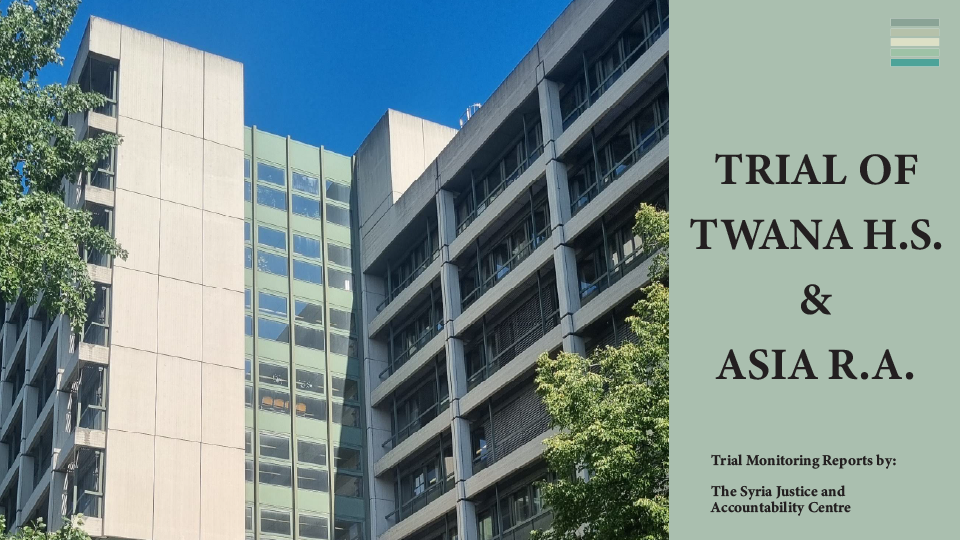
Inside the Twana H.S. and Asia R.A. Trial #28: The Scope of Narcissism
TRIAL OF TWANA H.S. AND ASIA R.A.
Higher Regional Court – Munich, Germany
Trial Monitoring Summary #28
Hearing Date: April 20, 2026
CAUTION: Some testimony may include graphic descriptions of torture, rape or other violent acts.
Note that this summary is not a verbatim transcript of the trial; it is merely an unofficial summary of the proceedings.
Throughout this summary, [information located in brackets are notes from our trial monitor] and “information placed in quotes are statements made by the witness, judges or counsel.” The names and identifying information of witnesses have been redacted.
[Note: SJAC provides a summary of the proceedings while redacting certain details to protect witness privacy and to preserve the integrity of the trial.]
SJAC’s 28th trial monitoring report details day 54 of the trial of Twana H.S. and Asia R.A. in Munich, Germany. This week, the Court heard a biographical statement by Twana H.S.’s Defense Team, which stressed a causality between an instance of sexual abuse of the Accused as a child in Iraq, followed by accusations of homosexuality against him, his decision to travel for asylum to Germany, and an eventual radicalization in Islamist structures in Munich. Furthermore, the Court heard the expert witness report of a forensic psychiatrist on Twana H.S., which described the Accused as a narcissistic personality offender with a disposition to commit severe acts of crime and as such, evaluated Twana H.S. as criminally liable, while recommending preventive detention.
Day 54 – April 20, 2026
On this trial day, the Court heard the forensic psychiatrist [redacted name], E5, as an expert witness, who was asked by the Court to draft a psychological report on the Accused Twana H.S. and on the question of whether, from a forensic standpoint, he could be considered as criminally liable.
Right after the Court informed E5 of her rights and duties and described the judicial purpose of her expert testimony, the Defense of Twana H.S. interrupted with the wish to first read out a statement on the Accused’s biography and personal circumstances. Immediately, the Presiding Judge granted the Defense the time to read out the statement, which was handed out to all parties to the trial in written form. During this and the following reading, E5 continued sitting in the witness stand in front of the Judges’ bench.
The Defense of Twana H.S. introduced the male Accused as an Iraqi, who was born in [redacted time] when his father was [redacted information] years old. Due to the war between Iraq and Iran, Twana H.S.’s family and [redacted information] siblings, of which one died in a gas attack, were constantly scared of the Iraqi Armed Forces and the Peshmerga. In search of more security, eventually, his parents decided to move to [redacted location], where Twana H.S. visited a school until the age of six. After that, he had to support his father in his shoe store. The Defense then specifically highlighted that Twana H.S. was sexually abused by another man when he was eight years old. According to the Defense, this led to widespread rumors in Twana H.S.’s family, community and school that he was homosexual, which resulted in “severe mobbing.” The Defense described this as a “typical case of perpetrator-victim-reversal." This was also the reason why Twana H.S. developed strong headaches, did not continue with school, but instead decided to start an apprenticeship to become a hairdresser. Since the rumors about his sexuality continued to affect him, the Accused decided to travel to Germany and use this marginalized position he found himself in as a reason to apply for asylum, according to the Defense. Twana H.S.’s asylum application was rejected, however. During this time, he started a relationship with [redacted name], F2, who shortly after gave birth to their son, and Twana H.S. was granted permanent residence in [redacted location] in May [redacted time]. When Twana H.S. found a job as a hairdresser, he started a new relationship with [redacted name], F4, who was his teacher in his hairdressing course. While, according to the Defense’s statement, “religion had no role in his life at that time,” Twana H.S. started to consume considerable amounts of alcohol, cigarettes, and occasionally cocaine with friends in Munich. He stayed together with F4 until [redacted time], wanted to marry her, according to the Defense, but was rejected and eventually thrown out by her due to his drug use. The Defense described this as a turning point in the Accused’s life, especially since at that time, he had no support with limiting his drug usage. Eventually, Twana H.S. got into contact with a Munich mosque, which helped him with finding new friends and with getting away from drugs. According to the Defense’s statement, Twana H.S. did “not feel like a Muslim” at this time of his life, because he “fell for the devil.” Because his new social circle was suddenly shaped by highly religious men, Twana H.S. started to become “more religious and radical by the day.” The statement described this setting as a “Salafist environment with daily Islam indoctrination.” Twana H.S. was approached to reverse his before lifestyle by “supporting the fight in Syria,” first by making donations and mailing old clothes. Subsequently, “many videos were shown” and Twana H.S. was told that “a real Muslim must become an ISIS member.” When his mosque friend [redacted name] aka [redacted name], F6, decided to travel to the Middle East to do exactly that, Twana H.S. followed him.
The Defense’s statement then jumped to 2015 and Twana H.S.’s first encounter with the female Accused Asia R.A. in Iraq, whom he “met and married very quickly religiously, as there were no other options.” Their marriage resulted in the birth of two children, with their son born disabled. In 2017, the two Accused left Iraq for Turkey, stayed in Turkey for one year and then traveled to Germany in 2018. There, Twana H.S. was immediately arrested and strongly suffered in custody. He had no contact with his family and was socially very “cut off.” This and his lack of contact with his children also made him realize that the marriage to Asia R.A. “had failed.”
The statement ended with specifying that currently, Twana H.S. “is still a Muslim, but sees it as a mistake to have gone to Iraq.” He “rejects ISIS and wishes for the co-existence of religions.” When the Presiding Judge asked Twana H.S. if everything read out was correct, he responded with “yes.”
The Court then turned to the expert witness E5 again, who started with the presentation of her report on Twana H.S. She explained that she was asked by the Court to evaluate Twana H.S.’s criminal liability and, on the basis of that, present a recommendation if the Accused should be held in preventive detention according to Section 66 StGB. E5 had access to all files of this trial as well as to the current and past prison files of Twana H.S.
Biographically, E5 mirrored most of the facts that the Defense had already stated shortly before. However, she did not testify on any experiences of sexual abuse or reasons for asylum, and described Twana H.S.’s path to radicalization in one sentence. The expert witness mostly focused on Twana H.S.’s time in prison in [redacted location] from 2019 onward, where, according to her, Twana H.S. expressed suicidal thoughts once. There, Twana H.S. did not stand out much and only had a few disciplinary shortcomings. The prison administration proposed psychological support, which the Accused eventually accepted, but which quickly ended, since Twana H.S. “denied everything” and was not willing to talk with anyone about his mental condition or experiences during past years in Iraq and Syria. In this context, the expert witness described him as “not cooperative.” Asia R.A. often rejected the contact to Twana H.S., which made the marriage status confusing, according to E5. As a reaction, Twana H.S. started to make degrading remarks about Asia R.A. to some friends, mostly via his smartphone, which he illegally gained access to, and which was then confiscated in September 2023. E5 testified that Twana H.S.’s specific smartphone usage also proved his continued radical Islamist beliefs.
Health-wise, Twana H.S. suffered from migraines and in April 2024, claimed to have had consciousness and breathing problems. The latter, according to the expert witness, seemed like simulation to her, however. Although he once claimed to have “heard voices,” there were no signs of psychiatric illnesses, E5 specified. Repeatedly, Twana H.S. complained about abuse and discrimination by prison personnel, which, according to E5, would not prove an independent psychological dynamic, but instead simple narcissism. Sexually, E5 could not point to any unusual behavior and regarding his drug use, Twana H.S. remained inconspicuous since 2014.
Subsequently, E5 turned to her diagnosis. According to the expert witness, Twana H.S. appeared as a controlled and non-affective person during this trial, who did not react in any way when P2, for example, testified on her sexual abuse sufferings under him. When E1 testified on Twana H.S. as Asia R.A.’s husband, however, he showed immediate affection and even had “teary eyes” [for the details of this testimony, see Trial Report #27]. This, along with many other examples from this trial, shows that Twana H.S. only got emotional when his life and personal standing were affected. Whenever the negative experiences of others were involved, the Accused did not seem to care, E5 testified. This proves a personality with narcissistic traits, an inner conflict of self-worth with the constant attempt to raise oneself in any possible context by bringing down others. This goes along with the search for recognition, power, attraction, and glamour. Besides, people with such a personality commonly lack empathy and compassion, give their own existence a special meaning that can sometimes lie above law and order, and tend to fall for denial and repeatedly inverse facts. Moreover, E5 added the hostility syndrome to these traits, which makes people belief that everyone stands against them in bad faith and that only they represent the truly good faith. Still, this would not qualify for a separate personality disorder, E5 testified.
Although one could find explanations for the development of his narcissistic personality in Twana H.S.’s brother’s death, his witnessing of violence during the Iraq – Iran war, or in his alleged sexual abuse and marginalization experiences, these should not weigh that heavily, according to E5. The expert witness then testified that Twana H.S. does not qualify as a psychopath, since he only reaches 16 of the necessary 25 points on the psychopath classification criteria. On top of that, there were no signs of pedophilia when it comes to Twana H.S. His sexual abuse of P1 and P2 was likely a result of his narcissistic personality, specifically a demonstration of power coupled with “intropsychological ideological moralization.” Finally, no signs of schizophrenia or neurological disorders exist, according to E5’s testimony, and Twana H.S. seems intellectually average.
All in all, the expert witness concluded, “Twana H.S. does not suffer from a context-independent psychological disorder, nor from a post-traumatic stress disorder, was at all times able to master day-to-day responsibilities, has no proven disorder of disease-value, no disorder in his sexuality, has full management capabilities and as such, only stands out with his narcissistic personality, which became a gateway for ideologies with inherent aspects of division.” According to E5, this makes Twana H.S. fully criminally liable.
Regarding the question of Twana H.S.’s disposition to commit similarly severe acts of violence in the future, the expert witness testified that narcissism bears the risk of being fully imminent to one's personality and thus, statistically becomes a common ground for repeated criminal activity.
According to E5, in the specific case of Twana H.S., the risk of reoffending can be further reasoned with Twana H.S.’s tendency to trivialize things, his externalization of responsibility, failure to comply with custody and prison conditions, his careful preparation of criminal behavior, his lack of doubt, his full ability to integrate into criminal subcultures and his antisocial thought patterns.
The expert witness concluded with her evaluation of Twana H.S. as an “offender due to his personality with a disposition to commit severe criminal acts.”
Following E5’s expert witness testimony, the Court turned to questions and wanted to know when Twana H.S.’s narcissism first developed. E5 replied that although the Accused could have been prone to such a personality since childhood, it likely fully developed and made him change his behavior towards others after his first arrival to Germany in [redacted time]. Until [redacted time], he was likely able to suppress it, since his social circle remained rather stable. This, however, changed dramatically when he left the country for Iraq, E5 testified.
***
[15-minutes-break]
***
After the break, the Court asked if jealousy could also be a part of narcissistic behavior, since both F2 and F4 testified that Twana H.S. got jealous very quickly, although he was the one that stayed outside alone often. In response, the expert witness testified that this would indeed be very common, especially in combination with Twana H.S.’s “manipulative deception” of him actually having been away from his relationships, although he kept complaining about jealousy and mistrust. Furthermore, the Court wanted to know why Twana H.S. had strong reactions to “so many seemingly small matters,” for example, the question of how the room-layout of the Accused’ home in Iraq was. E5 was not able to give a psychiatric explanation for this, but added that Twana H.S.’s constant notetaking can be seen as a narcissistic way of protection from all of the accusations against him. To the question of the Persecution, if “positive admiration” of oneself can occur whenever a perpetrator sees themselves as a victim, the expert witness responded with “yes.”
The Defense of Twana H.S. then only asked if anything would change in E5’s evaluation if it was proven that Twana H.S. did not sexually abuse P1 and P2, to which the expert witness replied with her repeated testimony that nothing would change, since Twana H.S.’s personality structure remains.
After the expert witness had been dismissed at 11:26 AM, the Court heard another statement by the Defense of Twana H.S., arguing for access to the video recording file of P2's UNITAD hearing. They aimed at proving that P2 wrongly claimed that one of her statements, specifically that she had already been abused on the very first night of her arrival, had not been recorded during her UNITAD hearing. According to the Defense, this could further affect P2’s credibility as a witness and thus, needed to be evaluated in open court. The Persecution commented that P2 already gave a comprehensive testimony in front of this Court, making the UNITAD hearing largely irrelevant to consider so carefully. Additionally, a video or audio file was largely useless due to the obvious language barriers, the Prosecution claimed.
The Court announced to decide on this matter, and on a potential additional translation of the file into German, another time.
The proceedings were adjourned at 11:34 AM.
The next trial day will be on April 29, 2026, at 09:30 AM.
___________________________
For more information or to provide feedback, please contact SJAC at [email protected] and follow us on Facebook and Twitter. Subscribe to SJAC’s newsletter for updates on our work