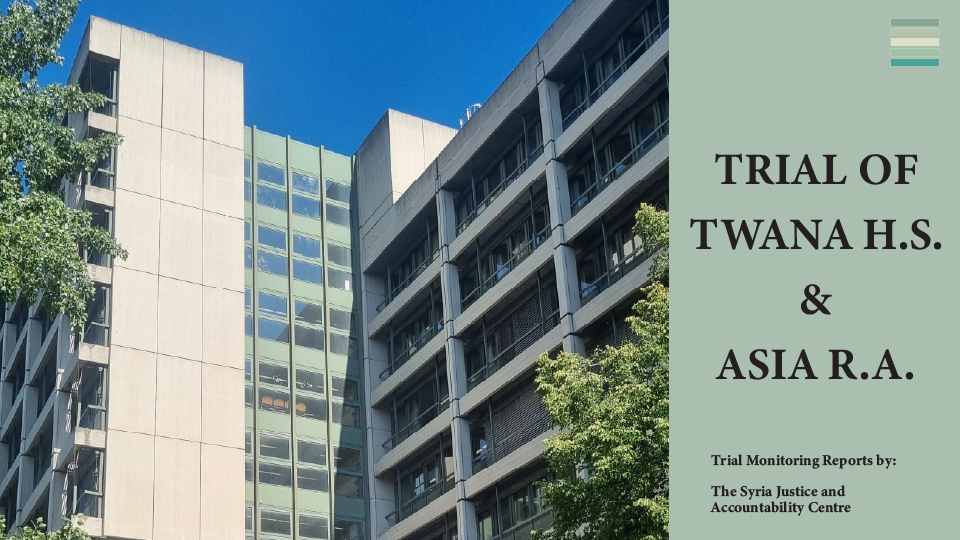
Inside the Twana H.S. and Asia R.A. Trial #25: Trauma of a Genocide
TRIAL OF TWANA H.S. AND ASIA R.A.
Higher Regional Court – Munich, Germany
Trial Monitoring Summary #25
Hearing Date: February 11 & 12, 2026
CAUTION: Some testimony may include graphic descriptions of torture, rape or other violent acts.
Note that this summary is not a verbatim transcript of the trial; it is merely an unofficial summary of the proceedings.
Throughout this summary, [information located in brackets are notes from our trial monitor] and “information placed in quotes are statements made by the witness, judges or counsel.” The names and identifying information of witnesses have been redacted.
[Note: SJAC provides a summary of the proceedings while redacting certain details to protect witness privacy and to preserve the integrity of the trial.]
SJAC’s 25th trial monitoring report details days 47 and 48 of the trial of Twana H.S. and Asia R.A. in Munich, Germany. On the first trial day of the week, the Court heard two officers of the German Federal Criminal Police Office (BKA). While the first officer was involved in the initial questioning of one Yazidi witness by Belgian authorities, the second officer sat in the UNITAD hearing of one of the Plaintiffs of this trial. Both officers shared their impressions, which mostly mirrored previous witness testimonies of this trial, but once again brought confusion to the timeline of the alleged rape and sexual abuse with regards to P2.
On the second day of this week, the Court completed F37’s testimony. F37 clarified certain details of her testimony of the previous day, but mostly repeated what she had already said. The Court then heard a new witness, E7, an expert on trauma psychology. He had interviewed 1403 survivors and found that most of them had a multitude of psychological disorders caused by their treatment under ISIS. E7 estimated that the genocide of 2014 could result in the Yazidi community ceasing to exist within 4-5 generations.
Day 47 – February 11, 2026
On this trial day, the Court first heard [redacted name], W24, as a witness. W24 is a chief officer at the German Federal Criminal Police Office (BKA) in Wiesbaden, and was involved in the questioning of the Yazidi witness and survivor [redacted name], F33, by [redacted location] authorities in December [redacted time].
The hearing started with the Presiding Judge informing the witness of his rights and duties, followed by the prompt to tell the Court about the setting and purpose of the questioning of F33. W24 began his testimony with describing how the [redacted location] colleagues picked him up, then the interpreters for Kurmanji and [redacted information], and then F33, and together drove to the [redacted location] town [redacted location]. The questioning happened in a small room, where two [redacted location] officers – one man and one woman – led the conversation with F33. W24 had no role in the questioning, was only present as a “listener” during the questioning and did not sit in any preliminary consultation with F33. The witness then continued by recalling what F33 had stated during the questioning. F33 explained to the [redacted location] authorities how her family had first been captured and then separated by ISIS. She was then brought to a hall with 2.000 other young women and children in [redacted location], from where the “Katiba leader” [redacted name], F47, took her with him and gave her to [redacted name], F134. According to the witness, F134 raped F33 and made her live with him for two years. During this time, F33 tried to commit suicide with pills. Eventually, F33 was brought back together with her sister [redacted name], F29. Both were brought to [redacted location] during the summer of [redacted time], but were separated again after roughly nine months. Due to the decreased security situation, F33 had to follow F134 to [redacted location] in late 2017, where they stayed in a house with the Accused Abu Abdullah aka Twana H.S. and Um Abdullah aka Asia R.A., who, according to the witness, had their own Yazidi slaves. There, also the Yazidi girl [redacted name], F34, who was bought by another ISIS family, lived. One of the Sabayas under Abu and Um Abdullah was named [redacted name], P2, and had just been sold a few days prior, according to F33, while the other one was called “[redacted name]”, P1, and had then been ten years old. W24 told the Court that F33 had explained the [redacted location] authorities that Um Abdullah aka Asia R.A. “treated the little girl very badly, gave her many orders and also hit her”. This was information, F34 had told F33, as she had a better connection to the Yazidi girls under Abu and Um Abdullah, P1 and P2. Additionally, “[redacted name]”, P1, was forced to pray according to Islamic rules and once told F34 that “Abu Abdullah raped her, which was Um Abdullah’s idea”. W24 further testified that the apartment the Accused lived together with F33 and F34 in had a large room, a restroom, a kitchen and a courtyard. Repeatedly, “[redacted name]”, P1, was screamed at by Um Abdullah when she failed to complete the household tasks she was forced to do. However, F33 knew that F34 was treated “neutrally” by Um Abdullah, as “she was not her property”. The witness then knew that F33 confirmed with “to 100 %” when she was shown pictures of Um Abdullah and “[redacted name]”, P1, by the [redacted location] authorities. She was shown both pictures of the Accused from their ISIS days as well as current pictures of them, and recognized Um Abdullah each time, but Abu Abdullah not once.
***
[60-minutes-break]
***
After the break, the Court continued with questioning the witness and requested more information on Abu and Um Abdullah. In response, W24 testified that F33 described Abu Abdullah aka Twana H.S. as an “Iranian Kurd with short hair, a long beard, a nose with a large hump, amber-colored eyes and an athletic built in his mid- to late-thirties”. Um Abdullah aka Asia R.A. was described as “not pale but also not brown”, roughly 1,70 meters tall, long-haired and in her late twenties. F33 described both of their clothing styles as “Afghan” and added that Abu Abdallah, who “worked in an office”, carried a pistol with him. Still, she stated that Um Abdullah wore “clothing where only the eyes were visible”. Furthermore, W24 testified that Abu and Um Abdullah were married, had “at least” one child aged three, that “[redacted name]”, P1, could only speak Arabic, that the street where the Accused last lived was a gravel road and that the house had a green door. When the Court asked about it, the witness did not know anything of P2’s rape, however.
The Court then wanted to know if F33 had mentioned another “[redacted name]” or an “[redacted name]” in her responses, which the witness negated without providing any further comment In this context, he testified that he had read his own notes in total three to four times again and last, two days before his testimony, that he speaks [redacted information] “well” and that he did not see any contradictories in his notes. Subsequently, the witness recalled that F33 was “very confident” during the questioning. She specifically not agreed to an audiovisual questioning, wanted to have a copy of the protocol, which she did not receive, and deliberatively planned to testify in front of the [redacted location] authorities as she claimed to have more asylum rights there, compared to in Germany. The questioning was then organized “in the context of ISIS terrorism”. While the [redacted location] authorities did not use the names Abu and Abdullah, which were mentioned by F33 directly, they did explicitly refer to Twana H.S. and Asia R.A in the questioning.
The witness then continued with responding to questions of the Court and testified that F134 was also named “[redacted name]”, that both Abu and Um Abdullah spoke Sorani with a dialect, also to “[redacted name]”, P1, that sometimes, everyone in the house received cookies, but not P1, that F33 did not know any specifics of the violence P1 had to endure, only saw P1 cry once but did not witness any direct violence, and that, according to F33, Um Abdullah once said that she “can do with her slaves whatever she wants, also sell them”. Furthermore, the witness knew that F33 was freed on December [redacted time].
After a few specific questions by both Defense Teams that the witness could not give any answer to, the witness was dismissed at 2:40 PM.
Next, the Court heard the German Federal Criminal Police Office (BKA) officer [redacted name], F37, who already testified in front of this Court in June and September of 2025 [for the details of this testimony, see Trial Reports #5 and #9]. F37 had been digitally present during the UNITAD hearing of [redacted name], P2, and was as such instructed by the Court to give a summary of her impressions of the hearing.
F37 and her colleague [redacted name], W8, both joined the UNITAD investigators [redacted name], W7, and [redacted name], F135, together with interpreter [redacted name], F106, between November 27 and December 10, 2023, during their hearing of P2 in [redacted location]. F37 and W8 joined via video and were able to ask questions through a chat function.
The Presiding Judge instructed the witness to testify on her memory of P2’s hearing, which F37 subsequently started by recalling most of P2’s experiences under ISIS captivity. This again included P2’s family’s whole time under ISIS captivity, the various places and ISIS families P2 and her siblings were held captive by, and the abuse from the Accused. Her testimony quite exactly mirrored P2’s testimony from this trial [for the details of this testimony, see Trial Reports #19, #20, and #21], although the witness repeatedly commented that most of P2’s timeframes must have been totally off. She did not provide any specific corrections or examples, however.
During her testimony, F37 explained that in the UNITAD hearing, P2 stated to have been “raped” not one but three times by the Accused, “in exactly the same manner as the first time”. According to F37, P2 stated in the UNITAD hearing that Abu Abdullah aka Twana H.S. “ejaculated” while he raped her “vaginally without protection” for the first time, and “raped” her “in exactly the same manner” the second and third time. On top of that, according to F37’s memory of P2’s UNITAD hearing, which F37 recalled as “rape”, when Twana H.S. woke P2 up with hitting her soles with a stick, happened after the rape, for which Um Abduallah aka Asia R.A. had prepared P2. Finally, F37 testified that the Accused Asia R.A. actively used violence against P1 and P2, for example, by hitting P1 twice for not having been able to fill up a water bottle, or when Asia R.A. forced both to stand on one leg for 30 minutes.
As F37 testified in a one-hour monologue on her memory of the UNITAD hearing on this trial day, the witness was dismissed with the announcement that the Court’s and Defense’s questioning will follow on the next trial day.
The proceedings were adjourned at 4:00 PM.
The next trial day will be on February 12, 2026, at 10:00 AM.
Day 48 – February 12, 2026
On the second trial day of this week, the Court resumed the questioning of [redacted name], F37, that began on the previous day. She started by describing how P2 had been shown various pictures in which she identified the Accused as her captors. When shown pictures of a child that likely displayed P1, P2 was not sure if it showed P1, according to F37.
The Court then asked F37 how P2 had known where Twana H.S. had been from, to which F37 responded that Asia R.A. had told P2. The Court then read a part from the transcript, where P2 had said that Twana H.S. had told P2 himself that he was from Germany. P2 had said that Twana H.S. reported that he had left Germany because of external circumstances, like problems with the police. P2 asked Asia R.A. whether Twana H.S. was allowed to approach P2. Asia R.A. answered that she, Asia R.A., could not do anything if Twana H.S. decided to rape P2. At one point, P2 was told that Twana H.S. wanted to get married. The witness recalled that P2 was relieved because she hoped that when he got married, he would leave her alone. However, she learned that she was mistaken since it referred to P2 having to marry Twana H.S. P2 was sold to Twana H.S. after she had refused to marry her previous owner, F37 recalled.
Next, F37 clarified a situation where Asia R.A. had hit P1 for being unable to fill a large water bottle due to her small size because she was still a child.
Twana H.S. justified his actions to P2 by saying that the prophet had taken a wife that was 6 years old and as both P1 and P2 were over 6 years old, his actions were justified. P2 had differentiated the actions of her different captors only after saying that Twana H.S. had raped her, classifying the others as sexual assault rather than rape, though she could not explain in detail how the sexual assault was different from the rape, yet stressing that it was. F37 remembered that while talking about her experience, P2 seemed composed and level-headed, though she did cry at some points.
Upon questioning by Twana H.S.’s Defense Counsel, F37 reported that Twana H.S. and Asia R.A. kept their guns and explosive belt in a wooden box in the room they slept in. P2 knew the daughter of the Accused only as [redacted name], not under another name. P2 knew P1 only under the name [redacted name] as well, not the name that the Accused had given P1. P2 also only knew that the Accused were given their money by ISIS at the end of the month. P2 was sexually assaulted by Twana H.S. during the first night after being awoken by being hit on the feet.
In response to Asia R.A.’s Defense Team’s questioning, F37 testified that P2 had been shown pictures of the wedding of Asia R.A. and Twana H.S. on a laptop. After this, F37 was dismissed.
The Plaintiff’s Counsel then read a statement regarding the credibility of P2 as a witness. She pointed out that P2 had always been consistent in her testimony, despite the Defense Teams claiming otherwise, providing quotes and perspective to the statement of the Defense Teams.
***
[64-minutes-break]
***
After the break, the Court heard [redacted name], E7, a psychological expert who led the special humanitarian quota program to bring 1200 Yazidi women and children to Germany so they could be treated for the psychological wounds that had been inflicted on them. E7 was responsible for evaluating who should be transferred to Germany.
E7 diagnosed the women mostly with PTSD, depression, anxiety, and dissociative disorders. He described the symptoms going as far as attempted suicides among almost half of the women, and explained that since the victims were still living in a warzone, evacuating them to Germany could help with these symptoms. He evaluated 1403 survivors, 880 of whom were women. 80% of these women were raped.
E7 then explained what most of the victims had to go through, including the most prominent slave routes, the mass shootings, and the treatment they had to endure. When asked, E7 said that “normal citizens” could also buy slaves, but it was mostly ISIS fighters that possessed slaves. Though it was rarer, victims of rape were also under the age of ten. The slave labor included housework and serving, but sexual assault and rape were also common. In some cases, the [ISIS] women helped or were themselves perpetrators of the violence. Sometimes the perpetrators recited various religious verses before the act.
The slave owners aimed to achieve that the enslaved, whom they called Sabiya [“slave” singular] or Sabaya [“slaves” plural], would some day convert to Islam and become part of the household. To that end, they gave the women and children Islamic names. While the greater community of the Yazidi later accepted these women back into their community after being abducted and enslaved by ISIS, most rural and smaller communities refused to accept the victims even to this day. The children of victims of slave owners are unwelcome in every part of the community, according to the expert witness.
E7 then explained the treatment plan in Germany including psychotherapy and involving the women in a regular and stable daily routine. E7 did experience some people lying about their original place of living, but those were 2-3 cases out of all the people he evaluated. The ISIS men expected the women and children to be thankful, as in their mind, they had freed them from their religion. When asked how a child who experienced this enslavement would develop and what kind of psychological effects this could have, E7 testified that he hoped that such a child could learn to live with what happened to them, but that he does not think that such a trauma can be healed fully.
E7 then detailed the registration process of the humanitarian quota. In response to the Judges’ questioning, he confirmed that some ISIS families helped their slaves escape. On average, the longer the victim was in captivity, the worse the condition. Rarely did the victims only have one psychological disorder.
***
[19-minutes-break]
***
Upon further inquiry, E7 explained that while there is a word for rape in Kurmanji, the victims rarely used it. If they used any word for rape, they used the Arabic word for it. While some of the victims lived in garrisons, some ISIS men even opted not to take the victims with them. When asked, E7 testified that when a child has to take care of other children, the child can develop several psychological disorders, including asocial and dissocial personality disorders.
Upon questioning by the Prosecutor, E7 said that the probability of recovery drops dramatically after victims turn 23 years. He added that the younger the girls were, the more expensive they were on the markets. E7 said that the Yazidi community - as it existed before 2014 - does no longer exist. He concluded that if nothing drastically changes, he estimates that the Yazidi community will cease to exist within 4 to 5 generations.
After repeating the prospects for victims re-entering society after experiencing such kind of trauma, E7 was dismissed.
The proceedings were adjourned at 3:00 PM.
The next trial day will be on March 11, 2026, at 9:30 AM.
___________________________
For more information or to provide feedback, please contact SJAC at [email protected] and follow us on Facebook and Twitter. Subscribe to SJAC’s newsletter for updates on our work