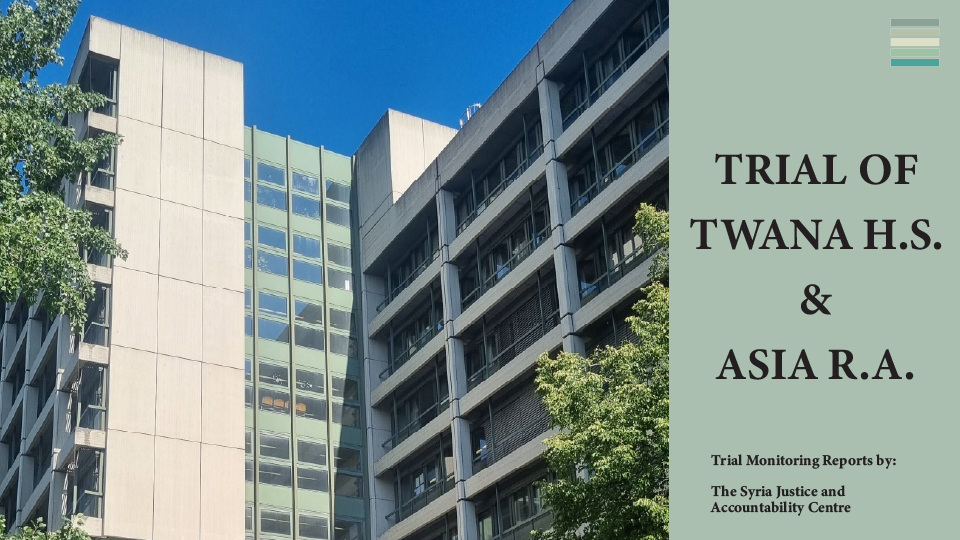
Inside the Twana H.S. and Asia R.A. Trial #19: (Un)Interrupted Plaintiff Testimony
TRIAL OF TWANA H.S. AND ASIA R.A.
Higher Regional Court – Munich, Germany
Trial Monitoring Summary #19
Hearing Date: December 10 & December 11, 2025
CAUTION: Some testimony may include graphic descriptions of torture, rape or other violent acts.
Note that this summary is not a verbatim transcript of the trial; it is merely an unofficial summary of the proceedings.
Throughout this summary, [information located in brackets are notes from our trial monitor] and “information placed in quotes are statements made by the witness, judges or counsel.” The names and identifying information of witnesses have been redacted.
[Note: SJAC provides a summary of the proceedings while redacting certain details to protect witness privacy and to preserve the integrity of the trial.]
SJAC’s 19th trial monitoring report details days 36 and 37 of the trial of Twana H.S. and Asia R.A. in Munich, Germany. On both trial days, the court heard the Plaintiff P2 as a witness, who testified about her family’s abduction by ISIS and her life and abuse under the Accused in great detail, sometimes speaking uninterrupted for hours. While the Defense tried to delay the Plaintiff’s testimony by questioning the quality of the translation of her UNITAD hearing transcript, demanding a retranslation, and after the Court had plenty of difficulties with finding a balance between interrupting the Plaintiff and letting her speak freely, P2 was eventually able to present a full and personal account of Yazidi life, sexual abuse, rape, and day-to-day violence under ISIS.
Day 36 – December 10, 2025
On this trial day, the Court started the hearing of Plaintiff [redacted name], P2, who traveled to Germany from an undisclosed location to testify over five separate trial days. The Plaintiff was represented by Counsels Ms. Natalie von Wistinghausen, and Ms. Sonka Mehner, as well as her own interpreter, [redacted name], F41, while Court interpreter [redacted name], C3, once again interpreted the testimony from Kurmanji. The hearing brought five press representatives and seven visitors to the courtroom, many more compared to most of the previous trial days [note: please find a letter sent by SJAC to the Bayerischer Rundfunk following the publication of an article related to this trial day below. SJAC is of the opinion that the article misrepresented the testimony of the Plaintiff and asked for the correction of the publication. As of the date of publishing, SJAC did not receive a response, nor was the article corrected.].
Before the Court officially started the hearing, Twana H.S. began a discussion with the Court police, his own Defense and the Plaintiff Counsel, as he demanded a seating position with direct eye contact to the Plaintiff. In an effort of plaintiff protection, and compared to the previous trial days, his seating position was moved to the front of the bench of the Accused, exchanging his position with the one of Asia R.A., to make it harder for him to keep direct eye contact with P2. According to his protest, his view was deliberately blocked by the Plaintiff Counsel, and he needed to see the Plaintiff to also hear her. Without the involvement of the Court, a solution was found.
The trial day then officially started with a request by the Defense of Asia R.A for C3’s expert opinion regarding the substantive and technical correctness of the translation of the UNITAD hearing transcript of P2’s hearing in front of [redacted name], W7. The Defense argued that last week, the Court already recognized - after hearing a 32-page expert analysis of the translation by C3 - that the UNITAD interpreter [redacted name], F106, mistranslated various parts of the UNITAD testimony of the Yazidi girl [redacted name], F30, and would have even deliberately missed or misrepresented many parts of F30’s statement. Since F106 also translated the UNITAD hearing protocol of today’s witness P2, similar gaps and mistranslations must be assumed there too. And since P2 was supposed to testify in front of court today, the Defense would not be able to base their questioning on any proper grounds, especially when it comes to comparability and witness credibility questions, as it would be totally unclear “what is right, wrong, or even what was stated and not stated.” Article 6 of the European Convention on Human Rights (right to a fair trial) and Article 47 of the Charta of Fundamental Rights of the European Union (right to an effective remedy and to a fair trial) require qualitatively correct translations of such hearing protocols for a just trial. As long as this quality cannot be ensured by the Court, the central witness P2 cannot testify, according to the Defense.
In seven arguments, the Prosecution then counterstated with various examples from translations of F30’s UNITAD hearing, with F106’s version and C3’s version, to show that the differences are mostly about the wording and style of translation, and that the extra, supposedly forgotten parts are redundant context explanations. One could not mirror a translation from one language into another, and the Defense did not present any actual examples in their statement in the first place, so it remained totally unclear how significant those differences really might be for F106's ability to have properly translated P2's UNITAD hearing protocol. To a clarifying question by the Presiding Judge, C3 further explained that in her critical evaluation of F106, she stuck to the Interpreter’s Guidelines by [redacted name], F107, from the [redacted information], who would be regarded as the strictest of her discipline and predominantly focuses on style, syntax and grammar, not necessarily on qualitative precision. Furthermore, C3 admitted that she is not a legal expert and additionally translated the transcript, interpreted from Kurmanji to English, into German, which naturally leaves further room for various interpretation results due to double translation.
Subsequently, the Defense asked the Presiding Judge if the Court had spoken with C3 ahead of today’s hearing to pre-discuss what she is supposed to say in response to such questioning. Immediately, the Court announced a break to discuss its further procedure.
***
[45-minutes-break]
[Note: During the break, the trial monitor witnessed a conversation between Asia R.A.’s Defense Counsel Mr. Shervin Ameri and a journalist, in which Mr. Ameri told the journalist about the Defense’s goal “to not get P2 to speak and testify as a witness today.” He specified that he prepared so many statements to the Court today, that it will take considerable time for the Court to decide on those.]
***
After the break, the Presiding Judge read a note from December 3, 2025, which specified that he called C3 about today’s hearing, and informed her that she might have to give her expert opinion on P2’s UNITAD hearing protocol, however, on December 18, rather than this trial day. C3 was not informed about what to say in response to possible questions by the Defense, according to the Judge. The Court then continued with reading its statement that the request of the Defense to order a new translation of P2’s UNITAD hearing protocol ahead of today’s scheduled testimony was rejected. The Court referred to the arguments of the Prosecution that the Defense did not present any examples of mistranslated passages, and to the qualifying explanations of C3 of her own analysis of F106’s translation qualities. The Defense was then asked to present any paragraphs to Court they see as potentially mistranslated by F106, so that C3 can give her expert opinion on them until December 18. Without further comments, both Defense Teams requested another break, while C3 jokingly complained to “only have 24 hours in my day.”
***
[25-minutes-break]
***
Upon return, both Defense Teams demanded a court order on the Court’s decision to reject the Defense’s request. Once again, the Court had to announce a break for further discussion.
***
[10-minutes-break]
***
After the break, the Court read the order in full reference to its above statement and announced the lunch break.
***
[65-minutes-break]
***
After lunch, the Defense of Asia R.A. presented another statement. This time, they argued to have revisited the UNITAD hearing protocol of P2 with their own interpreter yesterday and concluded that F106’s translation would indeed leave too many open questions to the Court. The Defense pointed out three examples from five hours of material, mostly on the question of who slept in whose bed in the home of the two Accused, and if the word “violence” or “force” was ever used by P2 in relation to the Accused. According to the statement, the Defense’s interpretation of the protocol concluded that other than in F106’s version, these terms were in fact not stated by P2 in front of UNITAD. Both the Prosecution and the Court quickly rejected the Defense’s statement with similar arguments to before. Since both Defense Teams once again requested a court order, the Presiding Judge declared another break.
***
[10-minutes-break]
***
When the break ended, and the Court quickly read their order in full reference to its previous explanation, Plaintiff P2 was called into the courtroom. The Presiding Judge informed P2 of her rights and duties and asked for her personal details. Immediately, the Plaintiff generously thanked the Court for her opportunity to testify and went on with responding that she was born in [redacted time], is [redacted information] years old, currently does not practice any profession or schooling, and is not in any familial relation with the Accused. The Presiding Judge then described that everyone present had read P2’s UNITAD hearing protocol, which highlighted plenty of ISIS men she was held captive by. He subsequently asked P2 to repeat the names in a chronological manner. P2 answered that [redacted name], F108, bought her first, who then sold her to [redacted name], F109. F109 sold P2 to [redacted name], F110, who sold the Plaintiff to the Accused Twana H.S., who she called Abu Abdallah while pointing at him. When P2 mentioned Twana H.S., she broke out in tears but asked the Presiding Judge to continue with her testimony. According to the Plaintiff, Abu Abdallah sold P2 to [redacted name], F111, who later sold P2 to [redacted name], F112.
Subsequently, the Court asked where Abu Abdallah would be, to which P2 pointed with her finger on the Accused Twana H.S. While the Plaintiff testified that she had not seen him when she first entered the courtroom, she specified to “know” that he was present and to have looked over to him once she sat down. Although P2 said that she could not look at him, the Plaintiff described how the Accused had a beard and ISIS clothes the last time she had seen him and that because he now looked different, she only recognized him “a little bit.” Additionally, P2 was able to recognize “this woman over there, Um Abdallah.” P2 further testified that she knew that Abu and Um Abdallah would be present today, as it had been publicly announced.
The Presiding Judge then prompted the Plaintiff to first talk about what she had experienced under the two Accused. P2 told the Court that Abu Abdallah bought her from F110 for money and brought her to his home. According to the Plaintiff, he specifically removed her hijab to look at her hair. During this, ISIS friends of the Accused commented that he must buy her, as she had not been “raped” before. Suddenly, and under the protest of the Plaintiff Counsel, the Court interrupted in the middle of P2’s testimony to announce another break, as “specific persons of the Court” needed to go to the restroom.
***
[20-minutes-break]
***
After the break, Twana H.S. repeated his earlier complaint that he could not see P2 properly. When his Defense brought it up to the Court, the Presiding Judge suggested that the Plaintiff should speak directly into her own microphone, and not just to the interpreter, so that Twana H.S. can at least hear her properly.
P2 then continued with her testimony. She told the court how she was brought to the home of the Accused, which was filled with other ISIS members and their families on that particular day, who she each described in a detailed manner. Abu Abdallah, being Twana H.S., told to the other men that his new Sabaya should do the dishes. P2 described how they brought her the cleaning supplies, told her to say “Bismillah” and start cleaning all the dishes of Abu Abdallah’s guests. P2 recalled that Plaintiff [redacted name], P1, was home during this as well. After the dishes, P2 was told to make coffee for everyone in the house, although she didn’t know how, which Abu Abdallah subsequently explained to her. The Plaintiff then described how, against her will, she had to bring the coffee into the room with all the ISIS men and poured it into their cups, which was “very hard” for her. During this, the ISIS men mocked P2 for being Yazidi, she testified. Afterwards, P2 and P1 wanted to go to sleep as they were “very exhausted.” Suddenly, Abu Abdallah came and woke her up hitting the soles of her feet with a stick, the Plaintiff recalled. According to P2, Abu Abdallah then explained how he had just slept with P1 and since she was even younger than P2, the Plaintiff would need to sleep with him as well now. P2 subsequently testified that Abu Abdallah “sexually abused” her under force and against her will that night. On the following morning, P2 asked P1 if it was true that Abu Abdallah did the same to her, which P1 confirmed. According to P2, she, however, told P2 to not say anything to Um Abdallah, being Asia R.A., as she might get mad. Um Abdallah had told P2 that her husband wanted a second wife, which Um Abdallah did not understand, and had urged him to instead buy a Sabaya, as they would be “impermanent and replaceable.” P2 then described how she and P1 had to do all of the household work and take care of the Accused’s daughter. Whenever P2 made a mistake, she was hit by the Accused. After one week and a few days in the home of the Accused, Um Abdallah told P2 that her husband would marry and that for these reasons, P2 needs to help her clean up a room upstairs. When the Plaintiff asked Um Abdallah who Abu Abdallah would marry, she responded that he would tell P2 when time comes. P2 recalled how she had thought in that moment that Abu Abdallah would probably not feel the need any more to do sexual harm to her, when he marries a second woman. Then, she described how she and P1 spent two full days, from morning to evening, cleaning the room. When the cleaning was completed on the evening of the second day, Um Abdallah criticized P2 for her dirty dress and forced her to wash herself. Since P2 was tired, as she explained, she urged Um Abdallah that she could wash herself the next morning, which Um Abdallah rejected. She then removed P2’s clothes and hijab, wanted P2 to show her hair, and started to apply makeup, specifically mascara, to her eyes. The Plaintiff testified how she protested the makeup but was too scared to be punished and eventually endured it. Um Abdallah forced P2 to then go up to the room she had just prepared for the wedding the two days prior and told her to wait for Abu Abdallah there. Then, the Plaintiff described how she started to realize what might happen next and urged Um Abdallah not to allow Abu Abdallah to “rape” her, as the Plaintiff would “understand nothing of those things.” Um Abdallah brought white bedsheets and pomegranate seeds to the room and sent off with the words to P2 that “now, Abu Abdallah will marry.” P2 recalled how she shivered in fear and cried when Abu Abdallah came soon after. She testified that she knew in this very moment that Abu Abdallah will “rape” her. Although P2 urged him not to do anything to her body, and promised to do “everything else” for him, he responded, according to the Plaintiff “I will rape you anyways. Either I just rape you, or I will rape you while also hitting you.” In tears, the Plaintiff described in detail how Abu Abdallah then locked the door, violently removed her clothes, began touching her, ate pomegranate seeds and urged her to do so as well, while he told P2 that she should not be scared as “it is easy.” P2 also remembered that ISIS nasheeds were playing in the background. When P2 asked Abu Abdallah if he would do the same to his daughter [redacted name], F113, he responded that the difference between F113 and P2 was that P2’s parents are nonbelievers and as such, she is also a nonbeliever. He added that it would not even matter how much of the Quran P2 reads, how much she prays or fasts, because God would always see it as legitimate for her to get “killed and raped.” Just like this, it was included in the Quran that Sabayas can be bought, sold and “raped,” Abu Abdallah had told the Plaintiff P2 then testified that she wished to die at that very moment. Then, as she quickly added, Abu Abdallah “undressed and raped” her. Besides generally mentioning that she bled, the Plaintiff did not describe the physical act any further. Afterwards, Abu Abdallah allowed P2 to go down to P1 and Um Abdallah, where Um Abdallah started to cry when P2 told her what her husband had just done to her. Here, the Plaintiff described Um Abdallah as “whiny” when she mentioned the way she apologized to P2, and added that this all happened since Um Abdallah did not want her husband to marry a second woman.
Later on, P2 testified, Abu Abdallah changed her name to Layla, as “every Muslim needs two names,” according to him. As an example, the Plaintiff said that she does not know the real name of Abu Abdallah, for example, but that Abu Abdallah is not it. During the one month the Plaintiff lived with the two Accused, she and P1 had to wake up in the middle of the night to pray, and then work all the way until the afternoon, while Abu and Um Abdallah often were still asleep. “They brought darkness into my whole life,” the Plaintiff added to her description of that month. Further, P2 recalled that Um Abdallah had told her that Abu Abdallah came to [redacted location] from Germany when ISIS was created. He also knew German. There, Um Abdallah showed the pictures of her wedding with Abu Abdallah to P2 on her laptop. During this, Um Abdallah admitted that she once was very happy with her husband, but that her feelings changed ever since he wanted a second wife.
After “a month of violence, beatings and sexual abuse,” as the Plaintiff described it, the situation in [redacted location] became unsafe and the two Accused decided to move to a different place where many ISIS families lived. There, P2 also met many other Yazidi women and girls, all of which were “treated like dogs.” The Accused regularly brought P1 and P2 to those Yazidi girls during the day, whose names P2 did not remember, although she recalled that one woman cooked for her and one girl was from [redacted location]. Each time when they got the opportunity to speak with each other in private, the Yazidi girls asked each other if they got “raped” by their ISIS men, which many regularly said yes to. In this context, P2 testified that P1 also admitted having been “raped” by the two Accused, although she was so young. According to the Plaintiff, P1 was [redacted information] years old, and all the other Yazidi girls were shocked, as no one had heard from another girl that had been “raped” at such a young age. The Plaintiff continued explaining how the Accused one day called for P1 and gave her a piece of paper with unknown writing on it. In the presence of another ISIS friend of Abu Abdallah, he then told P1 to be free. In this context, the two Accused also said that the war would get too dangerous and that they want to leave for [redacted location]. When the Plaintiff asked what would happen to her, Um Abdallah responded that her husband might sell P2 to his friend [redacted name], F114. In this moment, as P2 recalled during her testimony, she considered killing herself. P2 described that she was eventually sold to another ISIS member called [redacted name], F111, from said place where many Yazidi girls lived in. Abu Abdallah had been gone at this point already, according to the Plaintiff. P2 testified how an ISIS member who she called the “[redacted information]”, F115, picked both her and P1 up from the village and brought her to the house of F111, while P1 stayed with F115. The Plaintiff described the house of F111 as completely empty with no other residents besides herself and F111. There, F111 demanded P2 to remove all her clothes besides her underwear or nightgown, and to then lay down next to him. Although the Plaintiff was about to continue her testimony of abuse under F111, the Presiding Judge interrupted P2 and announced that the hearing for the day must end at this point.
After the Plaintiff spoke uninterrupted for 1.5 hours, the Court adjourned the proceedings at 4:00 PM.
The next trial day will be on December 11, 2025, at 9:30 AM.
Day 37 – December 11, 2025
On the second session of this week, the Court continued with the hearing of Plaintiff [redacted name], P2. [While the journalists from the day prior were not present anymore, the trial monitor witnessed how the Presiding Judge removed the Christian cross from the courtroom, which usually hangs in all state buildings in Bavaria, before the hearing started.]
The Plaintiff completed yesterday’s testimony of her life under F111 and described how “he raped [her] just like Abu Abdallah.” She described how she “once again” bled after the sexual violence and how she had to sleep on the bare ground after the act. Later on, F111 told P2 that he only bought her to “rape” her, to which the Plaintiff commented that her “life only consisted of being bought, sold and raped.” When F111 once asked her why she cried, she responded that she was [redacted information] years old when she was separated from her mother, her father was killed by ISIS in front of her own eyes, two of her brothers were killed as well as four uncles on her father’s side, while two of her siblings committed suicide. F111 responded to bring P2 to the Yazidi girl P1, who lived under F111’s friend F115, so that she can have some company. The Plaintiff described how she was then brought into a new village, where many supposedly [redacted location] ISIS members lived. F115 also lived there, and was married to a [redacted location], formerly Christian woman. Here, P2 suddenly mentioned that everyone who was not an ISIS member in this village did not “get a Yazidi.” In that village, P2 met another Yazidi girl called [redacted name], F116, who was “raped” by F115 and Abu Abdallah’s “fat friend,” according to the Plaintiff. Although P1 was around, P2 was not allowed to sleep in her presence, as F111 demanded “to have something sexual” with P2 during the night.
The Plaintiff then interrupted her testimony by explaining how she had given Abu Abdallah her uncle’s phone number, so that Abu Abdallah could call him to let her free. According to P2, Abu Abdallah responded that “even if I would own the whole world, I would never send you back to your family, because your family are nonbelievers.” Rather, he suggested bringing P2’s mother to her. He continued with his wish to force all European countries to become Islamic and to “rape all the Christians just like we raped you.” P2 concluded that this is also why her father was killed by ISIS.
After this, the Presiding Judge turned to questions. In response, P2 testified that she lived under F111 for one month, that the house in the village was inhabited by both F111’s and F115’s family, that F111 had two wives, one of which was Yazidi and had a daughter called [redacted name], F117, and that P2 slept in a room with P1 whenever F111 was not home. When F111 was home, however, even when the Plaintiff was sick, she had to sleep with him. Both P1 and P2 had to run the household and take care of the children. P2 then explained that F111 often tried to “sexually abuse” her, but she always resisted, which made him angry and “frustrated.” He regularly complained that P2 was bought as a Sabaya for that particular reason, and that there are plenty of younger Yazidi girls who don’t defend themselves and never complain. Eventually, F111 announced to sell her off. F111 then brought the witness to another family, who the Plaintiff described as ISIS members from [redacted location] or [redacted location]. One day later, P2 was brought to another ISIS building with men from [redacted location]. One ISIS member from [redacted location] considered buying P2. When he forced the Plaintiff to take her hijab down to show her hair, he called her ugly and rejected her. After about two days, according to P2’s testimony, she was brought to another place again. The Presiding Judge continued with asking plenty of clarifying questions on the various houses and places the Plaintiff was brought to during these times, which besides naming the places [redacted location], P2 was not able to respond to clearly, as both the Court and the Plaintiff got confused by the timeline and various stations of the testimony. P2 later specified that she was also “treated like a slave” in those households, but not as much anymore as under Abu Abdallah or F111.
The Plaintiff then continued and described how she was bought by [redacted name], F112, who brought her to a different ISIS camp. There, F112 “sexually abused” her as well and justified it with the claim that the wife of Prophet Mohammed had been six, P2 was [redacted information] years old, and with that, old enough. The Plaintiff told the Court that she stayed at F112’s family in [redacted location] for two weeks, during which F112 was fighting for ISIS. When P2 urged F112 to let her family pay him money so that she could be free, he eventually agreed, as he saw no use in the Plaintiff anymore with the war becoming more intense day by day. P2 then gave him the phone number of her uncle, who F112 subsequently got into contact with and demanded a “for [her] family very difficult amount of money,” of which F112’s Emir [the title of a Muslim leader, often on a local level] also wanted a portion. The communication was via WhatsApp voice messages on F112’s smartphone. F112 demanded “[redacted information]” from P2’s uncle, who ended up paying “one binder and [redacted information]” [note: both quotes represent how it was translated from German; with one binder, the Plaintiff likely meant a bundle of cash that equals 10 thousand USD]. When the Court asked where P2 had the phone number of her uncle from, the Plaintiff responded that her mother had given her the number when she was separated from P2.
F112 organized a friend of his who drove P2 to another [redacted information] family on a motorcycle. P2 stayed with this family, which she also described as abusive ISIS people, for two days. F112’s friend wanted to abuse P2 as well, but the Plaintiff was able to defend herself, as she explained. From there, a trafficker picked her up and gave her an ID with the name “Fatma” on it, which P2 was supposed to show whenever ISIS stopped and checked their car. P2 and the trafficker spent one more night with another [redacted information] family, and eventually, he brought her to his own family. P2 described his family as “very nice” and recalled how she felt happy for the very first time in years. From this family, P2 was picked up by members of the Kurdistan Worker’ Party (PKK), with which she spent one more night, before she was brought to [redacted location], where plenty of Yazidi girls lived, among them P1 and her sister [redacted name], F48, who had two children from ISIS men, according to the Plaintiff. P2 spent two weeks in [redacted location], where she was treated “very well,” before she was brought to [redacted location], where she finally reunited with her uncle from her father’s side and her grandmother.
***
[25-minutes-break]
***
After the break, the Presiding Judge asked for the date of P2’s liberation, which the Plaintiff responded with [redacted time], and urged the Plaintiff to tell the Court how her captivity under ISIS had started. Additionally, the Judge wanted P2 to not go into great detail, due to the limited time of the Court, and slowly and considerately explained P2 that any details will be cleared up in the subsequent questioning. To this, the Plaintiff Counsel raised that this would be a difficult task for the Plaintiff and that the Court should just let P2 speak. Although the Presiding Judge again commented that there would just be limited time, he agreed to just start and see.
P2 then started to talk about her family history. Her father’s name was [redacted name], F118, and he had two wives. While P2’s mother had four daughters and five sons, F118’s second wife was childless. F118 worked in the administration of the [redacted information] military, and two of P2’s brothers studied in [redacted location]. One day, her brother [redacted name], F119 came home from [redacted location] and reported that ISIS arrived in [redacted location] and “played soccer with the skulls of beheaded people.” According to the Plaintiff, her family thought that nothing would happen to them, as they were “a family of peace that just lived quietly.” Still, they decided to flee into the mountains, together with some of her uncles’ families. On their way, the families were ambushed by several ISIS trucks, who had black and white flags on them. The ISIS men, who wore clothes with plenty of blood on them, asked who the oldest of P2’s family was. When F118 stepped to the front and was asked if he would become Muslim or not, they shot him in his head, as he responded that he was and stayed Yazidi. F118 died, as P2 testified under tears. P2 added that the ISIS men originally also wanted to kill everyone else of her family, but they received a call from someone urging them that women and children must not be killed. Everyone was then supposed to kneel in front of the ISIS men and put their hands behind their heads. Subsequently, the men violently separated P2’s uncles and adult brothers from the women and the rest of the family, and brought her to a “police station” in [redacted location]. The Plaintiff described that place as full of dead people lying on the ground. P2 then recalled that her sister [redacted name], F120, wanted to kill herself. Everyone was crying and in fear constantly. The Plaintiff’s mother, younger brother and all her sisters were then brought back to [redacted location], where they were kept in a large hall in which nasheeds were playing, and ISIS flags hung from the walls. Everyone of P2’s family was forced to say the Shahada, and all jewelry as well as phones were stripped off the Yazidi people. During the months the Plaintiff’s family had to stay in this hall, they rarely received sufficient food and water and had to share a mattress among three to four people. Regularly, ISIS men came by to take pictures of the girls. P2 described how the pretty girls were taken away right away for the ISIS Emirs. Three of her sisters were violently separated from P2’s mother first, while P2, her mother, and youngest brother had to stay for a long time. In this context, the Plaintiff mentioned a Yazidi boy called [redacted name], F121, many times, although it remained unclear what his relation to P2’s family was. Eventually, P2 was brought into a school in the [redacted location] town [redacted location], while her sisters were brought to [redacted location]. In [redacted location], most Yazidi girls were in their early teenage years, while P2 told the Court that she was [redacted information] years old. Most meals consisted of a cucumber and a tomato. From there, P2 was brought into the formerly Shia village of [redacted location], that P2 described as having been stripped of its cultural heritage.
Here, the Plaintiff hesitated and repeatedly lost her train of thought, to which the Presiding Judge urged her to concentrate and continue with only the important aspects, as a “report on everything of all these years” would be too much for the Court. P2 then responded that an ISIS member called [redacted name], F122, who she described as “very fat and dark,” took away her brother, as he did not have any sons. According to P2, F122 was allowed to take whoever he wanted, and also took away another pretty Yazidi girl. Next, P2 was brought to [redacted location], where a cousin of P2 found her and brought her to [redacted location]. According to the Plaintiff, her mother and F121 were still with her. All were put into another school to learn about Islam. P2 recalled that all Yazidis were told to learn how to become Muslim, otherwise ISIS would kill them. From [redacted location], P2 was then brought back to [redacted location] and then a village called [redacted location]. P2 described that ISIS back then still thought that many Yazidis would become “honest Muslims” and started putting Yazidis into houses without any ISIS oversight. When plenty of Yazidis started to flee, ISIS recognized that their plan did not work and started to hold Yazidi girls as Sabayas. P2 recalled that her mother had the idea to dress like an old woman to not catch the interest of any ISIS men. According to P2, this worked, and her mother was able to flee, while P2 was left behind. P2 stayed several months in that village, where one of her aunts was also present with her.
Suddenly, the Presiding Judge interrupted P2 again and urged the Plaintiff that she “cannot talk about everything” and that the Court “does not need to know all of this.” He paused P2’s hearing to discuss the issue of the Plaintiff’s detailed testimony. Right away, the Persecutors argued that the task of the trial is to also evaluate general violence by ISIS in Syria and Iraq and not just the particular situation of the Plaintiffs and the Accused. While the Court has to find a compromise, statements like “we don’t need to know all of this” would not be helpful. The Plaintiff Counsel added that time cannot be an argument, as a longer testimony would also equate to a shorter questioning round by the Defense, as most things will have been cleared up by that point. Additionally, the indictment includes legal aspects that have never been discussed in front of German courts, and this trial has the rare chance to address them properly for the first time. On top of that, P2’s testimony would be “better than any expert opinion on ISIS.” She added that the Court must consider that P2 also needs to still undergo a bilateral psychological evaluation with a psychologist after her hearings. Since the psychologist Ms. Dr. Mehler, E4, is in the courtroom during P2’s testimony, she will not have to repeat everything in this bilateral setting, which would create a new risk of re-traumatization that could be mitigated by the Court’s approval of a more extensive testimony. To this, the Defense of Asia R.A. complained that they did not know about the psychological expert evaluation and requested an explanation by the Court how that came to be after the completion of P2’s testimony.
***
[70-minutes-break]
***
After the break, the Presiding Judge announced that he understood the complaints about his earlier comments and agreed to “just let the witness speak.” He further announced an explanation on the planned psychological evaluation for after today’s questioning of the Plaintiff.
P2 continued with her testimony and described how she tried to dress like a boy in that village and how she claimed in front of ISIS members that her aunt was her mother. Then, P2 and her aunt were brought to [redacted location], [redacted location], where everyone was forced into a dark room and subsequently separated from each other by ISIS men. P2’s aunt was taken away from her own children and the Plaintiff, and had to endure many beatings in the process. P2 was brought into a “Kindergarden,” where children aged between one and 13 years old were left behind. Regularly, ISIS men came by and bought children from that place. A newborn child, for example, cost 1000 [note: the currency was not phonetically understandable]. In the meantime, all children had to learn Islamic prayers and memorize the Quran. P2 recalled that once, an ISIS woman deliberately brought spoiled meat in vine leaves for everyone, which made many children very sick. According to the Plaintiff, an ISIS man called [redacted name], F123 was responsible for her very bad treatment during that time. P2 told the Court that he lied to everyone, as he promised the girls to get reunited with their mothers, if they could prove to have memorized the Quran. Still, P2 was brought out of that place and then violently brought to [redacted name], F108. When P2 attempted to defend herself and tried to hold on to her cousins, she was beaten and fainted.
F108 had two wives and four children, and when P2 arrived at his house, she immediately was forced to take care of the household. F108, however, wanted a third wife and on one day, asked P2 to join him to a neighboring house. There, he married another woman in secrecy and told P2 to not say anyone. But when P2 was confronted by the first wife of F108, she could not keep the secret. F108 got to know about this and subsequently beat the Plaintiff “the whole night” with a hose.
Later, the situation in [redacted location] got worse and F108’s family moved to [redacted location], along with P2. F108, who was an Emir, stayed back in [redacted location], as he was responsible for preparing ISIS trucks with suicide bombs. When P2 arrived in [redacted location], the family received the message that F108 got killed in [redacted location]. Still, P2 stayed with his family in [redacted location] for “a long time” and “was treated very badly.” She witnessed F108’s brother-in-law, [redacted name], F124 “sexually abuse” two Yazidi girls for one month and then sell them off each after one another. The first one was called [redacted name], F125, and the second one was called [redacted name], F126. P2 mentioned that she became good friends with both during her stay under F108’s family.
The Plaintiff then turned to testifying about her sisters. Her sister [redacted name], F127, was also “raped” by an ISIS man, but was able to later reunite with her mother. There, F127 described that P2’s other sister [redacted name], F120, was bought by an ISIS Emir, who also “raped” her. According to the Plaintiff, both of her sisters tried to kill themselves. While F127 could not, F120 killed herself by cutting her veins. ISIS men presented her dead body as a warning to other Yazidi girls, and subsequently just “threw her away somewhere.”
P2 then testified that F108’s family sold her off to an ISIS man that was from [redacted location] and did not speak Arabic. While P2 described him as still not good to her, she added that he “at least did not sexually abuse [her]”, which is why she wanted to stay with him. P2 stayed with that family for about two weeks, before the wife of the man told her that she was bought by someone, “who will most likely rape [her]”. According to P2’s testimony, it remained unknown for a long time who had bought her, which made her very anxious. When the ISIS man that bought P2 finally picked her up from the [redacted information] family, P2 described to have cried so much that the mother of this new ISIS man urged him to bring P2 back to the [redacted information] family, which he eventually did for the price of [redacted information.] P2 stayed 20 more days at the family from [redacted location], before she was sold to F109. F124 was supposed to drive P2 to F109, but stopped halfway in [redacted location], forced P2 into a house and “sexually abused” her. Afterwards, F109 brought P2 to the family of a different ISIS friend of his, who lived in [redacted location]. Here, started to switch between different ISIS members quite often. For example, the witness did not complete the narrative of how she arrived at F109’s house, but continued that F109 changed his physical appearance to travel from [redacted location]. She described F109 as an ISIS soldier, who mostly fought in the desert and had a camouflaged car. Whenever he came home from the desert, P2 had to cook for him and endure his sexual violence. P2 described how she stayed under F109’s family for about one month. Before he sold P2 off again, he “raped” her, the Plaintiff called out. The Presiding Judge then clarified if she meant “rape” or “sexual abuse,” to which P2 responded with: “I mean sexual abuse, only Abu Abdallah ever raped me.” P2 then added that F110, who was “older than [her] father.” was the ISIS member who bought her from F109.
***
[25-minutes-break]
***
After the break, P2 described F110 further. According to her, he was “fat, tall, had a white beard and white hair.” F110 was [redacted information], had two wives and lived with two other Yazidi girls, of which one was P1’s sister. During the one month P2 lived under F110, he “raped” her as well, as she testified. In response to a question by the Court, the Plaintiff quickly changed her testimony to “sexually abused,” but could not describe the difference when the Presiding Judge asked her about it. When the Judge announced that P2 should think about a response to this question until the next trial day, P2 shouted that the Court could “just ask Abu Abdallah.” Subsequently, P2 described how F110 sexually abused and hit her. P2 recalled that F110 wanted to “properly rape” her after one month, but that she was able to defend against it. Then, he drove her from [redacted location] to an ISIS camp and sold her to Abu Abdallah. The Court showed a lot of interest in the specific route F110 took, which P2 was only able to describe as “very far away” and “cold”. When P2 met Abu Abdallah for the first time, he wore ISIS clothes and a “typical weapon.” He then bought P2 for money and drove her to his house in a location the Plaintiff didn’t know. The drive lasted “one hour or half an hour.”
The Presiding Judge then announced to return to more specific questions on P2’s life under the Accused. P2 testified to not have been hit directly by Um Abdallah, Asia R.A., but punished in different ways. The Plaintiff was forced to stand on one leg, sometimes for up to 30 minutes. Um Abadallah just watched her suffer. P1 also had to endure this punishment, according to the Plaintiff. When the Presiding Judge asked if Abu Abdallah, Twana H.S., had told P2 to stand on one leg, the Plaintiff specified that Um Abdallah told Abu Abdallah about the punishment, who then forced P1 and P2 to endure it. While P2 only had to stand on one leg “one or two times,” P1 was punished with this method more often. Whenever P1 or P2 did not endure the punishment long enough, they were beaten by Abu Abdallah. The Plaintiff, however, never directly saw the Accused hit P1, as she specified. Still, P1 told her that she had to endure plenty of beatings, which P2 assumed to have either been hits with a hose or slaps in P1’s face. To the Presiding Judge’s question if P1 and P2 had to endure any other forms of punishment, the Plaintiff first had no answer but eventually described how Abu Abdallah hit her with wooden sticks on her soles. This happened while the Plaintiff was sleeping, and it hurt “for a long time.” Although P2 did not specify if she was hit on her soles more than one time, she subsequently testified that beatings always happened whenever she or P1 made a mistake in the household.
Here, the Presiding Judge interrupted P2’s testimony to announce the end of the hearing. He concluded the trial day with specifying when the psychological expert had been summoned to court, as requested by the Defense Team of Asia R.A.
The proceedings were adjourned at 4:15 PM.
The next trial day will be on December 18, 2025, at 9:30 AM.
_____________________________________________________________________________
Correction to Your Article from December 10, 2025
Dear BR Editorial Board,
We at the Syria Justice and Accountability Center greatly welcome the journalistic interest in the criminal proceedings before the Munich Higher Regional Court against Twana H.S. and Asia R.A. on suspicion of genocide, among other charges (file number: 8 St 4/24). However, we regret to note that your article “Munich Yazidi Trial: Victim Describes Martyrdom” dated December 10 misrepresented statements made by a key witness.
Since 2020, SJAC has been monitoring international trials related to Syria in German courts. Trial monitoring is one of the main activities of the Syria Justice and Accountability Centre (SJAC). The purpose of trial monitoring is to gather information in order to inform the general public, especially the affected community, about the peaceful and legal resolution of the Syrian conflict and to provide access to the proceedings. SJAC has already observed and reported on a large number of universal jurisdiction proceedings before German courts. In line with the requirements of truth-finding, witness protection, and procedural integrity, detailed trial reports are published in English and Arabic. Based on these reports and additional background research, SJAC regularly publishes blog articles and analyses. These further publications serve to provide objective trial reporting and to place the trial in its legal and practical context. These articles are also published in English and Arabic and serve to provide independent information to the public. The objective and accurate reporting of the content of the proceedings is of particular importance to the public and the community affected.
In the second paragraph of his article, journalist Joseph Röhmel mentions the alleged inability of the witness, victim, and co-plaintiff P2 to identify the accused: “When asked if she could identify the accused as one of these men, she said, ‘I can't look at him.’.” We were also present in the courtroom as part of our trial monitoring program and took verbatim notes of the plaintiff’s testimony. In our opinion, the plaintiff answered a total of eight questions from the presiding judge regarding the identification of the two accused. Among other things, at the judge’s request, the plaintiff pointed her finger at the accused Twana H.S., looked directly at him, and stated that she had “looked over” at him when she entered the courtroom. When asked whether she recognized the accused “from before,” the plaintiff merely replied that he had a beard and was wearing Islamic State (ISIS) clothing at the time. Only when asked again did she say, “I can’t look at him,” followed by “I recognized him a little.” The plaintiff also testified that she knew the accused, Asia R.A., from the past. In addition, the witness voluntarily referred to both defendants by their ISIS names. From a procedural point of view, this clearly cannot be interpreted as non-identification, which is what your article, however, implies. Furthermore, the quoted statement “I can’t look at him” must be placed in the context of the questioning, as it was not the plaintiff’s answer to an isolated identification question and was only a snapshot in time.
The identification of the accused by key witnesses can be decisive evidence in German criminal law. Undifferentiated and, in our view, inaccurate quotations such the article’s not only influence public perception of the trial and the vulnerable witnesses, victims, and joint plaintiffs, but can also cement a false view in the court or enable defense strategies based on false premises.
Even more significant for this specific trial is your implication that the accused “entered her” (paragraph 6, first sentence). Although the plaintiff did indeed testify about a “rape” (at least according to the already complex translation from Kurmanji) by the accused and its details, she did not provide any details about the sexual act itself. Rather, the plaintiff described that the accused either wanted to beat and “rape” her or just “rape” her. The plaintiff then described in one sentence the consumption of pomegranate seeds, the sound of “ISIS music,” and that the accused subsequently “undressed and raped” her. The plaintiff then only testified about her feelings at the time, Twana H.S.’s beatings, and the fact that she was bleeding. There was never any mention of penetration, not even of internal bleeding. However, this is clearly implied in your article, almost as if it were a direct quote.
A fundamental question in this trial is the criminally relevant distinction between purely sexual violence and rape, each of which occurs in highly complex cultural circumstances and may require further differentiation in terms of meaning. Various witnesses have already made diverse statements in this regard, and the reference to “penetration” would therefore be of central relevance. The question of whether penetration in the sexual sense took place may therefore in itself be decisive for the further course of the trial and the final verdict, on which the defense will also base its arguments. SJAC's verbatim notes were confirmed by another person present in the courtroom.
In addition, the sentence in the last paragraph of the article, “The accused had previously lived in Munich as an asylum seeker for more than ten years (...)”, is factually incorrect. Twana H.S. received a residence permit in 2004 and then a settlement permit as a permanent residence title in 2007. Furthermore, he lived in Germany for several years with his German partner and her daughter. This, too, could leave an impression based on false facts, at least among the general public, which is not desirable.
As we see it as our mission to ensure that there is a historical record of the trials relating to Syria and ISIS, to make the documentation available to victims and families in particular, but also to inform the general public about these key developments (not only) in international criminal law, we feel compelled to reprimand your article as described and ask for a prompt correction.
We are, of course, available at any time to answer your questions and look forward to your continued interest in this topic.
With best regards,
___________________________
For more information or to provide feedback, please contact SJAC at [email protected] and follow us on Facebook and Twitter. Subscribe to SJAC’s newsletter for updates on our work