Fair-trial shortcomings in Syria’s transitional justice process
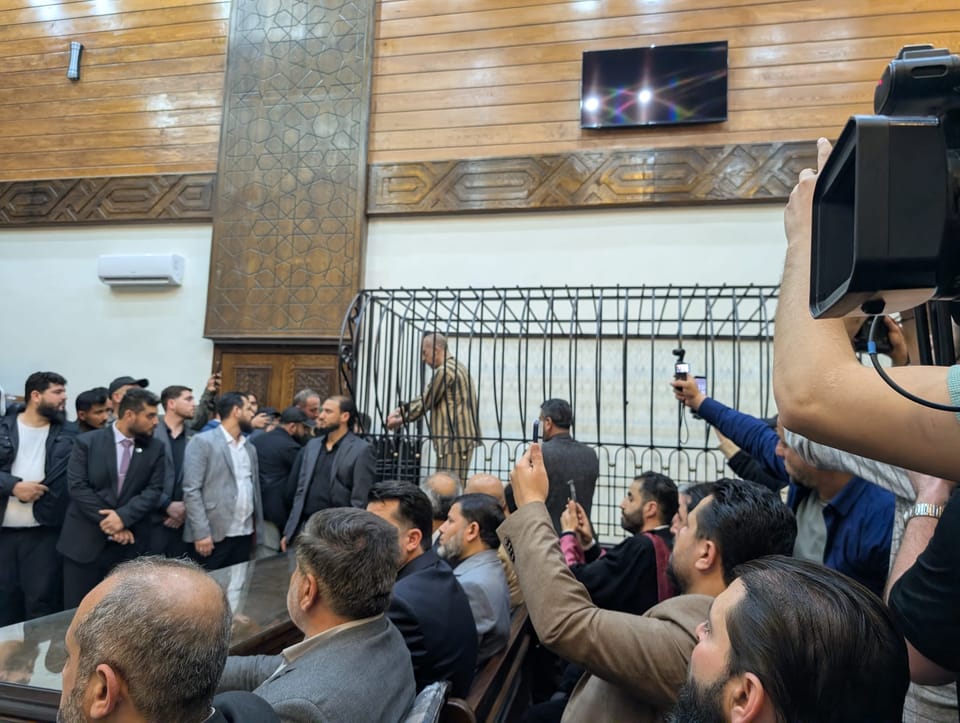
SJAC's trial monitoring team has attended and monitored the Atef Najib, Wassim Al-Assad, Ahmad Hassoun, and coastal incidents proceedings. In parallel, SJAC’s investigative and case building team has also supported the prosecution by identifying witnesses and contributing relevant documentation preserved in its database, including evidence gathered more than a decade before these trials began. These forms of engagement are complementary: preserving and providing evidence supports accountability, while independently scrutinizing the handling of that evidence and the conduct of the proceedings helps ensure that accountability remains credible and consistent with fair-trial standards. The following analysis draws on SJAC’s monitoring to examine the legal and procedural shortcomings that have emerged in these early proceedings.
In June 2026, over 40 demonstrations calling for justice were recorded across Syria. These mobilizations linked demands for accountability to wider grievances concerning deteriorating public services, economic insecurity, and the continued influence of individuals associated with the former government. They therefore reflected expectations that transitional justice would address both criminal responsibility, vetting and lustration, and the broader institutional and socioeconomic legacies of the previous system.
Criminal proceedings can address only part of these expectations, but their design and implementation also reveal whether the transition is building a coherent system of accountability grounded in law. Syria’s formal accountability process has begun to take institutional shape and provide victims with a platform to testify before a domestic court after fifteen years of denial. However, the process has been advancing with an incomplete institutional and legal framework, as well as limited fair trial safeguards. Strengthening those safeguards would serve the interests of both defendants and victims by making convictions less likely to be overturned or exposed to appeal and subsequent review.
Syria’s first high-profile trials
The first prosecution of a senior Assad-era official before the Fourth Criminal Court began on 26 April 2026. Atef Najib, the former head of Political Security Branch in Daraa, was charged with murder, incitement to murder, torture, unlawful detention, kidnapping, and acts intended to provoke civil war and sectarian conflict. The indictment alleged that he ordered or participated in the detention and torture of children and the use of lethal force against demonstrators in 2011. Proceedings against Wassim Al-Assad began on 23 June. He was charged with intentional killing, incitement to killing, acts intended to provoke civil war and sectarian conflict, and drug smuggling and trafficking. The indictment alleged that he directed armed groups supported by the Fourth Division, participated in operations against civilian areas in Eastern Ghouta, and was involved in violent robbery and the extortion of detainees’ families. The trial of Ahmad Hassoun, former Grand Mufti of the Republic, opened before the same court on 25 June 2026. Hassoun, arrested in March 2025 at Damascus Airport while attempting to leave the country, faces charges of incitement to murder, complicity in crimes against humanity, and abuse of his religious office for personal gain.
On 11 August 2026, the Fourth Criminal Court sentenced Najib to death in person alongside Bashar al-Assad, Maher al-Assad, and six co-defendants sentenced in absentia. Wassim al-Assad received the same sentence a week later on 18 August. The irreversibility of capital punishment gives the procedural and evidentiary shortcomings identified below a consequence that no subsequent review can correct.
These prosecutions were presented, rightly, as a moment of great historical significance. However, all three proceedings commenced before Syria had adopted a transitional justice law, before a coherent prosecution strategy had been published, before establishing sufficient capacity in the prosecutor’s office, and before the respective responsibilities of the National Transitional Justice Commission, the Ministry of Justice, the Public Prosecution, and the Fourth Criminal Court had been clearly delineated. All three cases therefore advanced while the legislative framework intended to govern the wider transitional justice process remains under development.
This lack of institutional clarity also affected responsibility for developing and advancing cases. Official statements referred to cooperation among the Commission, the Ministry of Justice, the Public Prosecution, and the courts, while providing limited public explanation of their respective roles in collecting evidence, preparing judicial files, determining charges, referring cases, and communicating with the public. A published allocation of their respective mandates would clarify how the Commission’s documentation and referrals support prosecutions while preserving independent prosecutorial decision-making and judicial adjudication.
The decision to begin with highly recognizable defendants appears, at least in part, responsive to mounting public demand for visible accountability. However, these were particularly difficult cases for an emerging system, requiring strong evidence linking senior figures to specific crimes across complex military and security structures, as well as a clear legal basis for indirect responsibility. Those requirements were not yet fully met, suggesting that public profile guided case selection before the evidentiary and institutional foundations required for prosecution were in place.
Since these proceedings are the first opportunity for Syrian courts to establish, in practice, the standards by which justice in Syria will be expected to operate, the foundations being laid now will determine what future cases can deliver, including cases involving defendants whose responsibility is more contested and harder to establish than that of the first figures brought before the court. The record these trials produce is also part of what Syrians are owed: an accurate and durable account of what occurred, who bore responsibility, and through which structures crimes were ordered and carried out. The conviction of Bashar al-Assad in absentia on charges of crimes against humanity represented precisely that opportunity, to establish on the record, at the level of the highest command. Without the documentary and organizational evidence needed to reconstruct the command chain in detail and uncover the full extent of the crimes committed, the verdict delivers a conviction, but leaves the underlying truth only partially told.
The legal basis for prosecution
Syria’s Penal Code criminalizes murder, unlawful detention, kidnapping, and certain forms of torture, but does not codify crimes against humanity, war crimes, enforced disappearance, or command responsibility. Prosecutors have sought to address these gaps by combining provisions of Syrian criminal law with the Constitutional Declaration, the Geneva Conventions, customary international law, and the Rome Statute’s definition of crimes against humanity, despite Syria not being a party to the Statute. While this reflects an effort to prosecute conduct that the domestic framework does not fully capture, it raises questions under the principle of legality, which requires criminal liability to rest on sufficiently clear and established legal rules applicable at the time of the alleged conduct.
The lack of codification also creates difficulties in determining the applicable penalties. Syrian law prescribes no penalties for crimes against humanity or war crimes, leaving the court to impose punishment through domestic provisions governing other offenses. Article 17 of the Constitutional Declaration, however, provides that no punishment may be imposed except as provided by law. Without legislation defining these crimes, their modes of liability, and the corresponding penalties, the current framework leaves unresolved both the legal basis for conviction and the punishment that may follow. The use of international legal sources not incorporated into domestic criminal law, the application of command responsibility without a domestic provision defining its elements, and the absence of prescribed penalties may therefore leave any resulting judgment vulnerable to challenge on appeal.
Beyond the legal framework, the proceedings have exposed substantial weaknesses in the evidentiary record, which remains thin relative to the gravity of the charges. The material presented publicly is limited, relies heavily on witness testimony, and makes little use of documentary or expert evidence to corroborate individual accounts and reconstruct each accused's role. These weaknesses have been compounded by the manner in which evidence was examined in court, with numerous witnesses heard in rapid succession and given limited opportunity to develop detailed accounts capable of contributing meaningfully to the historical record.
Survivors and eyewitnesses hold essential evidence of the former government's crimes, and their willingness to testify is a significant contribution to accountability. That testimony must, however, be tested through questioning that distinguishes direct observation from inference or secondhand information. This matters most for prominent defendants, where public anger runs high and courts may face less pressure to rigorously establish the link between testimony and individual responsibility precisely because guilt is already assumed. SJAC's monitoring of the Najib trial documented several such instances. Five witnesses placed Najib at relevant events and attributed shooting orders or operational authority to him, but at points their testimony moved from describing particular incidents to attributing direct responsibility without clearly establishing how his conduct connected to the crimes charged. Some of the court's questions incorporated disputed conclusions rather than asking witnesses to explain the factual basis of their accounts, and the compressed examination, roughly eighteen witnesses heard in ninety minutes, left little room to test any of it properly, while the defense was given no meaningful opportunity to question witnesses. The court also failed to ensure that Najib could follow and respond to the evidence against him. Neither Najib nor his defense lawyer was permitted to question the witnesses, and when Najib stated that he had not heard part of one witness’s answer and asked for it to be repeated, the court did not respond.
These restrictions were particularly consequential because several witness accounts raised clear questions that required further examination. One witness identified personnel on distant rooftops as Political Security without being asked how he determined their affiliation or whether conditions allowed reliable identification. Another described overhearing Najib order an ambush on demonstrators, without the court examining how the conversation was heard or how the witness avoided being noticed. Each of these gaps left potentially significant evidence, capable of bearing on individual responsibility, untested for reliability. The court’s approach also affected the conditions under which testimony was given. One witness, who appeared visibly distressed and was repeatedly unable to continue, testified without any apparent assessment of whether they were able to proceed or any offer of psychosocial support.
The evidence in the Wassim al-Assad proceedings raises related concerns. SJAC's monitoring of the first session documented that the hearing mainly consisted of the judge questioning the accused, with defense counsel playing no active role and no cross-examination conducted. The video evidence placed Wassim al-Assad on the front lines alongside army units, but he maintained that his mere presence did not reflect an operational role. The second session brought nine plaintiff witnesses who testified to a consistent pattern of extortion, detention, and personal violence, including accounts in which the accused shot a witness in the foot and threatened to shoot another in the head if he did not falsify a hospital report. While this testimony provided the most directly corroborated evidence in the proceedings, it bears primarily on the personal criminal conduct charges rather than on the broader war crimes and crimes against humanity allegations, leaving the legal characterization of the case as a whole more contested than the extortion evidence alone might suggest.
Demonstrating that the accused bore direct responsibility for the groups' conduct in Eastern Ghouta required documentary and organizational evidence, including command records, communications, and deployment orders, that the proceedings did not manage to produce. The evidentiary record on which individual responsibility was ultimately determined was developed largely outside public view, as the second, third, and fourth sessions proceeded behind closed doors, and the gap between the gravity of the charges and what was publicly established remained considerable. On the other hand, the court acquitted Wassim al-Assad of drug trafficking and smuggling on the grounds of insufficient evidence, despite these charges forming the basis of his US, EU, and UK sanctions designations.
The Hassoun proceedings, which opened on 25 June, raise related concerns. Unlike the Najib and Wassim al-Assad cases, the prosecution does not primarily rely on allegations of direct perpetration or operational command. Instead, the case appears to rest on a theory of accomplice liability based on Hassoun’s public statements and institutional authority. Establishing such liability requires the prosecution to demonstrate a clear connection between his conduct, the crimes alleged, and the required mental element, making the careful examination of testimonial and audiovisual evidence particularly important.
The manner in which this evidence has been examined, however, has raised concerns. SJAC’s monitoring recorded that questions were directed to witnesses exclusively by the presiding judge throughout the proceedings, while neither the prosecution nor defense counsel was given the opportunity to examine witnesses directly. Following each testimony, Hassoun was asked whether he accepted or rejected the account, but counsel on neither side was invited to probe inconsistencies, clarify the basis of a witness’s knowledge, or challenge particular assertions. Some questions incorporated disputed propositions that had yet to be established through evidence. The judge, for example, suggested a connection between Hassoun’s public statements and subsequent attacks in European capitals before such a link had been demonstrated. He also asked a witness directly whether Hassoun’s lectures and religious rulings were related to inciting the government to bomb, kill, and displace civilians. The examination of witnesses provided limited opportunity to test these accounts further. Furthermore, the court has not responded to defense counsel's request after he submitted a list of eighteen witnesses to testify on behalf of the accused. Among the five defense witnesses who did testify, several were reportedly subjected to mistreatment by court employees before or during their appearance. The presiding judge was informed and undertook to investigate, but no outcome has been made public yet. In a case that depends heavily on establishing the relationship between Hassoun’s statements, his influence, and subsequent criminal conduct, these limitations reduce the scope for testing the reliability and probative value of witness evidence.
Similar questions arose over the treatment of contested audiovisual evidence. The court did not provide defense counsel with a copy of the expert report, citing the need to protect evidence, making it impossible for counsel to engage with its findings or contest them meaningfully. Only excerpts of the videos were submitted and examined rather than the complete recordings, despite counsel requesting that the full videos be considered. When defense counsel submitted a request for an independent technical expert to assess the authenticity of the prosecution's video evidence, the NTJC's Accountability Department stated publicly that the expert report would not affect the evidentiary value of the videos and that excerpting the footage did not alter its meaning or legal value, before the court had itself ruled on the defense challenge. The absence of a reasoned judicial explanation for how this challenge was ultimately assessed makes it difficult to evaluate how contested evidence is being weighed in a case where the link between the accused's conduct and the underlying crimes remains central.
Limited fair trial safeguards
The credibility of any resulting judgment depends not only on the evidence presented, but also on whether the proceedings provide a meaningful opportunity to examine and challenge it. This requires both effective defense representation and a judiciary able to assess the case independently of public and political pressure.
Wassim Al-Assad appeared at his first hearing without retained counsel, prompting the Syrian Bar Association to assign a lawyer to represent him. The court then instructed counsel to provide an adequate defense pursuant to Article 279 of the Code of Criminal Procedure. Although this satisfied the formal requirement that he be represented, the circumstances of the appointment raise questions about whether counsel had sufficient access, resources, and incentive to participate effectively in the proceedings and build a serious defense.
These concerns reflect wider practical obstacles to the representation of former senior officials. Representing individuals associated with the former government carries significant professional and reputational risks, which discourages lawyers from taking on these cases and drives greater reliance on Bar Association assignments of counsel with no prior connection to the file. This significantly strains both counsel’s ability and willingness to engage fully in the defense, including by reviewing the dossier, consulting confidentially with the accused, investigating the allegations, and preparing to examine witnesses and challenge evidence. These constraints may be compounded where witness protection measures restrict access to parts of the prosecution case. Such measures are essential but should preserve the defense’s ability to access and test the substance of the allegations. In at least one of the proceedings monitored, defense counsel was initially granted only limited access to the case file, and although this was later expanded, counsel was subsequently prevented from copying or photographing it, contrary to lawyers' recognized rights under Syrian law to obtain copies of case documents. The quality of representation may be further weakened by low or absent remuneration, which gives court-appointed counsel little practical incentive to devote the substantial time and resources required to prepare a complex defense. In this case, counsel did not appear to advance a coherent defense strategy or engage substantively with the prosecution’s evidence. His closing statement only asked the court for mercy and compassion, rather than contesting the charges or evidence against his client. The appointment therefore remained largely symbolic, without giving the defense a meaningful role in protecting the accused’s rights.
Such conditions raise questions about compliance with the fair-trial guarantees binding on Syria under Article 14 of the ICCPR. These guarantees include adequate time and facilities to prepare a defense, confidential communication with counsel, access to the evidence relied upon by the prosecution, and a meaningful opportunity to examine witnesses and present defense evidence. The UN Human Rights Committee has made clear that the appointment or presence of a lawyer does not, by itself, amount to effective representation. Where counsel remains passive in the face of the prosecution’s case, the proceedings may fall short of fair-trial standards and any resulting conviction may remain vulnerable on appeal.
The ability to uphold these safeguards also depends on the conditions under which judges are required to adjudicate. In all three proceedings, judges are working within an unsettled legal framework, on evidentiary records that remain insufficiently developed for the complexity of the charges, yet under significant public pressure to deliver visible and severe punishment. Under these conditions, a conviction resting on an insufficient evidentiary basis may be vulnerable to reversal on appeal, yet the appeal process itself offers no guarantee of remedy: an appellate court will inherit the same absent statutory framework and face the same political constraints, no better placed to resolve the underlying tension. A finding that the prosecution has failed to prove its case, meanwhile, may be interpreted publicly as protection of the former government and evidence that impunity persists.
This leaves the judiciary to absorb the political consequences of unresolved shortcomings elsewhere in the accountability process, with individual judgments expected to carry the credibility of the wider transition. As a result, that credibility risks being measured by the severity of particular sentences rather than by the fairness and legal soundness of the proceedings. The death sentences handed down make this concern even more pressing. Article 6 of the ICCPR requires that capital punishment be subject to the strictest procedural guarantees, including a fair hearing, the presumption of innocence, and the minimum guarantees for the defense, precisely because it is irreversible. The stakes therefore extend well beyond the defendants now before the court: the procedural standards established in these first trials will shape how future cases are conducted and the protections afforded to all Syrians who come before the justice system.
Comparative lessons for case-building and sequencing
The weaknesses identified above are not unique to Syria, and comparative experience helps illustrate how the choices now being made may shape the credibility and durability of its accountability process.
Argentina's experience illustrates the evidentiary value of documentation undertaken before prosecutions begin, reducing reliance on witness testimony developed under the pressures of ongoing proceedings. The Argentine National Commission on the Disappearance of Persons (CONADEP) documented how the repression had been organized and carried out, building a substantial evidentiary record before the 1985 trial of the military juntas even began. Amnesty laws passed in 1986 and 1987, followed by presidential pardons in 1989 and 1990, then blocked further prosecutions for more than fifteen years. When Congress annulled those laws in 2003 and courts reopened the cases, prosecutors were able to draw on documentation gathered decades earlier, eventually bringing charges against hundreds of accused. This shows how sustained documentation can preserve the evidentiary basis of accountability even after prolonged political interruption.
Cambodia’s Extraordinary Chambers (ECCC) offer a complementary lesson on how a newly established court can begin with cases supported by the clearest available evidence while continuing to develop more complex files against senior officials. The ECCC was only able to commence proceedings over twenty-five years after the crimes, a delay that weakened witness recollection, compromised the preservation of evidence, and reduced the pool of surviving defendants. Hence, the court carefully selected its first case according to the strength of the available evidence. Rather than beginning with the most senior surviving Khmer Rouge leaders, the ECCC first prosecuted Kaing Guek Eav, the head of the S-21 security center. His responsibility for crimes committed within a specific institution against identifiable victims could be established through a comparatively direct evidentiary chain, without relying primarily on command-responsibility doctrine.
Beginning with this case allowed the ECCC to establish its procedures and legal approach before proceeding to trials that required the more demanding task of proving the responsibility of senior leaders positioned further from the direct commission of the crimes. Syria’s early proceedings have followed a different sequence, beginning with prominent defendants whose alleged responsibility depends on complex links across military and security structures while the statutory basis for command responsibility remains unsettled. Beginning with cases supported by more direct evidence would allow evidentiary standards and judicial practice to develop before the courts confront prosecutions that depend on more complex forms of senior-level responsibility.
Recommendations
Syria's transitional justice institutions have commenced proceedings under considerable institutional constraint and public urgency. However, while Interim President Ahmad Al-Sharaa has presented transitional justice as advancing gradually and in an orderly manner, the proceedings examined above reveal a growing gap between that official account and the conditions under which trials are actually taking place. Cases have moved forward before the necessary legal, evidentiary, and procedural foundations were fully developed.
To narrow that gap and place the process on a more coherent and legally durable footing, SJAC calls on Syria's transitional authorities to:
- Finalize the transitional justice law, expressly codifying crimes against humanity, war crimes, enforced disappearance, and command responsibility, while clarifying how the law will apply to proceedings already underway. Absent this clarity, applying the law retroactively risks violating the principle of legality, which bars prosecuting conduct under rules not clearly established at the time. The law could codify an exception for crimes already recognized under international law.
- Define the respective mandates of the National Commission for Transitional Justice, Ministry of Justice, Public Prosecution, and Fourth Criminal Court, including responsibility for case initiation, evidence management, referrals, and public communication.
- Publish an interim prosecution strategy setting out case-selection criteria and sequencing priorities. The latter should be developed according to legal and evidentiary readiness of cases, beginning with those supported by strong, well-corroborated evidence directly linking an individual to a specific criminal act, including documentary records, forensic evidence, or consistent, corroborated witness accounts, while allowing investigations time to build the more demanding chain-of-command evidence required for senior-level and command-responsibility prosecutions.
- Establish a formal pre-trial review process, drawing where appropriate on independent defense expertise from civil society, to assess whether the case file and supporting evidence are sufficiently developed for referral to trial.
- Adopt clear evidentiary and witness-examination protocols, including safeguards against leading questions, requirements for corroboration and authentication, and procedures distinguishing direct observation from inference or information received from others. SJAC's forthcoming Benchbook on the Adjudication of International Crimes, developed specifically for Syrian judges and practitioners, will provide operational guidance on these standards and could be integrated into judicial training and pre-trial review processes once available.
- Draw on the evidentiary record developed abroad. Documentation, forensic analysis, and expert witness testimony have already been tested in universal jurisdiction proceedings against Syrian defendants in Germany, France, Sweden, the Netherlands, and the United States. Syrian prosecutors and courts should establish direct channels with these foreign judicial authorities, whether through mutual legal assistance requests or direct outreach to the relevant prosecutors' offices, to access this material.
- Create an adequately funded defense mechanism, developed as a partnership between the bar association, the Ministry of Justice, and civil society organizations, with trained lawyers appointed publicly and early enough to review the dossier, consult confidentially with clients, investigate the allegations, and challenge prosecution evidence. It should establish professional standards and oversight to ensure that appointed counsel engages substantively with the evidence and actively protects the accused's procedural rights, as well as provide the appointed counsels with protection against physical or reputational harm. In an effort to do so, the mechanism could also include Arab lawyers from outside Syria alongside Syrian lawyers.
- Engage civil society organizations, legal experts, and survivor communities as structured partners in the design and oversight of the transitional justice process, including in the drafting of the transitional justice law, the development of evidentiary and procedural protocols, the establishment of the defense mechanism, and the design of public communication on what the process can and cannot deliver. Civil society has preserved evidence, supported witnesses, and sustained documentation efforts for over a decade; the institutional process should draw on that capacity systematically rather than consultatively.
___________________________
For more information or to provide feedback, please contact SJAC at [email protected] and follow us on Facebook and Twitter. Subscribe to SJAC’s newsletter for updates on our work