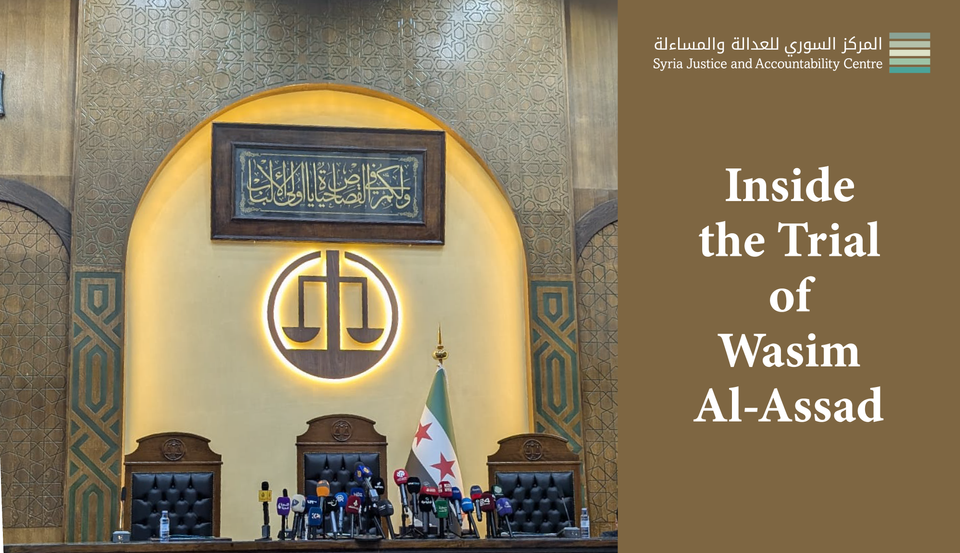
Inside the Trial of Wasim Al-Assad #1: The Innocent Lamb
TRIAL OF WASIM AL-ASSAD
The Fourth Criminal Court – Damascus, Syria
Trial Monitoring Summary #1
Hearing Date: June 23, 2026
CAUTION: Some testimony may include graphic descriptions of torture, rape or other violent acts.
Note that this summary is not a verbatim transcript of the trial; it is merely an unofficial summary of the proceedings.
Throughout this summary, [information located in brackets are notes from our trial monitor] and “information placed in quotes are statements made by the witness, Judges or counsel.” The names and identifying information of witnesses have been redacted.
[Note: SJAC provides a summary of the proceedings while redacting certain details to protect witness privacy and to preserve the integrity of the trial.]
SJAC’s 1st trial monitoring report details day 1 of the trial of Wasim Al-Assad in Damascus, Syria. On this trial day, Wasim Al-Assad appeared in court as an Accused for the first time. Some of the plaintiffs in the case attended the hearing, while others were absent. The indictment was read out in court, and the Prosecutor presented the charges brought against the Accused. The Judge began questioning the Accused, who denied all the allegations against him.
Day 3 – June 23, 2026
[Note: There was media coverage by the Ministry of Justice, official Syrian media outlets, and some Arab media outlets. Some international organizations attended the session].
The session began at 10:55AM with the entry of the Accused, Wasim Al-Assad, followed by the entry of the Judges at 11:00AM, at which time the interrogation of the Accused began. This is considered the first trial session of Wasim Al-Assad.
The Presiding Judge, Mr. Fakhr Ad-Deen, requested the Accused to state his full name, place of birth, and the nature of his work. The Accused responded as follows:
- Name: Wasim Badee’ Al-Assad
- Mother’s Name: Samira
- Date and Place of Birth: 1980, Latakia - Al-Qardaha
- Nature of Work: Commerce
The Accused, Wasim Al-Assad, appeared before the Court, and accompanied by his ad hoc court-appointed Defense Counsel C1, [redacted name], a registered attorney with the Bar Association - Damascus Branch.
The following Plaintiffs attended:
- P1 [redacted name]
- P2 [redacted name]
- P3 [redacted name]
- P4 [redacted name]
- P5 [redacted name]
- P6 [redacted name]: The Plaintiff was called but did not appear. So it was decided to record his absence and proceed with the trial in his presence by proxy.
- P7 [redacted name]: The Plaintiff was called but did not appear. So it was decided to record his absence and proceed with the trial as though he were present.
- P8 [redacted name]: The Plaintiff was called but did not appear. So it was decided to record his absence and proceed with the trial as though he were present.
The trial would comment publicly as though all parties were present
The Court requested Counsel C1 [redacted name] to adequately defend his client n and in accordance with the provisions of Article (279) of the Code of Criminal Procedure.
The Court requested the Accused to listen attentively to all evidence that will be read to him in accordance with the provisions of Article (280) of the Code of Criminal Procedure.
The Presiding Judge began reading a summary of the charges referred against the Accused, Wasim Al-Assad.
The indictment issued against Wasim Badee’ Al-Assad is summarized as follows:
The Accused is charged with forming and managing irregular armed groups, pursuant to an assignment by Brigadier General Ghiyath Dalleh, a brigade commander in the Fourth Division led by Maher Al-Assad and affiliated with the “former Syrian regime.”
At the beginning of 2011, the Accused formed two armed groups consisting of thirty fighters, supervised these two groups, and secured weapons, ammunition, funding, and logistical support for them, with the support of the Fourth Division. These two groups participated in the military operations that targeted areas of Eastern Ghouta, particularly the town of Al-Maliha, including consolidating control over the areas after they were subjected to artillery shelling and airstrikes. He is held responsible for participating in widespread military operations that targeted populated civilian areas and resulted in the killing of a large number of civilians. His role was not limited to logistical support only, but also included commanding combat groups that actually participated in the military operations. The Accused was aware of the nature of the attacks carried out against civilian areas.
The shooting of a civilian in the city of Jaramana by one of the groups affiliated with the Accused is also attributed to him.
He is also charged with participating, directly or indirectly, in the military operations that led to massacres in the town of Al-Maliha and its surroundings, most notably the attack that occurred on January 2, 2013, which led to the killing of dozens of civilians. He is further charged as an accomplice in the criminal acts committed by the groups he commanded which participated in military operations following bombardment of the area.
Based on these events, the acts attributed to the Accused constitute part of a widespread, systematic attack targeting the civilian population during the conflict. These acts fall under crimes against humanity in accordance with the provisions of Article 7, Paragraph (a) of the Rome Statute of the International Criminal Court. These acts are also considered war crimes because they were committed within a non-international armed conflict that targeted populated areas. These acts violate the rules of International Humanitarian Law and the Geneva Conventions, which prohibit targeting civilians, especially since the Syrian Arab Republic is a part of the international community and the United Nations and has signed the Geneva Conventions, particularly the Fourth Geneva Convention concerning the protection of civilian persons in time of war.
Accordingly, these crimes are subject to the following provisions:
The non-applicability of statutory limitations to war crimes and crimes against humanity, based on the 1968 Convention on the Non-Applicability of Statutory Limitations to War Crimes and Crimes Against Humanity, and the impermissibility of amnesty because these acts are among the grave international crimes affecting the entire international community and requiring continuous accountability regardless of the passage of time or changes in legal regimes. The Constitutional Declaration of the Syrian Arab Republic issued on March 13, 2025, confirmed that crimes against humanity are considered grave crimes that are not subject to statutory limitations.
The Accused is also charged with inciting violence through public statements, videos, and posts on social media, encouraging fighting against opposing civilians and describing them as terrorists, and calling for the support of military operations against them, which constitutes the crime of incitement to murder and violence. His actions contributed to fueling the internal conflict and deepening societal and sectarian division by forming civilian armed groups and involving them in the conflict alongside the regime forces.
The Accused, Wasim Al-Assad, is also charged with engagement in an organized activity involving the transportation and smuggling of drugs inside and outside Syria and trafficking them over a period of years.
He is charged with exploiting his affiliation with the Al-Assad family and his influence within the Syrian state. The Accused committed crimes of robbery by force on the Syrian coast, received sums of money in exchange for mediating the transportation of military personnel and civilians, and extorted the families of detainees by taking money in exchange for mediating their release from the security apparatuses.
Accordingly, the acts attributed to the Accused constitute a war crime as provided for by the Geneva Convention, particularly the Fourth Geneva Convention concerning the protection of civilian persons in time of war.
In addition to the foregoing, these acts attributed to the Accused constitute crimes punishable under the Syrian Penal Code No. 148 of 1949 and its amendments, and are provided for therein as follows:
- First: The felony of premeditated murder provided for in Article 535 of the Penal Code, and the felony of incitement to murder provided for in Article 533 with reference to Article 216
- Second: The felony of assault aimed at instigating civil war and sectarian strife provided for in Article 298 of the Penal Code
- Third: The felony of smuggling drugs and trafficking them provided for in Articles (39 - 4) of Public Law No. 2 of 1993
After the Presiding Judge finished reading the summary of the indictment, he asked the Accused whether he understood the charges preferred against him. The Accused confirmed that he did.
Thereafter, the Presiding Judge requested the Prosecutor to present the summary of the indictment.
The Prosecutor began by greeting the Presiding Judge and the Court panel, stating:
In the name of God, the Most Gracious, the Most Merciful.
May peace and God’s mercy and blessings be upon you. Mr. Presiding Judge, Honorable Judges:
The Prosecutor stands before you representing the Public Prosecution, bearing the trust of the law and the conscience of justice, to confront actions that were not merely fleeting violations, but rather part of an organized and systematic framework of violence whose effects extended to the lives of civilians and the security of society as a whole.
It has been established in this case file that the Accused, Wasim Al-Assad — who stands before you — formed two armed groups and supervised their arming and supply with ammunition and food in exchange for financial sums they received to serve as auxiliary forces to a regular military force, pursuant to an assignment by Brigadier General Ghiyath Dalleh of the Fourth Division. This was just one part of an integrated killing mechanism; artillery shelling and airstrikes by the Fourth Division and the Republican Guard, followed by the entry of those two groups established by the Accused to consolidate control over the ground. The result was clear and horrific: devastated areas, dead civilians, and houses turned into rubble. All of this was within a pattern of a widespread, systematic attack that can only be described as an organized assault on the civilian population. The acts attributed to the Accused — including premeditated murder and incitement against civilians — and contribution thereto amount to crimes against humanity and war crimes within the context of a non-international armed conflict, in accordance with established international jurisprudence and judiciary regarding the Syrian conflict at the time. Consequently, they are not subject to statutory limitations, nor do amnesty decrees apply to them. Furthermore, the Syrian Penal Law must be applied to them in accordance with the principle of complementarity established in international law.
It was also established in the case file that two clashes occurred between the armed formation supervised by the Accused and the National Defense Forces in the Jaramana area, which led to the killing of a civilian. In addition, the Accused used to incite the members of his aforementioned armed force to kill Syrians opposing the [Assad government], characterizing them as terrorists.
Because neither the Accused nor the members of the two aforementioned armed groups were military personnel, but were rather civilians, their aforementioned actions constitute the felony of assault aimed at instigating civil war and sectarian strife, which tears apart the Syrian social fabric composed of multiple sects.
The matter did not stop there, but the Accused’s activity extended to trafficking and smuggling drugs and facilitating their proliferation, revealing an integrated criminal cover that exploits war as a market for both profit and blood.
All that we have mentioned above has been supported by clear evidence in the case file.
The Prosecutor finished reading the case summary and addressed the Court panel with the following:
Mr. Presiding Judge, Honorable Judges,
Based on the foregoing information, and in my capacity as the representative of the Public Prosecution, I affirm that the Accused committed the crimes of premeditated murder, incitement to murder, assault aimed at instigating civil war and sectarian strife, and smuggling and trafficking narcotics.
God Almighty said: "Whoever kills a soul unless for a soul or for corruption [done] in the land - it is as if he had slain mankind entirely." [Quran, 5:32]
Please accept our highest respect and appreciation.
The Presiding Judge began the questioning of Wasim Al-Assad.
The Judge asked the Accused about the charges preferred against him. The Accused responded that these groups did not belong to him, and that he was the one who introduced Jamal Hasan to Ghiyath Dalleh because Ghiyath Dalleh wanted to form groups that had nothing to do with fighting in exchange for a salary. The Accused added that he also introduced Firas Za’roor to Ghiyath Dalleh, as that was his only mission — namely, introducing certain individuals to one another. There were individuals who wanted to work in such groups because they were in the reserve service or were deserters.
The Judge wanted to know whether the Accused’s task involved direct supervision over these groups. The Accused explained the nature of the work of these groups, clarifying that they were called “consolidation” groups and had nothing to do with fighting in the areas entered by the army. Moreover, the Accused testified that he was not responsible for them; rather, it was Jamal Hasan or Firas Za’roor. Regarding the nature of the work of these groups, the Accused added, they were non-combatant; after the Republican Guard and the Fourth Division finished bombarding the Ghouta neighborhood and the entrances to the area, these groups would enter to search, plunder, and “sweep” the area.
The Judge wanted to know whether the Accused reported to Ghiyath Dalleh. The Accused denied this, claiming that he had no relationship with these groups.
The Judge asked the Accused whether he knew or was aware of the type of weapons used by the armed groups. The Accused responded that they were rifles obtained through the Fourth Division.
The Judge wanted to know how long these groups continued to work. The Accused testified that it lasted for months, and that he went to them twice in the area of Al-Maliha just to bring them cigarettes and greet them.
The Judge inquired of the Accused whether there were other [armed] groups that participated in the fighting. The Accused denied this, emphasizing that these groups had nothing to do with fighting.
During the questioning of the Accused, a video clip was displayed showing him fighting alongside the army. The Accused admitted that the video was authentic, but claimed it was merely propaganda for the sake of fame and spectacle, and that he did not actually participate in the fighting.
The Judge asked the Accused where the groups were located. The Accused responded that they were in the Al-Maliha area.
Another video clip was displayed showing that the Accused was present on the front line with the army. The Judge requested the Accused to comment. The Accused admitted that the video was authentic and that he was on the front line on the borders of Deir ez-Zor, claiming once again that he did not participate in the fighting, but that it was merely for spectacle and fame.
The Judge wanted to clarify certain matters, recalling that the Accused previously mentioned that he was the one who introduced individuals to Ghiyath Dalleh to form groups for him, and that there was bombardment on Al-Maliha by the Fourth Division and the [Republican] “Palace” during that period. The Judge asked whether the Accused had information in that regard. The Accused responded that he introduced certain individuals to others and did not participate with them in any attack, adding that there was a massacre called the "Al-Maliha Massacre" that occurred during that period on January 2, 2013.
The Judge remarked that the formation of the [armed] groups took place during that very same period. The Accused replied that he had not heard about that.
[A video clip was displayed in which it is alleged that thirty people were killed as a result of bombardment by the Fourth Division and the “consolidation” groups.]
The Judge asked the Accused whether this was the same group he sent to Jaramana that killed a civilian. The Accused clarified that incident, testifying that he was with Firas Za’roor who had a “van.” Thereafter, the Accused went to Ghiyath Dalleh to greet him, whereupon Ghiyath Dalleh requested the Accused to send his driver to the Jaramana area. When the driver arrived at the NDF checkpoint, a problem occurred between the driver and the checkpoint personnel. Consequently, the driver contacted the Accused and informed him of the problem. The Accused then informed Ghiyath Dalleh of what happened. Ghiyath Dalleh requested a warrant officer 3rd class to take a military patrol to the checkpoint and bring the NDF commander to Ghiyath Dalleh’s office. Indeed, they headed to the checkpoint in the Jaramana area, and a major problem occurred between them, which resulted in the killing of one of them [i.e. one of the personnel of the checkpoint.] Subsequently, a case was filed regarding this matter before the military judiciary and procedures were completed. The Accused was not summoned due to his lack of connection to it. The case remained pending before the military judiciary until it was permanently closed.
The Judge clarified whether the Accused left the area and headed to Tartus following this incident in Jaramana, and whether he formed another [armed] group in the Al-Areen area. The Accused denied this.
After that, photographs of the Accused with Noah Zaiter were displayed. The Judge asked the Accused about his relationship with Zaiter. The Accused responded that it was a mere photograph and denied any relationship between them.
The Judge then requested the Accused again to speak about his relationship with Noah Zaiter. The Accused testified that he became acquainted with Noah Zaiter via social media (Facebook), and that Noah Zaiter visited Damascus more than once; however, the Accused met him twice by coincidence. The Accused then corrected himself, saying that their meeting in Tartus was by coincidence, but an appointment was scheduled with Noah Zaiter once in Damascus and another time in Lebanon.
The Judge asked the Accused whether there was a business relationship between them, and the Accused denied this.
The Judge recalled that the Accused had previously mentioned that a person on behalf of Wiam Wahab contacted the Accused and wanted to meet him. The Judge requested the Accused to clarify this matter. The Accused testified that Noah Zaiter contacted him and said that Wiam Wahab wanted to meet with the Accused. Therefore, the Accused responded to Noah Zaiter that there was a young man who contacted him after the liberation and asked him to speak about the coastal incidents and the formation of the [armed] groups, which the Accused refused, stating that he had nothing to do with the matter and that he did not want any problems.
The Judge pointed out that the Accused is accused of smuggling funds outside Syria, which the Accused denied.
The Judge asked the Accused about his transportation of drugs from Tartus to Al-Qardaha. The Accused denied having any connection to that.
The Judge wanted to know whether the brother of the Accused, named Bashar Badee’ Al-Assad, works in the field of drugs. The Accused responded that he only knew of this through the Judge’s question, and he knew nothing prior to that.
The Judge wanted to know whether the Accused — jointly with Noah Zaiter — transported drugs to Lebanon by trucks. The Accused denied this, claiming that the borders were controlled.
The Judge requested the Accused to state the nature of his relationship with Bashar Al-Assad and his brother Maher Al-Assad. The Accused responded that he saw Bashar Al-Assad only once at the funeral of Bashar’s brother, Majd, whereas he never saw Major General Maher Al-Assad. The Accused mentioned that in 2000, when Bashar Al-Assad assumed power, he imprisoned him [i.e., Wasim Al-Assad] and his brother with no reason for three years, and then they were released.
The Judge asked the Accused about exploiting his influence to transport employees in exchange for financial sums. The Accused answered that he would sometimes help without compensation “as a mediation (Wasta)”, and he would accept gifts at other times.
The Judge asked the Accused about the Plaintiff P6 [redacted name], and how the Accused requested from him a sum of two hundred and fifty thousand dollars in exchange for disclosing his fate [the reason for his detention, what he was charged with, and what would happen to him] in Aleppo where he was arrested. The Accused denied that.
The Judge asked the Accused about his commission of acts of plunder using violence on the Syrian coast. The Accused denied having committed these acts.
The Judge requested the Accused to clarify what happened at the Zaitouna Cafe in Tartus, and his commission of an armed robbery to seize the cafe. The Accused denied this and claimed that he entered a public auction that was awarded to him. According to the Accused, the old investor was required to vacate the premises within three months, whereupon the cafe was assigned to the Accused, who paid a sum of forty-five million Syrian pounds. Furthermore, the Accused denied that he committed any acts of violence or robbery, adding that he subsequently surrendered the cafe because he encountered problems because of it.
The Judge asked the Accused about the Plaintiff P1 [redacted name], who stated that he knows a person named P7 [redacted name] who was accused in 2023 of dealing in currencies other than the Syrian pound and was detained at the Al-Khatib Branch. P1 claimed that the Accused threatened him and took a sum of one hundred thousand dollars from him to secure P7’s release. The Accused answered in the negative.
The Judge likewise requested the Accused to clarify the nature of his relationship with the Plaintiff P8 [redacted name], as it was alleged that the Accused threatened him in order to seize lands in the Ya’foor area. Therefore, the Accused kidnapped the son of P8 and took a sum of twenty thousand dollars in exchange for revoking the power of attorney. The Accused responded by denying this, testifying that he wanted to buy land but no agreement was reached, and the contract and the power of attorney were canceled as a result.
The Judge asked the Accused about obtaining an honorary degree without paying a single pound for it. The Accused denied this, adding that he had heard about this matter.
The Judge asked the Accused about the Plaintiff P2 [redacted name], who claimed that his brother was arrested in 2023 and that the Accused extorted him into paying one hundred and twenty thousand dollars in order to release his brother, however, the Accused did not honor this. The Accused denied this.
The Judge asked the Accused about the incident of his shooting P5 [redacted name]. The Accused responded that he was in Latakia communicating via phone with Jamal Hasan — who was working with P5 at the customs clearance office in the Al-Arida area — and Jamal Hasan told him that P5 had fallen onto an iron rod (which was noted in the police report, according to the Accused) and was transferred to the hospital. Therefore, the Accused went to the hospital to visit P5.
The Judge requested the Accused to explain how he proceeded to assault the Plaintiff P4 [redacted name] in 2012, noting that the P4 was present in court. After that, photos of this assault were displayed. The Accused responded by denying this. He also did not recognize P4.
In conclusion, the Judge asked Wasim Al-Assad whether he had any other statements and whether he had fully exercised his right to make statements. The Accused confirmed that he had fully exercised his right to make statements.
The proceedings were adjourned at 12:00PM.
The next trial day will be on July 15, 2026, at 11AM.
___________________________
For more information or to provide feedback, please contact SJAC at [email protected] and follow us on Facebook and Twitter. Subscribe to SJAC’s newsletter for updates on our work