The right to education under fragmented control in Suwayda
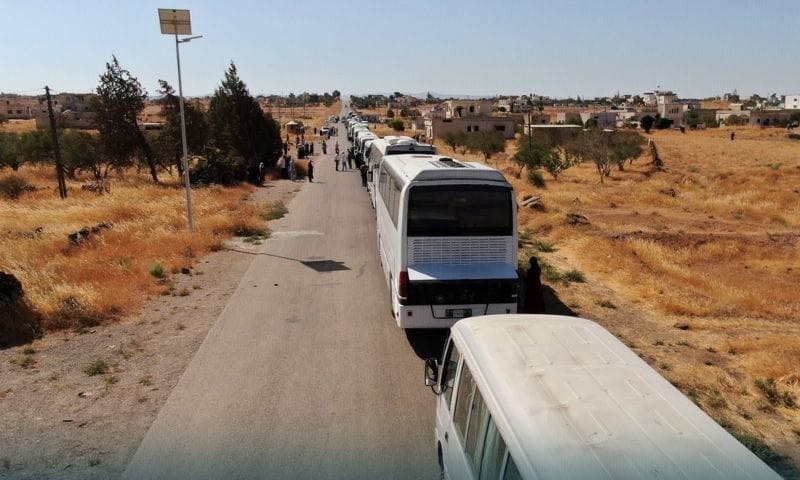
The blockade of Suwayda's exceptional examination session, which opened on 29 August 2026, prompts renewed concern over whether the transitional government and local armed factions are able, and more fundamentally willing, to guarantee children's access to education in the governorate, where checkpoints and access restrictions have repeatedly turned a basic right into leverage in a wider political contest. Students attempting to reach exam centers in Suwayda's northern countryside were stopped at checkpoints manned by the "Shahba Operations Room," an armed group affiliated with the National Guard, which cut the Damascus-Suwayda road at Shahba checkpoint, al-Anqud roundabout, and several other points, firing shots into the air to turn buses back. Ministry of Education officials delayed the session by one hour to allow stranded students to arrive, but many were not able to reach their centers in time regardless. By the second day, National Guard checkpoints had multiplied, and a group of students attempting to bypass one on foot was attacked. Only students who had already left Suwayda for Damascus reached their exams without incident, prompting the UN's Resident and Humanitarian Coordinator for Syria, Marianne Ward, to remind all parties that children are entitled to sit their examinations in safety.
The exceptional session was itself created to remedy an earlier failure to secure students’ access to education. Twenty-seven examination centers were established across Suwayda's northern countryside for approximately 13,000 registered students under Presidential Decree No. 163, issued on 19 August 2026 to provide another opportunity for students who had missed or been unable to complete the regular 2026 examinations. This marked a change from the regular examination cycle, when students had been required to travel to Damascus and Rural Damascus, but it did not resolve the underlying access problem. Many students still had to pass through checkpoints and contested routes to reach the northern countryside, and factions aligned with the National Guard again restricted those routes despite the foreseeable consequences for students. Two days before the session opened, official statements had already acknowledged that armed groups at the Umm al-Zaytoun checkpoint were restricting movement toward the exam centers, insisting that students should not be made to bear the consequences of a dispute that was not their own.
The repeated disruption of these examination cycles raises broader questions about how the right to education is protected in areas where access remains shaped by fragmented territorial control and an unresolved political dispute. Failure to protect this right undermines Syria's obligations under domestic and international law, deepens Suweyda’s alienation from the transitional process, and calls into question the credibility of commitments to protect basic rights during the transition. Guaranteeing safe access to future examination cycles should be treated as an immediate priority by the Ministry of Education and by all armed actors present in Suwayda.
The political and security context
The examination dispute developed within the political and security conflict that has persisted in Suwayda since the violence of July 2025. The UN’s Independent International Commission of Inquiry on Syria found that at least 1,707 people were killed in the sectarian violence that swept Suwayda in July 2025, the majority of them civilians from Druze then Bedouin communities, and that approximately 155,000 people remained displaced as of the following spring. The commission further stated that violations committed by all parties, including forces operating alongside government troops, may constitute war crimes, and that the situation remained unresolved months after a fragile ceasefire. The scale of the July violence was followed by a lasting deterioration in freedom and security of movement, as checkpoints, road closures, recurrent armed incidents, and competing territorial controls continued to affect travel between Suwayda and government-administered areas well into 2026.
In May 2026, the Ministry of Education relocated the year’s basic and secondary certificate examinations to Damascus and Rural Damascus, affecting an estimated 13,600 students. Militias aligned with Hikmat al-Hijri responded by closing roads through Suwayda city, Shahba, and the Umm al-Zaytoun checkpoint on the northern approach to Damascus. Only around 1,500 students eventually left the governorate. Some reached Damascus by travelling through unofficial routes in the western countryside toward Daraa, while others were permitted to pass checkpoints only after paying fees or relying on personal connections with checkpoint personnel. Both local authorities and the UN Commission of Inquiry subsequently emphasized that access to education should not depend on the political dispute surrounding movement in and out of Suwayda, with the Commission placing responsibility on the Syrian government to remove barriers preventing students from reaching their examinations. The impasse prompted close to a month of near-daily demonstrations by students and residents, whose demands included an exceptional examination session inside Suwayda city under Ministry of Education supervision and international observation.
When the exceptional session was announced in August, the Ministry moved the examination centers into Suwayda’s northern countryside rather than Damascus and Rural Damascus, but stopped short of locating them inside the city. As such, access to education remained dependent on arrangements that neither side had insulated from the wider dispute over authority in the governorate.
The politics of obstruction
The examination dispute has become one expression of the wider contest over authority in Suwayda, but the positions advanced by the parties do not fully reflect the interests of students themselves. The government has emphasized its provision of nationally recognized examinations and the responsibility of armed groups for preventing access. The National Guard and affiliated militias, in turn, have presented opposition to the examination arrangements as reflecting local rejection of decisions imposed by Damascus. Within Suwayda itself, the situation created marked internal divisions as tensions continued to rise. Some students, teachers, and local education actors called for an exceptional session inside Suwayda under Ministry of Education supervision, while others sought to sit the examinations wherever they were offered by the transitional government. That choice had itself become politically charged, with students and families who opted to travel to government-administered centers facing social pressure and, in some cases, accusations of disloyalty or betrayal.
The government’s responsibility lies primarily in the arrangements it maintained despite those constraints. Moving the centers from Damascus and Rural Damascus into Suwayda’s northern countryside was a meaningful adjustment, but it still required many students to travel through checkpoints manned by armed groups and areas where security conditions remained unstable, even when concerns over the location of the centers and the difficulty of reaching them had already been raised before the exceptional session began. When access was again obstructed, the government focused on securing routes and maintaining the examination program rather than further adapting the location of the centers. This approach treated the availability of state-administered examinations as the principal measure of access, even though effective access also depends on whether students can reach those examinations safely and on terms comparable to those available to students elsewhere in Syria.
Armed factions affiliated with the National Guard exercised more direct control over access. By closing roads and preventing students from reaching examination centres in the northern countryside, they directly restricted students’ ability to attend. Representatives of the armed groups presented the blockade as reflecting local opposition to the examination arrangements, but this did not reflect the full range of views among students and families, including those who sought to sit the examinations despite the surrounding security and access concerns.
The responsibilities of the two sides are therefore distinct. The government failed to establish examination arrangements sufficiently insulated from a foreseeable access and security problem, while National Guard-aligned factions actively restricted the movement of students seeking to attend. In both cases, students’ educational rights remained contingent on political and security considerations unrelated to their academic needs.
The right to education and effective access
These competing claims to authority do not reduce the legal obligations owed to the students affected by them. For the state, those obligations extend beyond the formal provision of examinations to ensuring that access to education is effective in practice.
Syria is a party to the Convention on the Rights of the Child, which requires secondary education to be made available and accessible to every child on the basis of equal opportunity. It is likewise party to the International Covenant on Economic, Social and Cultural Rights, whose Article 13 obliges the state to make secondary education accessible to everyone by every appropriate means, and to the International Convention on the Elimination of All Forms of Racial Discrimination, whose Article 5 prohibits distinctions that impair equal enjoyment of the right to education. The UN Committee on Economic, Social and Cultural Rights has further clarified that accessibility includes physical accessibility, meaning that education must be within safe physical reach, and that states must take measures to protect access from interference by third parties.
These obligations are reinforced domestically by Syria’s Constitutional Declaration of 13 March 2025, which guarantees children’s right to education and equality before the law and incorporates Syria’s ratified human rights obligations into the transitional constitutional framework. The relevant legal question is therefore not simply whether an examination session was formally provided, but whether the arrangements gave students a realistic and safe opportunity to participate and whether the measures taken were sufficient to meet that standard.
The state’s responsibility in this regard is not displaced by the conduct of armed non-state actors. Where access to education is obstructed by third parties, the state remains responsible for taking reasonable measures to protect students’ ability to exercise that right. In Suwayda, the creation of an exceptional examination session was an important response to the disruption of the regular cycle, but its adequacy must also be assessed against the continuing barriers to movement that were known before the session began.
The responsibility of National Guard-aligned factions is also engaged. Political opposition to the location or administration of the examinations, or broader grievances toward the transitional authorities, does not justify preventing students who choose to attend from reaching them. Restricting passage through checkpoints interfered directly with the exercise of the right to education and made individual students’ access contingent on decisions taken by the actors controlling movement. Reports that passage was, in some cases during the regular examination cycle, conditioned on payments or personal connections further illustrate the discretionary nature of that control.
The legal responsibilities are therefore distinct. The state must take reasonable and effective measures to make education accessible and to protect that access from third-party interference, while armed actors must refrain from obstructing students seeking to exercise that right. The repeated disruption of examinations in Suwayda illustrates how both dimensions of the right can be weakened when access remains dependent on unresolved political and security disputes.
Recommendations for protecting access to education
The disruption carries implications beyond the immediate loss of access to education. Transitional justice depends not only on accountability for past violations, but also on whether authorities can demonstrate that rights will be protected consistently during the transition. In a governorate already marked by deep distrust toward the central authorities and competing claims to sovereignty, failures to preserve access to basic services risk reinforcing the very grievances that a credible transitional process must address. These guarantees also depend on institutions and practices capable of protecting rights under conditions of political and security tension, including by preventing access to education and other essential services from becoming contingent on the balance of power between local armed actors and the state.
SJAC condemns the obstruction of students’ right to education and calls on the Syrian transitional authorities and all armed actors present in Suwayda to:
- Ensure that future examination arrangements are based on effective access. The Ministry of Education should assess security and movement conditions in advance and organize examination centers in locations that students can realistically and safely reach, with additional arrangements where necessary to reduce dependence on contested routes.
- Establish and communicate safe-access arrangements before examination periods begin. These should involve relevant local authorities and actors controlling movement, define clear procedures for student passage, and prohibit interference with students travelling to examination centers.
- Investigate allegations of payments, preferential treatment, or other informal conditions imposed at checkpoints. Any such practices should be addressed through transparent investigation and accountability, particularly where they affected access to education.
- Consult students, families, teachers, and local education actors when determining examination arrangements in areas affected by fragmented territorial control. Their assessment of accessibility and security should inform decisions before locations and schedules are finalized.
- Strengthen credible accountability for the July 2025 violence and other serious violations in Suwayda. Accountability processes should be transparent, address violations by all responsible actors, and provide affected communities with clear information on how cases are investigated and pursued.
- Treat access to essential services as part of guarantees of non-recurrence. The authorities should develop procedures that protect education and other basic services from foreseeable disruption in areas where political disputes and fragmented security control continue to affect civilian movement.
___________________________
For more information or to provide feedback, please contact SJAC at [email protected] and follow us on Facebook and Twitter. Subscribe to SJAC’s newsletter for updates on our work