Syria’s New ‘Transitional Justice Court’: Understanding the Fourth Criminal Court
The Fourth Criminal Court has become one of the first domestic venues through which Syria is attempting to address grave violations committed under the former Assad government. Its proceedings mark an important development in a context where victims and families have long been denied access to any formal process of accountability inside the country. Yet, the court is operating within a legal framework that is not fully equipped for the nature and scale of the cases before it. In the absence of a dedicated transitional justice law or a clearly defined special mandate, the court’s capacity remains limited in relation to the scale of harm it can recognize, the forms of responsibility it can establish, and whether its proceedings can provide a meaningful basis for truth, reparations, and non-recurrence.
What is the Fourth Criminal Court?
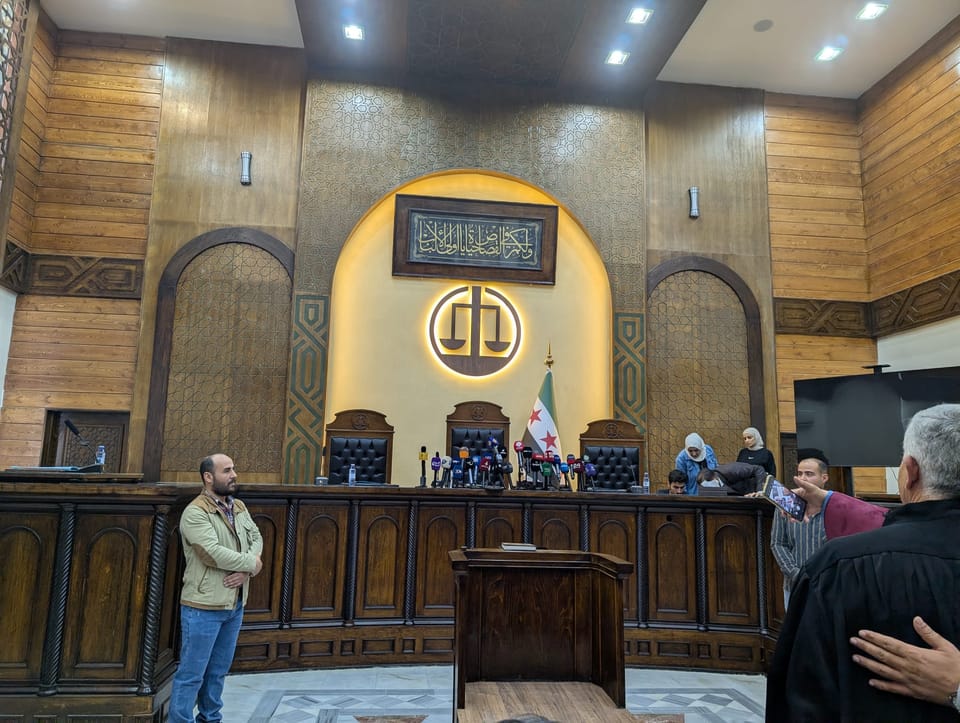
While Syria has yet to pass a legislative act creating a specialized transitional justice tribunal, the government has designated the Fourth Criminal Court in Damascus to hear transitional justice-related trials. No public announcement has clearly set out how this chamber was mandated to handle transitional justice cases, but a series of administrative decisions appear to have gradually shaped its role. Judge Fakhr al-Din al-Aryan, who was reinstated under Presidential Decree No. 70 in June 2025, was appointed as President of the Court in January 2026, whereas a dedicated courtroom in the Palace of Justice was inaugurated in April by the Syrian Minister of Justice, ahead of the first public trial of senior officials associated with the former Assad government.
The first case in front of the Fourth Criminal Court began on April 26, with Atef Najib appearing in person. Najib’s case is significant in light of his role in the early events of 2011, as he was the head of Political Security in Daraa when the arrest and torture of schoolchildren triggered the first wave of mass protests. The court also called a number of absent defendants, including Bashar al-Assad, Maher al-Assad, and former Defense Minister Fahd Jassem al-Freij, affirming the existing judiciary’s responsibility in adjudicating crimes that are fundamentally different from the domestic offenses it was designed to process.
What crimes can the Fourth Court prosecute?
Since Syrian law does not comprehensively codify crimes against humanity, war crimes, or genocide as distinct crimes, acts that may qualify under international law as part of a widespread or systematic attack against civilians are likely to be prosecuted through ordinary offenses such as murder, assault, unlawful detention, acts of torture, or abuse of authority. For example, conduct that could qualify as enforced disappearance under international law may instead be prosecuted simply as unlawful detention, without addressing the continued concealment of the victim’s fate.
The adoption of this legal framework carries significant implications, as it strips the crimes of their collective and political dimensions. In Najib’s case, the issue is not only whether specific arrests, torture, or killings can be proven. It is whether the court can show that these acts were part of a wider security response to the 2011 protests. Under international law, the arrest and torture of children, the death of detainees, including 13-year-old Hamza al-Khatib, and the use of live fire against protesters would be assessed together to determine whether they formed part of a widespread or systematic attack against civilians, rather than treated only as separate acts.
Under the Syrian penal code, the court can only focus on whether specific acts happened and whether Najib can directly be held responsible for them, which also affects the evidence presented. Cases built under international law typically rely on material that shows patterns and coordination, such as testimonies from multiple victims, documentation of repeated arrests, or evidence of how security forces operated across Daraa or all of Syria. Under the national penal code, the focus is narrower, relying primarily on evidence tied to individual incidents, such as witness testimony, detention records, or medical reports. Since the evidentiary focus is narrower, only a limited number of victims can be represented in any single case, while many others, whose experiences form part of the same pattern, remain outside the courtroom.
The Fourth Criminal Court has taken an important step toward addressing some of these limitations by grounding the accusations in international human rights and humanitarian law. The charges against Najib included the use of excessive force against peaceful protesters, arbitrary detention and unlawful deprivation of liberty, torture leading to death, incitement to murder, and issuing or participating in orders to kill, arrest, and torture, which the prosecution described as systematic abuses against civilian populations. Judge Fakhr al-Din al-Aryan stated that the acts attributed to Najib and the absent defendants amounted to war crimes and crimes against humanity, invoking international treaties and covenants to which Syria is a party. This framing is significant progress in acknowledging the organized and political character of the violence, but it remains unclear how far these characterizations can be translated into charges, modes of liability, and judgments under existing Syrian criminal law, without the adoption of a transitional justice framework.
What are the Court’s shortcomings?
The court also faces limits in how criminal responsibility can be assigned. Syrian law does not formally adopt the concept of command responsibility, which enables the prosecution of superiors who ordered, enabled, or otherwise failed to prevent crimes committed by subordinates. As such, there is no legal mechanism through which vertical chains of authority, which were central to the functioning of the former Syrian security apparatus, can be translated into criminal liability.
In practice, this means prosecutors can more easily pursue those who directly carried out arrests or abuse than those who oversaw them. As head of Political Security, Atef Najib was not necessarily the person physically carrying out these acts. Without a clear legal framework condemning his responsibility in ordering or allowing these crimes, it is harder to move from proving that violations occurred to proving that a superior should be held accountable for them.
The challenge is even greater for figures such as Bashar Al-Assad. To hold him accountable, the court would need to establish a direct link between decisions taken at the highest level and crimes carried out on the ground. Yet, the law in its current form is better suited to proving specific acts than to tracing how authority or instructions translated into crimes committed by others. As a result, lower or mid-level officials linked to specific, documented incidents, such as Amjad Youssef, may be easier to prosecute. Senior leadership cases, by contrast, are likely to be more difficult to build and less able to capture the full scope of responsibility.
Time also limits what can be prosecuted. Under Syrian law, serious crimes cannot be brought to court if more than ten years have passed without a case being opened. This raises practical questions surrounding which cases can be brought now for acts that could not be prosecuted at the time. This is directly relevant in the case of Atef Najib, as the acts for which he is accused in this specific instance happened over a decade ago. Given that the defendants could not realistically be brought before a court while the former government remained in power, the ruling judge affirmed that such crimes are not subject to limitation periods or amnesty under the 2025 Constitutional Declaration and Syria’s international obligations.
This reasoning demonstrates clear efforts directed at overcoming some of the legal constraints embedded in the current system. At the same time, the significance of this approach will depend on how consistently it is applied across future cases, how clearly international criminal law concepts are integrated into Syrian proceedings, and whether ordinary criminal categories can support the broader legal record that a transitional justice process requires. The reliance on narrower offense categories would otherwise limit the basis for collective or large-scale reparations, particularly in contexts of widespread destruction, displacement, and mass harm. In practice, this would likely confine redress to individual claims, with limited recognition of the extensive impact on affected communities.
What are the implications for accountability and transitional justice?
The Fourth Criminal Court marks a pivotal, yet precarious, attempt to reactivate domestic accountability in Syria. In a landscape defined by years of impunity, the appearance of senior former officials before a Syrian court carries immense legal and symbolic weight for Syrians, as it signals that impunity is no longer absolute and that victims’ claims can begin to be acknowledged. However, the rapid initiation of high-profile trials, in the absence of parallel legal reform, points to a process that prioritizes visible progress, but still lacks the means needed to build a comprehensive record of violations, support meaningful redress, and contribute to societal reconciliation.
These dynamics shape how accountability is experienced in practice. Many Syrians continue to live with the consequences of detention, killings, and displacement, often without clear answers about what happened or who was responsible. Where accountability is partial or uneven, two victims who suffered similar losses may see their cases handled differently, depending on whether one is documented, publicized, and allowed to be pursued through the courts, while the other remains outside the process. For families of the missing, or those whose experiences were never formally recorded, this can reinforce the sense that only a limited number of harms are being acknowledged. If the process is perceived as inconsistent or selective, it may deepen existing grievances and perceptions of exclusion.
The absence of a credible and accessible justice process can also fuel informal or retaliatory responses at the local level. At the same time, without legal safeguards and meaningful institutional reform, prosecutions alone are unlikely to prevent the recurrence of similar violations.
Addressing this requires strengthening the legal foundation of accountability so that it aligns with both the scope of abuses and the expectations of those seeking justice, including by:
- Adopting a transitional justice law that clearly defines how accountability will operate, including case selection, victim participation, reparations, and institutional reform.
- Incorporating formally international crimes into domestic law, including crimes against humanity and war crimes, to ensure that prosecutions can reflect the gravity, context, and collective impact of serious violations.
- Establishing a specialized tribunal or chamber by law, with a clear mandate, independent judges, and procedural safeguards to handle all conflict-related cases consistently. This should include defining modes of responsibility beyond direct perpetrators and clarifying how statutes of limitation apply where prosecution was previously not possible.
- Creating accessible pathways for victims to participate, including those whose cases are not publicly documented, so that access to justice does not depend on visibility or resources.
- Linking criminal proceedings to reparations mechanisms, so that court findings can support meaningful and consistent redress for families and communities.
- Ensuring coordination across institutions, including courts, commissions, and investigative bodies, to avoid fragmented or parallel processes.
These steps are intended to ensure that the accountability process operates on a consistent legal basis, one that extends beyond a limited set of defendants, reflects violations across different contexts, and contributes to preventing the re-establishment of practices that enabled them.
___________________________
For more information or to provide feedback, please contact SJAC at [email protected] and follow us on Facebook and Twitter. Subscribe to SJAC’s newsletter for updates on our work