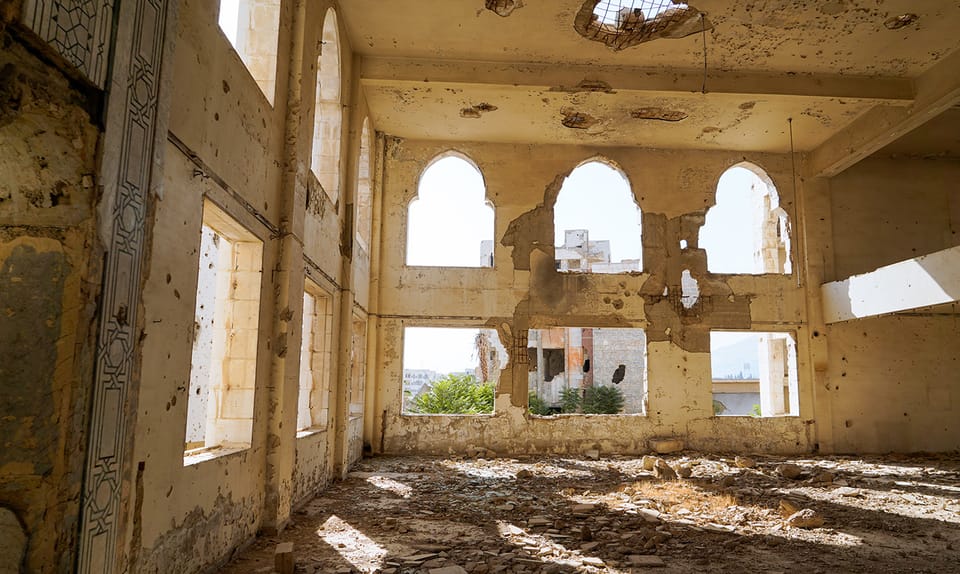
Safeguarding Syria’s Reconstruction: Why Anti-Corruption Must Come First
Syria is entering a new phase, one marked by renewed public engagement and growing international interest in reconstruction. Recent crowdfunding campaigns and early reconstruction initiatives have generated a sense of possibility that has been absent for many years. However, this moment also carries significant risk. Without strong safeguards, the same patterns of corruption and political capture that defined state institutions under the previous government may reemerge, undermining both reconstruction and public trust.
Corruption under the previous government was entrenched, systemic, and integral to its survival and control in Syria for decades. During the conflict, these practices intensified and were deployed strategically to consolidate power and punish dissenting communities. As documented by SJAC, Syrian intelligence agencies directly controlled the distribution of humanitarian aid to ensure that assistance served the government's political and economic interests rather than reaching communities most in need. A recent survey found that 50% of Syrians believe that corruption currently plagues state institutions, although 70% see it as less than under the Assad government.
Against this backdrop, the new influx of reconstruction funding demands careful management and meaningful accountability. Clear protections must be enshrined in the new legal framework to prevent Syria’s reconstruction from becoming a vehicle for corruption rather than a step toward a more just and transparent future.
Embedding Economic Accountability in Transitional Justice
Corruption under the Assad government was systemic and a central mechanism through which the old government financed, operationalized, and sustained war crimes. Because economic abuse, particularly those involving housing, land and property, directly enabled violations, accountability for corruption must be a part of the broader plan of transitional justice.
Addressing economic crimes alongside war crimes can facilitate asset recovery, ensure more equitable allocation of future reconstruction funds, and generate evidence that clarifies how financial interests shaped patterns of violence. If these economic dimensions are neglected, new reconstruction efforts risk entrenching the same networks that financed repression and reproducing the structures of exploitation rather than dismantling them.
Integrating economic accountability into transitional justice in Syria could take several complementary forms. Financial investigations would trace assets, freeze illicit holdings, and expose the misuse of public or humanitarian funds. For example, Rifaat Al-Assad was convicted of money laundering and tax fraud resulting in hundreds of millions of Euros in asset seizures in Spain and France - although the ultimate fate of those funds remains in question. Prosecuting economic crimes (both abroad and in Syria) would provide transparency, prevent further diversion of resources, and strengthen public confidence in post-conflict institutions. Recovered assets could be redirected to reparations funds, support housing restitution, or finance community rehabilitation, linking economic accountability to tangible benefits for victims. Collected evidence can be incorporated into war crimes and atrocity prosecutions. Such evidence helps establish command responsibility and reveal patterns of collusion. By embedding economic accountability within transitional justice, accountability extends beyond individual perpetrators to the broader economic structures that sustained violence, ensuring that reconstruction is both equitable and just.
Specialized Anti-Corruption Chambers Are Essential
In addition to prosecuting past abuses, Syria’s post-conflict justice system will need mechanisms capable of investigating and prosecuting current high-level corruption. However, the current judiciary faces capacity constraints. Many qualified judges fled during the war or were purged by the past government, legal education deteriorated, and remaining judges often lack training in international standards and transitional justice.
A practical, near-term solution is the creation of specialized anti-corruption chambers within the existing judiciary. These chambers would focus on high-level corruption such as embezzlement, diversion of reconstruction funds, misappropriation of aid, misuse of public assets, and illicit enrichment. This specialized chamber could gradually evolve into a more autonomous institution as judicial capacity increases. International experience supports this approach. Countries such as Ukraine and Indonesia established specialized anti-corruption courts to adjudicate complex cases that ordinary courts could not manage, demonstrating that specialized bodies can be effective where systemic corruption is entrenched.
To ensure credibility, a neutral judicial selection commission should be established to vet new judicial appointments, including for the specialized chamber. The commission should include representatives from civil society, vetted members of the existing judiciary, and international experts or Syrians with substantial international experience. Judges serving in these chambers should receive secure tenure, independent funding, and protections from political interference.
The specialized chamber should be supported by dedicated investigative teams, forensic accounting and financial intelligence capacity, and secure case-management systems. In the early phase, the chamber can work with broader transitional justice teams to investigate past economic crimes, while also developing the capacity to prosecute ongoing corruption.
By building specialized capacity within existing institutions, Syria can address corruption while simultaneously rebuilding judicial credibility and restoring public trust in the justice system during the transition.
Strengthening Syria’s Public Financial Oversight
Syria’s existing public financial oversight institution, the Central Organization for Financial Control (COFC), is responsible for supervising public funds, preventing corruption, and ensuring financial accountability across ministries and state-affiliated entities. Under the former government, corruption was organized and entrenched in sectors directly related to citizens’ livelihoods.
For reconstruction to proceed responsibly, the COFC must be transformed into an independent body, reporting directly to the parliament rather than the executive, with an Auditor General appointed by a qualified parliamentary majority for a fixed term. Its budget should be guaranteed by law, outside political discretion, to ensure that funding decisions cannot be manipulated to influence outcomes.
The reformed COFC must have unrestricted subpoena power and access to records of all ministries, public enterprises, and any private entity receiving reconstruction, donor, or crowdfunding funds. All public procurement and contracts above a defined threshold should be audited and made publicly accessible, including full disclosure of award criteria, bidder identities, beneficial owners, and funding sources. A transparent, publicly available online portal would enable civil society, media, and citizens to monitor reconstruction spending in real time.
Post-Conflict Property Restitution
One of the most pressing challenges for post‑conflict Syria is property restitution. Millions of Syrians have been displaced, their homes destroyed, and their property seized or appropriated during the conflict. Any sustainable recovery must address these losses, as returning homes and resolving disputes is central to rebuilding trust, social cohesion, and the rule of law. Syria’s property system was already complex before the war, combining formal deeds, informal settlements, and customary arrangements. The conflict has further complicated these issues through widespread destruction, forced displacement, and the manipulation of legal instruments, including expropriation and rezoning, to facilitate dispossession.
A comprehensive restitution program must recognize the varied forms of property rights, including formal documentation, customary occupancy, and inherited claims. It should establish an impartial mechanism to register claims, adjudicate disputes, and enforce restitution decisions while ensuring due process protections for both displaced owners and current occupants. The program must balance efficiency and fairness, provide remedies such as return, compensation, or alternative housing, and include international monitoring to prevent corruption. Property restitution should also be integrated within a broader transitional justice framework, reflecting that dispossession often intersects with broader violations of human rights.
The scale of the challenge is immense. Many displaced Syrians never held formal property titles, records have been destroyed, and populations have moved multiple times, complicating verification and adjudication. Conflicts between original owners and current occupants further underscore the need for a carefully designed, inclusive process.
The new Syrian government must create a detailed framework for addressing property loss throughout Syria that includes individuals’ rights to freely return to their homes of origin, without discrimination, and the state’s obligation to aid in return of refugees and displaced persons and facilities, property restitution or fair compensation by other means when restitution is not possible. It must also revoke any legislation or policies that hinder an individual’s right to return and pass supplementary legislation that enables the formation of a property restitution commission that has the mandate and power to adjudicate property disputes and determine appropriate redress to individual victims.
Empowering Civil Society, Local Oversight, and Public Transparency
Formal institutions alone cannot guarantee accountability. Civil society, affected communities, and citizens must be given meaningful roles in oversight, transparency, and participation. Civil Society should first be given the right to operate in Syria without governmental interference. To that end, Syria should adopt legal protections for investigative journalism, whistle blower statutes, and public interest litigation, enabling individuals and organizations to expose corruption, challenge mismanagement, and seek administrative or judicial review.
All major reconstruction and redevelopment projects should undergo public consultation. Social and economic impact assessments must be conducted, results published, and community feedback documented. Decision making processes should be transparent, participatory, and accountable to those affected by the conflict. Only with active civic engagement can reconstruction build legitimacy, restore social trust, and prevent new networks of corruption from re-emerging.
Conclusion
Achieving equitable reconstruction requires building a justice and oversight architecture that is independent, transparent, and resilient, and that draws on the lessons of Syria’s past. This architecture should include a specialized anti-corruption chamber, a reformed supreme audit institution, a fair property restitution mechanism, and an inclusive participatory framework for civil society.
Syria’s path to reconstruction is undeniably complex, but it is also filled with opportunity. By combining strong institutions with active citizen participation, Syria can ensure that reconstruction strengthens both governance and society. These efforts are an investment in trust, social cohesion, and the rule of law. With careful planning, inclusive participation, and strong oversight, reconstruction can become a transformative process: one that not only rebuilds infrastructure, but also restores the rights, dignity, and confidence of all Syrians.
___________________________
For more information or to provide feedback, please contact SJAC at [email protected] and follow us on Facebook and Twitter. Subscribe to SJAC’s newsletter for updates on our work