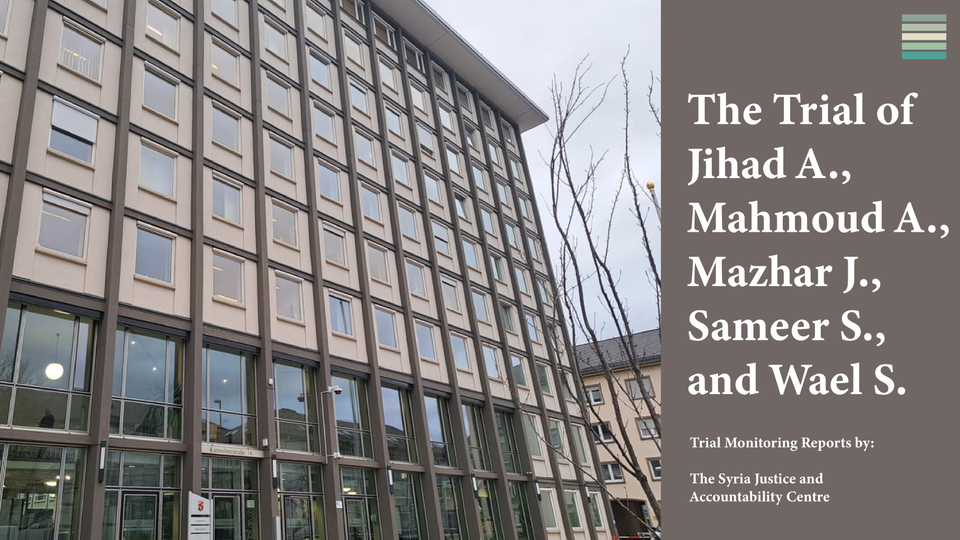
Inside the Yarmouk Trial of Jihad et al. #24
TRIAL OF JIHAD A., MAHMOUD A., MAZHAR J., SAMEER S., AND WAEL S.
Higher Regional Court - Koblenz, Germany
Trial Monitoring Summary #24
Hearing Dates: August 12 and 13, 2026
The Center for Victims of Torture (CVT) provided support to SJAC to monitor this trial and prepare the first six monitoring reports. CVT has continued the monitoring of this trial from report seven onwards and has edited them according to its own style guidelines.
CAUTION: Some testimony may include graphic descriptions of torture, rape or other violent acts.
This is an informal summary of the proceedings and not a verbatim transcript. CVT has chosen not to use the names of witnesses or detailed information that could be used to identify them.
Trial Report 24: Summary
CVT’s 24th trial monitoring report details days 43 and 44 of the trial of Jihad A., Mahmoud A., Mazhar J., Sameer S., and Wael S. On the first day of this week, the court heard from a Syrian surgeon who ran a hospital in Al-Yarmouk and testified about treating the wounded from a July 2012 demonstration, including a relative shot in the head and a young man with a life-threatening abdominal gunshot wound. In the afternoon, defense counsel stressed inconsistencies between the witness’s account and that of an ambulance driver, W5, who had previously testified before the court. The day ended with several defense counsel arguing that the witness's testimony helped their clients.
On the second day of this week, another witness from Yarmouk was heard and provided information about the July 13, 2012, demonstration, which he testified he had not personally attended. He testified about what he had heard from others, including the presence of militia during the demonstration and the gunshot wounds sustained by one individual to the head, back, and thorax.
Trial Day 43: August 12, 2026
The session started at 10:00 a.m. with everyone present. The witness, W23, a Syrian general surgeon now living in Europe, was brought in and instructed to answer truthfully, having been warned that false testimony could result in a prison sentence of up to one year. He testified that he was currently unemployed and not related to any of the accused, and briefly thanked the court, adding that he hoped justice would be done regarding what happened in Al-Yarmouk.
He then gave some personal background, indicating that he grew up and went to school in Al-Yarmouk, studied medicine, specialized in general surgery, and worked his way up from private practice to a position at a local hospital, where he conducted surgeries alongside his administrative duties. He also noted that he got married, had children, and moved to a nearby district around 2008, but stayed through everything that happened afterward. He left Syria in 2013 and explained that his last shift at the hospital had been on December, 17, 2012, the day an air strike hit the hospital, causing it to stop functioning. He mentioned that one accused's family used to live in his old neighborhood, but he had no contact with them since.
He then described in detail the events of 2012, explaining that it had been a particularly difficult year for the hospital, which was a civilian facility that treated people free of charge. He focused on one demonstration that he dated to around July 13. He recalled that he was called in that Friday afternoon and found chaos near the hospital, with wounded people already at the entrance. He was sent immediately into the operating room to help finish an operation on a stomach wound that a colleague had already started.
According to his understanding, the crowd had moved from the Palestine roundabout to a biscuit factory, and people were shot along the way. He explained that the less serious cases were treated at his hospital and the remaining cases were sent to Damascus. Among those brought in was a close relative of his, who had been shot in the head and who was transferred to Damascus because of the nature of his injury. He also recalled that another young man was brought in with a gunshot wound to the stomach that had damaged his intestine and that the injury would have been fatal if the bullet had hit a centimeter differently. He estimated that he treated four or five individuals that day and recalled staying at the hospital, mostly in the operating room, until the evening.
The judge rapporteur then asked several follow-up questions, including about the other two hospitals operating in the camp at that time, which belonged to different groups, and about a period when security forces raided the hospital and took away wounded patients. He further asked the witness to provide information about what had happened to the local security chief, who was later killed and replaced. The witness was also asked about an ambulance driver from another hospital, W5, whom the witness recognized from a photograph. The witness explained that the ambulance driver was a civilian who had first worked for the hospital's female director and later became its regular driver.
The witness also affirmed that he had never exchanged the names or numbers of casualties by phone with the hospital staff, because he was afraid that this information would reach the security services. The judge rapporteur then noted that this affirmation contradicted the ambulance driver’s testimony in court [Note: For W5’s testimony, see Trial Report #6].
Shown more photographs, the witness recognized one young man, now deceased, as belonging to a well-known local family, and identified one ambulance by its yellowish color as one that he had personally seen, though he was unable to say anything about a second, white ambulance depicted on the screen.
Regarding patient records, he indicated that a lot of people used false names and that the hospital staff never asked questions, treating everyone irrespective of which side they were on.
He was additionally asked about an incident where buses reportedly took young people from the camp toward the Israeli border for a memorial event. He recalled treating two or three people with minor injuries that day but affirmed that the group that caused the injuries only gained notable influence after he had already left the country.
[75-minute break]
[Note: The court allowed one defense counsel to speak with his client for around twenty minutes and the hearing continued at 1:19 p.m.]
Defense counsel then started their questioning, asking the witness several practical questions regarding the hospital where the witness had worked, including its size, the number of operating rooms it had, the number of beds, and how it compared to the other two hospitals in terms of size and funding.
The defense counsel also questioned the credibility of the ambulance driver [W5], and the witness affirmed that he was not aware of whether the latter had ever worked in an operating room but only knew that he drove ambulances between hospitals. The witness was further asked when the three hospitals stopped operating, as well as for his estimate of how the population level in the camp had changed by the time of the air strike compared to when the unrest started.
When asked about what had happened to the hospital's female director, he responded that he believed she had briefly been abducted and released before the air strike. He indicated that according to one of his contacts abroad, who had last been in touch with her about two years ago, she was still living in Syria. When requested to provide the latter contact's details to the court, he gave a name and the country only after the presiding judge stressed that he was legally obliged to provide the information. A phone number was then obtained from his phone and recorded separately for the defense.
The remaining questions of the defense concerned the gunshot wounds, including how the size and depth of an entry wound can be indicative of the distance from which a shot was fired, why he thought that the injuries came from an unseen shooter firing from far away rather than close up, and why no X-rays or bullets were ever retrieved from the first two men he treated. He testified that he was unable to name any specific sniper, since they stayed hidden.
When asked about death certificates, he explained the standard form used in Syria at the time. He said the form included personal details, the cause of death, and the treating doctor's signature, and was handed only to relatives. But burials often took place without any paperwork once the state stopped functioning properly. He was unable to remember whether he had personally signed any certificates on the day of the demonstration.
The witness was then dismissed without being sworn in and thanked the court before leaving.
After the witness left the courtroom, several defense counsel submitted statements pursuant to Section 257 of the German Code of Criminal Procedure (GCCP). One indicated that the defense did not believe the ambulance driver's account, pointing out a discrepancy as to whether the female hospital director had in fact been released after being abducted. Another said the witness had only placed one accused at the scene because of a family resemblance, had never seen him armed or in uniform, and had described him as the youngest person in that household, which counsel argued helped their client's case. A third agreed with the first, adding that the witness had been careful throughout to separate what he had seen himself from what he had only heard, and that his account did not match the ambulance driver's version on several points. The rest of the defense counsel joined these statements.
The proceedings were adjourned at 2:35 p.m.
The next trial day is scheduled for August 13, 2026, at 9:00 a.m.
Trial Day 44: August 13, 2026
The second hearing of the week commenced at 9:00 a.m. The Presiding Judge confirmed the presence of all parties to the proceedings. The Court then heard a new witness, W24, who was from Yarmouk. The witness first introduced himself, providing information about where he had lived in Yarmouk, and testified to his age and current country of residence.
The presiding judge then began questioning the witness. She first asked him to provide information about July 13, 2012, including whether he had been working that day. The witness explained that he worked as a dentist and, as usual, had been working at his office that day. He indicated that he had not participated in the demonstration, but that his brother had been present. He subsequently learned about the demonstration and the injured people from others, as he often volunteered at a hospital.
A discussion then followed regarding the usual number of people present on Palestine Street and Yarmouk Street. While the witness indicated that there were usually only a few people present, the presiding judge recalled that, according to the testimony of a journalist, more people were present on a normal day.
The witness subsequently provided information about what he had heard from others regarding the July 13, 2012, demonstration. He testified that he had not personally witnessed the presence of the “militia” but had been told that they had been present during the demonstration. He also recalled that there had been no internet connection that day and that, to the best of his knowledge, there had only been one ambulance. When asked about the ambulance driver, he indicated that he knew him.
Various images were then projected, including photographs of individuals and maps of Yarmouk. In particular, the witness was asked to identify Yarmouk Street and Palestine Street on the map, which he did. He was also asked whether he knew the individuals depicted on the courtroom screen, which he denied.
The focus of the questioning then shifted to a person who had been injured during the demonstration, identified as F101. The presiding judge asked the witness whether he knew how many gunshots F101 had received and which parts of his body had been injured. The witness indicated that F101 had received gunshots to his head, back, and thorax and that the two gunshot wounds to his back and thorax were more serious than the wound to his head. He also explained that he had learned about the injuries from F101’s family.
The witness further noted that on the day after the demonstration, he had visited his brother at the hospital, where his brother spoke to him about the demonstration.
Thereafter, one of the defense counsel began questioning the witness, asking whether he personally knew F101. The witness responded that he had no relationship with F101 before being confronted with his previous police statement, according to which he knew him. [Note: At this point the witness became agitated, and the presiding judge interrupted the questioning.]
Another defense counsel then continued the questioning, again inquiring about F101. The witness reiterated that he had heard from F101’s relatives that he had been shot in the back, thorax and head. When asked about the individuals present at the July 13 demonstration, the witness affirmed that he knew that militia members had been present at the demonstration and that they had later arrived at the hospital.
Thereafter, another defense counsel asked the witness about the checkpoints, including whether he knew about them and whether he had been at any of them. The witness responded that he knew of them because people talked about them, but that he had never been at any of them.
[10-minute break]
After the break, the prosecution presented photographs, which were projected on the courtroom screen. The witness testified that he did not recognize the individuals depicted in the photographs.
The court then dismissed the witness.
The proceedings were adjourned at 12:00 p.m.
The next trial day is scheduled for August 26, 2026, at 10:00 a.m.
___________________________
For more information or to provide feedback, please contact SJAC at [email protected] and follow us on Facebook and Twitter. Subscribe to SJAC’s newsletter for updates on our work