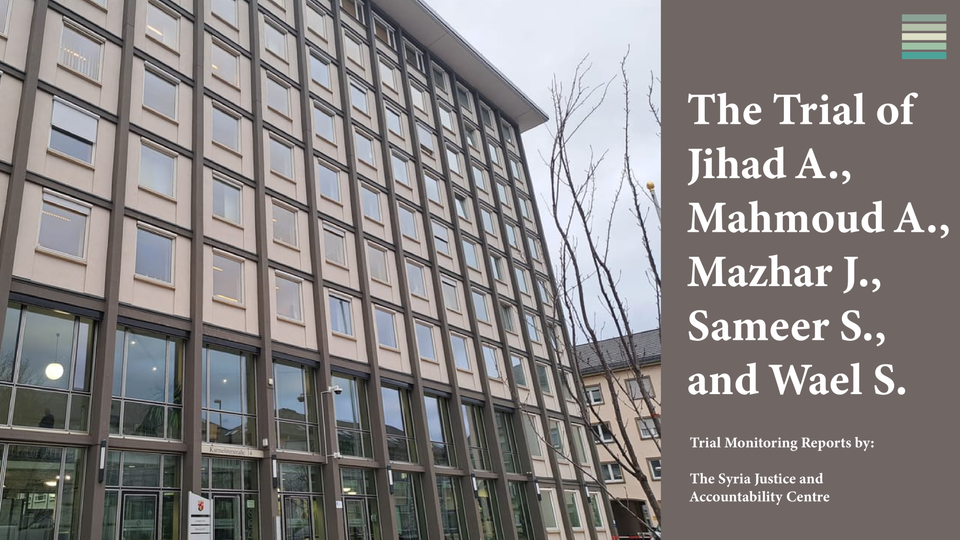
Inside the Yarmouk Trial of Jihad et al. #22
TRIAL OF JIHAD A., MAHMOUD A., MAZHAR J., SAMEER S., AND WAEL S.
Higher Regional Court - Koblenz, Germany
Trial Monitoring Summary #22
Hearing Dates: July 8 and 9, 2026
The Center for Victims of Torture (CVT) provided support to SJAC to monitor this trial and prepare the first six monitoring reports. CVT has continued the monitoring of this trial from report seven onwards and has edited them according to its own style guidelines.
CAUTION: Some testimony may include graphic descriptions of torture, rape or other violent acts.
This is an informal summary of the proceedings and not a verbatim transcript. CVT has chosen not to use the names of witnesses or detailed information that could be used to identify them.
Trial Report 22: Summary
CVT’s 22nd trial monitoring report details days 39 and 40 of the trial of Jihad A., Mahmoud A., Mazhar J., Sameer S., and Wael S in Koblenz, Germany. On the first trial day this week, the Court heard a new witness, W20, regarding the July 13 demonstration and his experience as a medical volunteer that day. The witness also testified that he had been held and tortured at the Palestine Branch and described the detention conditions in detail.
On the second day this week, the defense completed its examination of the witness who had testified the day before. The witness’s examination, again, focused on the July 13 demonstration in Yarmouk, his work as a medical volunteer, and his knowledge of the accused and other individuals. The witness also answered questions about hospitals, field clinics, information-sharing within Yarmouk, and his previous police statements. After the witness's examination, the presiding judge announced the bench's decision to deny a defense request for a previous witness's medical records.
Trial Day 39: July 8, 2026
Today, a new witness, W20, was called to testify. Defense counsel Eveling appeared as substitute counsel for defense counsel Grassel. Defense counsel Lamm appeared as substitute counsel for defense counsel Tahmaz-Ahmadvand.
One of the judges began the examination by asking the witness about demonstrations in Yarmouk Camp. The witness first explained that Palestinian inhabitants of Al-Yarmouk had sided with the Syrian people in the conflict. He explained that, since the revolution, there had been several demonstrations, including before July 13, 2012, even though the July 13 demonstration, in his view, was the largest and the first violent demonstration. The witness further explained that the General Command had distributed guns before the July 13 demonstration.
Recalling the day of the July 13 demonstration, he explained that he had closed his place of work that day and joined the front of the crowd as it passed by. He noted that the demonstrators then encountered a blockade of more than 20 individuals, including armed members of the security forces in uniform and armed members of the Shabiha wearing civilian clothing. He estimated that the distance between him and the individuals blocking the passage was approximately 200–250 meters.
The witness also testified that, after the shootings that day, he went to a hospital, where he volunteered. He estimated that there were about 30 injured individuals and ten individuals who had died, whom he referred to as “martyrs”. According to the witness, he cared for the wounded at the hospital and tried to stop their bleeding. He explained that he left immediately after learning from the hospital coordinator that the security forces were going to come to the hospital.
When asked whether his medical station had ambulances, he rejected the suggestion that ambulances had transported the wounded on 13 July. He also explained that, in general, helpers did not wear high-visibility vests during the demonstration, as the regime did not differentiate between individuals wearing vests and other individuals present at the demonstration.
[10-minute break]
After the break, the Court showed the witness a photograph. The witness did not recognize the person depicted. When another photograph of the same person was shown, the witness identified him as W5. He explained that he had encountered him a few times but did not know whether he was a volunteer or a medical employee.
He further testified that members of one particular family [possibly relatives of W21] had also participated in the demonstration. He continued by testifying that he heard that a person [presumably F66 and presumably a relative of W21] had died after being released from prison.
He also explained that he was aware that F7 had died during the demonstration and noted that he had known his father since 2006 or 2008. He added described the occupation of F7’s father.
Next, a photograph of Wael S. was shown. The witness testified that a place known to him was next to Wael S.’s workplace and gave some information about the work of Wael S. He also affirmed that Wael S. was among those who received arms from the General Command. He noted that he had once seen Wael S. carrying a Kalashnikov at a checkpoint and had also seen him patrolling the streets with a weapon.
When asked about his knowledge of F21, he testified that F21 had died in detention.
The witness further testified that he had gotten to know Jihad A. in Europe. After the “events” [presumably referring to the rise of the Shabiha in the Camp], people in the Camp had spoken about him and other individuals. He clarified that he had met Jihad A. in Europe through a mutual acquaintance and added that they had not discussed Syria, as he did not like talking about the regime.
The judge next questioned the witness about other individuals in the courtroom. The witness explained that he recognized Sameer S. from the Camp but did not recall seeing him carrying a weapon. In response to the judge’s question about whether he recognized the accused who was “wearing the green shirt”, he turned to Mazhar J. and asked whether he had worked for the Palestine Branch.
When asked about Mahmoud A., the witness recalled that he had spoken to a doctor who had told him that the doctor’s nephew had testified against the doctor, which had led to the doctor’s detention. He also recalled that, after his detention, the doctor weighed only 40kg. The witness only learned after his own incarceration that the nephew who had testified against the doctor was allegedly Mahmoud A.
The judge rapporteur then asked the witness about Mazhar J. The witness recalled that he had heard this name in connection with one of his friends being kidnapped and incarcerated.
[85-minute break]
After the break, the witness continued testifying about the July 13 demonstration, explaining that he had worked at a certain medical center in the morning and at his other place of work in the afternoon.
The hearing then shifted to the witness’s capture and detention. He testified that he had probably been kidnapped on a specific date in early 2013. He explained that he assumed that someone had reported to the authorities that he had been present at a certain location where the opposition met, and that he was, therefore, being sought as a criminal and terrorist.
The witness explained that he had been outside the Camp in another location he named, and had been captured because he had been driving in the direction of Tadamon. He recalled that, at a certain checkpoint, a vehicle from the secret service had pulled up and that they had pulled his shirt over his head. He recalled that he had been tied into a sitting position, with his head forced between his legs.
He further explained that he had been beaten throughout the journey to the branch. There, he testified, he had been forced to undress, searched, and then made to squat. He explained that he had received an “extra portion” of punches because he had arrived at the same time as the individuals responsible for an incident that had occurred at the time.
He explained that he had been taken with seven others to the Palestine branch, where people were beaten with the "Al-Akhdar Ibrahimi", a green pipe, until they began to bleed. He testified that he had been brought into the office of the staff sergeant. According to the witness, the sergeant had taken him to the toilets and suspended him there in the Shabeh method. He explained that his penis had been tied with a cable and that the staff sergeant had poured water down his throat to increase his urge to urinate. The witness testified that he had repeatedly lost consciousness as a result of the torture.
He further recalled that he was subsequently taken to a communal cell across from the toilets. According to the witness, he had remained there for a week before the detainees in the cell were distributed among smaller cells. He remained in one of these smaller cells for approximately one year, until he was transferred to an individual cell in a certain month of 2012.
The witness testified that the first cell measured approximately 3.5–4 meters by 5 meters and contained 130 individuals. He described the conditions as a policy of starvation, explaining that people died constantly. He also affirmed that the detainees suffered from various illnesses, including fever, scabies and diarrhea. He added that there had been one toilet inside the cell, separated from the rest of the room by a wall. He indicated that there had been a water tap but no possibility to sit down, explaining that everybody had to hold onto others to support themselves.
He noted that, on food distribution days, the detainees were divided into groups of 10 to 15 people and received a small amount of rice or potato water, while at dinnertime they received a piece of potato or tomato. He added that, when someone wanted to sleep, the detainees had to sleep stacked together like “swords”. He described the situation as a slow death by torture.
The witness provided further details about the cell, noting that there was a light bulb and that cameras had also been installed because the guards feared a revolution. According to the witness, obtaining confessions was not the prison warden’s goal. Instead, the guards decided, without any apparent strategy, which cell would be punished on a given day. The witness explained that the detainees also suffered psychological violence in the form of threats of violence against their mothers, sisters, or wives. He also recalled that there were no formal interrogations; instead, the detainees were tortured with electric shocks, the Shabeh method, or cigarettes. He further described instances in which a candle was placed under a chair.
He also provided details of the smaller cells, indicating that they measured four tiles by eight tiles and contained between two and 18 individuals. He noted that there was no toilet inside and that conditions in the cell were at the complete discretion of the warden. He recalled that, on one occasion, Warden F86 had not allowed the detainees to use the toilet outside the cell and that there had been bottles available for urination.
When the presiding judge asked about medical care, the witness laughed and responded that, in a prison without food, there was no medical care either. He further explained that, when someone died, the corpse sometimes remained in the cell for one to three days until the cellmates were allowed to remove it using a cloth. Regarding the air in the cells, he recalled that there had been no ventilation. He explained that, in summer, the cells were “like a pool”, while in winter, there were rugs full of lice and vermin. The witness testified that all of the detainees had scabies. No one requested rugs, but the ones inside the cell were spread on the floor. The witness testified that he had worn only his underpants for the first few weeks. He further explained that most clothing was in tatters and was used only as a pillow.
The witness estimated that he stayed for several months in one of the smaller cells [Note: These cells were referred to in court as individual cells, although they were said to accommodate more than one person]. He explained that, after being held in the Palestine Branch, he stayed for one night in a certain detention section not far from another that was said to already be holding as many detainees as possible at the time.
According to the witness, he was transferred to that other branch in 2014. He further recalled a particular date, because he had been questioned that day, and the questioner had informed him that he was lucky as it was his birthday and he would possibly be authorized to leave soon.
The witness testified that he had been released later in 2014, with some physical injuries, including scars on his body. He also noted that he had lost around 60 kg during his imprisonment.
He further recalled meeting F87 who had been held in a particular collection cell, and testified that F87 had been kidnapped by a person [possibly Mazhar J.] while trying to make arrangements to move to Lebanon.
The prosecution then began its questioning. The witness testified that there had been two to three deaths per day. He continued by testifying that the smell of death had been unimaginable. When asked about the relationships between prisoners, he responded that all cellmates had their own worries. He also noted that the screams of torture could be heard in the communal cells and that, sometimes, torture was carried out inside the cells.
The witness recalled the case of a young man who had only recently been detained and had informed a staff sergeant, F88, about the death of a cellmate and who, as a result, had been beaten to death by the sergeant in front of the door. He explained that the detainees had been able to witness the incident through the door because it had small holes.
He then recounted that he had been arrested a second time. He explained that the State Security Department had been looking for him and that he had been detained for a several weeks until the matter could be resolved.
Speaking about his current situation, the witness affirmed that he has overcome the trauma for the sake of his family and children, but that there are still difficult periods. He suffers from various physical conditions.
The witness was next asked again about F87. He explained that F87 had only been questioned once in detention and had been released after the second questioning.
[10-minute break]
After the break, the defense began its questioning. The witness confirmed that, on the day of the July 13 demonstration, there had been snipers on the balcony and roof of a police station, although he could not specify whether they had fired.
Proceedings were adjourned at 3:15 p.m.
The next trial day will take place on July 9, 2026, at 9 a.m.
Trial Day 40: July 9, 2026
On the second day this week, the defense completed its examination of the witness who had testified the previous day. Defense counsel Hedrich questioned the witness, W20, about the demonstration in Al-Yarmouk on July 13, 2012. The witness described the demonstration as involving approximately 1,000 to 1,500 people who chanted slogans such as “down with the regime”, “praises and lauds to the martyrs” and “Palestine and Syria are one”.
Defense counsel Hedrich continued by asking whether the witness knew of any buildings being set on fire in the days before or after the demonstration. He responded that there had been a fire in Al-Hajar Al-Aswad, which he believed the regime had caused to instigate unrest within the Camp.
Defense counsel Fratzky then asked the witness about the names of several individuals. The witness testified that the only person he knew was F40, who had helped him find a hotel when he was summoned to testify at the trial and had explained the logistical arrangements for his participation. The attorney’s final question concerned whether the witness had heard single shots or sustained fire in front of the police station. The witness replied that he had certainly heard sustained fire.
The next attorney to question him was defense counsel Greisner, who began by asking whether and how he knew several individuals, although the witness indicated that he knew none of them. Defense counsel Greisner proceeded to ask how many injured people he had treated when he worked at the hospital after the July 13 demonstration. He answered that he had treated two severely injured individuals. This was confirmed by police records of his earlier statements, in which he had stated that he had helped two severely injured people by providing blood transfusions. The final question concerned the political situation at the hospital and whether the regime interfered with the treatment of patients. According to the witness, the regime had ordered the hospital to provide the names of injured patients to the secret service, after which those individuals would be arrested.
Defense counsel Bodenstein and defense counsel Luth continued the questioning. The witness was asked how he had become aware of the field hospitals. He clarified that he had maintained secret contact with many of the doctors. He also interacted with regular hospitals, not only with secret ones.
The next question concerned how information spread within the Camp and how quickly information was typically exchanged, specifically on the day of or after the July 13 demonstration. He replied that, because of social media and close social contacts within the Camp, information was generally exchanged very quickly. Despite this, he said that he did not know of any relatives of witnesses being targeted by the regime after the demonstration.
Defense counsel Lamm, who represented Sameer S. on that trial day, asked whether there was an inscription on the ambulance at Al-Basil hospital. The witness did not know this detail but confirmed that the hospital had an ambulance. However, he could not recall hearing any ambulance sirens on the day of the July 13, 2012 demonstration.
The attorney proceeded to ask again how he knew Sameer and Wael S., pointing out that he had stated during the police examination in December 2024 that they “could” have a certain connection to each other. He replied that, at the time, he assumed that they were connected in this way and he gave reasons for this conclusion and felt it confirmed hearing the same from other people involved in the trial.
Thereafter, defense counsel Schönfelder and Flintrop continued the questioning. The witness was asked to explain the type of weaponry used during the demonstration. He testified that the Shabiha had used Kalashnikovs and pistols. According to him, the weapons were always ready to fire during the demonstration, and the Shabiha communicated through hand signs.
The discussion then moved to the witness’s employment at the hospital and how people became employed there. He replied that he had completed medical training, after which he was required to work for the state for six years, as many other employees had also done. He further noted that at the beginning of the conflict, even people who did not support the regime could be employed by the state. There was merely a brief round of questioning before they could begin work. He elaborated that there were also many field hospitals, but that he had never been in one and could not provide an exact number.
[15-minute break]
After the break, defense counsel Leymann asked how the witness knew about the events in the prisons and involving the secret service. He replied that he had been interested in politics for a long time before his arrest, and that the different branches of the secret service were not secret at all within the Camp. Upon further questioning, he also clarified that he had opposed the state for some time and had participated in most of the demonstrations that took place in Yarmouk.
Defense counsel Flintrop next asked the witness why he had been working on a Friday [referring to July 13, 2012], which was the weekly public holiday in Syria. He replied that he had been working privately at the hospital, not for the state, and that he had been helping someone. He was then asked how he could tell that the July 13, 2012 demonstration was different from previous demonstrations. He responded that the people in the streets were angrier than ever and that the slogans being chanted were more openly directed against the state.
The prosecution then inquired about his meeting with Jihad A. in Berlin. He explained that they had not discussed politics at that particular meeting and that he had not known about Jihad A.’s involvement in the crimes.
Defense counsel Fratzky asked the final question of the trial day regarding the period during which the witness had been incarcerated. He asked whether the witness had seen signs of torture on the bodies of his fellow detainees. According to the witness, everyone in detention showed signs of torture because all detainees were tortured.
After the witness was dismissed, the presiding judge read out the bench’s ruling denying defense counsel Leymann’s request that a previous witness provide all of his medical records in order to establish his mental fitness.
The proceedings were adjourned at 11:50 a.m.
The next trial day will take place on July 15, 2026, at 10 a.m.
___________________________
For more information or to provide feedback, please contact SJAC at [email protected] and follow us on Facebook and Twitter. Subscribe to SJAC’s newsletter for updates on our work