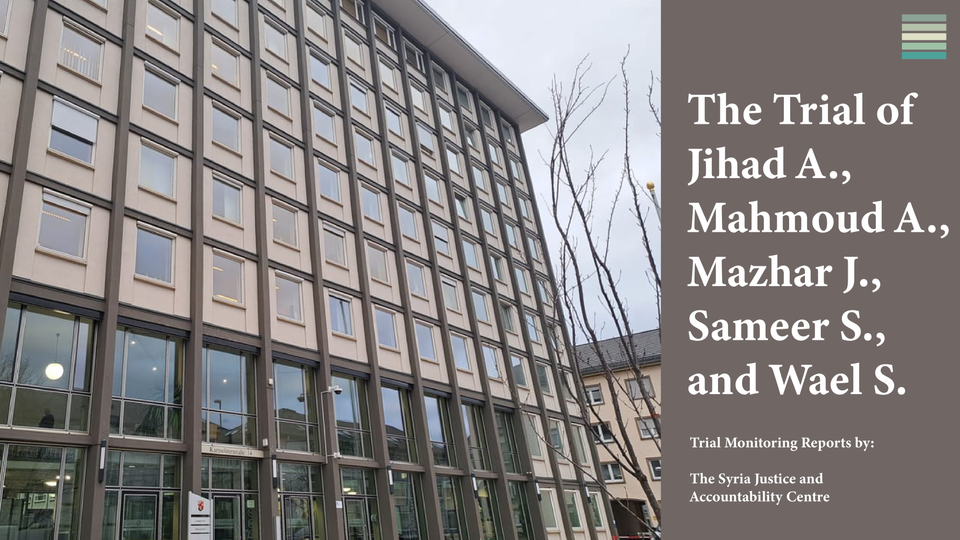
Inside the Yarmouk Trial of Jihad et al. #23
TRIAL OF JIHAD A., MAHMOUD A., MAZHAR J., SAMEER S., AND WAEL S.
Higher Regional Court - Koblenz, Germany
Trial Monitoring Summary #23
Hearing Dates: July 15 and 16, 2026
The Center for Victims of Torture (CVT) provided support to SJAC to monitor this trial and prepare the first six monitoring reports. CVT has continued the monitoring of this trial from report seven onwards and has edited them according to its own style guidelines.
CAUTION: Some testimony may include graphic descriptions of torture, rape or other violent acts.
This is an informal summary of the proceedings and not a verbatim transcript. CVT has chosen not to use the names of witnesses or detailed information that could be used to identify them.
Trial Report 23: Summary
CVT’s 23rd trial monitoring report details days 41 and 42 of the trial of Jihad A., Mahmoud A., Mazhar J., Sameer S., and Wael S. in Koblenz, Germany. On the first trial day this week, a new witness, W21, was heard and provided information about the July 13, 2012 demonstration in Yarmouk, including the presence of armed groups and two deaths. He also testified about the Free Palestine Movement (FPM) and the General Command, naming several individuals whom he identified as members of the FPM. The witness further described his encounters with several individuals during and after the demonstration, as well as confrontations with one of the accused.
On the second trial day this week, another witness from Yarmouk, W22, was heard. She testified that she had not participated in the July 13 demonstration but provided information about the arrest of F100 and the attempts to secure his release. In addition, she provided information about the alleged sexual abuse of a woman who had been taken to Tadamon, where she was allegedly detained, sexually abused and covered with acid. She also testified about one of the accused’s alleged involvement in the abuse.
Trial Day 41: July 15, 2026
The hearing began at 10:00 a.m. Presiding Judge Dr. Kerber confirmed the presence of all parties to the proceedings. Defense counsel Lamm was assigned to Sameer S. as a replacement for defense counsel Tahmaz-Ahmadvand.
The presiding udge then called the witness, W21, into the courtroom and invited him to introduce himself. He testified to his age and his profession in Yarmouk. He further explained that he was born in Yarmouk but had left Syria in 2012 and that his father was had a certain profession in Yarmouk whose office was located at a particular location there. His mother, sister and brother are still in Syria.
The witness recounted that he had participated in almost all of the demonstrations that took place in Yarmouk. When asked about a particular large demonstration, he identified the July 13 demonstration, which he linked to the remembrance of the Nakba.
The witness then described his experience that day, including witnessing a dead body, identified as F89. He testified that he had helped remove the corpse from the street.
The witness also testified to the presence of F90 and Moafak D. during the demonstration [Note: Moafak D. stood trial in Berlin].
He acknowledged having been involved in clashes with Jihad A. at the Palestine Circle. The witness lived on a nearby street and explained that the confrontation took place on Al-Maghrebina Street in the afternoon.
The presiding judge then asked the witness to elaborate further on the July 13 demonstration. He described two separate crowds: one coming from the police quarter and marching toward the biscuit factory, and another marching from Loubia Street toward the police quarter. He also recalled seeing cars from the police and the military, in particular the white van belonging to F35. When asked about his route, he testified that on his way back, he wanted to pass next to the house of F89 to inform his parents about his death.
He also recalled walking past the house of F7 and remembered seeing a crowd of people in front of it.
When asked whether there were also civilians attacking the demonstrators, he confirmed this, giving the examples of F21, Moafak D., and another person [presumably Moafak D.’s brother]. He added that, while others were shooting, these individuals hit people with their bare hands.
He next recalled meeting Jihad A. for the first time on the day of the July 13 demonstration and testified to how Jihad A. was dressed.
He was then asked whether he remembered seeing or hearing about any deaths on Al-Quds Street but stated that he had not seen any.
Thereafter, the judge rapporteur displayed a map of Yarmouk. When asked to identify different locations, the witness was able to orient himself on the map with ease.
He clarified that he knew F90 by sight and what his relationship was to Moafak D. He added that F21 lived in the same neighborhood.
Turning again to the dead bodies he had witnessed on the day of the demonstration, he recalled seeing F89 covered in blood, with a wound on his head. When asked whether he had seen further victims, he identified F23, a child, whom he recalled lying on his stomach with blood on his back.
He noted that from the time he heard the first shots until he arrived on Al-Quds Street, he had walked for around 30 minutes. He remembered encountering many people on Al-Quds Street and seeing F20 at his father’s office on his way.
The judge then returned to the clash that had occurred between the witness and Jihad A. According to the witness, Jihad A. stood on the street together with others [Note: the exact location was shown on a map in the courtroom], unarmed, when he provocatively repeated “is it worth dying for freedom?” The witness affirmed that he confrontedJihad A. and that they then got into aphysical fight. He explained that he “could not listen to this and keep quiet”.He added that a relative was also present and slapped Jihad A. on the cheek and that it was only at this point that he connected Jihad A.’s name to the person he knew by sight.
Continuing to recount the day of the July 13 demonstration, the witness explained that, afterarriving on Al-Quds Street, he tried to go in the direction of the shots to help potential victims. He described being unable to get there, because people from the General Command had blocked the street. He instead went back to his father’s office when the shots ended and armed security personnel in civilian clothing dispersed. He estimated that the armed security forces dispersed around ten minutes after the shots had ended. He further recalled that when he returned to his father’s office, his father was sitting in front of it with others. Some of them then walked along Al-Tira Street and talked about what had happened.
When asked about F22, he acknowledged knowing him and explained that he had met him during the demonstration at the General Command’s office as well as at the Al-Mujtahid Hospital. He testified that at the hospital, he had initially mistaken him for F35 because they both had bald heads, before realizing his mistake. He further affirmed that at the hospital, he also met F91, who was, according to the witness, responsible for the committee that organized the demonstrations and had been injured during the demonstration. He noted that, while he was with F91 at the hospital, he received a call asking him to reconcile with Jihad A., which he rejected.
The day after the demonstration, he spoke to F20 about “martyrs,” the Shabiha, and other matters. He also noted that, several months later, when he was on his way to Sweden, he spoke to F20 again because F20 was also a witness in another trial.
He also recalled that, the day after the demonstration, he again got into a confrontation with Jihad A. during a funeral procession, when Jihad A. was standing nearby.
Thereafter, a video sent to the court by one of the defense counsel was displayed. The video showed a screen recording of a phone call involving several individuals. The witness indicated that, in addition to F92, F93, and F94, he had participated in the conversation.
[75-minute break]
After the break, the same video recording of the phone call was displayed again.
The prosecution then asked the witness what he knew about the General Command. He responded that it was an armed Palestinian group centered around F95.
Regarding the Free Palestine Movement (FPM), he affirmed that it had been founded in 2006 by F18 to organize the humanitarian aid and medical centers in the Camp. He named several individuals whom he identified as members of the FPM, including F5, Moafak D., F21, F96, who had died in an accident, F42, F90, F97, and F98. He added that F21 was the most prominent among his brothers and his nephew, F99.
When asked how he distinguished between the General Command and the FPM, he responded that the FPM used Kalashnikovs, while the General Command had modified Kalashnikovs. He added, however, that members regularly switched between the groups.
Upon request, he identified Jihad A. in the courtroom and recognized Sameer S. but did not remember his name. He also affirmed that he had not been in contact with them before the trial.
The proceedings were adjourned at 2:35 p.m.
The next trial day is scheduled for July 15, 2026, at 9:00 a.m.
Trial Day 42: July 16, 2026
The presiding judge first confirmed the presence of all parties and approved a change of defense counsel for two of the accused. Defense counsel Lamm replaced defense counsel Tahmaz-Ahmadvand and defense counsel Zerowski replaced defense counsel Greisner.
Defense counsel Hedrich then submitted a statement pursuant to Section 257 of the German Code of Criminal Procedure (GCCP), stating that the testimony of the witness who had been heard the previous day, W21, was inconsistent with that of other witnesses.
Thereafter, a new witness was brought into the courtroom. The witness, W22, first introduced herself, testifying to her age and her involvement with people from the community in Yarmouk and in Germany. She also testified that some of the accused were her cousins and that she had lived in Yarmouk until 2013.
She was first questioned by the presiding judge about what she knew about the different groups operating in Yarmouk. She responded that she could not differentiate between the Palestinian groups because they all seemed similar to her. She added that they were armed and in charge of checkpoints.
When asked aboutJuly 13, 2012, she recalled that a demonstration took place that day but said she did not participate in it. She added, however, that her husband, W17, had participated. She also affirmed that the checkpoints had appeared after her child was born.
The presiding judge then confronted her with the fact that, according to her statement to the police, she had left Yarmouk in December 2012. She confirmed this, adding that, at the time, there had been no food, few children, no electricity, no water and constant fighting. In particular, she referred to the bombing of Yarmouk on December 17, 2012. She then testified that she had left Syria in 2013.
Asked whether she had seen any of the accused at checkpoints or carrying weapons, she denied having seen them there or carrying weapons.
She then recalled hearing about something that had happened with Wael S.
The presiding judge next inquired whether she had witnessed the arrests of relatives. The witness recounted that F100, a relative, had been arrested by someone at a checkpoint when he wanted tolook for official documents [presumably his passport].
She continued by testifying that her husband, W17, had contacted Sameer S. to obtaininformation about F100, but that Sameer S. had replied that they should wait. She then explained that they had been asked to pay a fee of approximately 50,000 lira to secure his relative’s release. For five months, W17 tried to talk to Sameer S. She recalled that he had beenintimidated and she assumed that F100 had probably been held at the Palestine Branch under the responsibility of the Syrian Air Force Intelligence Agency and explained that she had listened to the phone calls W17 had about the situation.
The judge rapporteur then asked about Sameer S. She explained that Sameer S. was a member of a group centered around F5 and she described the clothing he usually wore. However, she also acknowledged that she had had no direct contact with Sameer S.
Regarding Wael S., she noted that she had heard that he was a member of the same group and that she was surprised to hear he had joined the militia, as she had known him as an elegant and honest man. She also recalled that her husband and father had talked about how Wael S.’s violent actions.
The focus of the questioning subsequently shifted to alleged sexual abuse. The prosecution asked whether she had heard about any such cases. She confirmed that she had heard about several cases andprovided details of one specific case. She indicated that she had seen a picture of one of the accused in connection with a particularly severe case of sexual abuse. Although she had not known him at that time, she had already seen pictures of him and later learned that it was him from a friend. She had also heard that he was a member of the group centered around F5. The prosecution asked her to elaborate on this matter. At this point, one of the defense counsel interrupted the questioning, arguing that it was not part of thecharges. The presiding judge ordered the prosecution to continue, emphasizing that this matter could contain usefulinformation about the accused’s alleged role.
[10-minute break]
After the break, the witness provided further details about one particular case of alleged sexual abuse. She recounted that a woman had been arrested at a checkpoint and then taken to Tadamon, where she was allegedly detained, sexually abused, tortured, and covered with acid. She further testified that she hadheard that one of the accused had participated in the abuse and torture and maintained that she had heard about other cases of sexualabuse linked to the checkpoints.
The prosecution then asked whether she had been contacted regarding the proceedings. She denied this but added that her mother was very disappointed with her because, by testifying against relatives, she contributed to the separation of the families.
The defense counsel subsequently proceeded with their questions. Defense counsel Lamm asked her whether shebelieved that she could assess her husband’s trustworthiness and responsibility objectively, which she confirmed. He also inquired how she had learned of the death of F19. She responded that she had learned about it from newspapers.
The questioning next shifted to her own situation, her family, and the families of Sameer S. and Wael S.
She was additionally confronted with a statement she had given during a prior police interrogation, in which she had stated that Sameer S. had proudly boasted of being responsible for deaths. In addition to that, according to her statement, Sameer S. and F19 got into a fistfight, which only ended when F21 called on everybody to reconcile. Sameer S. was, according to her, the only one who refused.
Defense counsel Luth then asked about her relationship with Wael S.’s family. She clarified that their families had never been close but that they occasionally met at family gatherings. Defense counsel Luth also asked about her ex-husband. She confirmed that her ex-husband was also a relative of one of the accused. He further asked the witness to elaborate on the rumor that she had had romantic feelings for Wael S. She denied the rumor and added that she had never heard of it.
Regarding the question of whether she had spoken to her husband about the proceedings in Koblenz, she admitted that they had discussed them but only in general terms. She, however, refused to elaborate on why her husband, W17, had been irritated during his interrogation, claiming that this concerned personal matters [Note: For W17’s testimony before the Court, see Trial Report #19].
[10-minute break]
After the break, the presiding judge requested that she further elaborate on her husband’s interrogation. She explained that the police officer had repeatedly referred to “the ex-husband of your wife”.
The presiding judge then dismissed the witness.
Defense counsel Fratzky then asked the presiding judge whether the court could provide the accused with a list of witnesses before each trial day so that they could better prepare, while taking into account the potential risks to witnesses by redacting sensitive information.
The proceedings were adjourned at 11:45 a.m.
The next trial day is scheduled for August 12, 2026, at 10:00 a.m.
___________________________
For more information or to provide feedback, please contact SJAC at [email protected] and follow us on Facebook and Twitter. Subscribe to SJAC’s newsletter for updates on our work