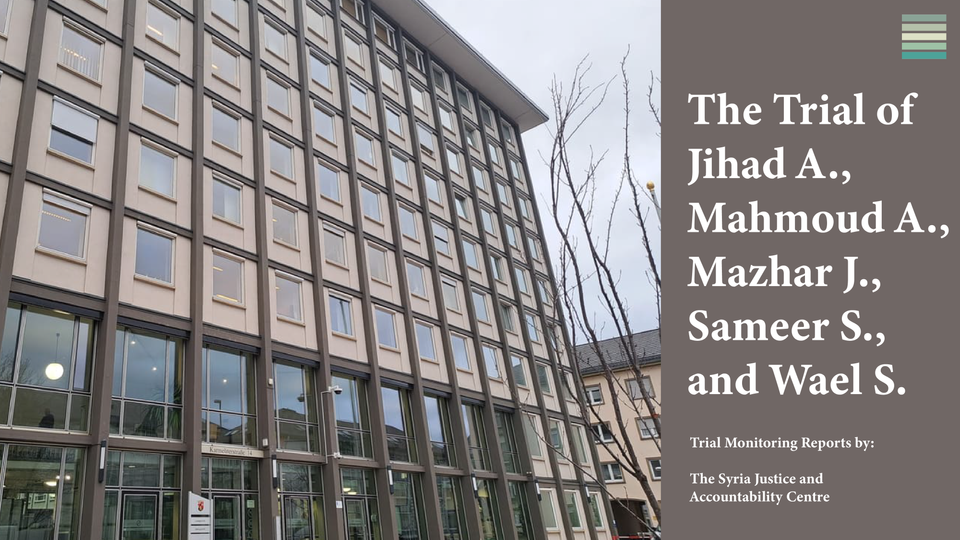
Inside the Yarmouk Trial of Jihad et al. #21
TRIAL OF JIHAD A., MAHMOUD A., MAZHAR J., SAMEER S., AND WAEL S.
Higher Regional Court - Koblenz, Germany
Trial Monitoring Summary #21
Hearing Dates: June 24 and 25, 2026
The Center for Victims of Torture (CVT) provided support to SJAC to monitor this trial and prepare the first six monitoring reports. CVT has continued the monitoring of this trial from report seven onwards and has edited them according to its own style guidelines.
CAUTION: Some testimony may include graphic descriptions of torture, rape or other violent acts.
This is an informal summary of the proceedings and not a verbatim transcript. CVT has chosen not to use the names of witnesses or detailed information that could be used to identify them.
Trial Report 21: Summary
CVT’s 21st trial monitoring report details days 37 and 38 of the trial of Jihad A., Mahmoud A., Mazhar J., Sameer S., and Wael S in Koblenz, Germany. On the first trial day this week, the court heard a new witness and former resident of Yarmouk, who described his experiences during the events in the camp, focusing on the July 2012 demonstration. He testified about his observations of armed individuals, his volunteer work in emergency medical services, the treatment of injured people, and answered numerous questions regarding various individuals, organizations, and some of his previous statements.
On the second trial day this week, the court continued hearing testimony from the witness heard the previous day. The witness testified about the Shabiha in general and his role in the camp. He further testified that he had not participated in the demonstration on July 13 but had witnessed the shooting.
Trial Day 37: June 24, 2026
The hearing began at 10:05 a.m. Today, a new witness, W19, a former resident of Yarmouk, was called to testify. He first introduced himself, stating that his age, where he now lives in Germany, and his employment status. He also confirmed that he is not related to any of the accused.
The witness recounted that he had lived in the camp for approximately 40 years before leaving at the end of 2015. He explained that the airstrikes forced him to move several times and that he sometimes stayed at a friend’s home.
He was then questioned about a demonstration on Palestine Street [presumably the July 13 demonstration]. He recalled that he had been passing through the area that day and remembered the place of the biscuit factory because people had been shot there. He further recounted that he saw the security forces open fire and that after hearing the gunshots, he fled toward a side street leading to a roundabout. He explained that he could distinguish the security forces from the Shabiha because many of the Shabiha were from the camp, and he recognized their faces, whereas most of the security personnel were strangers to him.
When asked about the deaths during the demonstration in 2012, he recalled that the events took place during the summer, around June or July. He also recalled that F7 was among those killed.
He further testified that he knew Moafak D. [Note: Moafak D. stood trial in Berlin] and another individual [note: potentially a relative of Wael and Sameer S., F21]. He recalled seeing Moafak D. carrying a weapon he believed to be a Kalashnikov. He noted that Moafak D. and the individual [presumably F21] were close friends and that he believed both were members of the Shabiha and/or the security forces and carried weapons.
He acknowledged that he was unable to estimate how many people were shooting or present from the Shabiha or security forces during the demonstration, explaining that he was too frightened to look for long.
When asked about the clothing of the Shabiha and security forces, the witness described two types of clothing. He believed that all of them were armed. He further acknowledged that he did not pay attention to any vehicles.
Upon further questioning, the witness explained that several demonstrations had taken place before the July 2012 demonstration. What, in his view, made the July 2012 demonstration stand out was the large number of people who were killed. He recalled seeing people being hit by gunfire even though he focused mainly on escaping. He was unable to provide any information regarding bullet impacts. He added, however, that during his police interview, he had stated that he later heard that both the Shabiha and the security forces had fired weapons at various locations.
He estimated that the distance between himself and the other individual [presumably F21] and Moafak D. was approximately the width of a street, or the distance between two sidewalks.
He further testified that after the demonstration, he returned home. When questioned about ambulances, he explained that he frequently heard ambulances but could no longer clearly distinguish which memories related to the demonstration and which were connected to airstrikes.
The witness described his work history and said he volunteered with emergency medical services, including at the Palestine Hospital and the Al-Basil Hospital, around the end of 2011 or the beginning of 2012. He explained that even though all hospitals had ambulances, injured people were often taken to private homes rather than hospitals because the Shabiha would come to hospitals and remove the wounded or the dead.
Several photographs of ambulances were then shown to the witness. He confirmed that he had seen similar vehicles in the camp but added that he had never seen an ambulance in the severely damaged condition shown in one of the photographs. He also explained that he had never worked as an ambulance driver.
In response to further questions, the witness clarified that his memory had significantly deteriorated over time.
Next, he was shown a photograph of a person whom he believed resembled F22, although he was unsure. The witness was then questioned about F22. He acknowledged that he could not say whether F22 had been present during one of the demonstrations [presumably the July 13 demonstration]. However, he remembered seeing him drive around the camp before the demonstration.
He also recalled that a funeral procession took place the following day. Concerning F7’s funeral, he testified that he had not personally attended the funeral. Some discrepancies with earlier statements were addressed during questioning.
The witness further explained that he had worked at the hospital with F82’s brother.
He did not know F4 personally but had heard that he had been killed by the security forces.
[10-minute break]
After the break, the witness explained that his nephew was engaged to the daughter of F22. The engagement had only taken place a few months earlier. Before the engagement, he had spoken with F22, including about the demonstrations and the transportation of injured people. He further noted that he did not know whether F22 had testified in another legal proceeding.
The witness then described an incident at a checkpoint. He recounted that after the Free Palestine Movement (FPM) had established a checkpoint, he had only passed through it once or twice and that on one occasion, he was with a relative and intended to leave the camp when a sniper fired at him. He recalled running to escape the gunfire without being hit.
Regarding the FPM, the witness also testified that he first became aware of the group at the beginning of the revolution. He identified F83 as its initial leader and testified that F5 later assumed military leadership. He admitted, however, that he was unable to clearly distinguish between the FPM and the General Command.
The witness further described the distribution of aid packages. He recounted that during these events, ropes were thrown at people, and individuals were beaten with green hoses. He added that he himself was struck on the head with one of these hoses and another person was hit on the head with a stone. He could not say with certainty whether Mahmoud A. was involved in the incident. He was unable to identify those responsible but believed they were young members of the Shabiha.
When asked about the accused Mahmoud A., the witness confirmed that he knew him. He explained where they lived in relation to each other and said that he had seen Mahmoud A. sell water. The witness was unable to affirm whether Mahmoud A. had also sold gas cylinders or had ever been detained. He also acknowledged that he had never personally seen Mahmoud A. carrying a weapon but noted that he had seen photographs of him with weapons on Facebook. To the best of his recollection, Mahmoud A. had been one of the founders of the FPM. The witness also added that he had seen photographs showing Mahmoud A. and F, greeting each other before or after a bombing.
Regarding F5, the witness testified that he had been friends with his brother but later lost contact with him.
The witness was then questioned about several additional individuals, including F76, F77, F28, Jihad A., Wael S., Sameer S., F78. Regarding several of them, he clarified that he had only heard their names and could no longer remember enough to provide reliable information.
Text messages allegedly sent by F28 were subsequently discussed, including arrests, alcohol-related problems, and certain forms of torture.
Regarding Jihad A., the witness noted that Jihad A. had contacted him and maintained his innocence. The witness added that he had seen photographs showing Jihad A. together with members of the Shabiha while carrying weapons.
He then indicated that F78 had worked with him in emergency medical services. He recalled that F78 was later arrested at a checkpoint and that he subsequently learned that he had died under torture.
The witness was next shown a group photograph, in which he identified Jihad A. and F21.
Using a map, the witness indicated Mahmoud A.’s place of residence as well as the location where he himself allegedly had been beaten with hoses by members of the Shabiha.
He also provided information about F77, F81, F79, and F80. He was unable to say what had happened to F79 after his disappearance. According to the witness, F77 and F79 had been arrested at different times. He added that F80 had also volunteered in emergency medical services and he gave information on where F80 currently lives.
The prosecution then questioned the witness about a building referred to as the “Alka” building. He explained that security forces, members of the Shabiha, and snipers had been stationed there. When asked why he had been there with his son, he said that he could no longer remember exactly but believed he had probably intended to go shopping.
Finally, the witness was asked about another massacre that had occurred during Ramadan and had resulted in numerous fatalities. He responded that deaths during demonstrations were unfortunately not unusual, although the high number of victims in this case had surprised him. He also remembered that grenades had been used during one of the incidents but was unable to provide further details.
Due to the high temperatures, the hearing was adjourned at 12:30 p.m. and scheduled to continue the following day at 9:00 a.m.
Trial Day 38: June 25, 2026
The hearing began with the presiding judge confirming that all parties were present. Defense counsel Schönfelder appeared as substitute counsel. The plaintiff’s counsel, Sonneborn, was also present.
The witness, who had testified the previous day, W19, then entered the courtroom and was reminded of his duties as a witness.
The judge rapporteur began the examination by asking the witness about medical facilities in Yarmouk Camp. The witness testified that there had been fixed medical stations in the camp. According to him, F81 and a person called F84 operated such medical centers on a certain street. He further explained that W5 had driven an ambulance but had not been responsible for organizing a medical facility. [Note: for W5’s testimony before the court, see Trial Report #6.]
When asked by defense counsel Fratzky about demonstrations in the camp, the witness clarified that they had neither been advertised nor planned in advance. He further noted that he had not participated in the demonstration on July 13, 2013, but had witnessed it. He explained that he could no longer remember many details but confirmed that members of the Shabiha and security forces always carried weapons.
The examination then turned to the witness’s previous contacts with counsel Patrick [presumably Patrick Kroker]. The witness testified that he met counsel Kroker in Berlin during proceedings involving Moafak D.
In response to further questions from defense counsel Fratzky, the witness explained that no photographs had been shown to him during the proceedings in Berlin, although investigators had shown him photographs. He further testified that F40 had likewise not shown him any photographs.
According to the witness, contact with F40 had been established through F41, with whom he had worked as part of a medical aid team. The witness explained that he had not informed his friend F41 about the trial in Koblenz because he understood that he was not permitted to do so.
Defense counsel Fratzky then requested that a photograph be displayed. According to the witness, the photograph showed the accused, Jihad A. He was holding two machine guns.
Defense counsel Greisner subsequently questioned the witness about alleged contact initiated by the accused, Mazhar J. through social media. The witness recalled that the accused called him after his own social media activity. The witness compared this to his earlier posts about another person, after which he also received threats. He further noted that although the accused, Mazhar J., changed his social media profile several times, he remained recognizable.
According to the witness, Mazhar J. threatened F41 and the witness by phone. He also noted that Mazhar J. expressed his support for Bashar al-Assad, and gave a reason for doing so. The witness further testified that Mazhar J. threatened to establish his own court with others and “teach them a lesson”.
The witness furthermore affirmed that another person [note: possibly F28] maintained that someone close to the witness had been abducted and imprisoned because Mazhar J., despite residing in Germany, still maintained good contacts with the Syrian secret service.
A discussion then followed regarding the term “relations officer” (“Beziehungsoffizier”). The witness testified that he did not recall the term. The presiding judge noted that the matter had already been discussed during the previous trial day. Defense counsel Greisner objected, stating that he wished to continue questioning the witness about the term. Raising his voice, he added, if he were not allowed to pursue this line of questioning, they could “just forget the whole thing here”.
[10-minute break]
[Note: During the break, defense counsel Greisner remarked to his colleagues that “everyone says: ask for context, and then I cannot even question this one phrase.”]
After the hearing resumed, the examination returned to the term “relations officer”. [Note: The relevance of the term remained unclear.] The witness explained that he had first learned the term during a conversation with a certain person [Note: possibly F28].
The witness also recalled that Mazhar J. had participated in demonstrations in Berlin and had posed with a photograph of Bashar Al-Assad.
A photograph was then displayed showing demonstrators standing in front of the Brandenburg Gate and a man posing in front of the Syrian and Russian flags. As the individual in the photograph was wearing sunglasses, the witness testified that he could not identify him with certainty. The photograph had been posted on a social media profile entitled “Mazhar […]”. The witness suspected that the accused Mazhar J. had published the photograph. During this part of the testimony, the translator informed the court that he did not fully understand the literal meaning of the social media post.
The examination then turned to the witness’s understanding of the Shabiha. The witness described the members of the Shabiha as individuals who supported the Syrian regime. In his view, even expressing support with a single word was sufficient for someone to be considered a member of the Shabiha. He further explained that the Shabiha had existed since the beginning of the Syrian revolution.
Another photograph was subsequently displayed. It showed several men standing in front of a wall, most of them wearing vests. The witness identified one of his friends, F41, and himself in the photograph. According to the witness, groups engaged in street cleaning, medical assistance, or food distribution wore vests of a particular color. He added that these groups had remained neutral and provided assistance to people in need but had nevertheless been regarded as terrorists by the Syrian regime.
Defense counsel Fratzky then asked the witness about his knowledge of Aknaf Bait al-Maqdis. The witness identified the group’s leader as F85, while noting that he was unsure whether this was the individual’s real name. He further explained that the group had controlled the camp until the so-called Islamic State (ISIS) took over, after which, according to the witness, the group relocated to Yalda.
Defense counsel Schönborn then referred to a previous police interview in which the witness had reportedly stated that he had only been able to identify Moafak D. as one of the shooters during the demonstration and that he knew the names of the other alleged perpetrators only through information provided by others. According to the previous statement, the witness had also been unable to recall the number of Shahiba members present during the demonstration.
In response to questions from defense counsel Luth, the witness testified that he had transported injured individuals to Al-Basil Hospital on July 13, 2012, and on other occasions, even though people had allegedly been abducted there. He recalled taking an elderly man to the hospital and explained that individuals could avoid abduction by stating that the injuries had resulted from attacks carried out by rebels. According to the witness, individuals who had been shot during demonstrations were generally not taken to the hospital but instead transported from one residential building to another.
When asked about his social media use, the witness testified that he had used Facebook on a daily basis since arriving in Germany in 2016.
Defense counsel Leymann then asked the witness about his medical condition and the reasons for certain difficulties. The witness testified that he believed his difficulties were related to experiences such as hunger and the siege.
Defense counsel Leymann subsequently filed a motion requesting access to the witness’s medical records. The representative of the Federal Public Prosecutor, Gretsch, opposed the motion, arguing that the reasons underlying the witness’s difficulties were not relevant to the proceedings. The judges postponed the decision on the motion.
The examination then focused on the witness’s own experiences during the conflict. The witness confirmed that he was a civilian and had never been a member of Al Eil Bakdji.
He then testified that he had sustained an injury from a missile and had attempted to tie a cable around his body. According to the witness, another individual had taken him to the Al-Hajar Aswad Hospital, from where he was later transferred to Palestine Hospital.
He further testified that individuals distributing food had informed him that Moafak D. had been responsible for attacks on people at a certain location. [Note: it remained unclear from the testimony whether the witness had been injured there.]
The presiding judge then dismissed the witness.
[10-minute break]
Following the break, the court viewed a short video recording of a telephone call involving several individuals. During playback, difficulties arose in translating and interpreting several participants’ statements. The translators were therefore instructed to prepare a written transcript of the conversation.
Defense counsel Greisner subsequently filed a motion pursuant to Section 257 of the German Code of Criminal Procedure (GCCP) concerning the witness. The court did not grant the motion.
Proceedings were adjourned at 11:30 a.m.
The next trial day will be on July 8, 2026, at 10 a.m.
___________________________
For more information or to provide feedback, please contact SJAC at [email protected] and follow us on Facebook and Twitter. Subscribe to SJAC’s newsletter for updates on our work