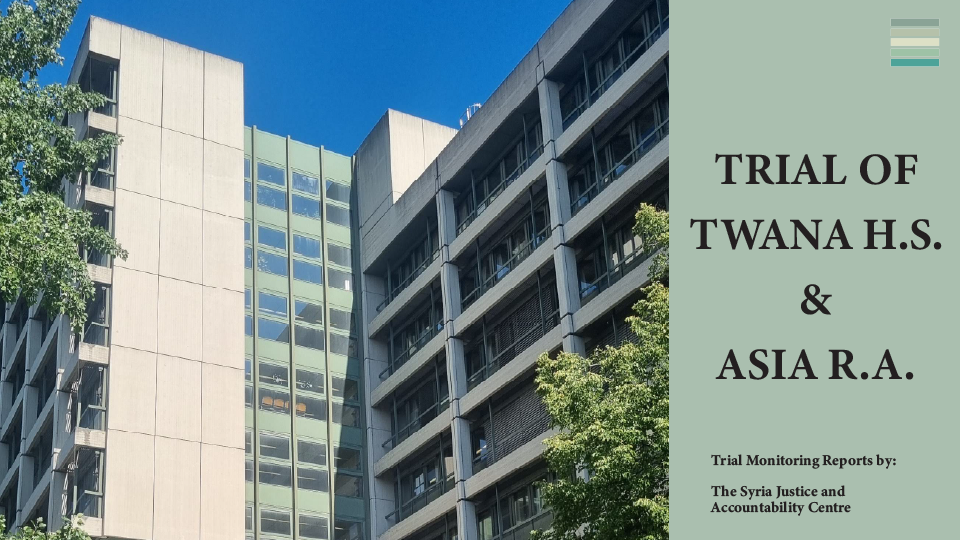
Inside the Twana H.S. and Asia R.A. Trial #35: The Final Judgement
TRIAL OF TWANA H.S. AND ASIA R.A.
Higher Regional Court – Munich, Germany
Trial Monitoring Summary #35
Hearing Date: July 13, 2026
CAUTION: Some testimony may include graphic descriptions of torture, rape or other violent acts.
Note that this summary is not a verbatim transcript of the trial; it is merely an unofficial summary of the proceedings.
Throughout this summary, [information located in brackets are notes from our trial monitor] and “information placed in quotes are statements made by the witness, judges or counsel.” The names and identifying information of witnesses have been redacted.
[Note: SJAC provides a summary of the proceedings while redacting certain details to protect witness privacy and to preserve the integrity of the trial.]
SJAC’s 35th trial monitoring report details day 62 of the trial of Twana H.S. and Asia R.A. in Munich, Germany. On this final trial day, the Court read out the oral version of the final judgement. It found that Twana H.S. and Asia R.A. committed Genocide, Crimes Against Humanity and War Crimes with regards to two Yazidi girls they held as slaves during the years of 2015-2017. While Twana H.S. received a life sentence, Asia R.A. was sentenced according to German juvenile law, and received a 9.5 year sentence. The Presiding Judge framed the judgement as an important reminder for the currently difficult state of international law, and closed his remarks with hopeful wishes to the Yazidi community.
Day 62 – July 13, 2026
On this trial day, the Court read out the oral version of the final judgement, which is a shorter and compressed version of the full judgement to be published in a maximum of 19 weeks after this final day of trial.
[note: Before the Court opened the proceedings, journalists were granted the time to take close-up photographs and videos of the two Accused, who entered the court room about ten minutes before the start of the proceedings. Around 20 press representatives were present on this day, in addition to about 30 regular visitors. Both Accused covered their faces with a sheet of paper during this press timeslot. Additionally, the Plaintiff [redacted name], P2, was present in the courtroom, but the press did not notice her. When the Court entered the court room, it stood still for roughly 30 seconds to give the press an opportunity to also take a picture of the full bench. Then, photo- and videographers needed to leave the room, and the two Accused presented their faces again.]
As it is custom in German criminal courts, the Presiding Judge opened the final judgement proceedings by reading out the sentencing section of the judgement first, while the Court and the public needed to stand. Without referring to the specific legal norms, he noted that the Court decided to sentence the male Accused Twana H.S. to life in prison for the offenses of Genocide in two counts, two counts of Crimes Against Humanity and two counts of War Crimes. The female Accused Asia R.A. was sentenced in accordance with juvenile law to 9 years and 6 months in prison for the offenses of Genocide in two counts, two counts of Crimes Against Humanity and two counts of War Crimes, of which one each was only fulfilled “in aid.”
The Court then took a seat, and the Presiding Judge started by giving some introductory remarks to the reasoning of the judgement. He specifically noted that this judgment is the result of tremendous efforts that took over one year, 62 hearing days and had their origin in crimes that “happened more than eight years ago in a small clay-house on the border with the Syrian desert.” He continued with the rhetorical question of why this Court cared about “happenings from so far away” and answered himself by giving the “existence of public international law and the principle of universal jurisdiction” as a reason. International law would have it “hard” everywhere in the world right now, but this does not have to be the case in the judiciary, which is why it would only be imperative to see its norms as the “guiding principles for our court room and these proceedings,” and to use these proceedings to “give [international law] more validity,” “also in the very name of the victims.” The Presiding Judge then continued with describing the “so-called Islamic State” as “not just any terrorist organization,” but as one that the international community was specifically not able to counter and even provided the power-vacuum for it. “Of course this must never repeat itself,” the Presiding Judge warned. Whenever such aggressions against people occur in this world, we should never carelessly look away, he added. However, the Court specified, one must note as well that the two Accused are not being sentenced “on behalf of ISIS,” but “because of their very own actions.” The Court ended his introductory remarks by highlighting that the crimes that came out of these actions are described by international criminal law as “the most severe crimes that affect the international community as a whole.”
Before the Court turned to the facts of the case, the Presiding Judge repeated that this case has been particularly unique, as the crimes were committed “so far away” and in the context of a “very different cultural circle,” that various languages and dialects played an important role and made the proceedings additionally complex, that “significant trauma” was omnipresent when it came to most Yazidi witnesses, that this case is the first in which a German court decided on a sentencing in accordance with Section 6 (1) (5) CCAIL, and that Twana H.S. had already been sentenced to several years in a German prison due to his ISIS membership. Finally, the Presiding Judge announced that he will address any Yazidi witnesses of this trial with only using their first names.
With regards to the facts, the Court noted that in referring to the Accused in her own trial and by naming the names of the Yazidi girls “[redacted name],” being [redacted name], P1, and “[redacted name],” P2, the witness [redacted name], F7, laid the foundation for an initial suspicion in accordance with the CCAIL towards Twana H.S. and Asia R.A. Following which UNITAD received a request for mutual legal assistance by the German authorities and slowly, Yazidi witnesses and the victims were identified. Only because of this, P2 was able to be found and heard. Furthermore, it is important to note that the crimes at stake in this trial only surfaced after Twana H.S.’s first sentencing.
Biographically, the Accused Twana H.S. was born into a Kurdish family in Iraq in 1981 and was trained as a hairdresser. In 2002, he traveled to Germany and applied for asylum, which was rejected. Twana H.S. stayed, however, and got into a relationship with witness [redacted name], F2, who he had a child in 2003. Two years later, in 2005, the Accused received a residence permit and started working as a hairdresser again, where he met his second partner, witness [redacted name], F4. From 2013 on, Twana H.S. radicalized himself in a Munich mosque, which led to his departure to Iraq in 2015, together with a “man named [redacted name],” F6, and his wife F7. In Iraq, Twana H.S. became an ISIS member, visited a Quran school first, followed by combat training, and joined one of ISIS’ Katiba fighting units in July 2015.
Asia R.A. was born in 1996 in Kirkuk, Iraq, and had to witness disruptions in her family early on. Her mother died shortly after Asia R.A.’s birth, so that the Accused grew up with her father, who was imprisoned when she was eight years old. This led to Asia R.A. only going to school for a few years. Later on, she developed a bad relationship with her stepmother and was eventually pressured to marry early. Her first marriage, in which she experienced a failed pregnancy, ended with the sudden death of her husband due to a bomb attack. Because of further pressure from her family, Asia R.A. eventually married Twana H.S. They have two children.
The Court then briefly described ISIS’ 2014 Sinjar offensive against the Yazidi community in Iraq and summarized that since then, in total 300,000 Yazidis were displaced, 6,500 abducted, of which many remain missing until this day, and 5,500 murdered. All of this had been meticulously planned and logistically prepared by ISIS. In their ideology, Yazidis are “angel- and devil worshippers,” the Court further explained, and as such, need to be mistreated in comparison to Muslims or Christians, for example. Yazidi men who refused to convert to Islam were killed by ISIS, while women most often were enslaved. During all of that, ISIS separated families, all with the “intention to efficiently destroy the physical and social further existence of the Yazidi community.”
The two Accused, the Presiding Judge continued, came to Iraq in 2015 and traveled with the ISIS front between Sada Bawisa, Raqqa in Syria, along the Euphrates River, all the way to Al-Mayadin and Abu Hamam until the fall of 2017. As Asia R.A. also knew, Twana H.S. was a fighter for ISIS, and both owned various weapons in their household. As a bridal gift, Asia R.A. wished for a Yazidi Sabaya, which led to Twana H.S. buying the Yazidi girl [redacted name], P1, from another ISIS member. As she had been born in [redacted time] or [redacted time], P1 was a maximum of [redacted information] years old when the Accused bought her. Twana H.S. and Asia R.A. treated her like “property,” forced her to take care of household tasks, like making coffee, cleaning and doing the dishes, and starved her on purpose. The Accused also prohibited her to speak her mother tongue Kurmanji, the Court specified, and only communicated in Kurdish-Sorani with her, while they also forced her to convert to Islam and pray regularly according to their rules. To exclude P1 further from her family and culture, the Accused gave her the new name “[redacted name].” Often, they punished P1, for example, by forcing her to stand on one leg for a long time or by pouring hot water over her, or they threw metal items at her and threatened her to apply more violence against her on a regular basis. During all of this, P1 got repeatedly insulted as a “non-believer,” the Presiding Judge stated. During [redacted information], which was shown to the Court as evidence, P1 said that the Accused’ treatment of her was “very horrific with regular hitting, violent oppression and other horrible things.”
In the fall of 2017, the Accused purchased another Yazidi girl, named [redacted name], P2, from ISIS members who previously held her as a Sabaya. Just like with P1, Twana H.S. and Asia R.A. gave her the new name “[redacted name].” The Court specifically pointed out that this decision was made because Twana H.S. wanted to marry a second wife, which Asia R.A. tried to prevent. As such, they decided to buy a second Sabaya, as it would have been a “lesser worry,” since Sabayas can “easily be sold off again.” In her testimony in front of this Court, P2 had stated that “Yazidis were slaves and even dogs had a higher standing [...]; why is it that my life consists of being sold off and being bought again; all of my childhood was shaped by suffering and rape,” the Presiding Judge quoted.
Next, the Court turned to the sexual abuse P1 and P2 had to endure. According to the Court, P1 got “vaginally raped” at least once by Twana H.S. when she was [redacted information] or [redacted information] years old. Even though it would be “likely” that more instances of sexual abuse occurred, those were not sufficiently evidenced in this trial, especially since it was not possible to summon P1 to court. Asia R.A. aided her husband “at least psychologically:” Although she had first been against Twana H.S.’s rape intentions, she later agreed to them and even pushed him further to it. With regards to P2, the Court established that three instances of sexual abuse occurred. The first one happened on the very first night of P2 with the Accused, after Twana H.S. hit her soles in the middle of the night and forced her to come into his arms, undressed her and “rubbed his genital on her until he ejaculated.” The second instance was of similar nature and happened after Twana H.S. had shortly before “been with P1.” And the third instance involved Asia R.A. and P2 herself preparing the room, in which a “wedding” should have taken place, which in reality became the carefully planned out place of rape against the Yazidi girl. Asia R.A. gave P2 specific clothes for it, made P2’s makeup and provided pomegranate seeds in the room. When P2 was left alone in the prepared room and Twana H.S. entered it and locked the door, he forced himself onto her, tied her up, turned on ISIS nasheeds, and “raped her against her will until a vaginal ejaculation.” During all of this, he knew that it was P2’s “first time,” the Court specified. Both Accused deliberatively wanted to sexually abuse the two Yazidi girls, as they knew that this would destroy their religious and social existence within their own community, the Presiding Judge further explained.
In late 2017, P1 was given to another ISIS member by the Accused, then stayed in the ISIS camp [redacted information] for a few years and today, lives with [redacted information], which is not further specified. The Court knows that P1 [redacted information]. P2, on the other hand, had to endure further rape at different ISIS families after the Accused let her go, and was eventually bought free. From that point on and until [redacted time], she lived in a refugee camp in [redacted location] with her sister and her brother. There, she had no chance of getting a further education and lived “without any hopes for the future in uneventful monotony.”
The two Accused entered Germany with forged passports in 2018. Shortly after, in July 2018, Twana H.S. was captured, and in October 2019, sentenced to 4 years and 3 months in prison for his membership in a foreign terrorist organization. He served the full prison sentence and was released from prison in February 2024. Until the two Accused were arrested in April 2024 again, Twana H.S. lived under supervised probation in northern Bavaria.
Regarding the current health status of P2, the Court established that she suffers from a continued and life-affecting post-traumatic stress disorder and that it cannot be ruled out that the Accused’ actions at least intensified her symptoms. Today, P2 still experiences regular fear, nightmares, severe day-tiredness and all in all, strong negative effects on her social life. According to the Court, she has distrust in her social surroundings, finds almost no places of social refuge, and lives an everyday life of no interests and no job or perspectives for the future. Since P1 was much younger when the Accused enslaved her, and since she lived for a much longer period under the Accused, had no social trust person and lived under many years of threats, one must assume that today, she also suffers from a severe post-traumatic stress disorder, the Judge argued. At the end of the day, her “childhood was stolen” and she had no chances to develop during the vital childhood phase of between at least six and eight years of age. Since her captivity continued beyond the Accused, she had no chances to catch up on these central years of her life, maybe even until today. Besides this logical assumption by psychological expert witness [redacted name], E4, trauma researcher and expert witness [redacted name], E7, testified that out of 880 Yazidi women who were psychologically examined after their ISIS captivity, of which most were much older compared to P1, almost all of them suffered from post-traumatic stress disorders.
Regarding the genocidal intent of ISIS, the Court noted that it has been a known goal of ISIS to completely destroy the Yazidi group. It was also known to ISIS members, the Court continued, that within Yazidi culture one will most likely get excluded when having had sexual encounters with non-Yazidis. As such, all of ISIS members’ actions were directed towards this genocidal goal, the Accused naturally included. In general, the Presiding Judge also noted that the Court did not find any reasons for a limitation of criminal liability with regards to either of the Accused.
The Court then turned to the evaluation of the collected evidence and the witnesses heard during the trial. First, the Presiding Judge noted that both Accused did not give personal statements during the proceedings and that all other pieces of evidence built a “mosaic-like overall picture”, reaching from Google-Maps screenshots on phones from the Accused to direct witness statements. ISIS’ planned genocide against the civil community of the Yazidis has sufficiently been proven in the context of other proceedings in front of German high courts, but was further laid out by the expert witnesses [redacted name], E3, [redacted name], E6, [redacted name], E7, [redacted name], W8, and with the help of reports from the Federal Criminal Police Office (BKA) as well as officially published ISIS propaganda. The fact that both Accused were members of ISIS was sufficiently proven by the witness statements of F7 and [redacted name], F17, who testified that Twana H.S. had been a “fighter of ISIS.” Logically, the Court noted, the female Accused Asia R.A. was not just the wife of an ISIS fighter but actively participated in ISIS life, by wishing for and keeping slaves, and by actively forcing those Yazidi girls to convert to Islam. Furthermore, Twana H.S.’s ISIS membership was legally confirmed by a German court in the context of prior proceedings. Twana H.S.’s and Asia R.A.’s identity as Abu and Um Abdullah was confirmed by various witness testimonies and by the fact that Asia R.A. asked P2 for forgiveness in this very court room. Furthermore, Asia R.A. detailed her feeling of remorse and life with ISIS and Twana H.S. in the private interview sessions the psychological expert witness [redacted name], E1, had with the female Accused. In her witness testimony, F7 confirmed that her former husband F6, who himself had been an ISIS fighter and friend of Twana H.S., had told her that Asia R.A. had wished for a Sabaya as a bridal gift and subsequently received a Yazidi girl called “[redacted name],” which was the name the Accused gave P1. When F7 confronted Asia R.A. in late 2017 about her repeated mistreatment of P1, the Accused at first defended her mistreatment of P1 by saying that “she is a Sabaya and does not deserve anything more.” Later, Asia R.A. tried to apologize to F7 by bringing her chocolate and asked her if she wanted to take on P1, as Asia R.A. and Twana H.S. could travel with the Yazidi girl to Germany. Even the witness F17 testified that he once met a Yazidi girl called “[redacted name],” who was “[redacted information] or [redacted information] years old at the time.” Furthermore, German authorities found Twana H.S.’s phone number saved in the contact list of the phone of former ISIS member [redacted name], F5, as “Abu Abdullah.” And finally, during the [redacted information], P1 described one of the ISIS men she had lived under as “Abu [redacted name], whose wife was a Kurdish German.” [redacted name] is the name of the Accused’ daughter, the Presiding Judge explained. Although this does not unfold any legal relevance, the Judge continued, not even the Defense Teams of either the Accused questioned their or P1’s and P2’s identity in their closing statements. As such, both the Accused as well as P1 and P2 have been sufficiently identified.
With regards to the circumstances P1 and P2 lived under during their time as Sabayas of the Accused, F7 specifically testified that she saw how P1 suffered from constant hunger as she only received food-leftovers that she had to scrape from used plates, and that she had to do a lot of household chores. Most other evidence stems from the testimonies of the Yazidi witnesses that appeared in front of this Court. Here, the Presiding Judge noted that they all were “very brave,” traveled to Germany from afar, in some cases even across continents, testified “impressively detailed,” and all thanked the Court for the justice it tried to find. According to the Presiding Judge, it was of course expected that those witnesses did not testify in the interest of neutrality, that some of them even testified more detailed in front of this Court as they have previously done in front of UNITAD, for example, or that they communicated with each other before and after their individual testimonies. This all, as well as any contradictions in especially the testimonies of [redacted name], F33, [redacted name], F29, and [redacted name], F34, who all only met the Accused and P1 and P2 briefly, however, has been sufficiently taken into account by the Court when writing this judgement. Most importantly, these nuances do not make the Yazidi witnesses non-credible, as the Defense has repeatedly claimed throughout these proceedings. Whenever it was claimed by the Defense that the UNITAD testimonies were substantially different, it must be noted that besides all the unresolved language difficulties, especially when it came to the also culturally different terms behind “sexual abuse” and “rape,” UNITAD followed a different intention and direction with their records of testimonies of Yazidis that cannot be put side-to-side with the questioning of a German court, the Presiding Judge pointed out. On top of that, many Yazidi witnesses had issues with testifying on sexual experiences or even just related terms, which the Court explained with the different cultural and religious norms and with the shame they must have felt. Some of the witnesses were even able to speak about their horrific experiences under ISIS for the first time in front of this Court, exactly because the Accused were present. If individual witness statements were less detailed in comparison to the UNITAD testimonies, this was simply due to the fact that their experiences happened many more years ago, compared to the UNITAD testimonies, which usually were done in the months and years immediately following the witnesses’ ISIS captivities. After referring to various quotes and examples from the Yazidi witness testimonies of this trial, the Presiding Judge concluded that a “sophisticated coordination” between the witnesses ahead of their individual testimonies that “had the potential to alter the outcome of these proceedings” must be ruled out. Furthermore, P2’s very own testimony over five full trial days provided plenty of evidence, just like P1’s statement in the [redacted information] that she was, among other things, once punished by the Accused in the snow. The Court was able to confirm this fact with meteorological expert reports. Asia R.A.’s statements to psychological expert witness E1, or her smartphone chats with her family members, also gave the Court a clear picture of her general development. In one of the chats, for example, Asia R.A. once responded to her uncle’s question about whether her husband was an ISIS member and owned Sabayas, by confirming that Twana H.S. had brought two Yazidi girls to their home “to have them raped.”
The Presiding Judge then turned to the evidence behind Twana H.S.’s rape of P1 and P2 and first noted that P1 herself did not state anything with regards to personal rape experiences, but that various witnesses have. Still, however, P1 mentioned in [redacted information] that she was once hit by Asia R.A. with a stick “to make her sleep with” Twana H.S. This cannot be seen as sufficient proof for a following rape, but “serves as one mosaic,” the Judge explained. P2 specifically testified that P1 had told her once that Twana H.S. “inserted something into” her, which F33 similarly testified. Additionally, P1’s sister [redacted name], F35, testified that F29 informed her that P2 was once told to “not make such a fuss” about not wanting to sexually engage with Twana H.S., as even P1 already let that go over her; and she was much younger compared to P2. Different to what her Defense tried to argue, according to the Court, Asia R.A. also aided Twana H.S.’s rape of P1. Witness F33, for example, specifically testified that Twana H.S only raped P1 after Asia R.A. had agreed to it. Besides asking for forgiveness in this court room, Asia R.A. told E1, as the Presiding Judge quoted, that “it has all been a catastrophe and [she] is now fully on the side of the slaves, sees [herself] as guilty, but that the circumstances had been different back then, [she was] young and [her] eyes were morally closed; no word can describe how sorry [she] is; no human can ever excuse the rape of someone and [she] will always carry this immense guilt with herself, but what Twana has done with those children was much worse.”
Most of the evidence on Twana H.S.’s rape of P2 came directly from P2’s very own testimony. Here, the Court again noted that Asia R.A. aided Twana H.S., and pointed out that the female Accused even talked with P2 after the rape, first asked for forgiveness and then presented family and wedding pictures to her. Asia R.A. also told P2 that she does not want Twana H.S. to marry a second wife. Besides P2 herself, also her brother [redacted name], F121, testified on her sister’s rape in front of this Court. In smartphone chats between Asia R.A. and a family member, the Accused was asked “if [Twana H.S.] had done it with them,” to which Asia R.A. just replied that “he has done it with her and then freed her, the nine-year-old; the twelve-year-old was also with him.” This would read as a confirmation with regards to rape of both P1 and P2, according to the Court, especially since Asia R.A.’s next message was: “even an animal is not as dirty as a man can be when it comes to sex.” Finally, the psychological expert E4 found that there likely is a direct connection between the rape P2 had to endure under Twana H.S. and her ongoing post-traumatic stress disorder, which will likely still affect her for many years to come.
The Presiding Judge then turned to the legal reasoning of the Accused’s crimes. First, he established that the Court has no doubt regarding their genocidal intent. Both Accused were intensively psychologically evaluated, but at the end of the day, their actions alone just speak a very clear language. Twana H.S. and Asia R.A. followed ISIS’ anti-Yazidi propaganda closely and forced P1 and P2 to convert to Islam, pray regularly, prohibited them from speaking their mother tongue Kurmanji, even punishing them for doing so, and repeatedly insulted them as non-believers who will never be able to become full members of either religious community again anymore. Twana H.S.’s rape had this exact goal of excluding the Yazidi girls from their own community, and was not motivated by pedophilic tendencies, as forensic psychiatrist [redacted name], E5, had confirmed. Furthermore, Twana H.S. once mentioned that he feels sorry about what ISIS has done to the Yazidis. Additionally, the police found a CNN article on his phone, which specifically discussed ISIS’ genocide of the Yazidis. According to the Presiding Judge, all of this clearly proves genocidal intent existed at the time of the crimes.
The Presiding Judge then continued by noting that Genocide according to Section 6 CCAIL does not require the “murder” of someone, and further defined the legal requirements of the norm under the CCAIL. The “destruction” that the offense requires does not need to be a “physical-biological one, but “can also solely lie in a social context,” according to the Judge, who himself referred to the opinion of the German Constitutional Court here. By having abducted, separated, raped, and religiously converted Yazidis, the full group of Yazidis was put in danger to become extinguished. P1 not being able to talk in Kurmanji to most of her family members during [redacted information] or not knowing her former Yazidi religion anymore, would be a prime example of that. Regarding the intent of the Accused, it is not necessary that the full destruction of the group must have been their final goal; it is enough if the actions were sufficient to destroy the social existence of the Yazidi slaves in question at least partially. Although P1 and P2 could have just been “house slaves,” they were specifically enslaved because they were Yazidi. And because they were Yazidi, they were supposed to get socially extinguished by the Accused, the Presiding Judge argued. Both P1 and P2 were violently separated from their families and until today, suffer from severe mental harm that makes it impossible for them to “live any normal and constructive life anymore.” As such, both no. (2) (serious bodily or mental harm) and no. 5 (forcible transfer of a child of the group to another group) under Section 6 CCAIL have been fulfilled by both Accused through their mistreatment of P1 and P2. No. (5) becomes especially relevant with regards to P1, as she is likely still [redacted information] and has as such been separated from her family since Twana H.S.’s and Asia R.A.’s enslavement of her, without even being able to speak her mother tongue or practice her former religion anymore; “the transfer into another group has without a doubt been fully successful,” the Presiding Judge concluded. Because P2 had been enslaved prior to the Accused’ ownership of her, no. (5) of the norm had already been “completed,” but not “ended,” which makes a dogmatic difference in German law, the Judge explained. Twana H.S.’s rape of P2, aided by Asia R.A., put this particular count onto another level, however, as it “continued P2’s transfer into another group” in a more severe manner. According to the Court, this is why no. (5) of Section 6 CCAIL was fulfilled with regards to both P1 and P2. Asia R.A. did not just “aid” Twana H.S. during this Genocide, as her actions also contributed to the severe mental harm of P1 and P2 and happened in the direct context of the rape and sexual abuse instances. She had “full criminal control and criminal intent” during her contributions to the offense and acted “jointly”. Furthermore, Asia R.A. was equally involved in both, P1’s and P2’s, enslavements. With regards to P1, Asia R.A. specifically wished for her as a bridal gift, while concerning P2, the female Accused wanted her as a second Sabaya to prevent Twana H.S.’s wish for a second wife.
Furthermore, both Accused fulfilled the requirements for Section 129a (1) (1) GCC and Section 129b (1) S. 1, 2 GCC by having been members of the foreign terrorist organization ISIS. According to the Court, this has been sufficiently proven. It must be noted, however, that Twana H.S.’s first sentencing in 2019 in accordance with these norms does not alter the outcome of these very proceedings, as back then, the case only concerned his decision to join ISIS, while the present case specifically deals with his and Asia R.A.’s enslavement of P1 and P2. The German legal principle against so-called “double-sentencing” thus does not apply here, according to the Court, and the fact that he already served his fully prison sentence after his sentencing in accordance with those norms only plays a role in evaluating the particular severity of guilt question to his favor.
The Presiding Judge then quickly turned to the Crimes Against Humanity section of the CCAIL and found that under Section 7 (1) CCAIL and no. (10) of the norm (persecution of an identifiable group or collectivity by removing or substantially restricting their fundamental human rights on political, racial, national, ethnic, cultural, religious, gender, sexual orientation), only the count of “religion” has been fulfilled by the Accused. The Presiding Judge specifically stated that the Court decided against the counts of “culture,” “age” or “gender,” which the Prosecution and Plaintiff Counsel had argued for, as for the Accused and ISIS as a whole, P1’s and P2’s Yazidi religious belief was the predominant reason for their enslavement and mistreatment. Although ISIS might have seen additional reasons for persecuting the Yazidi community, the Accused abused them because of their faith only [note: It is very likely that the Court saw the fulfillment of other qualifications under Section 7 (1) CCAIL by the Accused, like the Prosecution, Plaintiff Counsel and even the Defense Teams, for example, have also argued for. It did not, however, mention any of them in their verbal reasoning and only focused on no. (10) of the norm. Similarly, the Court provided no further details on the fulfillment of Section 8 CCAIL].
The Court continued with establishing that it saw no signs that could limit the Accused’ criminal liability due to severe mental or physical disorders. The Presiding Judge noted, however, that Twana H.S. has a narcissistic personality that comes with a lack of empathy, power fantasies, and a feeling of omnipotence. Furthermore, he did not recently deradicalize himself, which can be seen with the help of the reports about his behavior in detention, the Judge explained. As such, one could imagine that there is a danger of him repeating such crimes in the future. Since Twana H.S. has never been sentenced due to similar crimes before, however, the legal requirements for preventative detention cannot be fulfilled in his case. On the other side of the spectrum, no “less serious case” under the CCAIL can be established by the Court, as the Accused have committed these crimes with regards to not just one but two victims, and over the long timeframe of two years.
When it comes to the sentencing time, the Presiding Judge first noted that especially Section 6 CCAIL requires a life-long sentence, which in Germany commonly equals to 15 years in prison. Looking at the case of Twana H.S., one must note at his expense that he enslaved two Yazidi girls, of which P1 was exceptionally young, that he fulfilled not just one but two variants of Section 6 CCAIL, next to various variants of Section 7 CCAIL and Section 8 CCAIL, and that he did this all within the long timeframe of two years. To his benefit, the Court must see that Twana H.S. was not criminally active or sentenced before he committed those crimes, and that he already sat the full 4 years and 3 months in prison, when he was sentenced in 2019. All in all, the Court concluded, Twana H.S. “will be released from prison in 19 years and 3 months at the earliest.”
Regarding Asia R.A., on the other hand, the Court had to decide if she must be sentenced in accordance with juvenile law or regular “adult” criminal law. The cutoff date for this decision and Asia R.A.’s passing of the juvenile age of 21 was February 9, 2017, which objectively fell in the middle of the timeframe, in which the Accused committed the crimes in question. As such, the Court was required to fully evaluate her mental development and environmental circumstances at the time. According to German high courts, juvenile law “must especially be applied beyond an objective age number, when adolescents and developmental forces had a continued impact” at the time of the committed crimes. For this purpose, the Court asked the psychological expert witness E1 to submit a detailed report on Asia R.A.’s upbringing and mental development. There, it was specified that the female Accused had a “complex life story,” experienced the early death of her mother, the imprisonment of her father, plenty of conflict between various family members, pressure from her stepmother, the unwanted termination of her first pregnancy, the death of her beloved first husband, and the pressure to then marry Twana H.S. Furthermore, one Yazidi witness described Asia R.A. as “child-like and often scared,” and E1 also noted that the Accused vehemently showed signs of remorse and understanding during their interviews. Even if all of these factors would still not give the Court a clear idea of her maturity at the time of the committed crimes, the Court would at least be required to pick the legal alternative with the less severe penalty, which would indeed be juvenile law, the Presiding Judge argued. It could then be legally consequential to apply juvenile law for all criminal actions until a certain date, and full criminal law for all actions after that date, effectively building a penalty from both systems. When asking the question in accordance with Section 32 YCA of when between 2015 and 2017 the committed crimes had a focus, the Court has to take into account, however, if the crimes had a “direct root” in actions that were done in a former setting of immaturity, which then unfolded their meaning beyond the date in question. The Presiding Judge continued explaining that the Court there needs to ask itself if the committed crimes are just a continuation of those immature actions. Interestingly, the law focuses on the offender and not on the victim here, the Judge pointed out. Out of the over two years the Accused held P1 as a Sabaya, one year and four months fell under Asia R.A.’s status as a juvenile, while she must be considered an adult for the remaining nine months. According to the Court, the Genocide had clearly already been fulfilled with the initial purchase of P1 and as such, happened during Asia R.A.’s juvenile years, just like most of the abuse P1 had to endure under the Accused. Although P2 was bought when Asia R.A. was above the age of 21 already, the Court pointed out that with regards to her, Asia R.A. acted more as an “aid” and less as a “joint offender,” making the case of P1 more central in the complexity of this juvenile evaluation. Furthermore, Asia R.A. married Twana H.S. and with that, an ISIS member during her juvenile years. Only because of this marriage, her criminal offenses took place. This is why, according to the Court, “it all happened in one situational context that started with the purchase of P1 the very latest.” On top of that, Asia R.A.’s inhibition threshold was already lowered when Twana H.S. and she decided to buy P2. This is why the Court decided that juvenile law must be applied in her case “uniformly” and regarding the full timeframe in question.
Section 105 (1) YCA, the Court further explained, allows for a sentencing of 1 to 10 years. When evaluating the case of Asia R.A., the Court needed to note to her benefit that she had not been criminally sentenced before and that she actively asked P2 for forgiveness during this trial. However, at her expense, Asia R.A. would have received a lifelong sentence if juvenile status was not established, she furthermore fulfilled the requirements of many other criminal offenses, enslaved two Yazidi girls for in total two years and completed crimes “of highest injustice.” Because of this, all in all, the Court sentenced Asia R.A. to 9 years and 6 months in prison.
Following the completion of this legal reasoning, the Presiding Judge started his closing remarks by addressing the Defense Team of Twana H.S., specifically criticizing their closing argument for stating that the male Accused “got radicalized in a Munich mosque.” According to the Judge, “one never gets radicalized, but radicalizes oneself.” He further noted that “in the end of the day, everyone has their fate in their own hands and is responsible for their conviction and ideology.” Otherwise, this justice system could not work. He further rhetorically asked how it could have happened that an “ordinary hairdresser” radicalized himself and went on to commit such horrible crimes. While these proceedings were not the place to provide answers for this particular development, the various new mechanisms of information and radicalization, especially social media and the internet at large, must be brought more into the foreground of societal discussions, also in the context of criminal justice in Germany, the Presiding Judge concluded. He then continued with addressing P2, who was present in the court room, in the name of the Yazidi witnesses of this trial and stated the Court’s hope that the testimonies of all Yazidis will help them come to terms with their experiences, and, given the suffering they have endured, will contribute to the healing process and restoration of self-confidence and hope.
Finally, the Presiding Judge thanked every single regular party to the proceedings for their contributions during this “exceptionally difficult trial.” Specifically, he thanked the Defense for their fair treatment of the Court despite the many disagreements, the expert witnesses for their enormous efforts, and the police for their logistical support.
The Court announced that it will accept formal appeals to this judgement one week after today, and the reasonings to the appeals one month after the full written judgement will have been delivered. The costs of this trial cannot be a substance of any appeal.
Although Twana H.S. attempted to ask a final question to the Court, the proceedings were adjourned at 11:18 AM.
[note: Right after the proceedings were adjourned, Asia R.A. visibly spat towards Twana H.S. She missed her target, however.]
[note: Although press reports have noted that the Accused were also charged according to Section 232 (2) GCC (human trafficking) and Section 176 (1) GCC as well as Section 176a (2) (1) GCC (both (severe) sexual abuse of children; both versions from before July 2021), the latter only “in aid” in accordance with Section 27 GCC when it comes to Asia R.A., the Court did not mention any of those norms in their verbal reasoning.]
___________________________
For more information or to provide feedback, please contact SJAC at [email protected] and follow us on Facebook and Twitter. Subscribe to SJAC’s newsletter for updates on our work