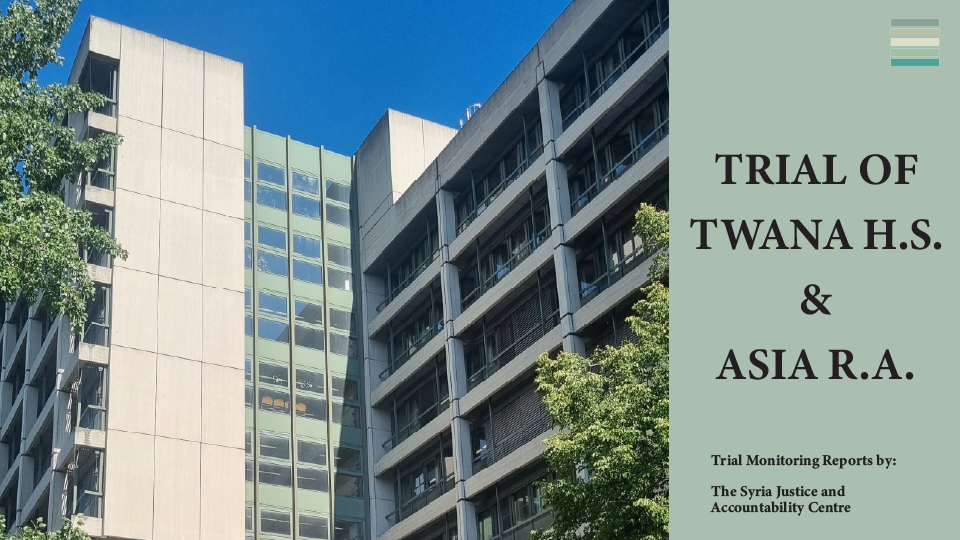
Inside the Twana H.S. and Asia R.A. Trial #08: Credibility – Challenged and Defended
TRIAL OF TWANA H.S. AND ASIA R.A.
Higher Regional Court – Munich, Germany
Trial Monitoring Summary #08
Hearing Date: August 5, 2025
CAUTION: Some testimony may include graphic descriptions of torture, rape or other violent acts.
Note that this summary is not a verbatim transcript of the trial; it is merely an unofficial summary of the proceedings.
Throughout this summary, [information located in brackets are notes from our trial monitor] and “information placed in quotes are statements made by the witness, judges or counsel.” The names and identifying information of witnesses have been redacted.
[Note: SJAC provides a summary of the proceedings while redacting certain details to protect witness privacy and to preserve the integrity of the trial.]
SJAC’s 8th trial monitoring report details day 16 of the trial of Twana H.S. and Asia R.A. in Munich, Germany. On this trial day, Asia R.A.’s maternal uncle, W2, was questioned for a second time. The Prosecution then read out a prepared statement rejecting the Defense’s previous arguments against F29’s credibility. Afterwards, the Defense read out a statement highlighting inconsistencies in last week’s witness’, F34’s, accounts and arguing that her traumatic experiences had distorted her memory. Subsequently, the second witness of the day, F26 – an acquaintance Asia R.A. had made in Germany in 2018 while Twana H.S. was in prison – was called and questioned.
Day 16 – August 5, 2025
On this trial day, Presiding Judge Dr. Stoll opened the Court by stating that he would immediately call the first witness of the day, [redacted name] W2, the maternal uncle of Asia R.A. He explained that he did not want to keep the witness waiting, as W2 was displeased at having been summoned by the Court a second time [W2 had already been questioned by the Court on June 6, 2025; see Trial Report #3]. After W2 was brought in, Dr. Stoll explained that he was being questioned again as all parties to the trial have the right to examine him, and they had not yet had the opportunity to do so, as the Accused, Asia R.A., had been found unfit to continue the proceedings during his previous testimony. He reminded the witness of his obligation to tell the truth and of his right to refuse to testify as the Accused’s uncle [Sect. 52 German Code of Criminal Procedure (GCCP)] When asked whether he wished to testify today, the witness confirmed.
Before the Defense had the opportunity to ask any questions, W2 spoke up and testified that he has “lived in Germany since 2003 and has nothing to do with all of this.” He further said: “the first time I was summoned, I had assumed that maybe I could be helpful, but in fact, I don’t know Twana H.S. whatsoever, I have never even seen him, and I did not even used to know his name. I am not interested to meet him, I have many relatives in [redacted location].” Once the witness had finished, Presiding Judge Dr. Stoll turned towards the Defense and gave it the opportunity to continue questioning the witness. Mr. Ewald, the Defense Counsel for the Accused Twana H.S., opened by asking W2 when Asia R.A. told him that she wanted to escape from Twana H.S. [note: The Defense continued its questions following the early adjournment on trial day 4; please see Trial Report #3] to which W2 responded that he does not know the date and that this happened at some point when he visited her. Asked when this attempted escape took place, the witness recalled that his niece [Asia R.A.] had told him she no longer wanted to live with her husband, and that he had told her that it was “her life” and that he did not want to get involved.
The Defense Counsel then asked whether this conversation took place when Asia R.A. was in refugee housing in Germany; W2 confirmed, explaining that she no longer wanted to live with him at the time. W2 then testified that he did not know whether Asia R.A. had visited her husband in jail or whether she had shown him their son. At this point, the witness, unprompted, reiterated that he had little information and recalled a phone call in which a male voice told him that his niece had been arrested and that, if he wanted to know why, he should speak with her lawyer.
Ewald then asked W2 if he remembered what he had said in his police interview when asked whether he knew that Asia R.A. and her husband were members of the Islamic State. W2 denied. Ewald informed W2 that, before the police, he had stated he received this information from his sister, in a conversation in which she also told him that his niece had married Twana H.S. W2 responded that he did not even know whether the two had a marriage certificate, at which point Ewald, slightly exasperated, ended his questioning.
Twana H.S.’s second Defense Counsel, Kämpf, began his questioning by asking W2 which of his sisters had told him about the Accused’s marriage. The witness replied that he had four sisters and did not know which one, though it may have been his sister [redacted name], F54. Provocatively, Kämpf inquired: “on what occasion did this sister whose name we do not know, and apparently neither do you, tell you about Asia R.A. and Twana H.S.’s wedding?” Irritated, W2 responded that he did not understand the question. The Presiding Judge then intervened, telling W2: "You’re welcome to sit back and relax, but please don’t try to determine the reasoning behind the questions. You’re not in a position to assess why something is being asked, please simply answer the questions." The witness replied heatedly that he could not answer questions he did not understand.
Kämpf repeated his question, asking which sister he had spoken with and on what occasion. W2 testified that he believed the sister to have been [redacted name], F54. Kämpf again asked when and where this conversation took place. W2 recalled that he had been in Germany, speaking on the phone, but could not recall when, adding that he spoke to his sisters frequently. When asked whether Asia R.A. and Twana H.S. were still in Mosul when the conversation took place, W2 again said he did not know when the conversation occurred but testified that Asia R.A. had been in Mosul and had had a child at some point. Kämpf ended the questioning.
Upon inquiry by Asia R.A.’s Defense Counsel, Ameri, W2 explained that he spoke to all of his sisters, of whom [redacted name], F55, was the oldest. When W2 began sharing that parents had died, Ameri interrupted him sharply, stating that this was “uninteresting” and that they should move on.
To Ameri’s question which sister was “the one in charge according to his culture,” W2 asked what he meant. Exasperated, the Counsel continued by asking which of his sisters had raised the Accused. W2 recalled that she had not been raised by any of them, but rather in Hawija حويجة. After a back-and-forth on the role of his sisters, W2 insisted that she had only visited them and that no one had played a particular role. Mr. Ameri, visibly annoyed, ended his questioning.
By mutual agreement of all parties, the witness was dismissed, but complained that he had not yet received his witness compensation for either this testimony or the previous one. After the Presiding Judge explained how he could obtain it, the witness thanked him, calling him a “nice and respectful” man, to which Mr. Ameri jokingly replied, “And what about the rest of us?”, prompting laughter in the courtroom.
Once the witness left, the Prosecutor was given the opportunity to respond to the Defense’s statement made under Section 257 of the German Code of Criminal Procedure (GCCP) on July 29, 2025 [see Trial Report #07] which concerned the witness statements made by [redacted name], F29 on trial day 10, 11, and 12 [see Trial Report #06. Sect. 257 GCCP gives the Accused the right to make a statement after each taking of evidence (e.g. after hearing a witness). Upon request, the Prosecution and Defense Counsels may also make a statement. Neither statement may pre-empt the closing speech.] The Prosecution rejected the Defense’s claim that witness F29 lacked credibility due to her alleged desire to see the Accused prosecuted at any cost, certain inconsistencies and contradictions in her testimony and earlier police statements, and her failure to identify the Accused in a photograph.
Reading from a prepared statement, the Prosecutor first addressed the Defense’s argument challenging F29’s credibility due to her alleged special interest in the prosecution of ISIS members. The Prosecutor emphasized that the fact that F29 had suffered serious trauma during three years of captivity with ISIS was not sufficient grounds to discredit her as a witness on the basis of a “eagerness to incriminate” [German: Belastungseifer] and a “intent to prosecute” [German: Verfolgungswille]. She rejected the Defense’s argument that the witness’s refusal to say the Accused’s names out loud, referring to them instead as “those ISIS people,” demonstrated such an eagerness. Instead, she argued that F29 referring to them as “those ISIS people” was not inherently derogatory and did not imply fabrication – rather, it reflected her experience during captivity, where her captors had also refused to use her name. The Prosecutor reiterated that it is natural for a victim to have an interest in seeing those responsible held accountable and that such an interest does not equate to inventing testimony.
Next, the Prosecutor turned to the alleged contradictions in F29’s testimony. She noted that the only substantive discrepancy between her court testimony and her earlier police statements was her newly added claim that [redacted name], P1, had spoken to her about the assault. The Prosecution acknowledged that this was a new detail but argued that it did not undermine the overall credibility of the witness. During the police questioning, the witness had not focused on details such as this one; rather, from her perspective, the emphasis had been on describing the general situation and her own experience of exploitation.
The Prosecution went on to say that F29’s description of the rape was in fact particularly compelling and strengthened her overall credibility. Notably, the witness stated that P1 did not explicitly use the word “rape,” but described the event in terms suggesting a childlike understanding of what had occurred – saying, for example, that the perpetrator “came on her body” and “inserted something into her.” This, the Prosecution argued, was consistent with how a child might recount such an experience without fully grasping its meaning. Additionally, numerous other parts of her in-court testimony were consistent with her police statements, further strengthening her credibility. This included her descriptions of the Accused’s house in Raqqa, the people present there, the clothing worn, the details of forced Muslim prayer, and the observation that P1 was [redacted information].
The Prosecutor further rejected the Defense’s argument that a change in the degree of detail in F29’s accounts undermined her credibility, noting that memory loss is not a linear process and that it is not always possible to recount everything at once. She explained that people are often more likely to recall details when they are placed in conditions similar to those of the original event, and that it was therefore reasonable that F29 remembered more now that she was being questioned in the presence of the Accused. Finally, the Prosecution also rejected the relevance of the fact that F29 had been unable to identify the Accused from a photograph during her police statement but was able to identify them in person in court. She explained that different memory processes are involved when looking at a picture compared to encountering someone in person.
Afterwards, the Defense submitted a statement under Section 257 GCCP regarding the previous week’s witness, [redacted name] F34, who testified on trial days 13 and 15, 2025 [for the details of this testimony, see Trial Report #07]. Ewald, Defense Counsel of Twana H.S., began by highlighting notable discrepancies between her police statements and her two court testimonies. For instance, in her police interview, she stated that she had found a weapon in the bedroom of the Accused, whereas in court, she could not name the rooms of the Accused’s house and said that she had never been in their bedroom. Furthermore, she stated at one point during her police interview that she spoke Kurmanji to P1; however, in court and at other points in the police interview, she stated that she spoke Arabic with P1, testifying that P1 “spoke like an Arab” and no longer remembered her mother tongue. In her police interview, she also said that she had observed bad treatment of P1, while in court, she testified that the Accused did not treat P1 badly in her presence. Moreover, she provided an additional detail during her second day of the court testimony, recalling that P1 had told her that Twana H.S. had inserted something into her during his assault – a detail not mentioned either to the police or on her first day in court.
Ewald then argued that the witness herself had been a victim of such traumatizing acts and that this had affected her perception and memory. He argued that this was indicated by the fact that, after the first day in court, she, having been re-traumatized, broke down. He proposed that she was suffering from “trauma-induced memory transference,” believing that events which had in fact happened to her had happened to P1. Consequently, Ewald argued, her testimony could not be accepted at face value. While the witness might be subjectively convinced that these events occurred as described, this could be the result of an unconscious reconstruction process in which details are added to create coherence, combined with hypervigilance, overinterpretation, and the blending of events that occurred later. This, he said, posed a risk to the reliability of the testimony and should be evaluated accordingly.
Defense Counsel Ameri only added a few points, noting that Mr. Ewald had already covered most of the relevant arguments. He once again emphasized the discrepancies in the witness’s statements and testimony and highlighted that it was only on her final day of testimony that she spoke of something being “inserted.” He also addressed the witness’s closing remarks to the court, in which she referred to the suffering of the Yazidis and expressed her hope that the Accused would receive an appropriate sentence. Mr. Ameri argued that there is a general problem in this trial of witnesses having considerable expectations regarding the outcome of their testimony. He stressed that their client, Asia R.A., was not to be held accountable as a stand-in for the atrocities committed by ISIS. He concluded by highlighting that, while divergences and new aspects in the witness’s account should not automatically be regarded as falsehoods, they raised the question of the extent to which her own experiences and memories may have become intertwined with those of P1. For this reason, he argued, her testimony should be assessed with caution.
***
[20-minutes-break]
After the break, the second witness of the day, [redacted name], F26, was called. When asked by the Presiding Judge whether he spoke German, the witness replied that he did not speak it perfectly. The Judge suggested beginning the questioning in German and switching to Arabic if necessary. Mrs. [redacted name], C2, was seated next to the witness to translate if needed. The Presiding Judge then recorded the personal details of the witness, who was born in [redacted time] in Iraq. He currently lives in [redacted location], where he completed vocational training as a retail salesman and is now in the process of completing vocational training to become a nurse.
The Presiding Judge then asked F26 whether he had ever engaged with the two Accused, to which F26 responded he has had contact with the woman [the Accused Asia R.A.] but not the man [the Accused Twana H.S.], specifying that his relationship with Asia R.A. had never been of a sexual nature. The witness confidently recounted that he met Asia R.A. when he moved to Germany in [redacted time] through his wife, who had arrived in Germany before him. His wife told him that Asia R.A. had confided to her that her father had been arrested by Kurdish freedom fighters (Peshmerga) for having been a member of Daesh. The witness found this story fascinating and wanted to find out whether it was true, so he began speaking directly with the Accused. Switching to Arabic and continuing in Arabic for most of the remaining testimony, the witness recalled that they met a few times, during which she repeatedly confided in him about the problems she was having with her husband [Twana H.S.], knowing that the witness had studied psychology in Iraq. F26 recounted that, according to Asia R.A., the main issue in the relationship was that he had not told her that he had had children in Germany previous to their marriage (the witness did not know whether one or more). In strict confidence, she also told the witness that her eldest daughter was not, in fact, the child of Twana H.S. Upon hearing this, Twana H.S. reacted visibly, widening his eyes in disbelief, shifting in his seat, and making repeated attempts to catch Asia R.A.’s gaze, while Asia R.A., in turn, observed the witness intently. The witness continued, testifying that everything had happened very quickly with the Accused’s marriage, that her father and Twana H.S. had known each other, and that the couple had been married only according to Islamic law. He explained that he believed that, after the marriage, the two came to Germany, where Twana H.S. was living at the time. The Accused, Asia R.A., also told the witness about her father, who was in prison, and said that she was afraid of separating from her husband. The witness added that Asia R.A. had not appeared to him to be a radical Islamist, noting that although she was Sunni and he was Shiite, she had nevertheless remained his friend.
Presiding Judge Dr. Stoll asked whether F26 knew Asia R.A.’s age, to which the witness replied that he believed she was two years older than he was, but that he did not know her birthday. In response to further questions from the Judge, he said that they spoke Arabic with each other, but that Asia R.A. had also taught him some Kurdish (Sorani dialect), and that they had met once alone and five times with his wife also present. He further specified that they also communicated via Facebook Messenger. The Judge then asked how he knew that her husband [Twana H.S.] was with ISIS. F26 remembered that he knew this from Asia R.A., as she had told him about their marriage, which happened within the “framework of the Islamic State and those people.”
When the Judge said he did not understand this statement, the witness clarified that he assumed Twana H.S. was part of the Islamic State because they were married in a place where ISIS was in power. The Judge followed up by asking whether Asia R.A. supported the fact that her husband was a member of the Islamic State and whether she herself had participated in ISIS activities. The witness responded that he does not know this, but that he did not believe Asia R.A. to be radical. The Judge then confronted the witness with the fact that, in his police interview, he had stated that he did not know whether her husband had ties to the Islamic State. The witness replied that he had never said this, testifying that “of course” Twana H.S. had ties to ISIS, and suggested that the discrepancy might have been due to a translation error. Dr. Stoll then asked F26 when he had ended his friendship with the Accused [Asia R.A.]. The witness reported that he had conducted a “psychological test” with her, but at some point, no longer wanted to engage with her, and after speaking with his wife, he texted the Accused to tell her that he would report everything to the police if she continued to contact him.
Judge Strafner asked the witness why Asia R.A.’s father had been imprisoned by the Peshmerga. F26 recalled that he had been a leader in ISIS. In a follow-up question, Judge Reichenberger sought to clarify whether he had been an “Emir,” which the witness denied, reiterating that he thought he was only a leader. Judge Strafner then asked about a Facebook Messenger chat in which the witness had texted the Accused, R.A.: “You are an ISIS follower and I have proof.” The witness admitted that he actually had no proof but had said this in order to scare the Accused into leaving him alone. In response to Judge Wosylus’ question about Asia R.A.’s age, the witness could only estimate and noted that he did not know her age for certain. Judge Hamel then asked whether Asia R.A. had ever said she was forced to marry Twana H.S., to which the witness replied that Asia R.A. had not said she was forced, but that the marriage had been arranged.
After the Judges finished their questioning, Defense Counsel Ewald asked whether, in 2018, Asia R.A. had mentioned how long she had been married, which the witness denied. He then asked why she had been scared to separate from her husband. F26 said that he does not know.
Ameri then asked F26 whether he had understood him correctly that Twana H.S. had met the father of Asia R.A. in prison. Interpreter Mrs. [redacted name], C2, intervened, claiming that she had not translated any such thing. Ameri responded that she was “only the interpreter” and that “this is not about her.” After a brief but heated back-and-forth between the interpreter and Ameri, the witness clarified that he had not said this.
Ameri then asked for further details about the arrangement of the marriage, specifically whether the witness had any concrete information about what this arrangement looked like. The witness explained what arranged marriages in Muslim culture can look like, but when pressed about the details of this specific arrangement, he was only able to say that he believed Asia R.A. and Twana H.S. had not known each other in advance of getting married.
When pressed on what Asia R.A. feared in case of separating from Twana H.S., the witness testified that she feared Twana H.S. F26 further testified that Asia R.A. had only occasionally visited her husband in prison and would get very angry when speaking about him.
On the question of why he believed that Asia R.A. was not “radical,” the witness explained that he had conducted what he called a “psychological test” over Messenger. He had asked her why she wore “Islamic clothing,” and the next time he saw her, she was not wearing it. He also noted that although he is Shiite [which the Islamic State is opposed to], she had no issue with his religion. He considered both points as indications that she was not radical.
The witness further testified that he had not finished his psychology degree and described his “psychological test” simply as asking questions on Islamic clothing and attitudes toward Shiites, rather than conducting a fully-fledged psychological evaluation. The witness was dismissed unsworn by mutual agreement of all parties and directed to the cost reimbursement office. He thanked the Court before leaving.
The Court then noted that, over the summer break, the Defense, the Prosecution, and the Plaintiffs’ Counsels will receive a list of records and documents to read themselves rather than reading them in court by taking cognizance of the wording of the documents [Sect. 249 German Code of Criminal Procedure]. Presiding Judge Dr. Stoll informed the Accused that they, too, would have the opportunity to read these documents, but were not obligated to do so. Before adjourning the proceedings for a four-week recess, the Judge remarked that he would follow up in September or October to check whether the parties had completed the reading.
The proceedings were adjourned at 12:13 PM.
The next trial day will be on September 2, 2025, at 9:30 AM.
___________________________
For more information or to provide feedback, please contact SJAC at [email protected] and follow us on Facebook and Twitter. Subscribe to SJAC’s newsletter for updates on our work