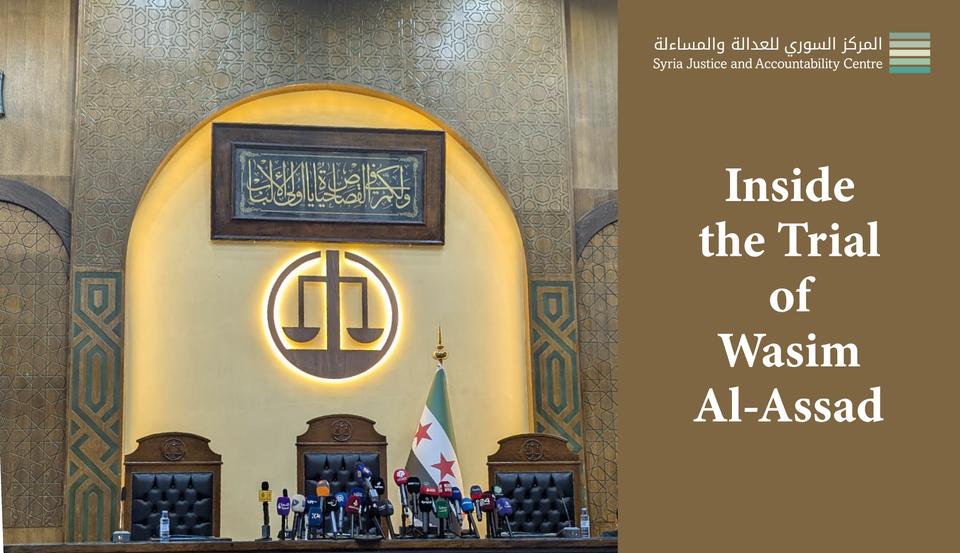
Inside the Trial of Wasim Al-Assad #6: The Judgment: ..Must Go Down
TRIAL OF WASIM Al-Assad
The Fourth Criminal Court – Damascus, Syria
Trial Monitoring Summary #6
Hearing Date: August 18, 2026
CAUTION: Some testimony may include graphic descriptions of torture, rape or other violent acts.
Note that this summary is not a verbatim transcript of the trial; it is merely an unofficial summary of the proceedings.
Throughout this summary, [information located in brackets are notes from our trial monitor] and “information placed in quotes are statements made by the witness, Judges or counsel.” The names and identifying information of witnesses have been redacted.
[Note: SJAC provides a summary of the proceedings while redacting certain details to protect witness privacy and to preserve the integrity of the trial.]
SJAC’s 6th trial monitoring report details day 6, the last day of the trial of Wasim Al-Assad in Damascus, Syria. On this trial day, the Court issued the death sentence against the Accused Wasim Al-Assad. The Accused was convicted of crimes including intentional murder and inciting sectarian strife, while being acquitted of the charge of drug trafficking.
Day 6 – August 18, 2026
[Note: There was media coverage by the Ministry of Justice and official outlets. Some international organizations attended the session].
The session began at 10:55AM with the entry of the Accused, Wasim Al-Assad, followed by the entry of the Judges at 11:00AM. This marked the sixth and final session for the sentencing of the Accused, Wasim Al-Assad.
The Accused, Wasim Al-Assad, appeared before the Court, accompanied by his ad hoc court-appointed representative, Defense Counsel C1 [redacted name], a registered attorney with the Bar Association - Damascus Branch.
The Plaintiff party was present.
The in-person trial proceedings commenced publicly, and as though all parties were present.
The Court unanimously announced the conclusion of the trial and rendered the following judgment:
I. Historical and Political Context Preceding the Facts of the Case
With the outbreak of peaceful protests in March 2011 against the "regime of the absconded criminal" Bashar Al-Assad and their confrontation with live ammunition and all types of lethal weapons, which compelled a segment of the popular movement to take up arms in self-defense, the "regime" established parallel armed groups of loyalist civilians known as the National Defence Forces, the shabiha, and auxiliary forces. These forces participated alongside the army of the "defunct regime," its security apparatuses, and employed foreign militias in suppressing the revolution, committing mass murder, torture, rape, looting, destruction of property, forced displacement, and enforced disappearances.
II. Complementarity and International Law Principles
The Court noted that it adopted the principle of complementarity between national jurisdiction and international criminal law, applying the legal classifications of crimes against humanity and war crimes to the facts of this case as a standard to measure the gravity of the acts and to dismiss any plea regarding statutes of limitations, immunity, or amnesties. The penalties, however, are applied in accordance with the Syrian Penal Code, pursuant to the principle of legality in criminal law.
III. The Court established the Accused's commission of the following:
- Formation of Auxiliary Groups and Participation in the East Ghouta Offensive. In 2011, the Accused met with Brigadier General Ghiyath Dalleh, a commander in the 4th Armored Division led by the absconding criminal Maher Al-Assad, where they agreed to form two groups of fighters within the auxiliary forces.
- The Accused secured thirty fighters distributed across two groups, for whom official contracts were executed with Brigadier General Ghiyath Dalleh in exchange for monetary salaries.
- The Accused supervised and led the operations of both groups, securing arms, ammunition, food, and funds for them through Ghiyath Dalleh, while regularly inspecting them at their deployment sites. The focus of their activity was in the town of Al-Mleiha in East Ghouta, near Jaramana, lasting for approximately two years, from 2012 to 2014.
- The operational pattern involved the 4th Armored Division and the Republican Guard initiating military airstrikes, artillery shelling, and various weaponry against populated areas based on initial intelligence provided by the Accused's two units. Following the bombardment, the Accused's groups entered to secure and consolidate deployment points, prevent residents from returning, and systematically loot the area — a practice later known as ta'feesh [looting]. This led to the emergence of widespread markets selling stolen furniture and household appliances looted from that area and other devastated Syrian regions.
IV. The Al-Mleiha Massacre and the Accused's Involvement
The massacre occurred in 2013 on the road connecting Al-Mleiha and Zabdin following airstrikes and later artillery shelling, which claimed the lives of approximately 75 civilians. Due to severe charring, it was impossible to identify around 30 corpses. The names of approximately 44 victims were documented from the residents of Al-Mleiha, Zabdin, Deir Al-Asafir, Ain Terma, Saqba, Arbin, Zamalka, and Al-Qaboun, as recorded by the Syrian Network for Human Rights (SNHR).
The Court detailed in its judgment the established occurrence and scale of the massacre, the shelling executed by the 4th Armored Division, the Republican Guard, and military aircraft, as well as the role played by the Accused and his two groups as a constituent element of the joint criminal enterprise.
V. Joint Criminal Enterprise
The Court established the existence of a joint criminal enterprise designed to suppress and crush the peaceful popular movement through the commission of widespread and systematic crimes against the civilian population — including murder, torture, arbitrary detention, and enforced disappearance. This enterprise originated in mid-March 2011 by decision of the top political and security leadership headed by the “absconded criminal” Bashar Al-Assad and army formations led by the 4th Armored Division and supporting units. It was also established that the Accused served as an element of local execution within this enterprise.
VI. Joint Intent
The Court established joint intent through the Accused's continuous engagement in these acts for over two years, the repetition of the same operational pattern, numerous reports, and the complete absence of any accountability. These factors constitute conclusive presumptions that he wilfully shared criminal purpose and accepted its unlawful means.
VII. The Court established through conclusive evidence the following events:
- An armed patrol belonging to the Accused arrived at a commercial shop in the town of Jaramana and seized its contents in broad daylight at gunpoint, without any legal or judicial authorization. The same forces abducted the shop owner and led him to an unknown location. The pretext for the abduction was participation in demonstrations and affiliation with an armed opposition group, establishing that the motive was purely political and tied to the victim's stance toward the existing leadership at the time.
- The victim and other detainees were subjected to severe torture in an undisclosed location outside any official detention facility or judicial oversight. The abductors handcuffed three detainees directly in front of the victim. The killings occurred outside any combat operation and were executed against unarmed, handcuffed, and defenseless individuals.
- The group commander issued a direct order to his forces to discard the corpses of the three victims in the orchards of Al-Mleiha, deliberately concealing the remains and denying their families knowledge of their fate or a proper burial.
- A protected witness testified that a detainee from the Al-Midan neighborhood was abducted alongside his wife, and the group threatened to rape his wife in exchange for his release. Furthermore, the protected witness testified that he survived execution only after disclosing that he was Christian — a highly significant fact demonstrating that religious affiliation served as a metric in sorting victims and that summary executions were carried out based on identity.
VIII. Superior and Command Responsibility
The judgment discussed in detail the legal elements of superior and command responsibility, applying them to the Accused in a standardized manner. The Court verified all established elements and confirmed his liability as a superior and director over his two units.
IX. Acquittal on Drug Trafficking Charges
The Court recorded in its judgment that no narcotic substances were seized from the Accused, nor were any laboratory analyses conducted. The Court noted that a photograph showing him alongside a known drug trafficker does not constitute legal proof of drug trafficking. Consequently, the Court ruled to acquit him of the offense of drug trafficking and smuggling due to lack of evidence.
X. Ordinary Crimes
It was established that the Accused exploited his kinship with the head of the "absconded criminal regime," Bashar Al-Assad, in order to commit crimes of extortion, threat, armed seizure of property, and firing upon civilians. These constitute ordinary domestic crimes subject strictly to national law, falling outside the classification of crimes against humanity and war crimes.
The Court noted that it withheld from the Accused any discretionary mitigating circumstances provided for in Article 244 of the General Penal Code due to the gravity of the committed crimes and the large number of victims. Therefore, pursuant to Articles 309, 310 et seq. of the Code of Criminal Procedure, and in the name of the Arab People in Syria, the Court unanimously ruled as follows:
- Conviction of the Accused Wasim Al-Assad — son of Badi', mother Samira — of the felony of premeditated murder, the felony of intentional murder of multiple individuals, and intentional murder accompanied by acts of torture and brutality against persons as crimes against humanity and war crimes, the felony of assault aiming to provoke civil war and sectarian strife, the felony of deprivation of liberty, and torture as crimes against humanity and war crimes — punishable under Articles 534, 535, 556, 298, and 216 of the General Penal Code, Paragraphs (e) and (f) of Article 2 of Law No. 16 of 2022, and Decree 20 of 2013 — and sentencing him therefor to death.
[Note: The Accused interrupted the Judge during the delivery of the judgment. The Judge ordered him to remain silent and listen.]
- Conviction of the Accused of the felony of assault causing permanent disability, provided for in Article 543 of the General Penal Code, sentencing him therefore to three years' imprisonment.
- Conviction of the Accused Wasim Al-Assad of the offense of fraud under a reclassified charge, provided for in Article 641 of the General Penal Code, sentencing him to three years' imprisonment and a fine of one thousand Syrian pounds.
- Merging of custodial sentences and executing the maximum penalty against him — namely the death sentence — pursuant to Article 204 of the General Penal Code, while cumulative fines shall all be enforced.
- Acquittal of the Accused on the two felonies of smuggling and trafficking in narcotic substances, provided for in Law No. 2 of 1993, due to insufficient evidence. The door remains open for the Public Prosecution to re-institute proceedings upon the availability of new evidence.
- Confirmation of the provisional seizure placed on the movable and immovable property of the Accused, converting it into an executory seizure.
- Obligating the Accused to compensate the eligible Plaintiffs in accordance with the table attached in the civil compensation section.
- Preservation of the rights of all injured parties who have not brought personal claims to date, as well as the families of victims and missing persons, to seek recourse before competent judicial authorities. This judgment shall not preclude such action.
- Confiscation of the convicted party's movable and immovable property in favor of the Public Treasury, to be executed following the satisfaction of civil obligation provisions.
- Preservation of the right of competent official bodies to seek recourse and claim compensation for damages inflicted upon public funds and public utilities.
- Preservation of the right of the Public Prosecution to pursue all other responsible entities, contributors, and accomplices not covered by this prosecution, opening future files against them whenever evidence becomes available.
- Continued application of witness protection measures ordered during the trial following the issuance of this judgment.
- Safeguarding the true identities of protected witnesses in a sealed, confidential file at the Court Registry, accessible only by a reasoned judicial decision.
- Prohibition of publishing, broadcasting, or circulating any data that might reveal the identity or residence of a protected witness, under penalty of legal liability.
- Referral of a copy of this decision to the National Commission for the Missing Persons for the purpose of searching for the remains of those reported to have been buried in the orchards of Al-Mleiha in 2012.
- Assessment of judicial fees and expenses against the convicted party.
The judgment is rendered in person with respect to the Public Prosecution, the Plaintiff party, and the Accused, and as though they were present regarding absent Plaintiffs, subject to appeal before the Court of Cassation.
Promulgated on 5 Rabi' Al-Awwal 1448 AH, corresponding to August 18, 2026 CE, publicly read and announced.
The hearing, and with it the trial, concluded at 11:25AM.
___________________________
For more information or to provide feedback, please contact SJAC at [email protected] and follow us on Facebook and Twitter. Subscribe to SJAC’s newsletter for updates on our work