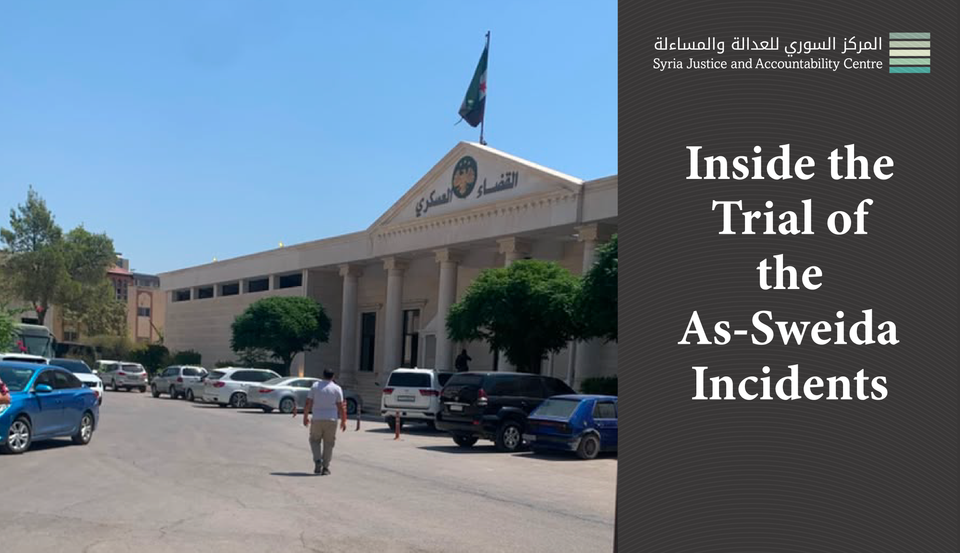
Inside the Trial of the As-Sweida Incidents #6: Further Details on the Al-Matuna Incident
TRIAL OF THE AS-SWEIDA INCIDENTS
The Military Criminal Court – Damascus, Syria
Trial Monitoring Summary #6
Hearing Date: October 19, 2026
CAUTION: Some testimony may include graphic descriptions of torture, rape or other violent acts.
Note that this summary is not a verbatim transcript of the trial; it is merely an unofficial summary of the proceedings.
Throughout this summary, [information located in brackets are notes from our trial monitor] and “information placed in quotes are statements made by the witness, Judges or counsel.” The names and identifying information of witnesses have been redacted.
[Note: SJAC provides a summary of the proceedings while redacting certain details to protect witness privacy and to preserve the integrity of the trial.]
SJAC’s 5th trial monitoring report details day 6 of the trial in Damascus, Syria pertaining to the As-Sweida Incidents. On this trial day, the Court heard seven cases. In the first case, the Bench heard two witnesses and adjourned the session for the submission of final defenses. In the second case, the Court granted the Prosecutor a final extension of time to submit its evidence. In the third case, the Court adjourned the session due to the failure to bring the Accused from prison. In the fourth case, the Bench approved conducting a single-expert technical analysis of digital evidence. In the fifth case, the Bench decided to continue the reviewing process. In the sixth case, the Court submitted the case file for review after the Defense requested the acquittal of its client. Finally, in the seventh case, the Court granted the Defense's request to hear the testimony of a confidential witness in the upcoming session.
Day 6 – October 19, 2026
The session commenced at 11:00AM. The Court examined the cases listed as follows:
The First Case:
Case No. 249 of 2026. The Accused Ezzeddein I. was brought in custody and appeared unhandcuffed. Defense Counsel C3, [redacted name], attended, representing the Accused. Plaintiffs’ Counsel, [redacted name] P5, attended, representing the Plaintiffs P1 [redacted name] and P2 [redacted name]. Plaintiffs’ Counsel C4 [redacted name] did not attend on behalf of the rest of the Plaintiffs.
The in-person trial commenced publicly and as though the parties were present.
The Accused reiterated his previous judicial statements.
The Prosecutor affirmed his previous statements requesting the conviction of the Accused in accordance with the indictment decision and the imposition of the maximum penalties upon him.
Both Plaintiffs’ Counsel repeated the substance of their claim set forth in their brief submitted to the Presiding Judge.
The Defense Counsel stated that he was able to bring only two witnesses and was unable to bring the remaining witnesses, requesting that their testimony be heard. He then asked for an extension of time to complete the testimony and respond after hearing the present witnesses.
Witness Testimonies
W9, [redacted name]
After taking the legal oath, W9 testified that there is no enmity or relation between him and the Accused; that he knew the Accused previously because he served with him in the same location; and that he does not know any of the deceased.
When asked about the incident, W9 testified that on that day, the Accused went to a [military] point near their checkpoint to charge his mobile phone. This incident occurred with the Accused, in which W9 was not present at all and only heard about it after it had occurred. W9 added that he heard from his friend W10 [redacted name] - who was a military personnel with them at the same checkpoint - that he saw the Accused the night before the incident waking up from his sleep and laughing for no reason.
The Defense Counsel asked the witness whether there were any civilian residents in the village of Al-Matuna when they were there, and whether anyone frequented the village. W9 answered that there were no civilian residents in the village of Al-Matuna when he was at the military checkpoints. W9 clarified that there was a checkpoint responsible for allowing civilians into the village, upon the civilians’ request. He testified that he did not see any civilian enter the village while W9 was present there.
The Defense Counsel inquired about whether one of the state guard points near their checkpoint was subjected to an armed attack a few days before the incident. W9 confirmed that one of the points was subjected to an armed attack according to what he heard from his colleagues, and that it was near their checkpoint.
The witness was asked about the time he learned of the incident, whether he was present at his workplace at the time, and who informed him that Ezzeddein I. was the one who shot the deceased. W9 answered that on the day of the incident and an hour and a half before the Maghrib call to prayer, W9 and some of his colleagues at the checkpoint learned that about four or five civilians were shot and were in critical condition. Late at night, W9 learned from his colleagues that their colleague Ezzeddein I. was the one who shot those civilians, because the Operations Department arrested Ezzeddein I. while he was at the checkpoint.
The Plaintiffs’ Counsel refrained from commenting on the W9’s testimony.
W10, [redacted name]
After taking the legal oath, W10 testified that there is no enmity or relation between him and the Accused, and that he knew the Accused previously because he served with him in the same location.
When asked about the incident, W10 stated that he was serving at a military post near the village of Al-Matuna during the incidents in As-Sweida. There were eight personnel at that post, and there were no civilians in the village at that time because the area was a military zone. W10 testified that one of the posts near theirs was subjected to an armed attack a week before the killing committed by the Accused, in which a military member from that post was killed. On the day of the incident, W10 observed abnormal signs in Ezzeddein I., as W10 saw him laughing excessively for no reason, and he would walk toward a post adjacent to theirs and turn back halfway. When the incident occurred, Ezzeddein I. returned to the post, and W10 noticed he appeared confused and his eyes were somewhat dilated, and Ezzeddein I. did not tell them anything about the incident. At sunset, a patrol arrived at the post and took all the personnel from the post, including Ezzeddein I.. Subsequently, Ezzeddein I. was arrested while the others were released, at which point they learned that Ezzeddein I. had shot several people.
W10 was asked about the armed attack on one of the adjacent posts. He replied that the attack took place in the exact same location where the crime committed by the Accused occurred.
The Plaintiffs’ Counsel refrained from commenting on the W9’s testimony.
Upon consultation, the Court decided to grant the Defense Counsel an extension of time to submit his final defenses, and adjourned the session to November 3, 2026.
The Second Case:
Case No. 171 of 2026. The Accused Mohammad M., Mohammad S., Mohammad H., Mohammad K., and Mustafa S. were brought forward. There were no Plaintiffs. Defense Counsel C2 [redacted name] appeared as legal Counsel for the Accused Mohammad S., Mohammad H., Mohammad K., and Defense Counsel C10 [redacted name] appeared as Counsel for the Accused, Mustafa S. and Mohammad M.
The in-person trial commenced publicly.
The Accused reiterated their statements provided in the previous sessions.
The Prosecutor requested an extension of time to submit new evidence confirming that the Accused committed the criminal acts attributed to them, and affirmed his previous requests for their conviction.
Both Defense Counsel reiterated their previous defenses.
Upon consultation, the Court decided to grant the Prosecution a final extension of time to submit whatever new evidence it possesses, and adjourned the session to November 17, 2026.
The Third Case:
The Accused, Tal’at S., did not appear because the order to bring him arrived late at the prison administration, and Counsel C11 [redacted name] appeared as Defense Counsel for the Accused.
The Court decided to reaffirm the order to bring the Accused, and adjourned the session to November 3, 2026.
The Fourth Case:
Case No. 226 of 2026. The Accused, Amr A., was brought in custody and appeared unhandcuffed. Counsel C1 [redacted name] appeared as Counsel for the Accused.
The in-person trial commenced publicly.
The Prosecutor repeated his previous requests for the conviction of the Accused in accordance with the indictment decision issued by the Military Investigating Judge.
The Accused reiterated his previous statements.
The Defense Counsel repeated his previous defenses and affirmed his request to conduct a technical analysis of the digital evidence as stated in his written brief submitted during the deliberation period.
Upon consultation, the Court decided to reverse its previous decision made at the October 5, 2026 session and grant Defense Counsel's request to conduct a single-expert technical analysis of the flash drive submitted by Defense Counsel and attached to his written brief dated September 7, 2026, in order to accurately determine the recording date of the clip and indicate whether the photographs attached to the Defense brief dated July 18, 2026, were extracted from the same video. The Court then ordered the Defense Counsel to pay an advance fee of five thousand Syrian Pounds to conduct the analysis, provided that it is carried out during the adjournment period, and adjourned the session to November 17, 2026.
The Fifth Case:
Case No. 394 of 2026. The Accused Rabi’ H. was brought in custody and appeared unhandcuffed. Counsel C7 [redacted name] appeared as Counsel for the Accused. There were no Plaintiffs
The in-person trial commenced publicly.
The Prosecutor affirmed its previous requests.
The Accused repeated his previous judicial statements.
Defense Counsel repeated his previous defenses.
Upon consultation, the Court decided to continue the review, and then adjourned the session to November 17, 2026.
The Sixth Case:
Case No. 274 of 2026. The Accused Firas A. was brought in custody and appeared unhandcuffed. Defense Counsel C6, [redacted name], attended, representing the Accused.
The in-person trial commenced publicly.
The Prosecutor affirmed his previous statements requesting the conviction of the Accused in accordance with the indictment decision and the imposition of the maximum penalties upon him.
The Accused repeated his previous judicial statements.
The Defense Counsel petitioned the Court to declare his client innocent and release him immediately, as the Prosecutor has thus far failed to prove that his client committed the offense attributed to him. Defense Counsel stood by the previous brief.
The Court decided to submit the case file for review, and then adjourned the session to November 3, 2026.
The Seventh Case:
Case No. 291 of 2026. The Accused Abdunnoor Q. was brought in custody and appeared unhandcuffed. Defense Counsel C2, [redacted name], attended, representing the Accused.
The in-person trial commenced publicly.
The Prosecutor reiterated his previous demands and requested the conviction of the Accused in accordance with the decision issued by the Investigative Judge.
The Accused reiterated his previous statements.
The Defense Counsel affirmed his previous defenses, adding that there is a confidential witness who confirms that the persons who were killed - the subject of this case - were an armed fighting group participating in combat, and that he is prepared to bring the confidential witness to the next session, provided he testifies confidentially to protect his life.
Upon consultation, the Court decided to grant Defense Counsel's request, and ordered him to provide the Court with the name of the confidential witness and bring him to the next session, provided that his testimony is heard after implementing witness protection measures to protect his life. The Court then adjourned the session to November 17, 2026.
The proceedings were adjourned at 1:00PM.
The next trial day will be on November 3, 2026, at 10:00AM.
___________________________
For more information or to provide feedback, please contact SJAC at [email protected] and follow us on Facebook and Twitter. Subscribe to SJAC’s newsletter for updates on our work