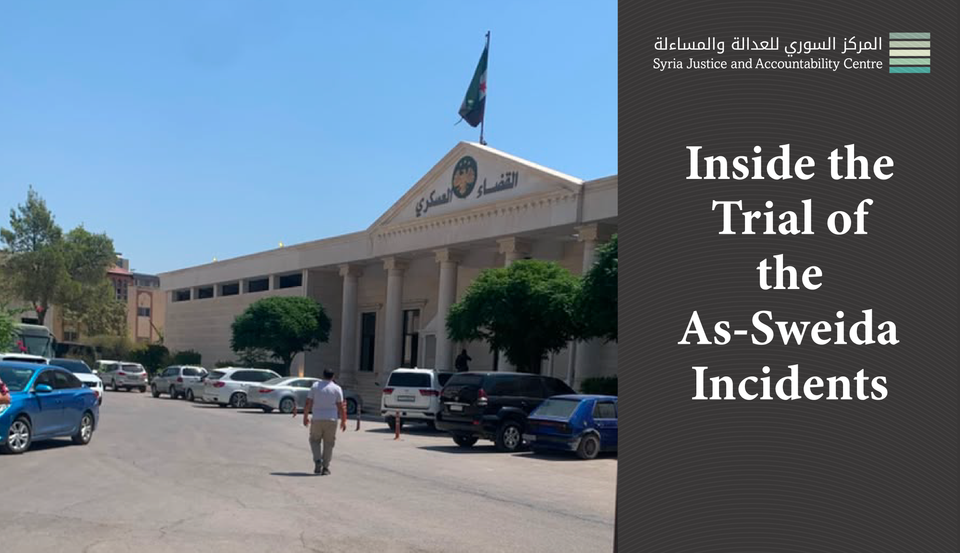
Inside the Trial of the As-Sweida Incidents #4: The Tribal Neuralyzer
TRIAL OF THE AS-SWEIDA INCIDENTS
The Military Criminal Court – Damascus, Syria
Trial Monitoring Summary #4
Hearing Date: September 21, 2026
CAUTION: Some testimony may include graphic descriptions of torture, rape or other violent acts.
Note that this summary is not a verbatim transcript of the trial; it is merely an unofficial summary of the proceedings.
Throughout this summary, [information located in brackets are notes from our trial monitor] and “information placed in quotes are statements made by the witness, Judges or counsel.” The names and identifying information of witnesses have been redacted.
[Note: SJAC provides a summary of the proceedings while redacting certain details to protect witness privacy and to preserve the integrity of the trial.]
SJAC’s 4th trial monitoring report details day 5 of the trial in Damascus, Syria pertaining to the As-Sweida Incidents. On this trial day, ten Accused appeared before the Court, half of whom were new. The Court heard witnesses regarding the case of one of the Accused. One witness testified that he dropped his rights against the Accused after learning that he was not among the members of the armed gang that shot at him and burned his home, which was what he had stated before the Investigating Judge. Furthermore, the second witness testified that the same Accused was indeed among that gang that attacked her home; however, she dropped her personal rights following a tribal reconciliation. The last witness in this session testified that an armed group attacked his home and burned his wife’s pharmacy, and that following a tribal reconciliation, persons informed him that the Accused was not among that group.
Day 5 – September 21, 2026
The session commenced at 10:30AM. The Court examined the cases listed as follows:
The First Case:
Case No. 171 of 2026. National Hospital Incident – Felony of Intentional Murder and Accomplice Liability.
The Accused Mohammad M., Mohammad S., Mohammad H., Mohammad K., and Mustafa S. were brought forward. There were no Plaintiffs.
All Accused appeared. Defense Counsel C2 [redacted name] appeared as an ad hoc court-appointed Counsel for the Accused Mohammad M. and Mustafa S., and as retained Counsel for the remaining Accused. He requested an extension of time to submit a written defense memorandum.
The Court decided to adjourn the session for the defense to October 5, 2026.
The Second Case:
Case No. 171 of 2026.
Case No. 249 of 2026. The Accused Ezzeddein I. was brought in custody and appeared unhandcuffed. Defense Counsel C3, [redacted name], attended, representing the Accused. Two Plaintiffs’ Counsel, P4 [redacted name] and [redacted name] P5, were present.
The in-person trial commenced publicly.
The Prosecutor reiterated his previous requests for the incrimination of the Accused in accordance with the indictment decision.
The Accused reiterated his prior judicial statements.
Upon consultation, the Court decided to direct Defense Counsel to advance the fee for conducting the expert analysis. The Court then adjourned the session until October 5, 2026.
The Third Case:
Case No. 291 of 2026. The Accused Abdunnoor Q. was brought in custody and appeared unhandcuffed. Defense Counsel C2, [redacted name], attended, representing the Accused.
The Judge noted that all case files were read out [note: the files were not read out during the session.]
The Prosecutor reiterated the incrimination of the Accused in accordance with the indictment decision as prescribed by law.
The Accused reiterated his previous statements.
The expert analysis report was received, confirming that the digital evidence was authentic.
The Court decided to adjourn the session and grant the Defense Counsel an extension of time to respond to the expert report submitted in the case, and then adjourned the session until October 5, 2026.
The Fourth Case:
Case No. 226 of 2026. The Accused, Amr A., was brought in custody and appeared unhandcuffed. Counsel C1 [redacted name] appeared as Counsel for the Accused.
The Public Prosecution reiterated its prior statements regarding the conviction of the Accused.
The technical expert analysis report on the digital evidence was received, consisting of three pages, and was duly added to the case file.
Defense Counsel stated that he had not reviewed the expert analysis report, and requested to be granted an extension of time to review it and submit his defense concerning it.
The Court decided to grant the request and accord the Defense Counsel an extension of time to submit his final defense, then adjourned the session until October 5, 2026.
The Fifth Case:
Case No. 274 of 2026. The Accused Firas A. was brought in custody and appeared unhandcuffed. Defense Counsel C6, [redacted name], attended, representing the Accused.
The in-person trial commenced publicly.
The Prosecutor requested an extension of time to bring the Complainant and hear the Prosecution witness's testimony due to the impossibility of bringing him to this session, and arrange necessary concealment of his identity to protect his life.
The Accused reiterated his prior judicial statements.
The Defense Counsel objected to granting the Prosecutor another extension of time to bring the confidential witness. He denied the allegations made by the Prosecution against his client and reiterated the defense set forth in his written memorandum submitted at the previous session.
Upon consultation, the Court decided to grant a second and final extension of time to the Public Prosecution to bring the confidential witness to be heard in accordance with due process. The session was then adjourned until October 5, 2026.
The Sixth Case:
The Accused Rabi’ H. was brought in custody and appeared unhandcuffed. There were no Plaintiffs
The in-person trial commenced publicly.
The legal Counsel [redacted name] was called, and his absence was noted. It was thus decided to appoint court-appointed counsel C8 [redacted name].
The Prosecutor requested the conviction of the Accused in accordance with the indictment issued by the Military Investigating Judge, and requested the Court to summon the witnesses who were heard before the Investigating Judge, as well as Witness W8 [redacted name], via the Court to hear their testimony in accordance with due process.
The Accused reiterated his prior judicial statements from previous sessions.
The ad hoc court-appointed Defense Counsel requested to grant the Public Prosecution's request to summon the witnesses and hear their testimony before the Court in accordance with due process.
The Court decided to summon the witnesses named by the Public Prosecution and bring them through the Court.
At this point, Defense Counsel C7 [redacted name] arrived, and the witnesses [requested by the Public Prosecution] were brought forward to hear their testimony.
Witness Testimony:
W6, [redacted name] [name was not heard clearly]
After taking the legal oath, W6 testified that he knows the Accused because he is his neighbor in the district, and that he was injured during the Sweida incidents by gunshot from an outlawed armed group due to his pro-Syrian state stance. He learned from his neighbors that the Accused Rabi’ H. was one of the individuals present with that group that shot at him. However, after investigating the matter, it became clear that the Accused Rabi’ H. had no connection to that group and was not present with them, but rather other individuals were there. Upon learning this, W6 informed the Investigating Judge and dropped his personal rights against the Accused. W6 added that this group burned his home. W6’s wife had informed him that the Accused Rabi’ H. was with that group, but following inquiry and investigation, it turned out that Rabi’ H. was not among the individuals who attacked him and burned his home.
The Prosecutor asked the witness whether his wife knew with certainty the individuals who burned his home. W6 confirmed this, noting that she was present in the courtroom to give her testimony.
The Prosecutor requested to hear the witness's wife to identify the individuals who burned the witness's home and whether the Accused was present among them.
The Defense Counsel accepted the testimony of W6 and raised no objection to hearing his wife's testimony in accordance with due process.
W7, [redacted name]
After taking the legal oath, W7 testified that the Accused Rabi’ H. was part of the group that attacked her home, fired at her and her family, and took her car. Subsequently, a tribal reconciliation took place between them and the car was returned. As a result, she dropped her personal rights, noting that the individuals who were present with the Accused were his cousins. She withheld mentioning their names because of a reconciliation.
The Defense Counsel pointed out that the witness had stated before the Investigating Judge that the Accused Rabi’ H. had no connection to the matter and that his cousins were the ones who attacked her home. He then asked her why she changed her statements before the Court. W7 responded that she had not changed her statements, and that she had stated before the Investigating Judge that Rabi’ H. was within the group that attacked her home, and that they had reconciled tribally, consequently dropping her personal rights.
W8, [redacted name]
After taking the legal oath, W8 testified that an armed group fired at him, attacked his home, and burned his wife’s pharmacy. W8 initially believed that the Accused was among the individuals who did that. However, following the tribal reconciliation, individuals came forward confirming that Rabi’ H. was not among those who participated in the shooting and the burning of his wife’s pharmacy.
The Defense Counsel requested an extension of time to submit his defense regarding the witnesses' testimony.
Upon consultation, the Court decided to grant Defense Counsel a final extension of time to submit the defense. The session was then adjourned until October 5, 2026.
The proceedings were adjourned at 12:45PM.
The next trial day will be on October 5, 2026, at 10:00AM.
___________________________
For more information or to provide feedback, please contact SJAC at [email protected] and follow us on Facebook and Twitter. Subscribe to SJAC’s newsletter for updates on our work