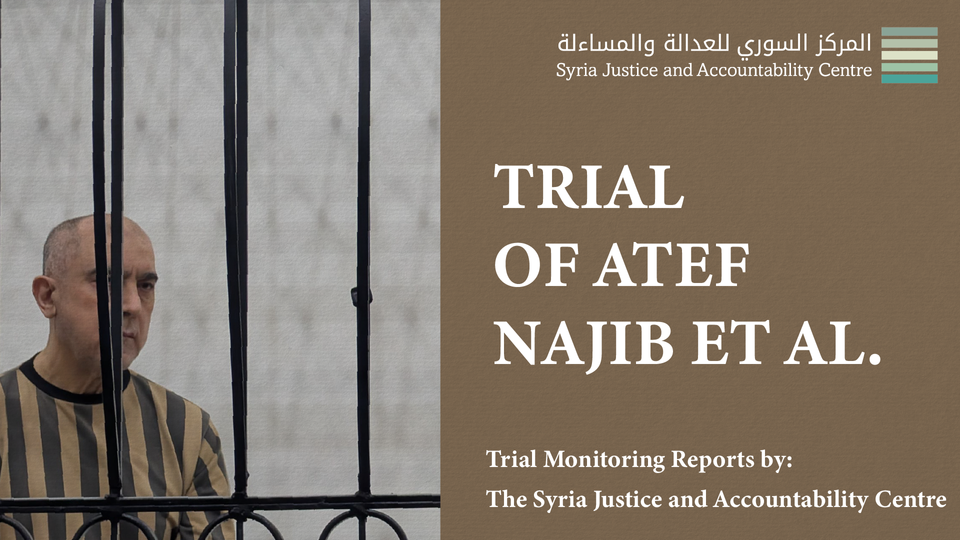
Inside the Trial of Atef Najib et al. #9: The Judgment: Sooner or Later
TRIAL OF ATEF NAJIB ET AL.
The Fourth Criminal Court – Damascus, Syria
Trial Monitoring Summary #9
Hearing Date: August 11, 2026
CAUTION: Some testimony may include graphic descriptions of torture, rape or other violent acts.
Note that this summary is not a verbatim transcript of the trial; it is merely an unofficial summary of the proceedings.
Throughout this summary, [information located in brackets are notes from our trial monitor] and “information placed in quotes are statements made by the witness, Judges or counsel.” The names and identifying information of witnesses have been redacted.
[Note: SJAC provides a summary of the proceedings while redacting certain details to protect witness privacy and to preserve the integrity of the trial.]
SJAC’s 9th trial monitoring report details day 9, which marked the last day of the trial of Atef Najib et al. in Damascus, Syria. On this trial day, the Court issued its judgment against the Accused Atef Najib, sentencing him to the death penalty. Corresponding verdicts and sentences were likewise handed down in absentia against the remaining Accuseds.
Day 9 – August 4, 2026
[Note: Many local and Arab media outlets attended the session.]
The session commenced at 11:05AM. This constitutes the ninth and last session in Case No. (1) of 2026 against the Accused, Atef Najib.
The Accused Atef Najib appeared before the court, accompanied by his representative, Defense Counsel C1 [redacted name].
The Plaintiff party was present.
The in-person and in-absentia trial proceedings commenced publicly.
The Court unanimously announced the conclusion of the trial and rendered the following judgment in Case No. 1 of 2026, comprising 396 pages, which shall subsequently be published on the official website of the Ministry of Justice following the redaction of protected witnesses' names in accordance with the provisions set forth at the end of this decision. The Court noted that it would read a summary thereof, which shall not be a substitute for the original judgment.
I. Historical and Political Context Preceding the Facts of the Case
In November 1970, Hafez Al-Assad executed a military coup in Syria, establishing an authoritarian security state reliant on security apparatuses and military force, seizing the country’s political and economic resources, and suppressing all attempts at change, whether peaceful or non-peaceful — most notably the bloody events in the early 1980s in Hama, Aleppo, Jisr Ash-Shughur, and the Tadmur Military Prison.
In 2000, Hafez Al-Assad died, and power transitioned to the absconding Accused, Bashar Al-Assad. He consolidated the same positions and powers, continuing his father's repressive course by relying on the army, particularly the 4th Armored Division led by his brother, the absconding Accused Maher Al-Assad,and the security services. His goal was the perpetuation of Al-Assad rule,contrary to the republican nature of the state, and closing all avenues for public participation in civic affairs.
With the advent of the Arab Spring, Syrians aspired to change, and voices calling for reform grew louder in early 2011, marking the inception of the facts of this case.
Indications of the popular movement emerged in the city of Dar’a in February 2011, when children set fire to wooden police guard posts and wrote slogans on school walls, most famously "It's your turn, Doctor" and "Al-Assad is plundering the country."
On February 15, 2011, and thereafter, security apparatuses,including the Political Security Branch, launched an arrest campaign targeting school students and other individuals. Testimony from witnesses, who were minors at the time, established that they were beaten, tortured, subjected to electric shocks, suspended (shabh), and had their fingernails pulled out, and that the Accused Atef Najib personally interrogated several of them and verbally abused their families and the people of Dar’a.
On March 18, 2011, residents gathered in a demonstration demanding the release of the detained children. They were met with live ammunition, resulting in the martyrdom of Mahmoud Al-Jawabra and Husam Ayyash. This was accompanied by the arrival of a security force from Damascus aboard helicopters that landed at the Municipal Stadium, where they were received personally by the Accused Atef Najib. Major General Hisham Al-Bikhtiyar also attended as an envoy of the absconded Accused Bashar Al-Assad, and presided over meetings of the Security Committee in the governorate, of which the Accused Atef Najib was a member. From day one, the Security Committee resolved to confront the peaceful movement with violence and live ammunition, as admitted by the Accused Atef Najib during his interrogation before the Court.
On March 19, 2011, forces from the security branches opened fire on mourners, resulting in multiple martyrs and wounded. This was followed by a sit-in at the Al-Omari Mosque in Dar’a, with residents demanding the release of the children and accountability for those responsible for the shooting, foremost among them the Accused Atef Najib.
On the nights of March 22 and 23, 2011, joint security forces from all branches, led by the Political Security Branch in Dar’a, stormed the sit-in at the Al-Omari Mosque from multiple axes using tear gas and live ammunition, leaving dozens martyred and wounded. Furthermore, fire was opened on ambulances, and the injured were detained for hours until several succumbed to their wounds, including the martyr Dr. Ali Ghassab Al-Mahamid. The sit-in participants were arrested and distributed among the security branches, including the Political Security Branch.
Consequently, residents from villages across the Dar’a Governorate mobilized in a peaceful march known as the "solidarity of the villages" (Faz'at Al-Qura) to support the people of Dar’a. The Security Committee convened under the chairmanship of Al-Bikhtiyar, with the attendance of the Accused Atef Najib and other heads of security branches, where the decision for military confrontation was taken. A plan dubbed "The Trap" was devised to attack and fire upon the peaceful protesters coming from the villages. All security apparatuses in the governorate participated in this trap, as it was called by the Accused Atef Najib during his interrogation. Atef Najib was at the helm of this operation, commanding it by virtue of his expanded powers in the governorate due to his kinship with the absconding Accused Bashar Al-Assad. The massacre, known as the Political Security Massacre or the Gas Station Massacre, took place near the Political Security Branch, resulting in dozens of martyrs and wounded. These facts, along with their supporting evidence, are detailed comprehensively in the judgment.
II. Complementarity and International Law Principles
The Court deliberated extensively in its judgment on the principle of complementarity between national and international jurisdictions, affirming that complementarity is a well-established principle in international law that establishes primary jurisdiction over international crimes within national courts. The Court further ruled that international jurisdiction is complementary to, and not a substitute for, national jurisdiction.
The Court also discussed the non-applicability of statutes of limitations or amnesties to international crimes, affirming the forfeiture of immunities for the crimes subject to this action.
III. Legal Basis for In Absentia Proceedings
The Court addressed the legal foundation for trials in absentia pursuant to Article 322 et seq. of the Syrian Code of Criminal Procedure, confirming that it fulfilled all necessary conditions to ensure the validity of the in absentia proceedings, as recorded in the judgment.
IV. Legal Classification of Crimes and Existence of Armed Conflict
The Court adopted the definition of crimes against humanity set forth in Article 7 of the Rome Statute, detailing its application in the judgment. It also applied the established standard in international criminal jurisprudence regarding the existence of a non-international armed conflict, finding that the conflict in Syria transitioned into a non-international armed conflict as of mid-July 2012 — the date formally announced by the International Committee of the Red Cross (ICRC) and affirmed by the Independent International Commission of Inquiry on the Syrian Arab Republic.
The Court evaluated the legal outcome for each defendant individually in its judgment:
- Atef Najib: The Court concluded that all acts falling within his indictment occurred between February and April 2011, prior to the inception of the non-international armed conflict. The sole contradicting evidence was a protected witness's statement before the Investigating Judge claiming to have seen Atef Najib in Dar’a in 2013, a statement the witness subsequently recanted before this Court. Consequently, the acts attributed to Atef Najib are classified strictly as crimes against humanity and domestic offenses.
- Remaining Absconding Accused, foremost Bashar Al-Assad: Their established acts, committed directly or under command responsibility, extended past mid-July 2012. Therefore, their actions constitute war crimes in non-international armed conflicts, alongside crimes against humanity and domestic offenses.
The Court detailed that in its judgment.
V. Command Responsibility and Individual Rulings
The Court detailed the overarching responsibility of the absconded Accused Bashar Al-Assad as the head of the joint criminal enterprise. Serving as President of the Republic throughout the period relevant to this action, he held all military, civil, and party authority under the constitution. He defined his regime's stance toward the popular movement by labeling it an external conspiracy, threatening confrontation and implementing it on the ground. The Court identified this as evidentiary proof of the legal elements of crimes as well as the constituent elements of crimes against humanity and war crimes. The Court has also detailed this in the decision.
Based on the foregoing information, the Court affirms that Bashar Al-Assad's contribution was not merely that of a superior negligent in oversight, but that of the ultimate decision-maker who formulated and declared policies, mobilized state apparatuses, and shielded perpetrators from accountability — rendering him a perpetrator-by-means liable for acts executed by others.
Regarding the Accused Atef Najib, the Court detailed in its judgment his extensive liability since assuming the leadership of the Political Security Branch in Dar’a in 2007; his membership in the governorate’s Security Committee and attending its meetings; the arrest and detention of minors under eighteen, subjecting them to severe torture, including sexual abuse, interrogating them personally, and [forcing them] to write [pledges] and humiliating them; his solicitation of military reinforcements from Damascus; his field presence at each massacre; his direct orders to open fire resulting in dozens of casualties, primarily targeting heads and chests, and his responsibility for that; the deployment of snipers on the roof of the Political Security building under his authority; and his interception of ambulances to detain the wounded until some of them died.
The Court grounded its judgment on consistent prosecution witness testimonies, Plaintiffs' statements, official documents, medical reports, audiovisual evidence presented during the proceedings, and documented international reports. The mass of witness testimonies were mutually corroborative and intersected across facts, times, and locations in a manner that rendered collusion impossible. The Court detailed this in its judgment.
The Court heard defense witnesses, extending them the same protection guaranteed to prosecution witnesses. In adjudicating this case, the Court adhered to the principle of witness and evidence protection — a principle grounded in safeguarding the right to life and physical integrity, upholding the State’s obligation to protect victims, witnesses, and evidence, and ensuring the discovery of the truth. Applying this practically, the Court heard witnesses identified by numerical designations without disclosing their identities to the public; a national judicial precedent within the framework of transitional justice, in addition to an established rule recognized in international practice and jurisprudence. The Court detailed this in its judgment.
The Court noted that the Accused Atef Najib issued a blanket denial of all charges, responding to every testimony with "I do not accept the testimony" and dismissing victim statements as "street and internet chatter." The Court found this denial irreconcilable with the established facts and evidence.
Furthermore, the Court noted that the Accused exhibited no remorse or apology when confronted by victims in court, leading the Court to withhold any discretionary mitigating circumstances and impose the maximum penalty allowed under national law.
The Court ruled that reparations constitute a fundamental right of victims and a core pillar of transitional justice without which judgment is incomplete. Drawing upon the compensation framework in Article 75 of the Rome Statute, international comparative jurisprudence, and Syrian judicial precedent, the Court ordered the convicted parties to jointly and individually pay civil damages to the eligible civil claimants, assessed individually based on harm. The Court explicitly preserved the rights of all unrepresented victims to pursue claims before the competent authority at a later date.
Therefore, having reviewed the indictment of the Public Prosecutor of the Syrian Arab Republic in Damascus No. 3205 dated September 25, 2025, the Indictment No. 15 dated April 6, 2026, the submission of the Public Prosecution in Damascus dated August 3, 2026, all case documents, and pursuant to Articles 309, 310 et seq. of the Code of Criminal Procedure, in the name of the Arab People in Syria, the Court unanimously ruled as follows:
- Conviction of the absconded Accused Bashar Al-Assad, son of Hafez, mother Anisa, born 1965, of the felony of premeditated murder, the felony of intentional murder of multiple individuals, intentional murder of children under fifteen years of age, intentional murder accompanied by acts of torture and brutality, the felony of incitement to premeditated and intentional murder on multiple occasions as crimes against humanity and war crimes; the felony of torture, torture leading to death, and the felony of deprivation of liberty on multiple occasions as crimes against humanity and war crimes — punishable under Articles 534, 535, 556, and 216 of the General Penal Code, and Paragraphs (e) and (f) of Article 2 of Law No. 16 of 2022 — and sentencing him therefor to death.
- Conviction of the Accused Atef Najib, son of Najib, mother Fatima, born 1960, of the felony of premeditated murder, intentional murder of multiple individuals, intentional murder of children under fifteen years of age, intentional murder accompanied by acts of torture and brutality, the felony of incitement to premeditated and intentional murder on multiple occasions as crimes against humanity, the felony of torture leading to death, deprivation of liberty, and the felony of kidnapping on multiple occasions as crimes against humanity — punishable under Articles 534, 535, 216, and 556 of the Penal Code, Paragraphs (e) and (f) of Article 2 of Law No. 16 of 2022, and Articles 1 and 2 of Decree 20 of 2013 — and sentencing him therefor to death.
- Conviction of the Accused Atef Najib, son of Najib, of the felony of assault aiming to provoke civil war and sectarian strife, punishable under Article 298 of the General Penal Code, sentencing him therefor to life imprisonment. He was also found guilty of the felony of theft of public funds, punishable under Article 8 of Law No. 3 of 2013, sentencing him to five years' imprisonment; and of the felony of money laundering, punishable under Article 14 of Decree No. 33 of 2005, sentencing him to temporary imprisonment for six years and a fine of one million Syrian pounds. Conviction of the Accused Atef Najib of the misdemeanors of inciting sectarian strife, abuse of authority, breach of official duties, and fraud, provided for in Articles 307, 366, 367, and 641 of the General Penal Code, sentencing him to two years' imprisonment and a fine of 500,000 Syrian pounds, three years' imprisonment and a fine of 200,000 Syrian pounds, and five years' imprisonment and a fine of 500,000 Syrian pounds.
- Merging of custodial sentences and executing the maximum penalty against him — namely the death sentence — pursuant to Article 204 of the General Penal Code, while cumulative fines shall all be enforced.
- Conviction of each of the absconding Accused:
- Fahd Al-Fraij, son of Jasem, mother Shaha, born 1950
- Maher Al-Assad, son of Hafez, mother Anisa, born 1967
- Lo'ay Al-Ali, son of Ali, mother Rima, born 1965
- Qusay Mayhoub, son of Ibrahim, mother Fatima, born 1961
- Wafiq Naser, son of Saleh, mother Fattoum, born 1964
- Talal Al-Aysami, son of Fares, mother Amriya, born 1957
of the felony of premeditated murder, intentional murder of multiple individuals, intentional murder accompanied by acts of torture and brutality against persons, and the felony of incitement to premeditated and intentional murder on multiple occasions as crimes against humanity and war crimes, the felony of torture, torture leading to death, deprivation of liberty, the felony of kidnapping on multiple occasions as crimes against humanity and war crimes — punishable under Articles 534, 535, 216, and 556 of the General Penal Code, Paragraphs (e) and (f) of Article 2 of Law 16 of 2022, and Articles 1 and 2 of Decree 20 of 2013 — and sentencing them therefor to death.
- Conviction of the absconding Accused Lo'ay Al-Ali, Qusay Mayhoub, Wafiq Naser, and Talal Al-Aysami of the felony of intentional murder of children under fifteen years of age as crimes against humanity and war crimes, sentencing them therefor to life imprisonment, the felony of assault aiming to provoke sectarian strife and civil fighting, punishable under Article 298 of the Penal Code, sentencing them to life imprisonment; and merging the penalties to execute the maximum penalty against them — namely the death sentence — pursuant to Article 204 of the Penal Code.
- Conviction of the several absconded Accused of the misdemeanors of inciting sectarian strife, abuse of authority, and breach of official duties provided for in Articles 307, 366, and 367 of the Penal Code, sentencing them to two years' imprisonment and a fine of 500,000 Syrian pounds, and three years' imprisonment and a fine of 200,000 Syrian pounds.
- Merging of custodial sentences and executing the maximum penalty against them — namely the death sentence — pursuant to Article 204 of the General Penal Code.
- Dismissal of the public claim against the Accused Ayman Ayyoush regarding the charges attributed to him due to death, pursuant to Article 435 of the Code of Criminal Procedure.
- Maintaining the active arrest warrants in absentia against all absconding Accused, circulating them to all competent authorities, and addressing the competent authority to take necessary action for their international prosecution in accordance with legal procedures.
- Confirmation of the provisional seizure placed on the movable and immovable property of the Accused, converting it into an executory seizure.
- Imposition of legal interdiction on the absconded Accused, stripping them of civil rights [i.e. from their civil rights, such as employment, education, and the ability to buy or sell,] and managing their assets under the administration of absentee property.
- Obligating the convicted parties to compensate the eligible Plaintiffs in accordance with the table attached in the compensation section of this judgment.
- Preservation of the rights of all injured parties who have not brought personal claims to date, as well as the families of victims and missing persons, to seek recourse before competent judicial authorities. This judgment shall not preclude such action.
- Preservation of the right of competent official bodies to seek recourse and claim rights regarding damages inflicted upon public funds and public utilities.
- Preservation of the right of the Public Prosecution to pursue all other responsible entities, contributors, and accomplices not covered by this prosecution, opening independent files against them whenever evidence becomes available.
- Continued application of witness protection measures ordered during the trial following the issuance of this judgment, including the use of symbols and pseudonyms instead of real identities.
- Safeguarding the true identities of protected witnesses in a confidential file at the Court Registry, accessible only by a reasoned judicial decision.
- Prohibition of publishing, broadcasting, or circulating any data that might reveal the identity or residence of a protected witness, under penalty of legal liability.
- Assessment of judicial fees and expenses against the convicted parties.
- Publication of the summary of judgment against those convicted in absentia according to established procedures.
The judgment is rendered in person with respect to the Public Prosecution, the Plaintiff party, and the Accused Atef Najib; as though they were present regarding absent Plaintiffs, subject to appeal before the Court of Cassation; and in absentia regarding all absconding Accused, subject to set-aside upon their arrest or surrender.
Promulgated on 28 Safar 1448 AH, corresponding to August 11, 2026 CE, and publicly announced.
___________________________
For more information or to provide feedback, please contact SJAC at [email protected] and follow us on Facebook and Twitter. Subscribe to SJAC’s newsletter for updates on our work