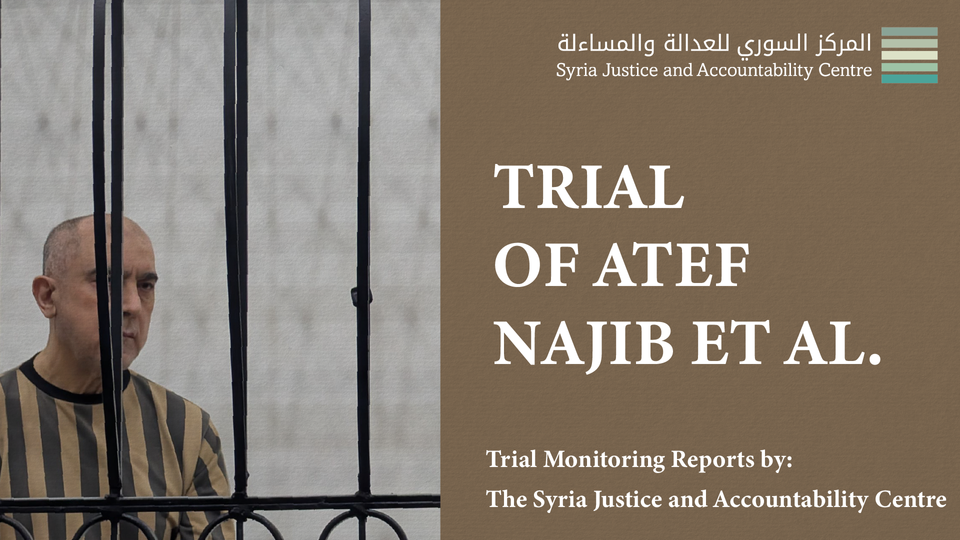
Inside the Trial of Atef Najib et al. #5: "Forget Your Children and Bring Your Women"
TRIAL OF ATEF NAJIB ET AL.
The Fourth Criminal Court – Damascus, Syria
Trial Monitoring Summary #5
Hearing Date: July 14, 2026
CAUTION: Some testimony may include graphic descriptions of torture, rape or other violent acts.
Note that this summary is not a verbatim transcript of the trial; it is merely an unofficial summary of the proceedings.
Throughout this summary, [information located in brackets are notes from our trial monitor] and “information placed in quotes are statements made by the witness, Judges or counsel.” The names and identifying information of witnesses have been redacted.
[Note: SJAC provides a summary of the proceedings while redacting certain details to protect witness privacy and to preserve the integrity of the trial.]
SJAC’s 5th trial monitoring report details day 5 of the trial of Atef Najib et al. in Damascus, Syria. On this trial day, sixteen witnesses delivered their testimonies before the Court.
The witnesses testified that the Political Security Branch held absolute dominance over events in Dar'a, as the Accused Atef Najib was the primary authority issuing orders. Multiple witnesses recounted the events of "Bloody Wednesday," the storming of the Omari Mosque, and the outbreak of demonstrations across Dar'a, describing how security forces opened fire on protesters, engaged in targeted sniping, and executed arbitrary arrests and severe torture, including against children.
Furthermore, one witness detailed how the Accused extorted the witness’s father prior to the revolution in 2004, taking 500 gold liras from him in exchange for ceasing his unlawful prosecution.
Day 5 – July 14, 2026
[Note: Media coverage was restricted to the media outlets of the Ministry of Justice only.]
The Accused, Atef Najib, was brought into the courtroom at 10:55AM. The Judges followed at 11:00AM, when the hearing of witnesses commenced. This constitutes the fifth session in Case No. (1) of 2026 against the Accused, Atef Najib.
The Accused Atef Najib appeared before the court, accompanied by his representative, Defense Counsel C1 [redacted name].
The Presiding Judge noted that the Accused, Atef Najib, had been granted a full opportunity during the previous session to state all details, and that it would be sufficient to state that he reaffirms his prior statements, which the Accused did.
The in-person and in-absentia trial proceedings commenced publicly.
Witness Testimony:
P14, [redacted name]
The Presiding Judge asked the witness to provide his testimony without addition or omission, whereupon P14 took the legal oath.
The Presiding Judge asked P14 whether he knew the Accused, Atef Najib, and whether there was any familial relationship or prior acquaintance with the Accused. P14 replied that he knew the Accused, but that there was no prior acquaintance or enmity between them before the incidents of 2011.
P14 testified that on Wednesday, March 23, 2011, they [i.e., the demonstrators] set out from Al-Hirak area toward Dar’a Al-Balad on foot heading toward the Al-Omari Mosque, where they arrived around sunset. When they arrived, there was a security checkpoint that let them into [Dar’a]. The Presiding Judge wanted to know the number of demonstrators. P14 replied that they numbered approximately seventy-five thousand people.
The witness continued his testimony, recounting that heavy and indiscriminate gunfire commenced upon their arrival at the security square [compound] opposite the Political Security Branch. The Presiding Judge wanted to know which entity was responsible for the gunfire. P14 responded that all forces belonged to the Political Security Branch, and there were snipers atop the Political Security Branch and the Farmers' Union. Following the heavy gunfire, the demonstrators took cover and fled; some were injured while others were detained. The Presiding Judge then inquired about the entities that detained them. P14 answered that the detainment was carried out by all security branches, but the Political Security Branch was in control because Atef Najib was the one issuing orders.
The Presiding Judge asked the Prosecutor whether he had any questions for the Accused, but the Prosecutor he had no questions.
The Judge asked the Accused whether he accepted the testimony of P14. The Accused answered in the negative.
W11, [redacted name]
The Presiding Judge asked the witness to provide his testimony without addition or omission, whereupon P14 took the legal oath.
The Presiding Judge asked P14 whether he knew the Accused, Atef Najib, and whether there was any familial relationship or prior acquaintance with the Accused. P14 replied that he knew the Accused, but that there was no prior acquaintance or enmity between them before the incidents of 2011.
W11 testified that on the day following Bashar Al-Assad’s speech on March 31, 2011, the residents went out in demonstrations to As-Saraya Square, where W11 was detained and subsequently taken blindfolded to the Political Security Branch, where he was tortured alongside a number of detainees.
The Presiding Judge wished to know how many people were tortured. W11 replied that there were between 15 to 20 people in the prison and that they were released on the same day.
The Presiding Judge asked about the person who interrogated the detainees. W11 responded that they were members of the Political Security Branch. W11 added that the martyr Ma'n Oudat was with them, then was released after some time, and was later assassinated.
The Judge asked the Accused whether he accepted the testimony of W11. The Accused answered in the negative.
W12, [redacted name]
The Presiding Judge asked the witness to provide his testimony without addition or omission, whereupon P14 took the legal oath.
The Presiding Judge asked P14 whether he knew the Accused, Atef Najib, and whether there was any familial relationship or prior acquaintance with the Accused. P14 replied that he knew the Accused, but that there was no prior acquaintance or enmity between them before the incidents of 2011.
W12 mentioned that this day was named Bloody Wednesday. He then testified that the demonstrators entered the stadium as soon as they arrived in Dar’a. All of the demonstrators saw members of the Political Security Branch at its entrance, however, they continued marching. They were fired upon from the direction of the Farmers' Union and the Post Office affiliated with the Political Security Branch. There were plain-clothed snipers, and they were the ones who opened fire on the demonstrators.
W12 mentioned some names of martyrs, such as Jamal Mohammad Imam, who was sniped from the Governor's House in his knee and subsequently in his head. Additionally, there were Salah Abdurrahman Al-Hariri and Mohammad Ahmad Al-Hariri, who were sniped in their heads. The Presiding Judge wanted to know whether the witness saw the Accused with his forces during the shooting. W12 replied that he saw only the forces.
Resuming his testimony, W12 testified that the demonstrators then continued marching until approximately 9:00PM and entered the railway track, whereupon they were surprised by gunfire from the Governor's House, and they remained at the railway track for about an hour. After that, they continued marching and found a wall and an Iraqi market. Suddenly, they fell into a trench, but individuals from the Christian community helped them get out.
The Presiding Judge asked whether any of the demonstrators were arrested. The witness confirmed that some of them were arrested.
The Prosecutor wanted to know if more than two individuals were martyred. W12 answered that there were only two individuals, adding that there were wounded people who were given first aid and beaten inside the ambulance: Among those wounded were Majdi Turkmani, Ahmad Abu Safi, Salah Al-Hariri, and Ahmad Al-Hariri.
The Judge asked the Accused whether he accepted the testimony of W12. The Accused answered in the negative.
W13, [redacted name]
The Presiding Judge asked the witness to provide his testimony without addition or omission, whereupon W13 took the legal oath.
The Presiding Judge asked W13 whether he knew the Accused, Atef Najib, and whether there was any familial relationship or prior acquaintance with the Accused. W13 replied that he knew the Accused, but that there was no prior acquaintance or enmity between them before the incidents of 2011.
W13 introduced himself as having served as a head of the jail at the Military Judiciary since the beginning of the revolution. After the revolution began, a large number of people were killed. Through his position, W13 learned that the [Military] Public Prosecutor, Mohammad Hasan Kanjo, was conducting executions in Sednaya Prison every Monday morning. The witness informed the Free Syrian Army of what was happening, and they requested that he monitor Kanjo and all his movements. On an evening in November 2011, Atef Najib went to the office of Mohammad Hasan Kanjo in Damascus. W13 added that the body of the martyr Hamza Al-Khatib was mutilated, and the “[former] regime” issued an arrest warrant against Atef Najib at the time; however, Atef Najib continued to frequent the office in the evenings for two or three days, staying there for two hours under the pretense of being detained, whereas he was entirely free. Thereafter, the witness continued in his post for some time before defecting, after which he became wanted and pursued by the security branches.
The Judge asked the Accused whether he accepted the testimony of W13. The Accused answered in the negative.
P4, [redacted name]
The Presiding Judge asked the witness to provide her testimony without addition or omission, whereupon P4 took the legal oath.
The Presiding Judge asked P4 whether she knew the Accused, Atef Najib, and whether there was any familial relationship or prior acquaintance with the Accused. P4 replied that she knew the Accused, but that there was no prior acquaintance or enmity between them before the incidents of 2011.
P4 testified that on February 15, 2011, the Political Security Branch conducted house raids approximately five times a day, with no set schedule for them. The Presiding Judge questioned how the witness knew that the forces belonged to the Political Security Branch. She responded that they [i.e., the people] knew them by their vehicles.
P4 continued her testimony, stating that on March 18, 2011, the situation was extremely scary, and people were living in intense fear and panic. House raids were carried out by all security branches, showing no respect for children, women, or the elderly. When the children were detained, the residents went out demanding their return, after which people confined themselves to their homes. P4 clarified that the people were unarmed and merely chanting slogans. The Presiding Judge asked the witness if any members of her family were martyred, which she denied.
P4 resumed her testimony, recounting that on March 23, 2011, people heard heavy gunfire, and electricity and communications were cut off. The young men called for help because all security branches — including the Political Security Branch — were opening fire on the demonstrators and sit-in participants. On this day, the massacre occurred and there were a number of martyrs. During the funeral procession at the Al-Omari Mosque, heavy gunfire suddenly erupted from all directions and from all security branches — including the Political Security Branch — resulting in the martyrdom of Fadi Al-Mahamid alongside nine other martyrs. On the same day, paramedics went out to March 18 Square and brought down the statue of Hafez Al-Assad, whereupon heavy gunfire commenced.
The Judge asked the Accused whether he accepted the testimony of P4. The Accused answered in the negative.
P30, [redacted name]
The Presiding Judge asked the witness to provide her testimony without addition or omission, whereupon P30 took the legal oath.
The Presiding Judge asked P30 whether she knew the Accused, Atef Najib, and whether there was any familial relationship or prior acquaintance with the Accused. P30 replied that she knew the Accused, but that there was no prior acquaintance or enmity between them before the incidents of 2011.
P30 reported that she is the sister of the martyr Ashraf Abdulaziz Al-Masri, who was martyred on March 23, 2011, in Al-Omari Square. On that day, people woke up to takbir from the minarets and calls announcing that young men participating in a sit-in were besieged in Al-Omari Square. When residents outside of Dar’a heard what was taking place, they came from the As-Sadd area to support those under siege. The witness was listening to and watching what was happening, describing it as a very terrifying night, as all security forces were deployed, heavy gunfire was taking place, and the takbir of the town's youth were echoing in pleas for help. An argument ensued between security personnel and the local youth; the youth said to them, "We are brothers, why are you killing us?" Her brother was present among the youth and the security forces when a verbal provocation occurred on her brother's part. Whereupon, security forces shot him in the flank and beat him, with blood flowing heavily from him, and twelve of his ribs were broken. As they were beating him, a security officer said to her brother, "Are you lacking oil or bread?" Her brother replied, "We want dignity, and we came out for our squandered dignity and the detained young ones." One of the security forces, a local of Dar’a named Khalid Al-Masri, was present. He was ordered to shoot P30’s brother but refused. Another security personnel then came and commanded her brother to state that Bashar Al-Assad was his lord, but her brother refused and said, "My Lord is God." The security personnel then shot her brother, and he was martyred.
After concluding her testimony, P30 attributed everything that occurred in Dar’a to the Accused Atef Najib, as he was the sole authority in command and responsible for the sea of blood that took place in the city.
The Judge asked the Accused whether he accepted the testimony of P30. The Accused answered in the negative.
P2, [redacted name]
The Presiding Judge asked the witness to provide his testimony without addition or omission, whereupon P2 took the legal oath.
The Presiding Judge asked P2 whether he knew the Accused, Atef Najib, and whether there was any familial relationship or prior acquaintance with the Accused. P2 replied that he knew the Accused, but that there was no prior acquaintance or enmity between them before the incidents of 2011.
P2 testified that Atef Najib had been in contact with P2’s father prior to 2011, when Atef Najib held the rank of Colonel and resided in Damascus. Atef Najib came to know P2's father through acquaintances [mutual friends], and his father was [regularly] summoned to go to the security branch blindfolded and remain there for about three hours. After some time, Atef Najib asked P2's father to write down what he owned on a piece of paper, and subsequently demanded one thousand gold liras [note: One gold Lira equals 8 gm of gold] from him to release him from the branch and cease pursuing him. Indeed, P2 recounted, his father paid five hundred gold liras, and he was released. P2 added that his father passed away in 2004, and that this incident occurred prior to that date.
The Prosecutor wanted to know the condition of P2's father's health [at the time]. P2 responded that his father suffered from several serious illnesses due to the fear he experienced while at the security branch.
The Presiding Judge wanted to know who delivered the sum to the Accused. P2 answered that it was done through his brother O2 [redacted name].
The Judge asked the Accused whether he accepted the testimony of P2. The Accused answered in the negative.
W1, [redacted name]
The Presiding Judge asked the witness to provide his testimony without addition or omission, whereupon W1 took the legal oath.
The Presiding Judge asked W1 whether he knew the Accused, Atef Najib, and whether there was any familial relationship or prior acquaintance with the Accused. W1 replied that he knew the Accused, but that there was no prior acquaintance or enmity between them before the incidents of 2011.
W1 testified that following the massacre at the [Omari] Mosque on March 22, 2011, at twelve o'clock at night, a distress call arrived from the eastern countryside. On the following day, March 23, 2011, at 11:00AM, people gathered in Al-Hirak to lift the siege on [Dar’a] and the [Omari] Mosque. Approximately two thousand demonstrators set out on foot in support of Dar’a Al-Balad, chanting "To the rescue, to the rescue against injustice and tyranny." After that, they performed the noon prayer and headed toward Dar’a Al-Balad, as their numbers grew to over 70 thousand demonstrators. The number of martyrs at that time was large. Upon their arrival at the Panorama Roundabout toward Dar’a Al-Mahatta, Atef Najib was standing at the checkpoint, accompanied by an individual wearing a black cloak. W1 was at the front of the demonstrators. The demonstrators were caught off guard when the shooting began, as there were armed forces from the Popular Army among them [who had infiltrated the demonstrators]. W1 added that there is a video clip in which an individual named Abu Riyadh says "Enter." When the demonstrators entered, their objective was to reach Al-Omari Mosque. When they arrived, heavy gunfire commenced from all directions. Among the demonstrators were the following martyrs: Jamal Al-Imam, Majdi Turkman, Mohammad Salamat, Ahmad Salamat, and Ahmad Al-Bahiyya. Jamal Al-Imam was bleeding. The demonstrators began fleeing from the gunfire. Members of the Political Security Branch, Military Security, Public Security, and the Popular Army along Post Office Road were firing upon the demonstrators.
The Presiding Judge wanted to know whether Atef Najib was present with the forces. W1 confirmed that the Accused was with them at the Political Security building.
W1 continued his testimony, recounting that the demonstrators dispersed following the heavy gunfire, headed toward a church near the location, hid inside for a short while, and then exited. At this point, the evacuation of the wounded began. The witness described this day as extremely terrifying, as electricity and communications were cut off, and that incident was named the Bloody Wednesday Massacre.
The Presiding Judge asked the witness whether he knew the number of martyrs, to which the witness replied that there were approximately six martyrs from Al-Hirak area, and the total number of martyrs exceeded 37, as every village had a share of martyrs due to the dense turnout, all of which was to support Dar’a Al-Balad.
The Judge asked the Accused whether he accepted the testimony of W1. The Accused answered in the negative.
W14, [redacted name] [was not present at this point, appeared later]
W15, [redacted name] [was not present]
P24, [redacted name]
The Presiding Judge asked the witness to provide her testimony without addition or omission, whereupon P24 took the legal oath.
The Presiding Judge asked P24 whether she knew the Accused, Atef Najib, and whether there was any familial relationship or prior acquaintance with the Accused. P24 replied that she knew the Accused, but that there was no prior acquaintance or enmity between them before the incidents of 2011.
P24 introduced herself as working as a social counselor in Tareeq As-Sadd. While she was at work at the beginning of the revolution in 2011, Lo’ay Al-Ali [Military Intelligence in Daraa] arrived accompanied by his assistant and forces from Military Security, and they arrested 15 to 20 children from the school. The children were subjected to severe torture. Among them was a child from the Al-Krad family who suffered from involuntary urination due to the severity of the torture, after which the child dropped out of school. P24 reported that the Military Security Branch and the Political Security Branch were the ones committing the torture. Lo’ay Al-Ali threatened the families and the school in the event they failed to cooperate with him.
The Prosecutor asked the witness whether she possessed any information regarding the Al-Omari Mosque massacre. P24 responded that her husband was one of the [demonstrators], and all security branches attacked him, and he was detained and tortured.
The witness stated that she seeks to secure her rights and the rights of all the people of Dar’a from Lo’ay Al-Ali and Atef Najib.
The Judge asked the Accused whether he accepted the testimony of P24. The Accused answered in the negative.
W16, [redacted name]
The Presiding Judge asked the witness to provide his testimony without addition or omission, whereupon W16 took the legal oath.
The Presiding Judge asked W16 whether he knew the Accused, Atef Najib, and whether there was any familial relationship or prior acquaintance with the Accused. W16 replied that he knew the Accused, but that there was no prior acquaintance or enmity between them before the incidents of 2011.
W16 recounted how he saw the Accused Atef Najib and recognized him through his work, as he was employed as a worker at the stadium. On one occasion, a vehicle entered the stadium while W16 was inside, from which Atef Najib and the Governor [of Dar’a] disembarked, and approximately eight helicopters carrying about 12 to 15 personnel landed. W16 recognized Atef Najib at that time. They [the witness and the security forces] came to stand off to one side, while ambulances and buses remained outside. Accompanying the security forces in the stadium was an individual wearing a suit. After that, the forces went to the buses.
The Judge asked the Accused whether he accepted the testimony of W16. The Accused answered in the negative.
P43, [redacted name]
The Presiding Judge asked the witness to provide his testimony without addition or omission, whereupon P43 took the legal oath.
The Presiding Judge asked P43 whether he knew the Accused, Atef Najib, and whether there was any familial relationship or prior acquaintance with the Accused. P43 replied that he knew the Accused, but that there was no prior acquaintance or enmity between them before the incidents of 2011.
P43 testified that when the Al-Omari Mosque was stormed and gunfire commenced from all directions, he was at his house located on [redacted information]. The sit-in participants were chanting “Hasten to Jihad [struggle].” Dense gunfire was heard at this point and martyrs began dropping dead. P43 added that Maher Al-Assad’s division participated alongside the security branches in the shooting. P43 also saw security forces between the alleys, but he did not know to which entity they belonged, as it was nighttime. P43 concluded by clarifying that the sit-in participants were in the streets.
The Judge asked the Accused whether he accepted the testimony of P43. The Accused answered in the negative.
W14, [redacted name]
The Presiding Judge asked the witness to provide his testimony without addition or omission, whereupon W14 took the legal oath.
The Presiding Judge asked W14 whether he knew the Accused, Atef Najib, and whether there was any familial relationship or prior acquaintance with the Accused. W14 replied that he knew the Accused, but that there was no prior acquaintance or enmity between them before the incidents of 2011.
W14 introduced himself as having served in the police in 2011 in Ash-Shajara district. On March 22, 2011, they received a telegram ordering them to open fire on demonstrators and not to allow the Security Committee — formed by Atef Najib, Mahmoud Ramadan, and Faisal Kalthoum from the Police Branch — to approach. Subsequently, the army entered Dar’a Al-Balad, but the soldiers refused to open fire on the demonstrators, whereupon the Ministry of Interior referred them to Criminal Security for interrogation. Following the interrogation, they were imprisoned and requested to disclose certain names, but they refused to provide any information; they were accused of treason and remained in prison for 25 days, after which they were referred to the Field Court and were later released under an amnesty decree. A week later, the Damascus Police Commander and the Assistant Minister of Interior reinstated the soldiers to their units. During that time, an assault on Dar’a Al-Balad occurred, and forces from the Political Security Branch detained [the witness] once again, after which W14 defected and was subjected to threats.
The Presiding Judge wanted to know whether W14 was aware of the massacres that occurred during that period. W14 responded that he learned of them through personnel [from the security forces or the army] in the Izra' area, where fire was opened on demonstrators from several locations, including the Research Center and the Ministry of Finance.
The Judge asked the Accused whether he accepted the testimony of P43. The Accused answered in the negative.
W4, [redacted name]
The Presiding Judge asked the witness to provide his testimony without addition or omission, whereupon W4 took the legal oath.
The Presiding Judge asked W4 whether he knew the Accused, Atef Najib, and whether there was any familial relationship or prior acquaintance with the Accused. W4 replied that he knew the Accused, but that there was no prior acquaintance or enmity between them before the incidents of 2011.
W4 introduced himself as having worked as an employee at the Syrian-Jordanian Free Zone. The National Hospital requested medications for bleeding from W4, and he secured the medicine. On March 22, 2011, he told the demonstrators that he could not deliver the [medications] to the mosque until his shift ended in the evening. In the evening, he took the medications to the mosque. Around midnight, the witness went outside to smoke, whereupon heavy gunfire commenced, and opposite the mosque was an archaeological site in which W4 hid. He was unable to move or exit from this location, therefore, he remained there for about two hours. There were security forces standing near his location carrying two-way radios. Orders were coming to them via the devices, and among these orders was placing weapons inside the Al-Omari Mosque. One of the personnel asked, "Who are you speaking with?" and one of them answered that [the speaker] was Atef Najib, and that he was the one who gave the orders to place the weapons inside. After some time, the witness was able to exit the location.
The Presiding Judge questioned whether the witness recognized any of the personnel, which W4 denied.
The Judge asked the Accused whether he accepted the testimony of W4. The Accused answered in the negative.
W17, [redacted name]
The Presiding Judge asked the witness to provide his testimony without addition or omission, whereupon W17 took the legal oath.
The Presiding Judge asked W17 whether he knew the Accused, Atef Najib, and whether there was any familial relationship or prior acquaintance with the Accused. W17 replied that he knew the Accused, but that there was no prior acquaintance or enmity between them before the incidents of 2011.
W17 testified that he worked as a radiology technician at Dar’a National Hospital from March 18, 2011, to April 8, 2011. W17 reported that he was at his house on "Bloody Wednesday," corresponding to March 23, 2011. At 12:00AM, people heard about the situation in Dar’a on the news. W17 went to the hospital with the mourners, accompanied by a young man named Ali Qassab. After they arrived to bury the martyrs, they went to the mosque to lift the siege on it. Gunfire erupted and security forces attacked them, whereupon the witness returned to the hospital. The Presiding Judge wanted to know who opened fire. W17 responded that it was the Special Tasks Unit, although he did not know whether the Political Security Branch was with them.
There was a call for succor near the Al-Sha'b gas station, and shots were fired on the demonstrators. The witness returned to the hospital to treat the injured, and the scene was extremely terrifying. The Presiding Judge wished to know whether the witness spoke with the injured, to which W17 answered that there was no time to speak with the injured due to the severity of the scene, the high number of casualties, and the required speed of first aid, as nurses were treating the injured and evacuating them through the back door of the hospital.
On April 8, 2011, Ahl Al-Qura [the villagers] Massacre occurred, and this day was named the "Friday of Steadfastness." W17 clarified that numerous demonstrations took place on Friday. The witness was with the paramedics, and ambulances were requested; one of them was targeted, injuring paramedic Mohammad Al-Khalil. There were numerous injuries in Dar’a Al-Balad, therefore, paramedics went out in their civilian vehicles to rescue people. There were several snipers stationed at the Post Office Roundabout and the Government Complex. The Presiding Judge wanted to know whether Atef Najib was present with the security forces. W17 replied that he did not see the Accused with them.
At that time, the Political Security Branch detained W17 on April 8, 2011, and security forces from Tartus and Lattakia were injured. The witness was tortured, insulted, and threatened while injured.
The Prosecutor wanted to know whether personnel from any of the security branches arrived while W17 was at the hospital. W17 confirmed that they did, however, he did not know to which branch they belonged.
The Judge asked the Accused whether he accepted the testimony of W17. The Accused answered in the negative.
W18, [redacted name]
The Presiding Judge asked the witness to provide his testimony without addition or omission, whereupon W18 took the legal oath.
The Presiding Judge asked W18 whether he knew the Accused, Atef Najib, and whether there was any familial relationship or prior acquaintance with the Accused. W18 replied that he knew the Accused, but that there was no prior acquaintance or enmity between them before the incidents of 2011.
W18 testified that [personnel belonged to] Lo’ay Al-Ali detained him from school when he was 13 years old, because of writing "It is your turn, Doctor." W18 was subsequently taken to the Military Intelligence Branch for interrogation, where he remained being tortured until the call to evening prayer. [Under coercion during interrogation,] W18 mentioned the names of P23 [redacted name] and O3 [redacted name]. W18 was then transferred to As-Sweida, to Brigadier General Suhail Ramadan, who interrogated him. W18 was tortured for 10 days using the tire method, cables, and severe beatings to force a confession and reveal the entity he belonged to. Thereafter, he was transferred to the Palestine Branch. Throughout the entire interrogation, he was blindfolded in a room, and two individuals were interrogating him whom he did not identify. After his release from detention, it was said that Atef Najib and Bashir [one of the personnel] were the ones issuing the orders, and that the town notables went to secure the release of the children, but Atef Najib refused to do so. Atef Najib and Suhail Ramadan were saying, "Forget your children and bring your women."
The Presiding Judge wanted to know whether Atef Najib was present during the interrogation in As-Sweida, which W18 denied, clarifying that he was blindfolded.
The Judge asked the Accused whether he accepted the testimony of W18. The Accused answered in the negative.
P22, [redacted name] [was not present]
P25, [redacted name]
The Presiding Judge asked the witness to provide his testimony without addition or omission, whereupon P25 took the legal oath.
The Presiding Judge asked P25 whether he knew the Accused, Atef Najib, and whether there was any familial relationship or prior acquaintance with the Accused. P25 replied that he knew the Accused, but that there was no prior acquaintance or enmity between them before the incidents of 2011.
P25 testified that March 18, 2011, was the first day of the launch of the “Al-Hamza and Al-Abbas [Mosque demonstration]” toward the Al-Omari Mosque. Afterwards, P25 [and the demonstrators] returned home. By late afternoon, security forces began detaining young men from Dar’a Al-Balad, among whom was the martyr Mahmoud Ayyash. Among the demonstrators, there was a blond young man who entered the house with them [i.e., with the witness and the demonstrators], wearing a yellowish shirt. When asked what he was doing among them, the young man responded that those were the orders of "Boss Atef," as Atef Najib, P25 explained, used to make his forces infiltrate among the demonstrators to open fire on them.
P25 reported that at the time of the Al-Omari massacre at 1:00AM, people were performing prayers when they heard young men [stating that security forces attacked the sit-in participants and slaughtered them]. Consequently, people went out to see what was happening and went to the medical center to assist. Heavy gunfire commenced from all directions. They [i.e., the demonstrators] hid in an ancient archaeological site and began banging on cars to distract the security forces and dissuade them from entering the mosque or attacking the ambulances. They [i.e., the demonstrators] then fell back, and one of the forces began opening fire on them. When the security forces reached the mosque, they deployed tear gas and one of their personnel was killed. People began withdrawing and numerous arrests occurred. The Presiding Judge asked whether the witness knew to which branch the forces belonged, which P25 denied.
On the following day, P25 saw Haytham Manna’ saying on television that these events must be brought before the Security Council. On March 20, 2011, people went out in a large demonstration — approximately 200 people — and forces from the Political Security Branch began opening fire. Afterwards, the demonstrators withdrew toward the west and hid in a house belonging to the Political Security Branch, as it was vacant; the house belonged to Brigadier General Fayez Isma’il.
The Judge asked the Accused whether he accepted the testimony of P25. The Accused answered in the negative.
The Court decided to summon the remaining witnesses and hear their testimony in the upcoming session.
The proceedings were adjourned at 1:00PM.
The next trial day will be on July 21, 2026, at 11AM.
___________________________
For more information or to provide feedback, please contact SJAC at [email protected] and follow us on Facebook and Twitter. Subscribe to SJAC’s newsletter for updates on our work