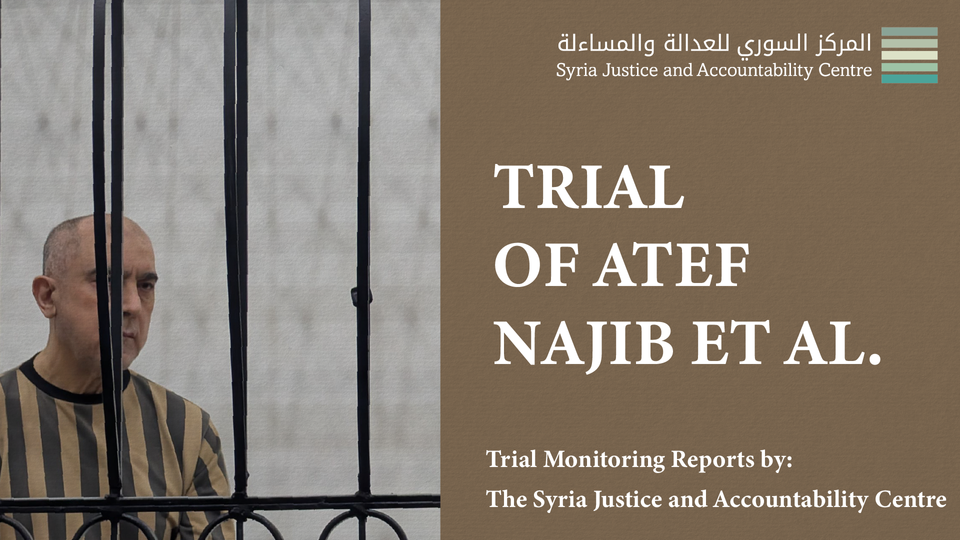
Inside the Trial of Atef Najib et al. #3: Denial, Denial, and Denial
TRIAL OF ATEF NAJIB ET AL.
The Fourth Criminal Court – Damascus, Syria
Trial Monitoring Summary #3
Hearing Date: May 19, 2026
CAUTION: Some testimony may include graphic descriptions of torture, rape or other violent acts.
Note that this summary is not a verbatim transcript of the trial; it is merely an unofficial summary of the proceedings.
Throughout this summary, [information located in brackets are notes from our trial monitor] and “information placed in quotes are statements made by the witness, Judges or counsel.” The names and identifying information of witnesses have been redacted.
[Note: SJAC provides a summary of the proceedings while redacting certain details to protect witness privacy and to preserve the integrity of the trial.]
SJAC’s 3rd trial monitoring report details day 3 of the trial of Atef Najib et al. in Damascus, Syria. On the trial day, five witnesses appeared before the Court and provided their testimony. They indicated that the Accused was the one who ordered the shooting of demonstrators in Dar’a and held him responsible for the Al-Omari Mosque incident. However, the Accused denied all charges brought against him, as well as any responsibility for the arrest of children in Dar’a.
Day 3 – May 19, 2026
[Note: Media coverage was restricted to the media outlets of the Ministry of Justice only.]
The session began at 10:55 AM with the entry of the Accused, Atef Najib, followed by the entry of the Court officials at 11:00 AM, at which point the interrogation of the Accused commenced. This constitutes the third session for Case No. (1) of 2026 regarding the Accused, Atef Najib.
The Accused, Atef Najib, appeared before the Court, and his representative, Defense Counsel C1 [redacted name], was present with him.
The Presiding Judge noted that the Accused, Atef Najib, had been granted a full opportunity during the previous session to state all details, and that it would be sufficient to state that he reaffirms his prior statements, which the Accused did.
The Judge questioned the Accused regarding periodic [security] meetings that were held regularly, whether he used to attend them, and about their minutes. The Accused responded that those meetings were held at the party branch headquarters [i.e. Al-Ba’th party]. The Accused added that no written session minutes existed after March 18, 2011, because the meetings were being held on an emergency basis. The Judge followed up by asking whether there had been any objections [in the meetings] prior to that date, to which the Accused answered that there may have been some occasionally.
The Judge inquired about the dispute that took place with Hisham Al-Bikhtiyar regarding the agreed-upon security plan. The Judge wanted to know what transpired between them and what the plan was. The Accused responded that there was a march coming from the countryside of Dar’a, and the National Security Bureau deemed it appropriate to set an ambush for the demonstrators.
The Judge asked the Accused for clarification as to why this matter was discussed with him individually without involving the Security Committee. The Accused replied that there had been a dispute regarding the martyrs the previous day, therefore, the dialogue took place between them in private, adding that he objected to this proposal and that he had been called to the meeting two hours prior [to the meeting with the rest of the security branches].
The Judge wanted to know what was planned to be carried out in the ambush. The Accused responded that the plan aimed to entrap the demonstrators, asserting that he objected to this procedure and did not participate in the shooting.
The Judge inquired about what took place during the meeting with the Security Committee. The Accused replied that he had not been invited to attend that meeting.
The Judge wanted to know how the Accused learned of that meeting. The Accused stated that it was his conclusion, and that the details of setting the trap were not explained to him, reiterating his objection and his non-participation in the shooting, and that he was transferred on the same day to Damascus.
Witness Testimony:
W1, [redacted name]
W1 testified that a demonstration set off at exactly 12:00 AM, and upon its arrival at the Panorama roundabout, the Accused, Atef Najib, was spotted wearing a hat on his head accompanied by another person. Upon the entry of the demonstrators, [the Accused] signaled them to keep moving, and then three shots were fired into the air, which served as the commencement signal, whereupon heavy gunfire rained down on the demonstrators. W1 added that all security branches participated in this entrapment.
The Judge asked the Accused if he was present at that scene, and the Accused denied being present during the entry of the demonstrators, claiming that he was inside the branch headquarters with the personnel of the branch.
The Witness added that the Accused, Atef Najib, brandished his weapon and opened fire on one person, who was martyred.
When the Judge confronted him, the Accused denied this accusation, asserting again that he was inside the branch headquarters and that one of the personnel was the one who opened fire.
W2, [redacted name]
W2 testified that he saw the Accused upon their arrival at the gas station, and the Accused was wearing the same hat and clothing, with personnel from the Political Security standing by his side.
When the Judge questioned him about this matter, the Accused denied and said that he was inside the branch headquarters.
The Judge noted that the witness testified that the Accused drew his gun and shot a person dead, but the Accused denied this.
P17, [redacted name]
P17 testified that the Accused was giving orders to all personnel and the remaining security branches to open fire on the demonstrators coming from the countryside. The Accused denied this statement.
The Judge noted that a group of personnel from the Political Security Branch was seen complying with the orders of the Accused. However, the Accused denied this.
P14, [redacted name]
P14 testified that the shooting began from the roof of a building near the Officers' Club and the Governor's house. The Accused countered that the aforementioned location is not close to the branch headquarters.
The Witness added that the Accused was leading the military operation when shooting occurred at the gas station, leading to dozens of casualties. However, the Accused denied this.
The Witness said that there were snipers belonging to the Political Security on the roof of its headquarters, and that the Political Security was the entity that deployed them there. When the Judge asked the Accused to comment on this statement, he again denied it.
The Judge wondered whether it was possible — according to the knowledge of the Accused — for snipers from the Political Security to deploy on roofs. The Accused responded that there was no one shooting from atop the roofs.
The Judge said that all evidence indicates that the Accused is the one who undertook the execution of that entrapment. However, the Accused categorically denied this.
The Judge asked whether the Accused admits that the Security Committee met in his absence. The Accused affirmed, adding that the Military Security and the State Security met on the same day, and noting the absence of written reports and that the personnel were at the branch.
The Judge wanted to know which high-ranking levels of administration they were communicating with during those meetings. The Accused answered that the Security Committee and the National Security Bureau were the ones undertaking communication with Damascus, and that orders were being issued by either the Minister of Defense or the President of the Republic.
The Judge sought clarification as to whether any communication had occurred with Bashar Al-Assad or Maher Al-Assad regarding the incidents that were taking place in Dar’a before the Accused was dismissed from his position. The Accused responded that he never communicated with them.
The Judge questioned whether the Accused notified the Command after he learned of the security plan. The Accused responded that there was no communication with him, and that he did not notify the Political Security Directorate. When asked by the Judge about the reason for not notifying them, the Accused answered that this occurred in the early morning, and that there was no need to notify them.
The Judge noted that W3 [redacted name] and the P27 [redacted name] witnessed the Accused passing in his car through the checkpoint, at which point they were fired upon, and that they asserted that the Accused was at the location. The Accused denied, claiming that this incident occurred with the Military Security.
The Judge wondered why Atef Najib was personally accused in all of these allegations. However, Atef Najib denied their veracity.
The Judge recalled that witnesses had testified that Atef Najib was supervising the distribution of detainees among the security branches, and that he personally led the military operation in the Omari Mosque massacre. The Accused denied this and any claims that he issued any directives in this regard whatsoever.
The Judge asked the Accused about the fate of the detainees in the security branches. The Accused responded that he has no knowledge of anything related to this matter, and that he did not receive any report in that regard.
W4, [redacted name]
W4 testified that while he was present, he heard personnel talking over the wireless radio device that the Accused, Atef Najib, was the one who issued the order to bring weapons into the Omari Mosque. The Accused denied this, claiming that there were no wireless radio devices at the time, and that communication was limited to mobile phones.
The Judge confronted the Accused with the fact that most testimonies indicate and confirm that he was the one who established the security checkpoint at the Al-Karak roundabout; that he issued orders to open fire on demonstrators and ambulances; and that he was the one who killed Dr. Ali. The Accused responded that he took that road during the day and saw a damaged medical vehicle on the roadside, suggesting it was more likely that the Military Security and the State Security were the ones that issued the shooting orders. The Accused added that he does not know anyone personally by name, not even the deceased martyr.
The Judge reminded the Accused that in his previous statement, he denied that anyone had died inside the branch. The Judge then recalled that P22 [redacted name] had stated that the death of his father, [redacted name], in the Political Security Branch was a punishment for him because his father did not turn him over [to the security apparatuses]. The Accused denied this incident. The Judge wondered why P22 accused him specifically regarding the case of his father’s death, but the Accused rejected the accusation.
The Judge recalled that a number of witnesses stated that the Accused arrested a group of individuals and distributed them among several security branches. The Judge wanted to know the number of detainees held by the Accused at the branch. The Accused denied the veracity of these statements.
The Judge wanted to know if the Accused had any knowledge regarding the existence of mass graves in Dar’a based on what was broadcast on television, and whether he had any idea about the potential locations of these graves. The Accused answered that he knows nothing about this matter.
The Judge requested an explanation from the Accused for all the witness testimonies confirming the intervention of the Political Security Branch, despite the Accused’s denial of any intervention in his statements. The Accused responded that there was no intervention by the branch.
The Judge noted that there were several massacres that took place during the period of the Accused’s presence in Dar’a — from March 15 to March 18, 2011. The Judge wanted to know whether those massacres occurred pursuant to a systematic policy. The Accused answered that the Monday massacre had been pre-planned.
The Judge followed up by asking whether the Accused believed these events were planned by the Security Committee or with the higher authorities, and questioned whether a security cell could make decisions at this level. The Accused admitted that a security cell could make such a decision.
The Judge sought clarification from the Accused as to whether he notified the Political Security Directorate of the losses and the deaths of martyrs following the massacres which, according to the Accused’s statements, he witnessed but had no connection to. The Accused clarified that this procedure is called a “notification via fax,” and testified that he had notified the General Intelligence Directorate at the time of what occurred, and had informed Damascus that Intelligence had raided the Omari Mosque, and that it was said that the Military Security was the one that caused the death of martyrs.
The Court displayed photographs of the casualties and the wounded. The Judge asked the Accused whether these photographs had been shown to him before. The Accused responded that it was the first time he had seen these photographs.
Photographs and video clips of an individual being tortured inside the branch were displayed. The Judge noted that when that individual was asked [later, as part of this ongoing trial] about who was beating him in the video, that individual stated that they were Political Security personnel. The Accused denied this, adding that he does not know the detainees from the Omari Mosque.
The Judge sought clarification from the Accused regarding the nature of his relationship with the children of Dar’a, and the Accused responded that he had no relationship with them whatsoever.
The Judge asked the Accused about the reason for his transfer and summons for investigation, and what the decisions of the committee concluded. The Accused responded that the summons was following a dispute with the National Security Bureau, and that after the committee became convinced of his lack of connection to the incidents, the decisions were limited to a travel ban without imposing any disciplinary sanction.
The Judge recalled the incident where a member of the Air Force Intelligence Directorate was arrested, and wanted to know what his fate was and what legal measures were taken against him. The Accused responded that the investigation department was the entity that undertook that task, noting that Major Malek Hasan was the head of the investigation department at that time.
Upon questioning him about the names of the officers who served concurrently with him during his service, the Accused responded that he does not remember any names.
The Judge inquired about the duration of the Accused’s service inside the branch, and the Accused testified that it amounted to three years.
The Judge recalled that the Accused had previously denied requesting a military force from Damascus. The Judge then pointed out that Yousuf Abu Roumiyyah, who was a member of the People’s Assembly, stated in his testimony on television that he heard about the arrest of children and the summoning of forces from Damascus, and that the Accused proceeded to open fire and that dozens were martyred. The Judge requested that the Accused comment on that. The Accused responded that the statement of that person is incorrect because the military force belonged to the Military Intelligence Directorate.
W5, [redacted name]
W5 testified that he met with the Accused and spoke with him directly inside the branch headquarters at the request of the Accused, and that he urged the Accused to withdraw the security branches’ personnel from the city of Dar’a, but the Accused refused this and requested military reinforcements from Damascus. The Accused denied what was mentioned in the witness’s testimony.
The Judge asked the Accused whether there were other juvenile detainees who had been held at the branch. The Accused responded that a telegram had been received from the branch indicating the presence of a group of children under the age of eighteen, some of whom were referred to the court and some to the Political Security Branch.
Afterwards, the official record was displayed on the screen of the Court. The Accused explained that the number of children ranged from 6 to 7, who were arrested at the Political Security Branch and handed over pursuant to official records, namely: P37 [redacted name], P18 [redacted name], P19 [redacted name], P20 [redacted name], and O1 [redacted name], all of whom were under eighteen and present at the State Security Branch, and they were transferred through the Political Security Branch; however, the police was the entity that issued the official record, and the children were presented before the Court at that time through the Political Security Branch. The Accused added that there is a juvenile [detention] center in Dar’a where they stayed for two days, before the Political Security returned them to the State Security, and subsequently they were referred to the judiciary.
The Judge wanted to know why the Accused initially denied that these children were detained at the Political Security Branch and claimed they were not subjected to torture, noting that those children were tortured during the period of their detention at the branch, and that the Accused would be confronted by them during the trial. The Accused denied his connection to the matter.
The Judge noted that the Accused had previously denied any relationship with the children, then confronted him with the testimony of P23 [redacted name], who stated that he saw the Accused arrive at the office of Wafiq Naser at the Military Security Branch, where the Accused undertook the interrogation of P23, placed his feet on his neck, and ordered one of the personnel to urinate on him. P23 added in his statement that he was subjected to torture, including the pulling out of his fingernails and electric shocks, and that the Accused saw the marks of this torture. When requested by the Judge to respond, the Accused denied all of these statements.
The Judge noted that other children stated that the Accused, Atef Najib, was present during their torture and that he interrogated them himself. The Accused responded that the head of the branch does not undertake interrogations.
The Judge recalled that the Accused had previously mentioned that Sheikh Ahmad As-Sayasneh visited him for the purpose of mediation, pointing out the existence of testimony which states that the Accused insulted the Sheikh during that visit. The Accused denied having insulted the Sheikh and that anyone had approached him at all.
The Judge wanted to know the reason for the Accused’s presence in the city of Dar’a after the decision to terminate his service had been issued, despite his previous denial of that. The Accused reiterated his denial [of staying in Dar’a].
Regarding the reason for the recurrent accusations against him, the Accused answered that he does not know a reason for that.
The Judge noted the kinship of Atef Najib to the “fugitive Accused, Bashar Al-Assad,” and that many witnesses stated Atef Najib was the primary perpetrator, and that all security branches held him in great deference [because of that kinship. Note: Atef Najib is the son of Bashar Al-Assad’s maternal aunt.] The Accused denied that the security branches feared him due to his kinship with Bashar Al-Assad.
The Judge noted that the Minister of Interior summoned the Accused to Damascus to discuss what was occurring in Dar’a, and that he refused to comply with the order and did not go. Consequently, the Minister of Interior was forced to go in person to the branch headquarters. The Accused denied that this had occurred.
The Judge wanted to know from the Accused — in his capacity as the Head of the Branch — who was the person delivering reports regarding what was occurring in Dar’a. The Accused responded that there were no written reports “from Friday to Tuesday;” rather, information was being exchanged orally only.
The Judge inquired about the information that the Accused shared with Damascus. The Accused responded that he had apprised them of everything.
The Judge asked the Accused about the massacres that took place during his presence in Dar’a, such as those related to the Omari Mosque and the targeting of ambulances. The Accused responded that the entity responsible for the Omari Mosque incident was the Military Security, represented by brigadier General Suhail [Ramadan]; the State Security, represented by Ahmad Deeb; and the Air Force Intelligence Branch, represented by Qusay Mahyoub. When the Judge inquired about the entity that opened fire on the ambulances, the Accused answered that it was the Military Security Branch.
The Judge sought clarification from the Accused as to whether the demonstrators were unarmed, within the context of previous statements where Atef Najib denied involvement transporting weapons to the Political Security Branch and claims he did not request reinforcement from Damascus. The Accused confirmed [that they were unarmed].
The Judge wanted to know if there was any threat by the Political Security Branch [to the demonstrators]. The Accused denied, adding that he did not see any weapon, despite the demonstrators being subjected to gunfire. He added that he heard about the death of martyrs and the targeting of ambulances near the Al-Karak road, and about a damaged vehicle on the road. As a result, he sent one of the personnel at that time to follow up on the matter.
The Judge asked whether the Accused admits that what occurred in Dar’a represents a systematic policy pursued by the regime to confront the opposition with violence, and that children and martyrs were the ones who paid the price for it. The Accused did not offer any response.
The Judge inquired about the monthly salary of the Accused during his tenure in office. The Accused responded that it was 60,000 Syrian pounds.
The Judge asked the Accused whether he owned assets inherited from his family. The Accused answered that there are lands and movable assets deposited in the bank with a value of $300,000, in addition to commercial shops in the city of Jableh.
Upon questioning whether he owned a villa in the As-Saboura area with an estimated value of two million dollars, the Accused responded that he had purchased the land 40 years ago and inhabited it in 2011.
The Judge wanted to know if the Accused owned a house in the Barzeh area in Damascus. The Accused confirmed, clarifying that it belongs to his family.
Regarding a house in Jableh, the Accused testified that it is a house belonging to his family, and added that he owns a private Skoda pickup truck.
The Judge confronted the Accused with the fact that he owns more than 10 cars from the Republican Palace. However, the Accused denied this.
The Judge noted that the Accused did not provide any explanation regarding the source of his wealth. The Accused asserted that he inherited it from his family.
The Judge wanted to know the nature of the Accused’s relationship with his maternal uncle, Mohammad Makhlouf, and whether he was considered Makhlouf’s right-hand man in corruption cases. The Accused responded that his uncle had no need for him.
The Judge confronted the Accused with what was included in some of the investigation files regarding his receipt of extortion money and bribes from military and security branches during his period of service, pointing out that there is a witness to this fact named P2 [redacted name], in addition to what the case files indicate regarding his expropriation of lands belonging to the Ministry of Awqaf in the Jableh area, encompassing an area of 300 dunams. However, the Accused denied all of this.
At the conclusion of the questioning, the Judge noted that the Accused has denied all charges brought against him; argued that he has no connection to the torture of detainees nor the opening of fire on demonstrators; and that he continues to reaffirm all of his past statements. The Judge then asked him whether he affirms having obtained all of his rights to defend himself before the Court, which the Accused confirmed.
The Court decided to adjourn the session to tender the case files for the Defense Team, the arguments, and the Prosecution.
The proceedings were adjourned at 12:25PM.
The next trial day will be on June 19, 2026, at 10AM.
___________________________
For more information or to provide feedback, please contact SJAC at [email protected] and follow us on Facebook and Twitter. Subscribe to SJAC’s newsletter for updates on our work