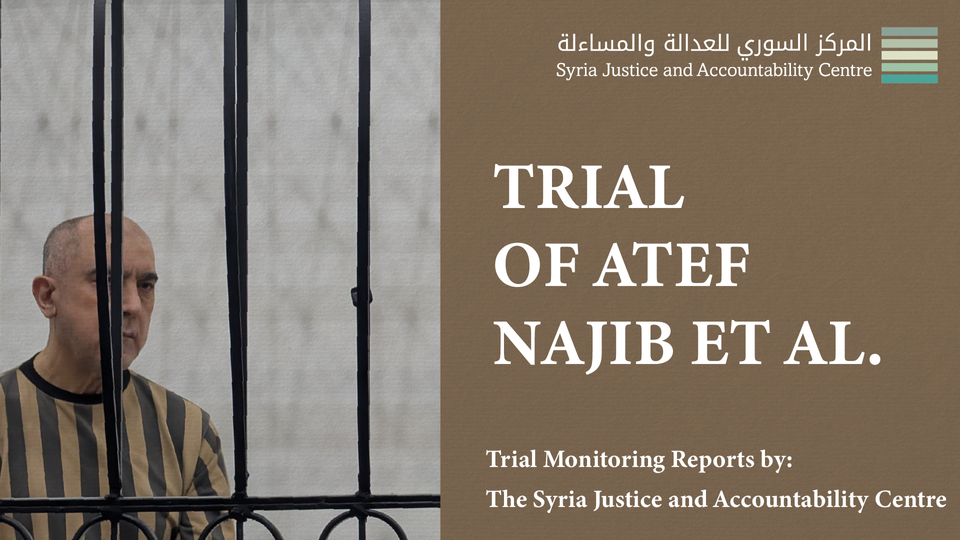
Inside the Trial of Atef Najib et al. #2: The Cradle of the Revolution
TRIAL OF ATEF NAJIB ET AL.
The Fourth Criminal Court – Damascus, Syria
Trial Monitoring Summary #2
Hearing Date: May 10, 2026
CAUTION: Some testimony may include graphic descriptions of torture, rape or other violent acts.
Note that this summary is not a verbatim transcript of the trial; it is merely an unofficial summary of the proceedings.
Throughout this summary, [information located in brackets are notes from our trial monitor] and “information placed in quotes are statements made by the witness, Judges or counsel.” The names and identifying information of witnesses have been redacted.
[Note: SJAC provides a summary of the proceedings while redacting certain details to protect witness privacy and to preserve the integrity of the trial.]
SJAC’s 2nd trial monitoring report details the second day of the trial of Atef Najib et al. In Damascus, Syria. At the Fourth Criminal Court in Damascus, the Presiding Judge interrogated the Accused, Atef Najib, regarding the acts of violence he is accused of committing in Dar’a province at the onset of the uprising. The Accused denied all charges leveled against him.
Day 2 – May 10, 2026
[There was extensive media coverage and attendance by a number of local and Arab media outlets, as well as Arab and international organizations].
The session commenced at 10:55 AM with the entry of the Accused, Atef Najib, followed by the entry of the Judges at 11:00 AM. This marks the second session for Case No. 1 of 2026 regarding the Accused, Atef Najib.
The Accused, Atef Najib, appeared before the Court, accompanied by his representative, Defense Counsel C1 [redacted name].
Prosecution Committee:
A team of attorneys was formed, and their attendance was recorded:
- Mr. C2 [redacted name]
- Ms. C3 [redacted name]
- Mr. C4 [redacted name]
- Mr. C5 [redacted name]
Subsequently, the absent Accused were called, namely:
- Bashar Hafez Al-Assad
- Fahd Jasem Al-Fraij
- Maher Hafez Al-Assad
- Mohammad Ayman Mahmoud Ayyoush
- Lo’ay Ali Al-Ali
- Qusay Ibrahim Mahyoub
- Wafiq Saleh Naser
- Talal Fares Al-Usaymi
Upon calling the Accused who were absent from the previous session, their summonses are deemed duly served. Accordingly, it was decided to record their non-appearance, declare them fugitives, try them as fugitives in absentia, hold them civilly liable, and place their assets under government administration.
The public and in-person trial proceedings commenced pursuant to Article 322 of the Criminal Procedure Code.
Thereupon, the Presiding Judge began presenting a summary of the indictment to the Accused, Atef Najib, which includes the following:
1- The charges against the Accused, Atef Najib, pertain to the 2011 incidents in Dar'a Governorate, where peaceful protests were met with excessive force. Responsibility is attributed to him in his capacity as the Head of the Political Security Branch during that period, holding direct and joint command responsibility for systematic acts targeting civilians, which included murder, torture, and arbitrary detention, based on the contents of this case file:
In February 2011, the security apparatus, primarily the Political Security Branch, detained children and school students over political writings on walls. The detainees — including minors — were subjected to methods of physical and psychological torture, such as extracting fingernails, electric shocks to sensitive areas, and severe beatings. A number of detainees — including children — died under torture. Demands by Dar'a dignitaries for the release of the detainees were rejected, and the Accused, Atef Najib, issued direct threats against the children's families.
Orders were issued by the high command — foremost among them the fugitive Accused, Bashar Hafez Al-Assad — to use the armed force against peaceful demonstrators.
2- Participation in the Al-Omari Mosque Massacre: The Accused, Atef Najib, is also charged with participating in what is known as the Al-Omari Mosque massacre, as follows:
- Storming the peaceful sit-in inside the mosque using excessive military and security force.
- Direct firing upon peaceful sit-in participants from multiple directions.
- Resulting in dozens of casualties and injuries.
- Preventing medical aid to the wounded and detaining ambulances, leading to the death of several individuals due to severe bleeding.
- Participating in systematic mass murder.
3- The Accused is also charged with participating in the following acts:
- Targeting peaceful demonstrators with live ammunition via snipers stationed on government buildings, including the Political Security building in Dar'a, which he headed.
- Committing multiple massacres, including what is known as the Political Security massacre and the massacre of firing upon mourners, with dozens of casualties falling in each of these aforementioned incidents.
- He is further charged with torture leading to death, as he is accused of participating in systematic torture within detention centers at the Political Security Branch he headed, in coordination with other security branches, resulting in the deaths of detainees under torture, including children and detainees’ fathers.
- He is also charged with utilizing detention as a means of extortion, forcing the relatives of detainees to turn over other individuals.
- Regarding command responsibility, he was the ultimate authority in Dar'a Governorate, and direct responsibility is attributed to him for issuing orders to kill, detain, and torture.
- Leading security and military operations in coordination with other security and military apparatuses and political leadership.
- Participating with security, military, and political leadership within an organized hierarchical environment in committing these gross violations.
International law has been adopted as a complementary and interpretive framework supporting national legislation, given the nature of this trial which falls within the scope of transitional justice; pursuant to Articles 12 and 49 of the Constitutional Declaration of the Syrian Arab Republic issued on March 13, 2025 - Article 12 thereof stipulating that all rights and freedoms provided for in international human rights treaties, charters, and conventions ratified by the Syrian Arab Republic shall be considered an integral part of the Constitutional Declaration, and Article 49 thereof providing for an exception to the principle of non-retroactivity of laws for war crimes, crimes against humanity, and the crime of genocide committed by the “former regime;” - and under the principle of the unity of domestic and international law, which together constitute a single legal system.
Accordingly, the acts attributed to the Accused, Atef Najib, and the remaining fugitive Accused are characterized not merely as ordinary offenses, but as gross violations of human rights and war crimes according to the following description:
- Infringement upon the fundamental rights safeguarded in the International Bill of Human Rights, by virtue of violating the right to life provided for in Article 6(1) of the International Covenant on Civil and Political Rights.
- Infringement upon bodily integrity provided for in Articles 7 and 10 of the same Covenant, and Articles 1, 2, 4, and 16 of the Convention against Torture, to which the Syrian Arab Republic acceded on August 19, 2004.
- Infringement upon the right to freedom of expression and peaceful assembly, as they are internationally guaranteed fundamental rights.
- Infringement upon the rights established under the 1989 Convention on the Rights of the Child and its Optional Protocol, ratified by the Syrian Arab Republic on July 15, 1993, by virtue of violating a child's right to life, survival, and development provided for in Article 6, and committing acts of arbitrary detention and cruel treatment of children provided for in Article 37.
Whereas the acts attributed to the Accused, Atef Najib, jointly with the remaining fugitive Accused, satisfy the following elements: they occurred within the framework of a widespread or systematic attack; this attack was directed against a civilian population; and they were committed knowingly and intentionally in execution of an organized policy of repression; these acts were therefore not of an individual or customary nature, but rather part of a systematic policy to repress the civilian population. Furthermore, the Accused played a pivotal role in the execution and intent within the organizational structure of this policy.
Consequently, these acts attributed to the Accused, jointly with the remaining fugitive Accused, constitute war crimes based on the four Geneva Conventions, Additional Protocol I, and customary international humanitarian law, which was realized through the commission of the crime of willful killing of protected persons in the context of an armed conflict, and pursuant to Common Article 3 of the four Geneva Conventions, Articles 50 and 51 of the Second Convention, Article 129 of the Third Convention, and Article 147 of the Fourth Convention; the commission of the crime of torture provided for in the same articles of the four Geneva Conventions; and the commission of the crime of imprisonment and deprivation of liberty provided for in Article 147 of the Fourth Geneva Convention and Articles 43 and 75 of Additional Protocol I. Given that these acts constitute peremptory norms (jus cogens) in public international law pursuant to Article 53 of the Vienna Convention on the Law of Treaties, they represent crimes against humanity. Accordingly, this Court relies on the following principles in prosecuting the Accused, Atef Najib, along with the remaining fugitive Accused:
- The Principle of Non-Applicability of Statutory Limitations: Pursuant to the 1968 Convention on the Non-Applicability of Statutory Limitations to War Crimes and Crimes Against Humanity.
- The Principle of Non-Amnesty: Since these crimes constitute grave international offenses affect the State and the international community as a whole.
- The Principle of Continuous Accountability: Regardless of the lapse of time or changes in legal regimes.
In addition to the foregoing, the acts attributed to the Accused, Atef Najib, jointly with the remaining fugitive Accused, also constitute crimes provided for and punishable under Syrian Penal Code No. 148 of 1949 and its amendments, namely:
- The felony of premeditated murder and the felony of intentional homicide against more than one person; intentional homicide against children under the age of fifteen; intentional homicide accompanied by acts of torture and cruelty towards persons; and the felony of incitement to premeditated murder and intentional homicide on multiple occasions, punishable pursuant to Articles 534 and 535, read in conjunction with Article 216 of the General Penal Code.
- The felony of torture, torture leading to death, deprivation of liberty, and the felony of kidnapping on multiple occasions, punishable under paragraphs (e) and (f) of Article 2 of Law No. 16 of 2022, Article 556 of the General Penal Code, and Articles 1 and 2 of Decree No. 20 of 2013.
- The felony of assault aiming to incite civil war and sectarian strife, punishable under Article 268 of the Penal Code; the crime of theft of public funds, punishable under Article 8 of Law No. 3 of 2013; and the felony of money laundering, punishable under Decree No. 33 of 2005.
[The Presiding Judge concluded the reading of the summary here.]
Subsequently, the Public Prosecution was heard to present the grounds for the indictment.
The Chief Public Prosecutor commenced by detailing the following events: Dar'a was the cradle of the revolution. The spark was ignited when children wrote anti-regime slogans on a school wall, inciting the ire of the security apparatuses. The Accused, Atef Najib, served as the Head of the Political Security Branch in Dar'a, while the fugitive Accused, Lo’ay Al-Ali, served as the Head of the Military Security Branch. They detained the children and subjected them to the most severe forms of torture, including extracting their fingernails and administering electric shocks to their bodies. Dignitaries from Dar'a intervened to secure their release; however, Atef Najib responded by only insulting their dignity. His words acted as the spark that ignited the revolution. Consequently, the residents launched several peaceful protests, demonstrations, and sit-ins — most notably the Al-Omari Mosque sit-in in Dar'a. The security apparatuses subordinate to the Accused, Atef Najib, and the fugitive Accused — Lo’ay Al-Ali, Qusay Mahyoub, and Talal Al-Usaymi (the former Head of Counter-Terrorism) — responded by opening fire on the demonstrators and sit-in participants, resulting in numerous casualties and injuries. Furthermore, live ammunition was fired at mourners, dozens of whom were detained, causing further fatalities and injuries. The Accused “stripped himself of his humanity” when he obstructed ambulances from reaching and providing medical aid to the wounded, and they [the demonstrators] were subjected to gunfire that culminated in their “martyrdom.”
Additionally, there is the Political Security massacre, which occurred when the residents and dignitaries of Dar'a arrived peacefully to lift the siege on the city. Instead, all security branches adopted the slogan “Assad, or we burn the country.” The residents of Dar'a were surprised by the arrival of Maher Al-Assad, accompanied by the fugitive Accused, Mohammad Ayman Ayyoush, along with a battalion from the Fourth Division — a military battalion. They perpetrated crimes of torture, murder, and detention against the residents under orders from the former Minister of Defense, the fugitive Accused Fahd Al-Fraij, and the fugitive Accused, Bashar Al-Assad, in his capacity as President and Commander-in-Chief of the Armed Forces, who issued his orders to confront the demonstrators with brutal repression and gunfire.
Moreover, the Accused, Atef Najib, committed two offenses: theft of public funds and money laundering, all of which are substantiated by comprehensive evidence contained within the case file.
The Chief Public Prosecutor questioned whether it was conceivable for such criminality to occur over phrases written by innocent children who lacked sufficient awareness of their actions.
Given that the aforementioned Accused committed all acts of murder and torture against unarmed civilian populations — thereby rendering these acts crimes against humanity — they are not subject to amnesty or statutes of limitations, nor do amnesty decrees apply to them. Consequently, the Syrian judiciary holds jurisdiction to adjudicate these crimes, and the Syrian Penal Code must be applied to them in accordance with the principle of complementarity under international humanitarian law. The Prosecutor concluded by stating that, based on the foregoing and in his capacity as the representative of the Public Prosecution in this case, he affirms that the aforementioned Accused committed the crimes of premeditated murder, intentional homicide against more than one person, murder of children under the age of fifteen, torture leading to death, and incitement to premeditated murder as crimes against humanity, as well as assault aiming to incite civil war, [sectarian] strife, theft of public funds, and money laundering.
Upon concluding the hearing of the Public Prosecution’s statement, the Presiding Judge announced that the interrogation of the Accused, Atef Najib, would commence. Given that certain questions would involve confidential documents and the hearing of witnesses protected under witness protection programs, the Presiding Judge requested the media to vacate the courtroom and cease live broadcasting, limiting coverage to the media affiliated with the Ministry of Justice due to the confidentiality of the proceedings.
***
[15-minutes-break]
***
The Presiding Judge commenced the interrogation of the Accused, Atef Najib, at 11:35 AM.
The Judge sought to ascertain when the Accused assumed his duties at the Political Security Branch in Dar'a. The Accused responded that his tenure lasted from late February 2007 until March 22, 2011.
The Judge inquired whether the Accused continued to exercise his functions after the conclusion of his mandate. The Accused replied that orders had been issued for his dismissal and for him to remain at his domicile under house arrest.
The Judge questioned the Accused regarding the scope of authorities and duties entrusted to him prior to the revolution. The Accused answered that there was cooperation with the Ministry of Defense, the conducting of training courses for employees within the framework of the law, and the suppression of smuggling and weapons trafficking operations.
The Judge sought to identify which entity issued detention orders prior to the revolution. The Accused responded that the competent authority rested exclusively with either the civil or military judiciary.
The Judge questioned the reason underlying the absence of dedicated detention facilities for children. The Accused explained that no such facilities existed except the holding cell of the branch.
The Judge wanted to know whether children under the legal age were placed in the holding cell. The Accused claimed that he had not detained any child.
The Judge questioned whether the Accused enjoyed special authority. The Accused stated that the security apparatuses operated independently.
The Judge sought to clarify the relationship between the Accused and the remaining branches. The Accused clarified that the Political Security Branch and the Police shared a single relationship, whereas no coordination whatsoever existed with the remaining branches, as each maintained its own procedures. He added that he had a good relationship with the Police Chief.
The Judge noted that several children were detained after the outbreak of the revolution due to slogans written on school walls. The Accused denied having any knowledge regarding the detention of children.
The Judge sought to ascertain whether the [children] were monitored and whether a report to that effect was submitted to the Political Security Branch. The Accused denied possessing the authority to ascertain the whereabouts of detainees and further denied any connection to the children.
The Judge noted that P20 [redacted name] was interrogated regarding writing the phrase “Your turn has come, Doctor.” The Accused responded that he had no connection to this, and that the civil police were responsible for Dar'a Al-Balad.
The Judge asked the Accused whether he had instituted specific measures against the children. The Accused denied.
The Judge wanted to determine who was responsible for taking measures and conducting the interrogation, and whether the [children] were subjected to special treatment [upon detention]. The Accused responded that there were neither cells nor torture chambers within the branch.
The Judge noted that P23 [redacted name] stated that the children were subjected to torture and that the Accused, Atef Najib, was present during the interrogations. The Accused denied any knowledge of this witness and reaffirmed that no child had been detained.
The Judge sought to know whether it was true that Sheikh Ahmad As-Sayasneh requested an audience with the Accused, Atef Najib, to tender an apology for the actions of the children. The Accused responded that he had released the children [in response to the Sheikh's request].
The Judge noted that, based on the statements of P22 [redacted name], a detention center existed within the Political Security Branch, and that his father had been detained therein and subsequently died under torture. The Judge inquired whether the Accused possessed any information regarding this matter. The Accused denied.
The Judge recalled the statements of P23 [redacted name], who stated that the Accused had threatened him with the detention of his wives and children unless he surrendered himself. The Judge asked whether this was true, which the Accused denied.
The Judge questioned whether any transgressions occurred during the presence of the Accused [in office] during the revolution. The Accused denied the occurrence of any transgressions.
The Presiding Judge noted that a demonstration broke out demanding the release of the children and the two “martyrs,” Mahmoud Al-Jawabra and Hosam Ayyash. The Judge wanted to know who gave the orders to open fire upon the demonstration. The Accused meandered and was evasive in his response, subsequently claiming that the residents of Dar'a had demands regarding the purchase and sale of land within the border zone without security clearance, and that the demonstration bore no relation to the children or the detainees.
The Judge wanted to know who gave the order to open fire on Friday. The Accused responded that the demonstrators marched after Friday prayers, assembled, and informed Sheikh Ahmad As-Sayasneh; subsequently, the Sheikh contacted the Accused after the demonstration concluded and requested him to release the children.
The Judge asked the Accused whether Political Security personnel were present during the demonstration. The Accused answered that personnel from State Security were present.
The Judge inquired whether the Accused was the one who requested forces [for reinforcement]; however, the Accused denied, claiming that he had rejected any forms of reinforcements and that Brigadier General Ahmad Deeb from the State Security Branch was the one who executed the raids.
The Judge asked whether the Accused had submitted a report in this regard. The Accused responded that he had sent a report via fax and that the situation remained calm.
The Judge questioned whether it was conceivable for the Head of the Political Security Branch to remain inside the Branch under such circumstances. The Accused responded that the forces arrived from Damascus and assumed command of the National Security Branch on Sunday, and that the Branch was to establish a cordon around Dar'a Al-Balad.
The Judge wanted to know whether the Accused was a member of the Security Committee. The Accused confirmed, noting that the committee held meetings every week, fifteen days, or on a monthly basis.
The Judge inquired whether the Accused had declared his disapproval [of the measures taken against the demonstrators]; the Accused confirmed and recalled that the Head of the Committee, Hisham Al-Bikhtiyar, arrived in Dar'a to find a solution to the matter.
The Judge wanted to know the decisions taken regarding the protest. The Accused responded that an arrangement was made to organize a meeting outside the unusual schedule, and that a mosque sheikh was inciting “sectarian strife against Christian brothers.” The Accused testified that the Governor, the Police Chief, the Head of the Political Security Branch, and the Head of State Security Branch were all present and decided to dismiss the sheikh because he sought to incite strife.
The Judge questioned the source of the public objections if the Accused did not approve of the measures and sat as a member of the Security Committee. The Accused testified that he did not attend on Tuesday [i.e., the day of the meeting], and communication was established with the investigative judge, as orders had been issued by Hisham Al-Bikhtiyar and Ali Mamlouk directing the Accused, Atef Najib, not to intervene, stating that they wanted to establish checkpoints to ambush the demonstrators, which the Accused refused.
The Judge noted that P20 [redacted name] stated that he witnessed the Accused wearing traditional Arab attire and giving orders to open fire. The Accused denied all of this.
The Judge wanted to know who confronted the funeral procession. The Accused responded that he had not heard anything regarding this matter, adding that the Head of National Security closed and evacuated the square for security precautions. The Accused testified that he communicated with “one of the brothers” in Dar'a who confirmed that nothing occurred during the funeral procession, and that the matter was resolved objectively without a single shot being fired.
The Judge noted that some individuals testified that the Accused was present. However, the Accused denied this and any involvement of Political Security Branch personnel in that incident.
The Judge requested the Accused to explain the contradiction in his statements regarding the Al-Omari Mosque massacre and the alteration of his account. The Accused stated that he went at night to a pharmacy containing medications and was requested to take and deliver them to the Directorate of Health, and upon his arrival, there was nothing going on outside the Al-Omari Mosque.
The Judge noted the case of [redacted name] [unclear full name] and P29 [redacted name], both of whom stated that the Accused stopped them at the Al-Karak checkpoint, detained them, and prevented them from reaching the hospital. The Accused denied any connection to the matter.
The proceedings were adjourned at 12:30PM.
The next trial day will be on May 19, 2026, at 10AM.
___________________________
For more information or to provide feedback, please contact SJAC at [email protected] and follow us on Facebook and Twitter. Subscribe to SJAC’s newsletter for updates on our work