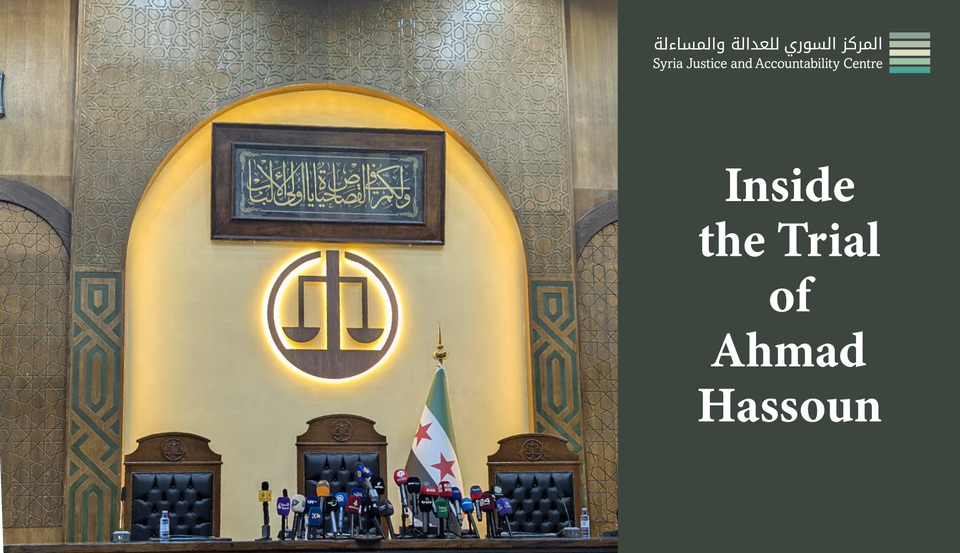
Inside the Trial of Ahmad Hassoun #6: The Judgment: The Harvests of Their Tongues
TRIAL OF AHMAD HASSOUN
The Fourth Criminal Court – Damascus, Syria
Trial Monitoring Summary #6
Hearing Date: August 24, 2026
CAUTION: Some testimony may include graphic descriptions of torture, rape or other violent acts.
Note that this summary is not a verbatim transcript of the trial; it is merely an unofficial summary of the proceedings.
Throughout this summary, [information located in brackets are notes from our trial monitor] and “information placed in quotes are statements made by the witness, Judges or counsel.” The names and identifying information of witnesses have been redacted.
[Note: SJAC provides a summary of the proceedings while redacting certain details to protect witness privacy and to preserve the integrity of the trial.]
SJAC’s 6th trial monitoring report details day 6, the last day of the trial of Ahmad Hassoun in Damascus, Syria. On this trial day, the Court sentenced the Accused Ahmad Hassoun to life imprisonment. He was convicted of multiple offenses, including inciting civil war and incitement to intentional murder. Mitigating factors were withheld from him.
Day 6 – August 24 2026
The preparations included a broad security presence alongside attendance of international, local, public, and private media outlets.
The session was interspersed with frequent power outages.
The Accused was brought into the courtroom, followed by the entry of the Prosecutor and then the Judges. The trial commenced at 11:00AM.
The Accused, Ahmad Badreddein Hassoun, was called and appeared before the Court. Defense Counsel C1, [redacted name], was present on his behalf pursuant to the power of attorney submitted in the case file. Plaintiff P1, [redacted name], was also present pursuant to the complaint submitted in the case file. Plaintiff P2, [redacted name], and [redacted name] were present. Counsel C2, [redacted name], was not present on behalf of six Plaintiffs. Counsel C3, [redacted name], attended pursuant to the produced power of attorney on behalf of four Plaintiffs.
The in-person trial proceedings commenced publicly, and as though all parties were present.
The Court unanimously decided to conclude the trial and render the following decision:
I. Historical Context of the Case
In early 2011, peaceful demonstrations broke out in a number of Syrian governorates demanding reform. The security and military forces confronted them using live ammunition and lethal weapons. The “[former] regime” utilized various military forces and security agencies in suppression operations, alongside informal armed formations and militias brought in from outside the country. Acts involving widespread murder, torture, sexual violence, looting, destruction of property, forced displacement, and enforced disappearance were committed against the civilian population in a manner that constituted a widespread and systematic attack directed against the civilian population.
Data indicates that the official religious institution, led by the Fatwa Office (Dar Al-Iftaa) in the Syrian Arab Republic, was employed within this general policy to provide religious cover for military and security operations and to justify them to public opinion. Among the acts attributed to it was the justification of the use of barrel bombs, unguided munitions which when dropped on populated areas causes widespread and indiscriminate destruction that fails to distinguish between military targets and civilian objects. This constitutes a violation of the principle of distinction and the prohibition of indiscriminate attacks provided for under international humanitarian law.
II. Facts of the Case
The following was established to the Court from the facts of the case:
The Accused appeared in a video recording addressed to the residents of Idlib Governorate containing statements calling for murder and destruction. According to the database of the Syrian Network for Human Rights, a massacre committed against civilians was documented during the period following these statements, coinciding with the subsequent wave of escalation between September 23 and October 24, 2019.
The Accused appeared in a video clip with Issam Zahreddine - a deceased officer of the former regime who is accused of committing war crimes and violations against Syrians - praying for the officer’s success, protection, and victory.
It was established that the Accused received sums of money and in-kind gifts in exchange for securing the release of civilian detainees held by the security agencies of the “defunct regime.”
The Accused periodically provided financial support to the leadership and members of the Al-Quds Brigade, an armed formation that participated in military operations during which violations were committed against the civilian population during the armed conflict in Syria. The Court affirms that this support was not a mere social or charitable act, but rather constituted a material resource that contributed to enhancing that formation’s capacity to continue its military activities.
The Accused appeared in video recordings praising the Iranian and Russian intervention in Syria. Based on the request of the Defense Counsel, the Court conducted a three-member technical expert analysis of the videos. The Court concluded that the videos are excerpts from original material; that the contents of the technical reports do not detract from the legal value of the presented evidence or affect its significance; and that any truncation or editing in certain areas does not weaken the core of the evidence or its legal admissibility.
III. The Role of the Accused in the Crimes
The Court affirms that the role of the Accused was not limited to expressing an abstract religious or political opinion; rather, it was directed repeatedly and publicly through speeches containing explicit or implicit incitement to use force and violence against specific groups of people.
It was established to the Court that the acts relating to the case occurred in the context of a widespread non-international armed conflict that witnessed the commission of murder and severe violations against civilians, and that the Accused was aware - by virtue of his position and capacity - of the nature of the addressed forces and the acts they were committing. Nevertheless, he issued statements that would reinforce the resolve of the perpetrators, bestow legitimacy upon their actions, or encourage them to continue therewith.
The Court finds that the established facts in this case are grounded in the theory of aiding, abetting, and moral support, particularly as a fundamental aspect thereof consists of verbal and public acts that constitute an effective contribution to the commission of war crimes and crimes against humanity.
IV. Classification of Crimes and Denial of Mitigating Factors
Therefore, the Court decides that the acts established against the Accused constitute acts falling within the framework of war crimes and crimes against humanity committed in the context of a widespread and systematic armed conflict. Since these crimes are among those for which customary and conventional international law has established that perpetrators shall not enjoy impunity, the public claim is not subject to the statute of limitations or general amnesty.
The Court decides not to grant the Accused discretionary mitigating circumstances provided for under Article 244 of the General Penal Code, in view of the gravity of the acts established against him, which are legally classified as crimes against humanity and war crimes.
V. Judgment
Therefore, pursuant to the provisions of Articles 533, 298, 307, 342, 216, and 218 of the General Penal Code and Articles 309, 310 et seq. of the Code of Criminal Procedure, the Court unanimously decides as follows in the name of the Syrian Arab People in Syria:
- Convicting the Accused Ahmad Badreddein Hassoun, son of Mohammad Adib, mother Hamidah, born in 1949, of the felony of launching an assault aimed at inciting civil war and sectarian strife, punishable under Article 298 in conjunction with Article 216 of the General Penal Code, and sentencing him therefore to life imprisonment.
- Convicting him of the felony of incitement to intentional murder, punishable under Article 533 in conjunction with Article 216 of the General Penal Code, and sentencing him therefore to temporary imprisonment for twenty years.
- Convicting him of the felony of principal complicity in intentional murder, pursuant to the provisions of Article 533 in conjunction with Article 218, paragraphs (b) and (d), of the Penal Code, and sentencing him therefore to imprisonment for ten years.
- Convicting him of the offense of abuse of office, punishable under Article 342 of the General Penal Code, reclassifying the legal characterization from Article 347, and sentencing him therefore to temporary imprisonment for three years, and a fine equal to three times the value of what he received, amounting to 195,000 USD.
- Convicting him of the offense of inciting sectarian and racial strife provided for in Article 307 of the General Penal Code, and sentencing him therefore to imprisonment for six months, a fine of one thousand Syrian pounds, and deprivation of civil rights pursuant to Article 65 of the General Penal Code.
- Merging the custodial penalties and executing the most severe penalty, namely, life imprisonment, pursuant to Article 204 of the General Penal Code, and combining and executing the fines.
- The Court affirms the deprivation of the convicted person from benefiting from any general or special amnesty, conditional release, suspension of execution of sentence, or suspension of an enforceable judgment, due to the gravity of the acts established against him, which are legally classified as crimes against humanity and war crimes.
- Ordering him to compensate the eligible Plaintiffs in accordance with the attached table under the civil compensation section.
- Preservation of the rights of all injured parties who have not brought personal claims to date, as well as the families of victims and missing persons, to seek recourse before competent judicial authorities. This judgment shall not preclude such action.
- Confirmation of the provisional seizure placed on the movable and immovable assets of the Accused, converting it into an executory seizure.
- Confiscating the convicted person’s movable and immovable assets in favor of the Public Treasury, following the execution of the civil liability clauses.
- Preservation of the right of competent official bodies to seek recourse and claim compensation for damages inflicted upon public funds and public utilities.
- Reserving the right of the Public Prosecution to pursue all other responsible parties, contributors, and accomplices not included in this prosecution, and to open independent files against them whenever evidence becomes available.
- Maintaining the witness protection measures ordered during the trial in effect following the issuance of this judgment.
- Preserving the true identities of protected witnesses in a confidential, sealed file in the Court registry, which shall not be inspected except by a reasoned judicial decision.
- Prohibiting the publication, broadcasting, or dissemination of any data that might reveal the identity or place of residence of a protected witness, under penalty of legal liability.
- Assessing all court fees and legal expenses against the convicted person.
The judgment is rendered in person with respect to the Public Prosecution, the Plaintiff party, and the Accused, and as though they were present regarding absent Plaintiffs, subject to appeal before the Court of Cassation.
Promulgated on 11 Rabi' Al-Awwal 1448 AH, corresponding to August 24, 2026 CE, publicly read and announced.
The hearing, and with it the trial, concluded at 11:45AM.
___________________________
For more information or to provide feedback, please contact SJAC at [email protected] and follow us on Facebook and Twitter. Subscribe to SJAC’s newsletter for updates on our work