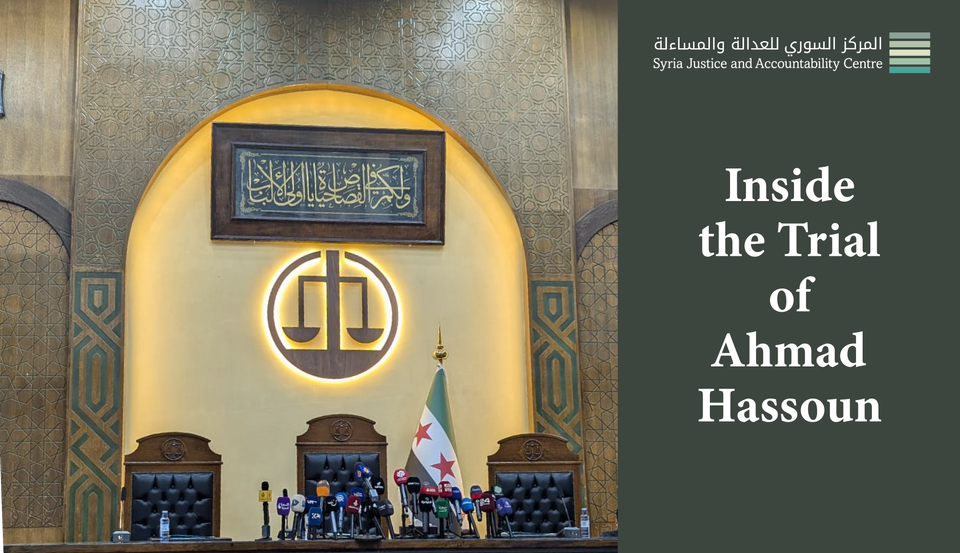
Inside the Trial of Ahmad Hassoun #5: I Demanded the Destruction of Cities, Not the Slaughter of Mankind!
TRIAL OF AHMAD HASSOUN
The Fourth Criminal Court – Damascus, Syria
Trial Monitoring Summary #5
Hearing Date: August 6, 2026
CAUTION: Some testimony may include graphic descriptions of torture, rape or other violent acts.
Note that this summary is not a verbatim transcript of the trial; it is merely an unofficial summary of the proceedings.
Throughout this summary, [information located in brackets are notes from our trial monitor] and “information placed in quotes are statements made by the witness, Judges or counsel.” The names and identifying information of witnesses have been redacted.
[Note: SJAC provides a summary of the proceedings while redacting certain details to protect witness privacy and to preserve the integrity of the trial.]
SJAC’s 5th trial monitoring report details day 5 of the trial of Ahmad Hassoun in Damascus, Syria. On this trial day, the Prosecution delivered its closing argument, followed by a similar submission from a Plaintiff’s party. Both parties requested the death penalty for the Accused. Meanwhile, the Defense Counsel submitted a note stating that the defense had not received a copy of the expert report previously delivered to the Court.
After that, the Accused delivered his final statement, in which he claimed that he was never aligned with the former regime and had saved many individuals from execution, portraying himself as a dove of peace attempting to reconcile people. He likened his remaining in Syria alongside Bashar Al-Assad to the prophet Moses remaining with Pharaoh to advise him with kindness. In his defense, he argued that he had not called for the killing of people, but only for the destruction of cities.
Day 5 – August 6 2026
[Media coverage was restricted to media outlets affiliated with the Ministry of Justice.]
Defense Counsel C1, [redacted name], was present on his behalf pursuant to the power of attorney submitted in the case file. Plaintiff P1, [redacted name], was also present pursuant to the complaint submitted in the case file. Plaintiff P2, [redacted name], was present. Counsel C2, [redacted name], was not present. Counsel C3, [redacted name], attended pursuant to the produced power of attorney on behalf of four civil claimants.
The in-person trial proceedings commenced publicly, and as though all parties were present.
[Note: The Syria Justice and Accountability Centre(SJAC) was unable to attend the session from start, as SJAC’s trial monitor was permitted entry only fifteen minutes later, at which point the representative of the Public Prosecution was delivering his submission.]
…Therefore, and for all the foregoing, the Public Prosecution requests that the honorable Court declare the Accused responsible for the charges brought against him and impose upon him the death penalty, disregarding pity or mercy.
The Public Prosecution places this action into your hands, confidently relying upon justice, as the judiciary remains the unassailable fortress.
I conclude with the words of Almighty God: "And fitnah [tumult and oppression] is worse than killing" [Quran 2:191], and the verse: "And do not kill the soul which Allah has forbidden, except by right" [Quran, 17:33], as well as the saying of the Prophet Muhammad, peace be upon him: "There is no obedience to creation in disobedience to the Creator."
Following the conclusion of the Prosecution's submission, Plaintiff P2 provided a three-page claim memorandum, requesting the imposition of the maximum penalty upon the Accused, namely execution, and the restoration of due civil rights to their rightful owners.
Thereafter, Defense Counsel C1 presented a defense memorandum, stating that he was unable to obtain the expert report. He put forward several requests within the memorandum submitted to the Presiding Judge.
The Presiding Judge requested that the Accused deliver his final statements.
The Accused opened his statement by reciting a Quranic verse: “If you should raise your hand toward me to kill me - I shall not raise my hand toward you to kill you. Indeed, I fear Allah, Lord of the worlds.” [Quran, 5:28]
He then mentioned that from the time he assumed the position of Grand Mufti until the day he was discharged from it and the position was abolished [subsequently reestablished by the opposition], there was a fatwa registry within the Ministry of Religious Endowments (Awqaf), and not a single fatwa was issued by him to oppress or kill people. He added that the current Mufti was a fellow member of the fatwa Council with him, and they used to convene at his [the Accused’s] home. Therefore, the Accused likened his remaining in the country [at the time] — despite ongoing events — to the prophet Moses, peace be upon him, remaining with Pharaoh for thirty years, speaking gentle words to him.
The Accused noted that he saved men and women from execution, and that they had testified before the Court to his role in saving them from death. The Accused requested the Court to check the recordings once again and listen to them in full, maintaining that not a single word inciting killing was uttered by him.
[The Presiding Judge interrupted the Accused and requested that he not repeat his previous statements.]
The Accused said that he appeared on television addressing the brothers in East Aleppo to urge them to evacuate areas subject to bombardment. He asserted that he asked the army to destroy the area, not to kill the people.
The Accused wondered why the position of fatwa in Syria was abolished during the era of the "defunct regime," claiming that this occurred because he was never aligned with the "regime." Rather, the "regime" accused him of harboring sympathies for the Mujahedin, and he asserted having saved many of their leaders, leading to the abolition of the fatwa post under the pretext of age — which was nothing short of retaliation against him for refusing to serve as a slave to the "regime."
The Accused requested the Court to re-examine every video presented in court, arguing it would reveal he did not incite killing, but was rather a unifying figure, and that his travels to Iran and Russia were intended to unite schools of thought, not to urge the killing of anyone. The Accused added that he was offered the opportunity to flee the country, but refused to do so.
After that, the Accused offered an apology for any word that was interpreted as incitement against the revolutionaries or the revolution, affirming that his sole intention was to bring people together. He then recited the same opening Quranic verse again and concluded by declaring his love for his homeland, his country, and his fellow Syrian brothers.
The Court unanimously decided to adjourn the proceedings for review.
The proceedings were adjourned at 12:00PM.
The next trial day will be on August 24, 2026, at 11AM.
___________________________
For more information or to provide feedback, please contact SJAC at [email protected] and follow us on Facebook and Twitter. Subscribe to SJAC’s newsletter for updates on our work