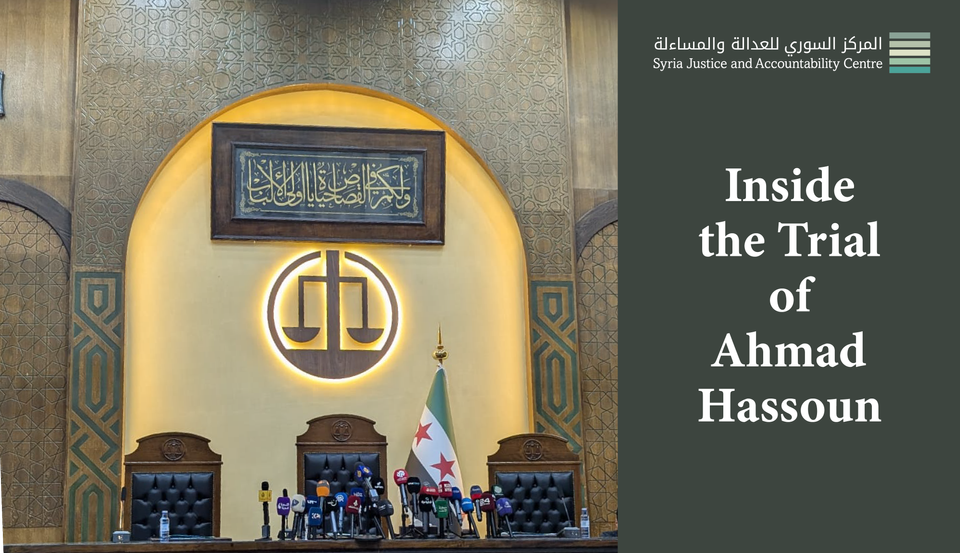
Inside the Trial of Ahmad Hassoun #4: His Iranian Brothers and Russian Friends
TRIAL OF AHMAD HASSOUN
The Fourth Criminal Court – Damascus, Syria
Trial Monitoring Summary #4
Hearing Date: July 30, 2026
CAUTION: Some testimony may include graphic descriptions of torture, rape or other violent acts.
Note that this summary is not a verbatim transcript of the trial; it is merely an unofficial summary of the proceedings.
Throughout this summary, [information located in brackets are notes from our trial monitor] and “information placed in quotes are statements made by the witness, Judges or counsel.” The names and identifying information of witnesses have been redacted.
[Note: SJAC provides a summary of the proceedings while redacting certain details to protect witness privacy and to preserve the integrity of the trial.]
SJAC’s 4th trial monitoring report details day 4 of the trial of Ahmad Hassoun in Damascus, Syria. On this trial day, a summary of the three-member expert report was read before the Court. Its final conclusion established that the video recordings constituted excerpts from authentic original source materials, and that the technical findings contained in the report in no way diminished the legal probative value or legal force of the presented evidence.
Thereafter, a protected witness testified to his personal account regarding his interactions with the Accused while seeking mediation to secure the release of his detained sister, as the Accused was interested in the female detainees' files. The witness detailed a series of escalating demands levied by the Accused: at times requiring royal cloaks as gifts for his "Iranian brothers," at other times demanding one hundred kilograms of traditional Syrian sweets for Russian officials, and on multiple occasions extracting monetary payments totaling approximately $65,000, in addition to $20,000 paid to a judge of the Counter-Terrorism Court, culminating in his sister's ultimate release.
Day 4 – July 30 2026
[Media coverage was restricted to media outlets affiliated with the Ministry of Justice.]
The Accused was brought into the courtroom, followed by the entry of the Prosecutor and then the Judges. The trial commenced at 11:00AM.
The Accused, Ahmad Badreddein Hassoun, was called and appeared before the Court. Defense Counsel C1, [redacted name], was present on his behalf pursuant to the power of attorney submitted in the case file. Plaintiff P1, [redacted name], was also present pursuant to the complaint submitted in the case file. Plaintiff P2, [redacted name], was present. Counsel C2, [redacted name], attended on behalf of six Plaintiffs. Counsel C3, [redacted name], attended pursuant to the produced power of attorney on behalf of four civil claimants.
The in-person trial proceedings commenced publicly, and as though all parties were present.
A summary of a three-member expert report comprising seven pages was read out in court. The summary of its conclusion was that the videos are excerpts from original materials; that the technical content of the reports does not diminish the legal value of the presented evidence nor affect its significance; and that any truncation or excerpting in certain parts does not weaken the core of the evidence or its legal probative force.
Counsel C2 submitted a written memorandum that was read publicly. He constituted himself as a Plaintiff in addition to the represented party. The substance of the memorandum was that the Accused issued religious edicts (fatwas) to the “defunct regime” and its soldiers to kill the revolutionaries and their civilian support base, destroy their cities and villages, and forcibly displace them, elucidating for them — in order to achieve that end — all prohibited and permissible means alike. Counsel C2 requested the conviction of the Accused based on the abuse of his position and the imposition of the maximum penalties upon him.
Witness Testimony:
W7, Witness 04
The witness attended the session masked, and his name was not disclosed.
The Presiding Judge asked the witness to provide his testimony without addition or omission, whereupon W7 took the legal oath.
W7 testified that security forces arrested his sister some time in July, 2012, in Damascus, and she remained detained for fifty-eight days. W7 used to visit Ahmad Hassoun’s office and home daily. W7 was accompanied to the Accused by an individual named Tariq Fadloun, who passed away during the COVID-19 pandemic, as the Accused was interested in the file of female detainees. During that period and with every visit, the Accused made a new demand:
First Demand: The Accused informed W7 that Damascene merchants had gathered to support the diesel (mazot) crisis, requesting that he contribute ten thousand dollars. W7 paid the amount at the Accused's office and delivered it to the mediator, Tariq Fadloun.
Second Demand: The Accused requested that W7 purchase twenty royal cloaks to present as gifts to the "Iranian brothers" to prove that Syrian markets were still operating. W7 delivered them [i.e. the cloaks] to the guards' room [at the Accused's office].
Third Demand: The Accused informed W7 that a Russian delegation would visit Syria and wished to present them with sweets to demonstrate that Syrian sweets were distinctive and first-rate. Per the Accused's request, W7 purchased one hundred kilograms of traditional Syrian sweets and delivered them to the supervisors of the Accused's office.
Fourth Demand: The Accused requested five thousand [dollars] for the detainees' case. Demands continued sequentially each time, once for fuel and other times for various purposes. The Accused made calls to officials in W7's presence to inquire about his sister. Following her release, W7's sister informed him that she had not been subjected to any torture. The total cash amounts paid by W7 over the fifty-eight days reached approximately sixty-five thousand dollars [for the Accused], in addition to twenty thousand dollars paid to a judge of the Counter-Terrorism Court at a restaurant in Damascus, alongside the in-kind contributions.
The Judge asked the Accused whether he accepted the testimony of W7. The Accused answered in the negative.
The Court unanimously decided to adjourn the session for requests, prosecution arguments, and defense submissions.
The proceedings were adjourned at 12:00PM.
The next trial day will be on August 6, 2026, at 11AM.
___________________________
For more information or to provide feedback, please contact SJAC at [email protected] and follow us on Facebook and Twitter. Subscribe to SJAC’s newsletter for updates on our work