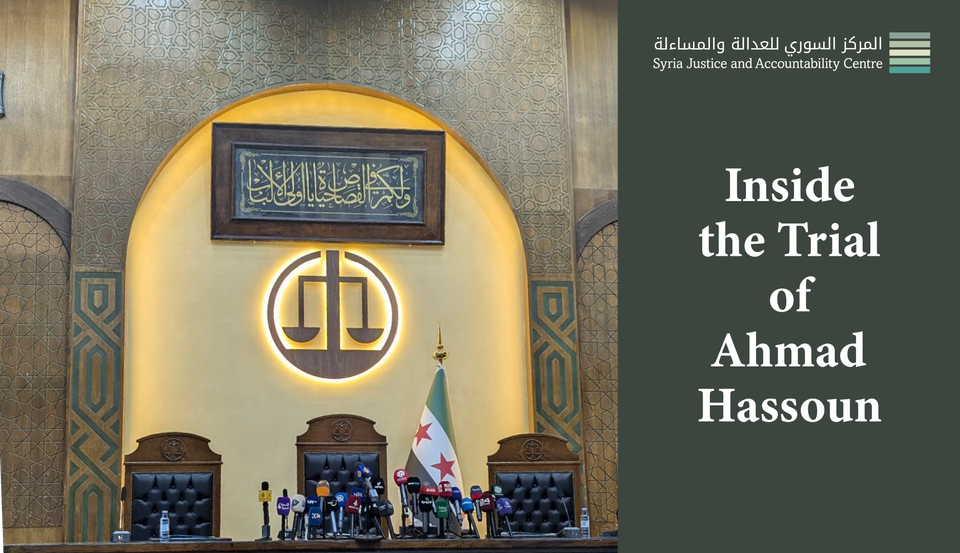
Inside the Trial of Ahmad Hassoun #1: He Fears the Lord of the Worlds
TRIAL OF AHMAD HASSOUN
The Fourth Criminal Court – Damascus, Syria
Trial Monitoring Summary #1
Hearing Date: June 25, 2026
CAUTION: Some testimony may include graphic descriptions of torture, rape or other violent acts.
Note that this summary is not a verbatim transcript of the trial; it is merely an unofficial summary of the proceedings.
Throughout this summary, [information located in brackets are notes from our trial monitor] and “information placed in quotes are statements made by the witness, Judges or counsel.” The names and identifying information of witnesses have been redacted.
[Note: SJAC provides a summary of the proceedings while redacting certain details to protect witness privacy and to preserve the integrity of the trial.]
SJAC’s 1st trial monitoring report details day 1 of the trial of Ahmad Hassoun in Damascus, Syria. This day marked the opening of the trial of Ahmad Hassoun — the former Mufti of the Republic under Bashar Al-Assad. The Presiding Judge read a summary of the indictment, accusing Hassoun of exploiting his position for personal gain, maintaining special relationships with officers of the former regime, inciting the killing of civilians, and instigating civil war and sectarian strife, among other charges. The Judge noted that these actions were committed with the Accused’s awareness of the context — specifically, that the crimes occurred within the framework of a widespread and systematic armed conflict. The Judge added that such acts constitute war crimes and crimes against humanity.
The Accused denied the charges brought against him and testified that he had remained in Syria to save those who were left, that the video clips were taken out of context, and that he was not a supporter of the former] regime, but was rather saving people from it.
Day 1 – June 25, 2026
[Note: SJAC subsequently verified certain details.]
[Media coverage was restricted to media outlets affiliated with the Ministry of Justice.]
The Accused was brought into the courtroom, followed by the entry of the Prosecutor and then the Judges. The trial commenced at 11:00AM.
The Accused, Ahmad Badreddein Hassoun, was called and appeared before the Court. Defense Counsel C1, [redacted name], was present on his behalf pursuant to the power of attorney submitted in the case file. Plaintiff P1, [redacted name], was also present pursuant to the complaint submitted in the case file.
The in-person trial proceedings commenced publicly.
The Presiding Judges requested Counsel C1 to adequately defend his client in accordance with the provisions of Article (279) of the Code of Criminal Procedure. He also requested the Accused listen attentively to all what will be read to him in accordance with the provisions of Article (280) of the Code of Criminal Procedure.
Thereafter, the Presiding Judge read a summary of the indictment.
The Presiding Judge indicated that the facts attributed to the Accused consist of his extensive ties to the former regime, exploitation of his position as the Mufti of the Republic for personal gain, and establishment of private relations with the head of the former regime, Bashar Al-Assad, Ali Mamlouk, and others. The Accused also delivered lectures to military officers urging them to support the former regime against the opposition and participated in public meetings in which he incited violence against civilians and refugees. Furthermore, on Syrian News TV Al-Ikhbariya, he demanded that civilians in Aleppo evacuate the city, instructed the army to destroy every location from which shells were fired, and threatened the residents of Idlib Governorate. Moreover, the Accused praised and supported Brigadier General Issam Zahreddine and Qasem Soleimani, who were involved in war crimes. Additionally, the Accused endorsed the Iranian and Russian intervention in Syria.
The Presiding Judge added that these repeated statements incited against civilians and supported the crimes of the regime, having been issued by the Accused within the context of an armed conflict. The Accused knew — or ought to have known — that the forces he addressed were committing these crimes systematically, and this discourse encouraged them to carry out their actions and justified their violations against civilians. Thereby, rendering the Accused an accomplice to the outcomes of those operations.
Based on the aforementioned, the Accused was charged with the following:
- Incitement, moral encouragement, and provision of legitimacy for acts committed by Assad affiliated militias and their allies, with knowledge of the general context and ongoing widespread and systematic attacks targeting civilians within a non-international armed conflict. This constitutes war crimes pursuant to the four Geneva Conventions, particularly the Fourth Convention relative to the Protection of Civilian Persons in Time of War, ratified by the Syrian Arab Republic.
- Commission of crimes against humanity under Article 7 of the Rome Statute of the International Criminal Court, in addition to Article 25(3)(b), (c), and (d) of the same Statute.
- Commission of the crime of persecution against an identifiable civilian group on political grounds by labeling them as traitors and justifying their targeting, within the context of a widespread and systematic attack against civilians.
Accordingly, these crimes are subject to the following provisions:
- The non-applicability of statutory limitations to war crimes and crimes against humanity, pursuant to the 1968 Convention and the Rome Statute.
- The non-permissibility of pardon or amnesty, as they constitute grave crimes.
- Continuous accountability.
- An exception to the non-retroactivity of laws, based on the Syrian Republican Declaration issued on March 13, 2025.
In addition to the aforementioned, the Syrian Penal Code No. 148 of 1949 and its amendments govern and penalize the acts of the Accused in accordance with the following:
- Incitement to premeditated murder, under Article 533 in conjunction with Article 216 of the Penal Code.
- Complicity in intentional murder, under Article 533 in conjunction with Articles 218 and 219 of the Penal Code.
- Complicity in inciting civil war and sectarian strife, under Article 292 in conjunction with Articles 218 and 219 of the Penal Code.
- Incitement of sectarian and racial strife and instigation of conflict between sects, under Article 307 of the Penal Code.
- Trading in influence in exchange for material benefits, under Article 347 of the Penal Code.
Hereby, the Presiding Judge concluded reading the summary.
Then, the Presiding Judge yielded the floor to the Prosecutor, who read the Public Prosecution’s statement.
The Prosecutor indicated that he appeared before the Court on behalf of the public, the martyrs, and the forcibly disappeared, submitting a critical case file that does not concern an ordinary individual, but rather a significant religious figure. The Prosecutor attributed the following to the Accused:
- The Accused delivered lectures at an institute established by Ali Mamlouk for officer training. Accordingly, the crime of trading in influence is attributed to the Accused.
- Media interviews in which the Accused directed a message to European society threatening that every bombardment in Syria would convert every Syrian and Lebanese person in Europe into a martyr-in-waiting. Accordingly, the crime of incitement to intentional murder is attributed to the Accused.
- Threatening the people of Idlib with the entry of the former regime's forces. Accordingly, the crime of direct complicity in premeditated murder is attributed to the Accused.
- Traveling to Iran to sign agreements to combat terrorism — meaning fighting the rebels. Accordingly, the crime of complicity in an assault that incites civil war and sectarian strife is attributed to the Accused.
The Prosecutor concluded his statement by reminding the Accused of the Quranic verse: “And do not incline toward those who do wrong, lest you be touched by the Fire” [Quran, 11:113].
[Note: The session was predominantly characterized by frequent interruptions of the Accused at times, and his failure to complete his answers at other times, often digressing or meandering in his responses.]
The Presiding Judge asked the Accused to respond to the charges brought against him. The Accused began reciting a Quranic verse: “If you should raise your hand toward me to kill me - I shall not raise my hand toward you to kill you. Indeed, I fear Allah, Lord of the worlds.” [Quran, 5:28]. The Presiding Judge interrupted him, instructing him to answer the question directly and refrain from delivering a sermon. The Accused denied the charges brought against him and testified that he had remained in Syria to save those who were left, that the video clips were taken out of context, and that he was not a supporter of the “[former] regime,” but was rather saving people from it.
The Presiding Judge sought to determine when the Accused assumed the office of the Mufti of the Republic. The Accused answered that he served as the Mufti from 2000 until 2021.
The Presiding Judge questioned the Accused regarding the nature of his work in his capacity as the Mufti. The Accused clarified that [religious] scholars used to meet with him at the beginning of each month, and that his contact with the head of state occurred three times a year: during Eid Al-Fitr, Eid Al-Adha, and the Mawlid An-Nabawi [Prophet's Birthday].
The Presiding Judge asked the Accused about his relationship with the military branches and the former regime. The Accused replied that he had ties only to Ali Mamlouk, and that he was invited to deliver two lectures at the institute Mamlouk had established.
[A video was displayed to the Accused in the courtroom]
The Presiding Judge pointed out that the Accused praised the Iranian intervention in Syria [in the video] and stated that he would transfer bombings from Syria to Europe, noting that incidents subsequently occurred in certain European capitals. The Presiding Judge wondered whether the Accused or the former regime played a role in these operations.
The Presiding Judge further added that the use of chemical weapons is prohibited and constitutes an unforgivable crime, and that the Accused had stated to media outlets that Eastern Aleppo should be completely destroyed.
The Presiding Judge then noted the Accused's boasting, alongside Shadi Helwi, over the former regime's advance in Eastern Aleppo, as well as his incitement to kill the civilians and his threats of murder and displacement against the people of Idlib.
Thereafter, the Presiding Judge questioned the Accused regarding his relationship with Brigadier General Issam Zahreddine.
[The Accused did not comment on the foregoing.]
The Accused testified having met with Hasan Nasrallah and Qasem Soleimani once, and that his discussion with them revolved around their statement that they had come to Syria for the sake of Palestine, not to fight its people.
The Presiding Judge inquired whether the Accused was aware of what was occurring in Saydnaya Prison. The Accused denied any knowledge of the violations taking place there.
The Judicial Panel unanimously decided to adjourn the proceedings to hear witnesses in the next session.
The proceedings were adjourned at 12:00PM.
The next trial day will be on July 16, 2026, at 11AM.
___________________________
For more information or to provide feedback, please contact SJAC at [email protected] and follow us on Facebook and Twitter. Subscribe to SJAC’s newsletter for updates on our work