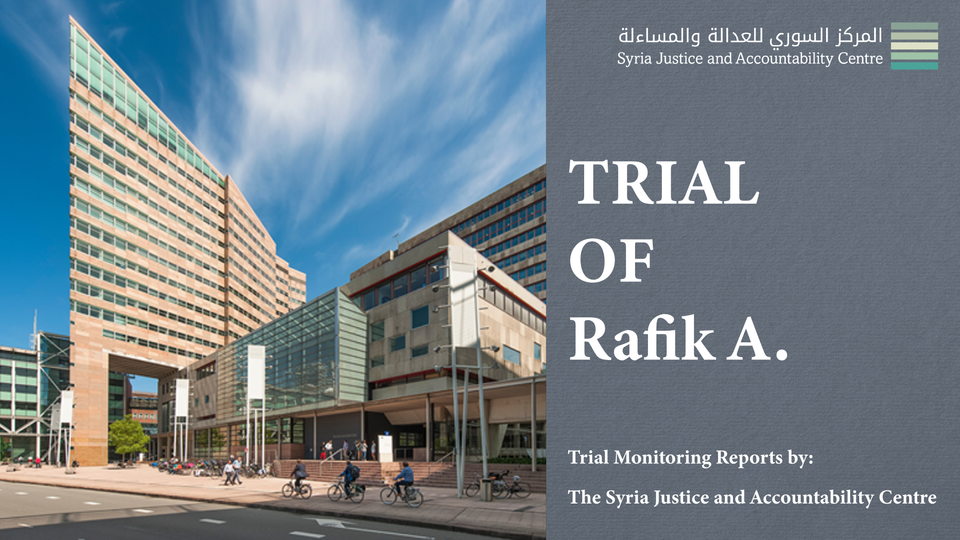
Inside the Rafik A. Trial #2: Reclaiming Agency: The Plaintiffs’ Statements
TRIAL OF RAFIK A.
District Court the Hague - The Hague, The Netherlands
Trial Monitoring Summary #2
Hearing Dates: April 13 & 14, 2026
CAUTION: Some testimony may include graphic descriptions of torture, rape or other violent acts.
Note that this summary is not a verbatim transcript of the trial; it is merely an unofficial summary of the proceedings.
Throughout this summary, [information located in brackets are notes from our trial monitor] and “information placed in quotes are statements made by the witness, judges or counsel.” The names and identifying information of witnesses have been redacted.
[Note: SJAC provides a summary of the proceedings while redacting certain details to protect witness privacy and to preserve the integrity of the trial.]
Trial Monitoring reports of the Rafik A. trial are a result of a partnership between the Syria Justice and Accountability Centre and the Criminal Justice Clinic at the University of Amsterdam, the Netherlands.
SJAC’s 2nd trial monitoring report details days 3 and 4 of the trial of Rafik A. in the Hague, the Netherlands. On the first day of this week, the Court addressed the final complaints against the Accused concerning the alleged torture in detail, presenting the several testimonies. Many details overlapped across the various testimonies, and the dates mentioned by victims and witnesses were corroborated by Facebook posts from around the time of their detention, as well as by other witness statements. As on previous days, the Accused continued to refer to the statement he had given to the police and did not provide further explanation as to how he had obtained such information. He also reiterated his concern that his police interview had not been adequately translated and urged the Court to listen to the original audio recordings. At the start of the hearing, the Judge gave him the opportunity to present his account and offered him further opportunities to respond at several points throughout the hearing.
On the second day of this trial week, the victims were present in the courtroom to deliver their victim impact statements, focusing on the impact that the alleged offences had on them. The Plaintiffs’ Counsel then read out the statements on behalf of three victims, while the remaining victims delivered their statements themselves. The Court did not give the Accused the opportunity to respond to these statements on that day. He will be given that opportunity at the next hearing.
Day 3 – April 13, 2026
Today’s hearing began at 9:20 AM. Several victims attended the hearing and sat next to their Counsel. The Presiding Judge welcomed everyone in the courtroom and informed the Accused that, while he was required to pay attention, he was under no obligation to answer any questions. A Syrian journalist attended the hearing and filmed in the courtroom. He would not film the Accused, and he would not record the Accused’s voice.
The Court explained that, today, it will discuss the final documents from the case file, including the statements of the Plaintiffs, referred to as F., J. and H. The Court will then address the Accused’s personal circumstances. The Presiding Judge repeated the agreement that everyone was required to refer to the victims/injured parties by the agreed letters. The livestream was also resumed that day, and the Court slightly reduced the pace of the proceedings to ensure that the interpreters could follow accurately.
The Accused began by stating that he found it difficult to read the case file he had received, partly because names had been blacked out. The Presiding Judge noted that the Court had received the same case file, as had the Prosecution, and moved on.
One of the Judges indicated that she will be questioning the Accused that day. Before moving on with the substantive hearing, she gave the Accused ten minutes to present his account. The Court explained that it was allowing him this opportunity because, during the previous hearing days, it had become clear that he wished to tell his side of the story. By giving him time to do so at the outset, the Court aimed to ensure that the substantive hearing could proceed smoothly afterwards.
The Accused thanked the Court and asked whether he could address the Plaintiffs directly. The Court explained that this was not permitted and that he should address the Court instead. The Accused then gave his account, including remarks about the city of Salamiyah. He ended by stating that he was innocent. The Judge then presented the statement of Plaintiff H. to the Accused. Before doing so, she told the victims that they should inform the Court in case the hearing became too distressing, or they wished to leave the courtroom.
H. had stated that he had been required to report to the NDF and that the NDF had interrogated him seven times in total. During those interrogations, they tortured and threatened him, and at one point placed a pistol in his mouth. H. stated that he had been able to look out from underneath his blindfold and had recognized the Accused in that way.
The Judge then referred to several witness statements that supported H.’s account of his detention, the torture he described, and the injuries he sustained. The Accused responded by stating that he was not the perpetrator. He argued that H. had only identified him as the perpetrator after seeing a video of him. The Prosecutor then asked the Accused several questions about this, but he refused to answer. He continued to decline to respond and repeatedly referred to the statement he had previously given to the police. The Judge continued by discussing several statements that had been given to the police, to the examining magistrate, and to the Syria Justice and Accountability Centre (SJAC).
The Judge then turned to the statement of Plaintiff F. Plaintiff F. described how the NDF had arrested and interrogated him when he was still a minor, under the command of the Accused. He stated that the abuse had made him want to die. The Judge also referred to several statements by Plaintiff’s D. and H., who described how Plaintiff F. had returned to the cell with serious injuries. The Court discussed that F. had suffered lasting physical and psychological harm.
The Judge again gave the Accused the opportunity to respond. However, he did not specifically address the statements that had been presented to him, and the Judge interrupted him. She emphasized that the Court had given him the opportunity at the start of the hearing to present his account, and that he now had the opportunity to respond to the documents from the case file.
The Judge then discussed the statement of Plaintiff D. Plaintiff D. stated that, in 2013, the NDF had arrested his brother and told him that he had to report to them, otherwise they would also imprison his mother. Plaintiff D. reported to the NDF, and the abuse began almost immediately. He stated that the Accused tortured him for a long period of time and humiliated him during the torture. Plaintiff D. further stated that he already knew the Accused from Salamiyah. He described how the Accused sometimes spoke with a different accent to conceal his identity.
After Plaintiff D. was released from detention, he encountered the Accused on the street. According to Plaintiff D., the Accused wanted to apologize to him and to the other victims [Plaintiffs].
Plaintiff F. stated that he had been detained together with Plaintiff D. The authorities also found a list of prisoners that included Plaintiff D.’s name. The Court then gave the Prosecution the opportunity to ask questions about these substantive parts of the case file. The Prosecutor noted that the Accused appeared to have extensive knowledge of the detention locations in Salamiyah and that he also seemed to know a great deal about the Plaintiffs. She asked him how he had obtained all this information. The Accused responded that, first, he maintained the statement he had given to the police and did not wish to add anything to it. Second, he added, he wanted to tell his story and that the Court should give him time to do so. The Judge informed him that, at this stage, he could only respond to the statements of Plaintiffs F. and D., and that he would have fifteen minutes to do so. The Court monitored the time.
The Accused then explained that he had information about the Plaintiffs who, according to him, did not want the outside world to know. He then recited a verse from the Quran. During his statement, he addressed Plaintiffs D. and F. directly. The Court interrupted him and reprimanded him as this was not appropriate. The Court told the Accused that he had to address the Court while making his statement. The Accused concluded by saying that, in his view, the Plaintiffs’ accounts contained inconsistencies and that it was for the Court to determine this.
The Court then moved on to the Accused’s personal circumstances. The Accused interrupted the Presiding Judge and said that he had only told half of what he wanted to say. The Judge explained that his Counsel would have the opportunity to present his account during the pleadings, and that the Accused himself would also have the opportunity to speak during his final statement. The Judge then continued with the discussion of the Accused’s personal circumstances.
Psychiatrists in the Netherlands had assessed the Accused at the Pieter Baan Centre. The Accused then remarked that he was in a great deal of pain, but that he wished to remain silent about it because, in his words, his enemies would otherwise celebrate. He complained that he had been in detention for twenty-eight months, that he did not speak Dutch, and that no interpreter was present during his detention. He also argued that he could not defend himself if the documents were not written in Arabic. The Judge did not respond to this statement.
The Judge then discussed the substance of the psychiatric report. According to the report, the psychiatrist did not diagnose PTSD or a personality disorder. The psychiatrist also did not observe any trauma-related symptoms in the Accused. The report described the Accused as balanced and stable, and noted that he was capable of presenting himself in a friendly manner towards the investigators. However, during one of the observations, the Accused behaved aggressively towards one of the observers. When the psychiatrist confronted him with this, he denied that it had happened. The report further noted that he repeatedly denied the charges against him, gave a coercive and authoritarian impression, focused strongly on himself, and showed a lack of empathy for others.
The Prosecutor asked the Accused several questions in response to the report. She asked why he had not given the authorities permission to contact his wife and children. The Accused replied briefly that it would be shameful if the police wanted to approach his family. The Prosecutor also referred to a statement in which the Accused had said that he himself had been abducted in Syria. She asked him how he viewed the victims’ accounts, given that he claimed to have experienced abduction himself. The Accused replied that their accounts were lies. The Accused then addressed the media and said that he hoped the truth would come to light.
The Presiding Judge asked whether the Prosecution, the other Judges, or the Defense had any further questions, which all parties denied. The Court then switched off the livestream, and the proceedings were adjourned.
The proceedings were adjourned at 12:37 PM
The next trial day would be on April 14, 2026, at 9:00 AM.
Day 4 – April 14, 2026
[Note: During this hearing, the Plaintiffs’ Counsel indicated that the Plaintiffs preferred to be referred to as “survivors” rather than “victims.” The Prosecution maintained the use of the term “victims,” as this is the legally recognized term within Dutch criminal law. For an accurate reflection of the hearing’s content, this report also uses the term “victims” as used by the parties.]
Today, the Court will address the victims’ statements and the civil claims submitted by the Plaintiffs. The Presiding Judge welcomed everyone to the courtroom and informed the Accused of his rights and duties. Seven Plaintiffs were present in the courtroom, and their statements were also broadcast via the livestream.
One of the two Plaintiffs’ Counsels began by reading an opening statement. She explained that the Plaintiffs had travelled to the Netherlands to attend the hearing and that, in their statements, they will address the impact the events have had on them. She noted that, by speaking today, the Plaintiffs were reclaiming agency over the situation, which contributes to their sense of justice and recovery. She further highlighted that, during the previous hearing days, the Accused had repeatedly insulted the victims and cast doubt on their accounts. According to the Plaintiffs’ Counsel, this constituted a clear example of secondary victimization.
The Counsel then addressed the situation in Syria in 2011 and described how the Plaintiffs had participated in peaceful demonstrations for democracy and recalled the violent response of the National Defense Forces (NDF) to mind. She noted that the livestream was being followed in Salamiyah and stressed that, in recent days, approximately twenty additional women had come forward with allegations against the Accused in connection with this case. She discussed the role of the Accused, emphasizing that he continued to deny the allegations and minimize the suffering of the victims. She further argued that the Accused had effectively re-threatened the victims by suggesting that they had made a “life-changing mistake” by bringing charges against him. The victims described the Accused as sadistic and stated that he appeared to take pleasure in the torture. According to their accounts, the abuse often continued even after they had already confessed.
The second Plaintiffs’ Counsel then continued and addressed the Plaintiffs’ statements in more detail. She emphasized the consistency of the accounts and expressed admiration for their willingness to share their experiences, both previously and again during the hearing. She noted that the Plaintiffs had heard other interrogators refer to the Accused as “master” during the interrogations. She also described how the Accused not only inflicted physical harm but also subjected the victims to psychological abuse. According to the Plaintiffs, they were continuously exposed to the fear of torture or death.
At that point, the Accused interrupted the proceedings, noting that he needed to use the restroom. The Court asked whether this could wait, but the Accused denied. The Judge allowed him to leave the courtroom briefly, but Judges and Plaintiffs’ Counsels appeared irritated. Once the Accused returned, the hearing resumed.
The Plaintiffs’ Counsel then continued by explaining that their clients had consciously chosen not to describe all the atrocities in detail and that they preferred to be seen as survivors rather than victims. She emphasized that they wished to speak on behalf of those who had not survived. The Counsel then read out the statement of Plaintiff S., who was not personally present due to personal circumstances. In the statement, Plaintiff S. described the impact of the events. She also referred to the Accused’s complaints about his detention in the Netherlands, noting that he has a mattress, receives food, and has access to daylight. Plaintiff S. was of the opinion that the Accused had no right to complain about these conditions, as the victims did not have such basic necessities during their detention.
The Counsel then explained that Plaintiff M. was not present because the process was too psychologically burdensome. Since the detention, Plaintiff M. has continued to suffer from severe anxiety.
The Plaintiffs’ Counsel also read out the statement of Plaintiff D. Although Plaintiff D. was present in the courtroom, he chose not to read his statement himself. In his statement, he described how, at the age of sixteen, he had dreamed of a Syria governed by the rule of law and respect for human dignity, and how that dream had been shattered following his detention.
The Court thanked Plaintiff S., M., and D. for their statements and confirmed that their voices had been heard.
***
[20-minute-break]
***
Following the break, Plaintiff A. then delivered his own statement. He spoke about the property, assets, and money that had been taken from him. He emphasized that the injustice continued to affect him to this day. He also described how the Accused had torn families apart in Salamiyah.
Plaintiff J. also delivered his own statement. He described how he had carried this pain for years and that he now finally had the opportunity to express it before a court committed to establishing the truth. He added that this process provided recognition for the wider community.
The Presiding Judge thanked both victims for their statements and reminded those present that sharing the livestream link was not permitted.
Plaintiff H. then delivered his own statement. He described how individuals who failed to comply with NDF demands had paid a high price. He noted that he did not wish to elaborate on his suffering, as doing so would give satisfaction to the Accused. He did not want to grant him that. He described how the events had changed his life. The Judge thanked him for sharing his statement.
The Defense Counsel then recognized that the victims should be treated with respect. He also emphasized that the Accused denied the allegations and has not been convicted.
Next, Plaintiff F. then delivered his own statement. He spoke about the last time he saw the Accused and recalled that the Accused told him it would be the last time he would see his family and that he would go to hell. F. added that his father had also been detained and that he had never fully understood his father’s experience until he himself was detained at the age of seventeen. He described how everything changed after that. He stated that he had witnessed people die as a result of torture during his detention and that he had even seen a six-year-old child. He also described how detainees could hear women being raped and how they wanted to intervene but were powerless to help. He emphasized how proud he was of the women who had endured these experiences and were still present.
Then, Plaintiff R. delivered her own statement. She began with a message to women who have experienced sexual violence, urging them not to remain silent. She apologized for having to leave the courtroom the previous day, explaining that it had become too overwhelming for her. She stated that she found it distressing that the Accused might claim to suffer from PTSD, as she did not want to share anything in common with him, not even such a condition. She described the impact of the events on her life and the trauma she continues to experience. She emphasized that she is not damaged and stated that she had been deeply affected by the Accused referring to her as “damaged” during an earlier hearing. For that reason, she chose to speak today in her own voice. She also stated that her interviews with the police had felt like a form of therapy and had helped her to begin forgiving herself. She spoke about her achievements in recent years, including obtaining several diplomas and learning the [redacted information] language. She added that she could have achieved much more had these events not occurred.
Subsequently, Plaintiff O. also delivered her own statement. She explained that she left Syria in 2013 because she could not bear the idea of being detained again. She described how she had travelled to other countries, where she was rejected and at times left homeless. These experiences have continued to affect her for years. She mentioned the names of missing children and stated that their mothers still do not know what has happened to them. She described the case of a mother whose two children had been taken. She explained that, after the fall of the regime, people searched the prisons in an attempt to find those children. Plaintiff O. noted that her dignity as a person cannot be taken away. She explained that she has spent thirteen years trying to convince herself of this, and that she continues that struggle every day, and every day, she prevails. She questioned why the details of rape and sexual violence had to be discussed so extensively during the proceedings, noting that this had not been helpful for the victims. She concluded by stating that she wants to know where the bodies of the missing children are.
The Court thanked her for her statement and addressed her question. The Court explained that, within the Dutch criminal procedure, it is unavoidable that such details are discussed, as all parties must have the opportunity to respond to them. This forms part of the right to a fair trial and the rights of the Accused.
The Court then moved on to the civil claims submitted by the Plaintiffs. It noted that the substantive positions will be addressed during the closing arguments and the Prosecution’s submissions. The Plaintiffs’ Counsels specified that they were submitting claims for compensation on behalf of the injured parties. On behalf of Plaintiffs D., M., O., S. and R., the Plaintiffs’ Counsels claimed €35,000 in non-material damages. They argued, in summary, that these individuals were not only subjected to torture, but also to sexual violence, including rape, constituting crimes against humanity. For the Plaintiffs A., H. and J., the Plaintiffs’ Counsel claimed €30,000 in non-material damages.
The Defense Counsel then argued that the claims should be declared inadmissible, since the Defense intended to request an acquittal on behalf of the Accused. The Defense also argued inadmissibility on the basis of insufficient access to Syrian law.
The Accused requested an immediate opportunity to respond to the victims’ statements. The Court rejected the request and informed the Accused that he will be given the opportunity to respond on the next hearing day and adjourned the proceeding.
The proceedings were adjourned at 2:23 PM
The next trial day would be on April 21, 2026, at 9:00 AM.
___________________________
For more information or to provide feedback, please contact SJAC at [email protected] and follow us on Facebook and Twitter. Subscribe to SJAC’s newsletter for updates on our work