Inside the Rafik A. Trial # 05: Rafik A. Convicted on 19 Counts of Crimes Against Humanity
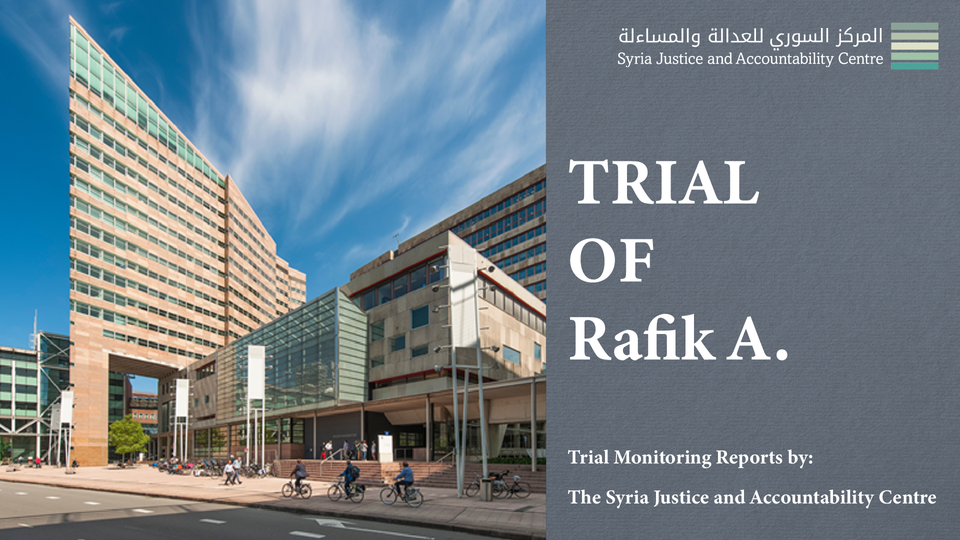
TRIAL OF RAFIK A.
District Court the Hague - The Hague, The Netherlands
Trial Monitoring Summary #5
Hearing Dates: June 15, 2026
CAUTION: Some testimony may include graphic descriptions of torture, rape or other violent acts.
Note that this summary is not a verbatim transcript of the trial; it is merely an unofficial summary of the proceedings.
Throughout this summary, [information located in brackets are notes from our trial monitor] and “information placed in quotes are statements made by the witness, judges or counsel.” The names and identifying information of witnesses have been redacted.
[Note: SJAC provides a summary of the proceedings while redacting certain details to protect witness privacy and to preserve the integrity of the trial.]
SJAC’s 5th trial monitoring report details day 9 of the trial of Rafik A. in the Hague, the Netherlands. On this trial day, the Dutch Court delivered its judgment in the case of Rafik A., finding him guilty on 19 counts of crimes against humanity committed against eight victims. The Court held that the Accused, who served as an interrogator for the NDF during the Syrian uprising, was involved in torture, rape, and sexual violence. Rafik A. was sentenced to 26 years’ imprisonment. The claims for damages were declared inadmissible.
Day 9 – June 15, 2026
On this trial day, the proceedings started at 4:09 PM before the Meervoudige Kamer of the District Court in The Hague. The Presiding Judge welcomed everyone present in the courtroom as well as those following the proceedings via livestream. He then announced that the Court would deliver its judgment in the case of Rafik A. He explained that only the main findings would be presented during the hearing and that the full written judgment would be published online at a later stage.
The Court first made clear that the Accused would be sentenced to an unconditional term of imprisonment. It found that, since April 2011, the Assad regime had carried out an attack against the Syrian civilian population pursuant to a state policy. During the Syrian uprising in 2013 and 2014, the Accused served as an interrogator for the NDF, a paramilitary organization affiliated with the Assad regime. The NDF operated its own detention facilities, where detainees were interrogated and subjected to torture and other forms of violence. The Court held that, in his capacity as an NDF interrogator, the Accused must have been aware of the attack on the Syrian civilian population.
The Court found it sufficiently established that the Accused had served as an interrogator for the NDF. In reaching this conclusion, it relied on witness testimonies and official documents demonstrating his membership in the NDF. The Court also referred to photographs of the Accused taken in August 2013, showing him wearing a camouflage uniform and carrying a weapon. Through geolocation analysis, the police confirmed that these photographs had been taken at one of the NDF's detention facilities.
The case concerned 25 charges relating to nine victims. In its pleadings, the Defense challenged the reliability and credibility of the testimonies given by the Plaintiffs and witnesses. The Court, however, found these testimonies to be reliable. It also considered the Plaintiffs’ identification of the Accused to be largely reliable. In addition, the Court noted that the case was supported by sufficient corroborating evidence, including credible open source evidence.
The Court therefore found the Accused guilty, either as a sole perpetrator or as a co-perpetrator, of torture as a crime against humanity in relation to all Plaintiffs, with the exception of O. It also found him guilty of torture for the purpose of obtaining information or a confession as a crime against humanity in relation to all Plaintiffs, again with the exception of O. In addition, the Court convicted the Accused of the rape of R. as a crime against humanity, and of sexual violence as a crime against humanity in relation to F. and R.
The Accused was acquitted of sexual violence as a crime against humanity in relation to M., D., and S., as the Court found that the acts did not meet the threshold of gravity comparable to the other acts listed. With respect to S., the Court considered the acts of a sexual nature committed against him to form part of his torture. The Accused was also acquitted of the torture of O. as a crime against humanity. The Court held that O.’s identification of the Accused may have been influenced by her brother, and that there was no other evidence indicating that the Accused had been the person who tortured her.
The Accused was therefore found to have been involved in torture, rape, and sexual violence as crimes against humanity against eight victims. He either committed these acts himself or instructed others to do so. The victims were abused, forced into car tires, and hung upside down. They feared for their lives and did not know whether they would ever leave prison. The Court held that the Accused appeared to enjoy torturing and dehumanizing the victims. These acts have continued to have serious consequences for the victims to this day. During the trial, the Accused again insulted the victims, causing them further harm. In total, the Court convicted the Accused of 19 counts of crimes against humanity. It sentenced Rafik A. to an unconditional prison sentence of 26 years, with the time already spent in pre-trial detention to be deducted.
Regarding the claims for damages, the Court found that the Accused, as an interrogator for the NDF, an organization operating under the government and Assad regime, was to be considered a public servant and therefore enjoyed functional immunity under Syrian law. On that basis, the Court concluded that the Dutch courts had no jurisdiction to decide on the claims for damages. The claims were therefore declared inadmissible.
Closing the hearing, the Presiding Judge stated that the parties had 14 days to appeal the judgment.
The proceedings were adjourned at 4:30 PM.
___________________________
For more information or to provide feedback, please contact SJAC at [email protected] and follow us on Facebook and Twitter. Subscribe to SJAC’s newsletter for updates on our work