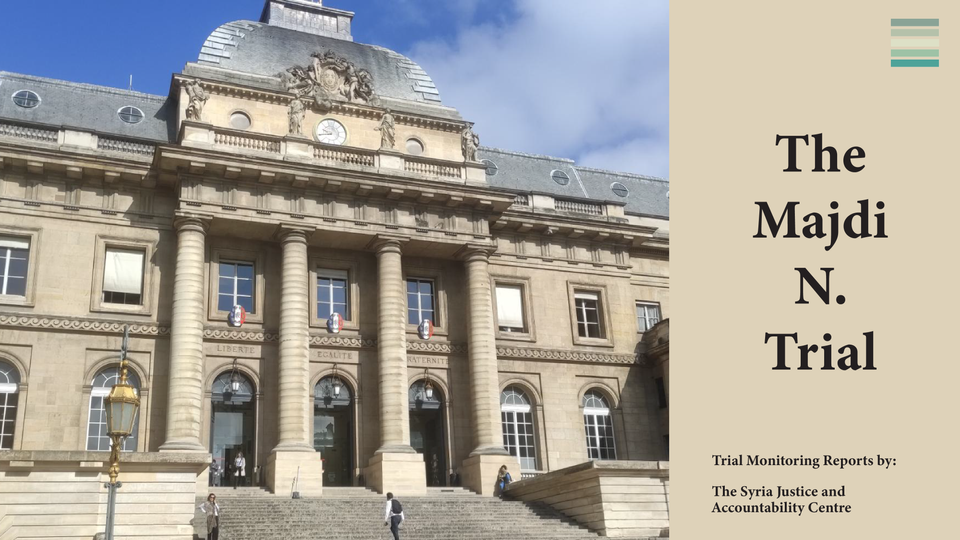
Inside the Majdi N. Trial #25: Testimony of Civil Party Mazen Darwish
TRIAL OF MAJDI N.
Court of Assize – Paris, France
Trial Monitoring Summary #25
Hearing Date: May 11, 2025
CAUTION: Some testimony may include graphic descriptions of torture, rape or other violent acts.
Note that this summary is not a verbatim transcript of the trial; it is merely an unofficial summary of the proceedings.
Throughout this summary, [information located in brackets are notes from our trial monitor] and “information placed in quotes are statements made by the witness, judges or counsel.” The names and identifying information of witnesses have been redacted.
[Note: SJAC provides a summary of the proceedings while redacting certain details to protect witness privacy and to preserve the integrity of the trial.]
[Note: Rather than publishing the trial reports of the Majdi N. case in chronological order, SJAC has organized them thematically and coherently based on the content of the hearings, making the material more accessible by highlighting key issues and connections across the proceedings.]
SJAC’s 25th trial monitoring report details day 11 of the trial of Majdi N. in Paris, France. On this trial day, Mazen Darwish detailed his background and the work of the Syria Center for Media and the Freedom of Expression (SCM) on violations committed by Jaysh Al-Islam. Regarding the disappearance of the “Douma four,” Mazen Darwish reported how he conducted discussions with Jaysh Al-Islam to obtain information on their fate, but in vain. Questioned about Majdi N.’s involvement in the crimes at stake, Mazen Darwish argued that the Accused had a prominent role that went beyond his responsibilities as spokesperson.
Day 11 – May 19, 2025
Afternoon Session
Proceedings resumed at 4:21 PM.
Mazen Darwish, W19, was heard as a Civil Party to the case.
Mazen Darwish reported that the Syrian Center for Media and Freedom of Expression (SCM) represented more than 800 victims in 29 legal cases, the vast majority concerning crimes committed by the Syrian regime. In the present case, some victims had professional ties with the SCM.
Mazen Darwish detailed his background as an opponent and detainee of the Syrian regime before and after the revolution and testified that he endured torture. He emphasized that he had read Majdi N.’s declaration about his own arrest by the regime, and the detention of his brother [redacted name] F4 in Sednaya. As a response to Presiding Judge Lavergne’s question on amnesty, Mazen Darwish explained that political activists were never granted it.
Mazen Darwish detailed the history of the SCM to Presiding Judge Lavergne. Regarding Razan Zeitouneh, Mazen Darwish emphasized that he knew the “Douma four” [F21, F22, F23, F24] and had asked Razan Zeitouneh to join the SCM in October 2011, in case he himself would be arrested by the Syrian regime.
Presiding Judge Lavergne asked Mazen Darwish to describe his contact with Jaysh Al-Islam after his release by the Syrian government on August 10, 2015. Mazen Darwish declared that the kidnapping of the “Douma four” directly resulted from their documentation activities. After his release, Mazen Darwish had been informed of the suspicion toward Jaysh Al-Islam and heard that Zahran Alloush was about to travel to Saudi Arabia for discussions with the Syrian opposition. Mazen Darwish considered it an opportunity to discuss the matter with him. Consequently, Mazen Darwish traveled to Riyadh in 2015.
However, Zahran Alloush did not appear in person at the meeting, and Jaysh Al-Islam was represented by his cousin [redacted name], F7, head of the Policy Office المكتب السياسي as well as other figures. Mazen Darwish urged them to find a solution, stressing that if the issue was not solved, he would take legal action. Their first reaction was to deny any involvement by Jaysh Al-Islam, expressing anger toward the families of the “Douma four” who accused them. Mazen Darwish insisted that he did not wish to have a conflict with them and rather intended to focus on the crimes committed by Bashar Al-Assad. The Jaysh Al-Islam delegation then asked Mazen Darwish if he could guarantee that Razan Zeitouneh and the others would respect the contract in case they were released, and Mazen Darwish commented that he considered this statement a proof of Jaysh Al-Islam’s involvement.
The next day, Jaysh Al-Islam’s delegation told Mazen Darwish that they would convene a meeting between him and Islam Alloush in Istanbul in three weeks, for them to have time to conduct investigations on these missing persons. They repeated that they were not responsible for the kidnapping. However, Zahran Alloush was assassinated before those three weeks had passed.
Two months later, Mazen Darwish met F7 in Geneva, expressed his condolences for the death of Zahran Alloush, and reiterated his concern for the liberation of the “Douma four.” However, F7’s behavior was appalling, Mazen Darwish reported. He was very harsh, insulting, and arrogant, and told Mazen Darwish that his agreement was with Zahran Alloush and he should go discuss it with him. From then on, Mazen Darwish planned to open an investigation. He declared he was convinced of Jaysh Al-Islam's responsibility in the disappearances.
A debate ensued on the charges brought against Majdi N., which did not include the enforced disappearance. However, Presiding Judge Lavergne declared that the war crimes mentioned in the indictment could include the kidnapping.
Presiding Judge Lavergne then questioned Mazen Darwish about what he knew of Islam Alloush. Mazen Darwish explained that the SCM had documented war crimes and crimes against humanity committed by Jaysh Al-Islam and depicted the group’s chain of command. The SCM also put together a file on Jaysh Al-Islam’s main commanders, and Mazen Darwish believed Majdi N. was one of them.
The SCM learned that Majdi N. was in Marseille through a person who had warned the Accused that a case had been filed against Jaysh Al-Islam in France and that he should leave. Islam Alloush apparently responded that he had good relations with the French intelligence services and foreign affairs and was protected by the judiciary. Mazen Darwish said that he did not want to give the name of the person who had this discussion with Majdi N.
Presiding Judge Lavergne noted that from the information shared by the SCM, some was proven true, but some turned out to be wrong. As an example, a person declared that Islam Alloush had personally tortured him, but nothing pointed to that in the case file. Mazen Darwish replied that the SCM followed strict criteria in its documentation work, and when a witness declared to have been subjected to torture, they did not judge him. It’s the tribunals’ responsibility to do so, Mazen Darwish argued.
Presiding Judge Lavergne asked if Mazen Darwish considered the present Syrian government capable of ensuring the safety of witnesses in the present trial, and Mazen Darwish said he did not believe so. He deplored that many victims and witnesses could not attend the trial, some because of fear and threats they received, others because of family members who were still present in unstable areas. Still, most victims could not travel out of Syria because of visa issues, Mazen Darwish regretted. Jaysh Al-Islam remained very strong on the ground, despite the recent arrest of its chief in the United Arab Emirates, Mazen Darwish added. When he traveled to Syria and encountered victims and witnesses from Douma and Eastern Ghouta, Mazen Darwish continued, some people even did not dare meet him publicly.
When questioned about [redacted name], who worked in the SCM and had mentioned during the investigation a video of people put in cages and exhibited in Douma, Mazen Darwish confirmed the SCM tried to preserve such open-source videos.
Mazen Darwish stressed that the combatants of Jaysh Al-Islam [who fought against the regime] deserve a great deal of respect, but they were used and manipulated by commanders and leaders whose only goal was to establish a zone of control where they could get rich and exploit local resources—at the expense of those who were genuinely striving for freedom. Several factions that were truly and sincerely opposed to the regime were eliminated by Jaysh Al-Islam. Mazen Darwish then claimed that all victims have the right to justice.
Civil Parties’ Counsels’ Questioning of Mazen Darwish
Counsel Baudouin praised the professionalism of the SCM’s work and asked how the SCM obtained information on violations committed in Ghouta. Mazen Darwish explained that after the revolution, they created a center dedicated to documenting violations and registered more than 300,000 documents on all parties to the conflict. The center also registered more than 100,000 cases of disappearances. Mazen Darwish emphasized that most volunteers of the SCM were in Syria, and added that the SCM became a consultative body at the UN in 2011 and signed three conventions with the International, Impartial and Independent Mechanism (IIIM).
Referring to critics on the legitimacy of the present trial, Counsel Bailly reported the Defense’s suggestion that the Court was incompetent, and at risk of ethnocentrism and judicial colonialism. Counsel Bailly emphasized that it was Mazen Darwish who initiated and documented Jaysh Al-Islam’s crimes and asked him if he considered the French judiciary legitimate. Mazen Darwish declared that he had first presented evidence at a trial in Koblenz [See SJAC’s Trial Reports here], where he had expressed his wish for a trial to take place in Damascus before a neutral court. However, Mazen Darwish believed it was not possible today, and as a result, victims could in his opinion use all available means to obtain justice. Mazen Darwish considered all cases brought before European and American courts legitimate and stressed that it was the very essence of universal jurisdiction.
Referring to a conference that took place at the Institute of the Arab World in Paris in 2025, where he had declared that he was in favor of transferring all investigations to Syria, Mazen Darwish clarified that this should be the case only if conditions of fair trials were met. However, he reported that victims had withdrawn their complaints against Jaysh Al-Islam out of fear, and Majdi N. himself expressed concerns because of declarations he had made against Jaysh Al-Islam. Mazen Darwish added that hundreds of Syrian victims were following this trial and hoped for responses [on Jaysh Al-Islam's crimes] and a sentence.
Mazen Darwish reported that the Accused had already been identified in the first complaint brought against Jaysh Al-Islam by the SCM [in France in June 2019]. Mazen Darwish added that he had nothing personal against Majdi N., but the present case concerns crimes committed by Jaysh Al-Islam at a time when he was one of its chiefs.
Concerning the attack on Adra Al-Omaliya, Mazen Darwish declared it was among the most terrible massacres that occurred in the region. Counsel Bailly referenced the video dated July 2015 showing children working for Jaysh Al-Islam in a factory. Mazen Darwish certified that all crimes mentioned during the trial had occurred: summary executions; torture; accusations of belonging to ISIS, etc. Mazen Darwish claimed that Majdi N. did not give any explanation on the fate of the thousands of ISIS prisoners and added that the victims of these crimes were inhabitants of Douma, who were themselves against the Syrian regime.
Counsel Bailly further mentioned a discussion with [redacted name] in which Majdi N. said that 2,800 people were arrested in Ghouta and that half of them belonged to ISIS. Counsel Bailly added that Majdi N. presented himself as a whistleblower. Mazen Darwish commented that Jaysh Al-Islam controlled everything in Ghouta and signed contracts with the Syrian regime to obtain food that they then stored in warehouses and resold at exorbitant prices. He claimed that Jaysh Al-Islam enriched themselves at the expense of the population and issued fatwas authorizing the consumption of cats and dogs.
Counsel Bailly inquired about the Unified Judiciary Council. Mazen Darwish first emphasized that documents presented by the Defense [see Trial Report #16] showed that Islam Alloush was representing Jaysh Al-Islam and was an important member. Mazen Darwish also noted that Majdi N. once presented himself as Deputy of the Policy Office. As for Ghouta’s judicial system, Mazen Darwish said it reminded him of tribunals under Bashar Al-Assad where confessions were extracted through torture, trials were not public, decisions were not reasoned, etc.
Counsel Zarka mentioned a communiqué from the municipal council of the Jobar جوبر neighborhood in Damascus which condemned the executions committed by Jaysh Al-Islam and the fact that the group took the law into its own hands. Reacting to this, Mazen Darwish depicted the work of Razan Zeitouneh in support of local committees and declared that when Jaysh Al-Islam took control of a territory, they did everything to dissolve those bodies. Mazen Darwish also mentioned [redacted name], F53, who had denounced Jaysh Al-Islam’s crimes during a recent victory celebration organized after the fall of the regime.
According to Mazen Darwish, Jaysh Al-Islam never intended to overthrow the Assad regime but rather to become the Syrian version of Hezbollah and control its own neighborhood. Jaysh Al-Islam launched a campaign against Mazen Darwish at a time when the SCM filed complaints against the Syrian regime, he added.
Prosecution's Questioning of Mazen Darwish
The Prosecutor referenced Mazen Darwish’s statement that the trial of Majdi N. was the most complex one for the SCM, notably because of the disinformation campaigns against the SCM and threats received by some witnesses. She emphasized that under Jaysh Al-Islam, the media seemed to be used to mislead and threaten.
Mazen Darwish responded that Syrians were still experiencing media campaigns, threats, and pressure today, and confirmed Jaysh Al-Islam was part of it. He reported to know individuals who were part of Jaysh Al-Islam’s security apparatus, but were still at serious risk, so the SCM decided not to publish the information they had. As for the media, Mazen Darwish declared it was one of the weapons the Nazis used and with those weapons, massacres were committed.
The Prosecutor asked Mazen Darwish to react to a press article published in the newspaper Al Jisr جريدة الجسر on March 12, 2021, which mentioned an organization formed in support of Majdi N. and aiming to obtain his release from prison. The organization declared that measures must be taken against Mazen Darwish, and evidence must be found to prove Islam Alloush’s innocence. The Prosecutor added that [redacted name], F29 was part of this organization. Mazen Darwish confirmed he had seen this article.
Defense Counsel’s Questioning of Mazen Darwish
Counsel Ruiz started by thanking Mazen Darwish for his message to the Court, which he supported almost viscerally. But since he was also a lawyer, Counsel Ruiz continued, Mazen Darwish could imagine the difficulty of associating Majdi N. with [Nazi leader] Goebbels. Counsel Ruiz then asked if Mazen Darwish was familiar with the legal standard under international law. Mazen Darwish responded that being assisted by professional lawyers such as them was the first condition of a fair trial and repeated that he had nothing personal against the Accused, but the evidence attested he took part in a group which committed crimes.
Counsel Ruiz asked if, as a lawyer, Mazen Darwish believed that it was sufficient to have known that a crime was committed to be considered an accomplice. Mazen Darwish responded that he indeed believed so and that Majdi N. was involved, and it was time for him to tell the truth. Someone who brainwashed young people by telling them they will fulfill their dreams by joining the cause, and someone who held meetings with commanders and met with foreign intelligence services [was necessarily involved]. Mazen Darwish concluded that, just as money, crimes could be laundered, too.
Counsel Ruiz highlighted the UN statement that transitional justice is only effective when delivered as close as possible to the victims. He asked what Mazen Darwish thought of this view, which was that of the UN and not just the Defense. Mazen Darwish believed that crimes against humanity were not simple offenses and claimed he had no link to imperialism, stressing that all victims were Syrians.
Counsel Ruiz noted Mazen Darwish’s declaration that Majdi N. belonged to the Policy Office of Jaysh Al-Islam and further referenced the organizational chart provided by the SCM which showed that Majdi N. belonged to the Moral Guidance Office مكتب التوجيه المعنوي. Counsel Ruiz asked if Mazen Darwish believed that Majdi N. occupied all these functions inside Jaysh Al-Islam. Mazen Darwish retorted that the Defense itself had presented documents that showed Islam Alloush participated in meetings with other Syrian factions as a representative of Jaysh Al-Islam. That made Mazen Darwish say that Majdi N.’s role went beyond the one of spokesperson. Counsel Ruiz retorted that his interpretation was an assumption, since all these meeting reports only showed that Majdi N. represented the group, and it could not be deduced that he participated in the group’s political command. Mazen Darwish stressed that if Majdi N. had only been spokesperson, he would have had nothing to do with these meetings. Counsel Ruiz asked Mazen Darwish if he knew Jaysh Al-Islam member [redacted name], who also participated in these meetings, whom Mazen Darwish did not know.
Regarding the criticism expressed by the Civil Parties that the Defense had a Manichean view, Counsel Ruiz wondered if it was not also Manichean from Mazen Darwish to pretend that Jaysh Al-Islam combatted all genuine revolutionaries and only intended to become the Syrian version of Hezbollah.
As a Syrian who was forbidden to return and yet continued to work for Syria, Mazen Darwish declared, he believed he had sufficient experience to share his political vision. As such, he confirmed that Jaysh Al-Islam intended to become the Sunni version of Hezbollah. Mazen Darwish added that in contrast, after seven years spent in France, he could not pretend to take part in debates on the country’s politics.
Proceedings were suspended.
___________________________
For more information or to provide feedback, please contact SJAC at [email protected] and follow us on Facebook and Twitter. Subscribe to SJAC’s newsletter for updates on our work