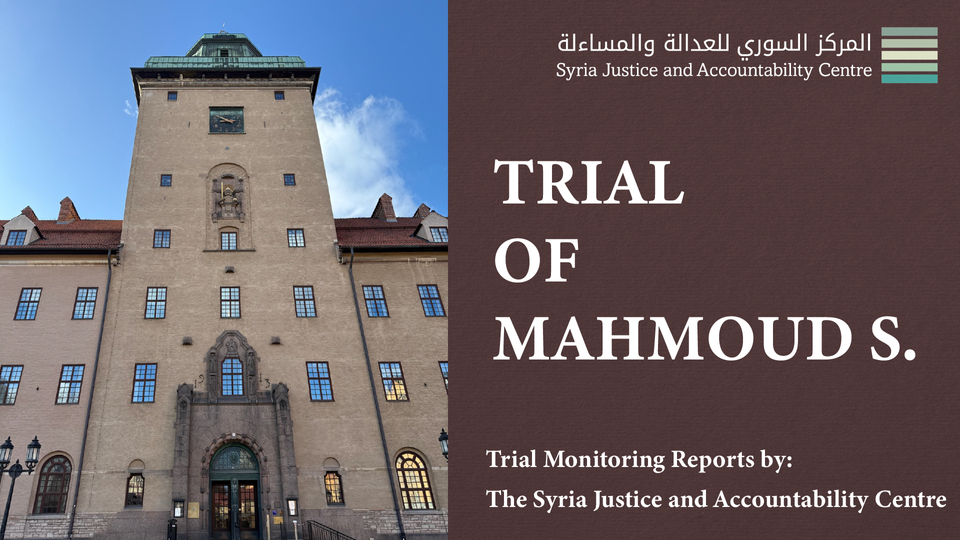
Inside the Mahmoud S. Trial #18: The Prosecutor’s Closing Argument
TRIAL OF MAHMOUD S.
Solna District Court – Stockholm, Sweden
Trial Monitoring Summary #18
Hearing Date: March 17 and 19, 2026
CAUTION: Some testimony may include graphic descriptions of torture, rape or other violent acts.
Note that this summary is not a verbatim transcript of the trial; it is merely an unofficial summary of the proceedings.
Throughout this summary, [information located in brackets are notes from our trial monitor] and “information placed in quotes are statements made by the witness, judges or counsel.” The names and identifying information of witnesses have been redacted.
[Note: SJAC provides a summary of the proceedings while redacting certain details to protect witness privacy and to preserve the integrity of the trial.]
Trial Monitoring reports of the Mahmoud S. trial are a result of a partnership between the Syria Justice and Accountability Centre, the University of Stockholm, Sweden, and the Center for Victims of Torture (CVT).
SJAC’s 18th trial monitoring report details days 51 and 52 of the trial of Mahmoud S. in Stockholm, Sweden. This week, the Court heard the Prosecutor’s closing argument. The Prosecution’s closing argument focused on establishing that a non‑international armed conflict existed in Syria during the relevant period and that regime forces and affiliated militias acted in coordinated operations in the area. It argued that civilians were subjected to war crimes through a targeted attack on a peaceful demonstration and through systematic abuse, arrests, and killings at a northern roadblock. The Prosecution maintained that the accused was allied with pro‑regime militias and played an active role in both the attack on demonstrators and the operation of the roadblock, including identifying individuals for arrest. It further contended that the evidence, taken as a whole, established criminal responsibility either as a direct perpetrator or, alternatively, for aiding and abetting serious international crimes, and requested a life sentence.
In addition, civil claims for moral damages were presented, seeking financial compensation for survivors, injured victims, bereaved families, and individuals unlawfully detained.
Day 51 – March 17, 2026
Today, the Prosecution read out its closing argument.
The disposition of the pleading was as follows
1. Legal assessment part 1
2. Cooperation between the Syrian regime and pro-regime militias
3. Mahmoud S. allied with pro-regime armed militia
4. Demonstration
5. Checkpoint
6. Legal assessment part 2
7. Legal consequences, etc.
1- Legal Assessment Part 1
The Prosecutor began by going through the basis for the prosecution, which was first to establish an “armed conflict.” The legal requirements of International Armed Conflict (IAC), Non-International Armed Conflict (NIAC), nexus (connection) and Chapter 22 Section 6 of the Swedish Penal Code (BrB) were presented. Then, two reports were presented, one from COI [Report of the Independent International Commission of Inquiry on the Syrian Arab Republic August 2015] and one from IIIM [Brief on the commencement of the initial non-international armed conflict in Syria, September 2020], both of which showed that there was a NIAC before the demonstration. One report also claimed that the armed conflict continued even after the demonstration (i.e. at the checkpoint). Subsequently, three judgments from the Svea Court of Appeal and one from the Stockholm District Court were presented, stating that a NIAC at the very least existed in the first quarter of 2012, which proves that there was a NIAC in Syria during the period covered by the charges. Regarding the nexus requirement (linkage), the Prosecution argued that there were clashes around Yarmouk between the FSA and the regime forces, and that the perpetrators were regime forces. It was further explained that there was a need to quell the opposition in Yarmouk in order to maintain control of the area and thus prevent further advances of the FSA in the direction of Damascus.
It was then described that the establishment of the checkpoint (at the northern entrance to Yarmouk) to prevent FSA toward Damascus did not in itself constitute a war crime, rather it was the fact that it was also used to subject civilians to oppression. The Prosecutor then addressed the applicability of Chapter 21, Section 6 of BrB by discussing Art. 3 of the Geneva Convention IV which Syria has ratified and adopted, listing a number of prohibited acts. The Prosecutor then highlighted that even though Syria has not adopted Additional Protocol II (Articles 4 and 13), it constitutes customary law based on, among other things, the Rome Statute and the ICRC's customary law study.
2 - Cooperation between the Syrian regime and pro-regime armed militias
The Prosecutor presented events/situations that were of importance for the regime's armed attack and the siege of Yarmouk.
It presented two timelines as images:
Image 1:
June 5-6, 2011 >> à The People’s Committees >> à Unrest in Yarmouk
Image 2:
Hamas leaves Yarmouk, February 2012 >> à The Murder of Imad Sariyya, June 29, 2012 >> à The massacres on July 11, 2012
The following was then compiled:
- The witness [redacted name], W33 has corroborated the General Command's (GC) and FPM's information about the armed conflict, [redacted name], F19 has said that Mahmoud S. was present at the demonstration on June 6 and [redacted name]’s, E2’s report shows the developments on June 5-6.
- The Prosecutor then claimed that E2’s report, testimony of [redacted name], E1, and F19 have proven that regime-loyal armed militia groups and People’s Committees in Yarmouk collaborated with the Security Services.
- A report from SCM has shown that FPM was active in the camp and [redacted name], W22 has been heard about FPM and GC recruiting members.
- [redacted name], W34, [redacted name], W7 and [redacted name], W14 have verified FPM and GC's cooperation with the Security Services. Subsequently, [redacted name]'s, F8’s relationship with FPM as founder has been confirmed by [redacted name], W35 and [redacted name], W27 (cousin).
- The Prosecutor then explained that the Syrian rebels’ offensive against Yarmouk in July 2012 was a circumstance that led the GC to decide to arm the People's Committees, which were then transformed into the military part of the FPM.
- Finally, the following persons had verified the presence and relations of the GC, FPM and the Security Services in Yarmouk: [redacted name], P2, [redacted name], F12, [redacted name], W22, [redacted name], W1, [redacted name], W5, [redacted name], W36, [redacted name], W23,
***
[15-minute break]
***
3 - Mahmoud S. allied with pro-regime armed militia
The Prosecutor began this part by first reading out the indictment. She then went on to say that [redacted name], W18, [redacted name], W11, W34, E1, and W22 have proved that the Accused had contact with the Security Services before the war.
It was then explained that [redacted name], F14, and F19 have clarified Mahmoud S.’s participation in FPM as well as the Facebook post from May 10, 2013 where Mahmoud S. is seen with FPM members who show that he was involved before he left Syria. The Prosecutor also brought up the second Facebook post (the wanted persons) from July 8, 2013, i.e. before the checkpoint was closed and the complete siege, where the FSA was looking for, among others, Mahmoud S. The Prosecutor argued that the search was one of the reasons he left Syria and that his main duty ended at the checkpoint due to the total siege.
The Prosecutor then pointed out that the Swedish Migration Agency’s information about when Mahmoud S. left Syria indicates that he was in Yarmouk at the time of the alleged manning of the checkpoint. Then they were able to conclude that he had been back in Syria for certain periods between 2017–2019 and that they had been able to prove contact with, among others, F8. In this context, the Prosecutor also emphasized that W23 and W36 had provided support for the view that Mahmoud S.'s actions in Sweden demonstrate that he is allied with regime-loyal militias. Which they have then been able to demonstrate, through examination of his mobile phone, that FPM based of pictures with FPM logos and of the leader [redacted name], F5, and his contacts with FPM's sniper and shooting.
4 - The demonstration on 13 July 2012 (count 1 of the indictment)
This part of the plea began by showing the following picture as events/situations leading up to the armed attack on the demonstration on 13 July 2012 (especially the last two):
Hamas leaves Yarmouk, February 2012 à The Murder of Imad Sariyya, June 29, 2012 à The massacres on July 11, 2012
The Prosecutor stated that many dared to demonstrate after the murder of Imad Sariyya and that it had an impact on how the regime forces acted against civilian protesters, as well as that the Security Services and the armed groups together were in control.
It was then established that the places of the shootings were Palestine Street, Quds Street and other small streets, but the Prosecutor focused on Palestine Street, where several people said that they had been shot at near the biscuit factory. The compilation of people who corroborated the shooting on Palestine Street was [redacted name], P11, [redacted name], P6, [redacted name], W37, P2, [redacted name], W9, [redacted name] W4, [redacted name], W16, W35, [redacted name], W17, [redacted name], W19 and [redacted name], W38. What proved [redacted name] 's P4's injury, who was one of the injured on Palestine Street, was P4 himself, F12, and W5.
***
[60-hour break]
***
The Prosecutor also stated that reports from SOHR [the Syrian Observatory for Human Rights], the UN and Aljazeera showed that there were fatalities and injuries on July 13, 2012 in other parts of Syria as well, not only in Yarmouk. However, what has proved the victims and injured in Yarmouk was W37 and [redacted name], W3, and specifically for Palestine Street it was W35, W9, P11, W4, [redacted name], P10, W36, W37, W3 (as well as [redacted name], P8, [redacted name], P9, F14, P2 who testified about the victim [redacted name], F3 who was likely killed on Palestine Street). In addition, they identified three videos published on the same day that show that the shooting occurred in the afternoon on Palestine Street. After that, the shooting continued in the alleys, which have been supported by P6 and W27 as well as P2, W37, and W9 when it comes to injured people in the alleys. Then the Prosecutor emphasized that the statements from W37, W9, W7, F14, W34, and P9 corroborate the shooting on and around Quds Street and that the victim [redacted name], F48’s, death was corroborated by [his mother] [redacted name], P12, P4, and a memorial page for the deceased in Yarmouk. Finally, the Prosecutor pointed out that all interrogators either directly or indirectly stated that it was a peaceful demonstration and the fact that some threw stones and firecrackers after they were shot at does not change that assessment. Thus, the Prosecutor considered that it has been proven that there has been a targeted attack against peaceful civilian demonstrators.
***
[15-minute break]
***
Next, the Prosecution turned to Mahmoud S.'s participation in the demonstration. According to the Prosecutor, Mahmoud S. was part of the armed militia groups whose presence has been confirmed by the video material from the day in question. In addition, the Prosecutor highlighted that it has emerged from F19, W35, W1, P6, and W38 that there were armed groups moving in vehicles.
Furthermore, the Prosecutor compiled the individually identified perpetrators whereupon W6 (70-80% sure), P6 (100% sure), P11, P8 (had confirmed what P8 said), W7 and F14 had seen Mahmoud S. Other perpetrators who had been identified included [redacted name], F6, Moafak D. and [redacted name], F10. Some of them had also testified that they had seen "F8's group" together with the Security Services. Finally, the Prosecutor argued that they could prove that F8's group had directly attacked civilian demonstrators, and that Mahmoud S. was a member and had intent. In addition, they were able to establish Mahmoud S.'s involvement both on Palestine Street through P11, P8, P6 and W35 and on Quds Street through F14 and W7.
5 - Northern Roadblock December 2012 – July 31, 2013 (count 2 of the indictment)
It was explained that the indictment regarding the checkpoint consisted of three parts, which were first about GC and FPM setting up checkpoints, then about a large number of people being deprived of their liberty and about civilians losing their lives, and finally about Mahmoud S.'s involvement. The Prosecutor claimed that there was a change in the conflict in Yarmouk that formed the basis for how things turned out, which could be substantiated by reports from [redacted name], E2, OMRAN [Center for Strategic Studies," The Syrian Military Establishment in 2019] and the UN who wrote about the change in the situation in the camp. Then it was explained that it was pro-regime militias manning the checkpoints, as shown by IIIM and E2, but also SCM which specifically investigated the FPM's presence. In addition to SCM, among others [redacted name], W2 and W36 confirmed the presence of FPM at the checkpoint. Then, the Prosecutor went on to talk about the first period after the bombing and said that the regime or Security Services were dependent on "loyal people from the camp", which could be proven by [redacted name], F29, [redacted name], W39, F14, W38, [redacted name], W25, W14, W23, P2, W5, W34, E2, and P9. The Prosecutor also claimed that many of the testimonies described how terrifying the checkpoint was, including statements from P8, W37, and [redacted name], W26. Finally, the Prosecutor presented "accomplices" who were the persons they had information about and whom they argued Mahmoud S. had acted together and in concert with. The individuals had been named by the testimonies to have acted at the checkpoint, which the Prosecutor emphasized was in accordance with the chain of command that SCM compiled and that they all had a relationship with Mahmoud S. The Prosecutor finished reading the pleading regarding the checkpoint and noted that she will continue on the next hearing day.
Proceedings were adjourned at 3:00 PM.
The next hearing will take place on March 19, 2026 at 9:00 AM.
Day 52 – March 19, 2026
Resumption of the Prosecutor’s Closing Argument
The proceedings began at 9:03 AM. The hearing focused on the final two topics of the Prosecutor’s closing argument: first, the evidence concerning arrests, abuse, and severe harm at the roadblock and second, the alleged involvement of the Accused, Mahmoud S., at the roadblock.
6 - Legal Assessment Part 2
The Prosecutor began by addressing evidence that individuals suffered harm after being arrested at the roadblock. The Prosecutor argued that extensive evidence showed that civilians were arrested there and referred to the report The Syrian Government Detention System as a Tool of Violent Repression, which, according to the Prosecution, demonstrated that even women and children were subjected to abuse by those guarding the roadblock. The Prosecutor further summarized witness testimony indicating that many boys and men had been arrested at the roadblock. The Prosecutor then addressed reports concerning the presence of a minibus or minivan at the roadblock. She noted that witnesses had given differing accounts regarding the color of the vehicle but emphasized that several witnesses consistently described a van associated with security personnel. According to some witness testimonies, both men and women were arrested at the roadblock, forced into the minivan, and driven away. The Prosecutor also referred to witness accounts from December 2012 alleging that many people were arrested, beaten, and killed by men in military uniforms.
The Prosecutor additionally referred to witness testimony placing Mahmoud S. at the roadblock near a mosque. The Prosecutor stated that some witnesses described the presence of a masked individual whose role was to identify persons to be arrested. According to certain witnesses, this masked person was Mahmoud S.
***
[20-minute break]
After the break, the Prosecutor continued by addressing witness testimonies of severe suffering during the arrest process itself. The Prosecutor stated that the majority of witnesses who had been arrested described physical and psychological abuse during the arrest and during transport to the defense units. The Prosecutor then turned to the treatment of detainees after arrest, summarizing testimony that civilians were either deprived of their lives or subjected to severe physical and mental suffering, including torture.
***
[20-minute break]
***
The Prosecutor then moved to the final topic of her closing argument, the Accused’s alleged involvement at the roadblock. She referred to testimony from witnesses who testified that they had seen Mahmoud S. point out individuals at the roadblock who were then arrested. The Prosecutor also cited testimonies from additional witnesses who recalled that they had heard that Mahmoud S. was the masked person identifying people for arrest, although they had not observed this directly. The Prosecutor nevertheless argued that these testimonies retained evidentiary value because it had been said that Mahmoud S. was masked in Yarmouk Camp.
The Prosecutor then addressed the credibility and reliability of the witness testimony. She stated that the Defense’s position appeared to be that the Plaintiffs and the witnesses had coordinated their accounts in order to retaliate against the Accused. In response, the Prosecutor argued that it was common for survivors of serious abuse to come together to discuss what had happened to them and to gather information when they suspected that crimes had been committed and intended to report them to the police. She stated that this was what had occurred in the present case. The Prosecutor referred to 17 witnesses whose testimony, in her view, contained limited or unclear details. She nevertheless argued that, even where some aspects were imprecise, the core elements of their testimony were reliable. The Prosecutor said that these testimonies should be treated as corroborative evidence supporting the allegation that many of the witnesses had seen Mahmoud S. at the roadblock on one or more occasions.
***
[60-minute break]
***
The Prosecutor then presented the legal assessment and asked the Court to convict Mahmoud S. as charged in the indictment, primarily for a serious international crime, or alternatively for aiding and abetting a serious international crime, whether through advice or actions and requested the Court to impose a sentence of life imprisonment.
7 - Other Legal Consequences
Claim for damages by Plaintiffs’ Counsel
The Plaintiffs’ Counsel then addressed the Plaintiffs’ civil claims for damages. The Counsel emphasized that the Plaintiffs’ primary motivation in recounting their experiences had not been compensation, but rather to have their voices heard. The following claims for moral damages were presented:
- 70,000 kr [Swedish Krona] each for surviving Plaintiffs who lost their children [approx. 7,600 USD/6,500 €].
- 150,000 kr for [redacted name], P2, who suffered a life-threatening gunshot wound to the abdomen.
- 200,000 kr for [redacted name], P3, who suffered a life-threatening gunshot wound to the head.
- 70,000 kr for [redacted name], P4, who suffered a serious gunshot wound to the thigh.
- 120,000 kr for [redacted name], F14, who was injured while carrying out medical work.
- 30,000 kr each for three individuals who were unlawfully arrested at the roadblock.
Proceedings were adjourned at 2:10 PM.
The next hearing will take place on March 23, 2026 at 9:00 AM.
___________________________
For more information or to provide feedback, please contact SJAC at [email protected] and follow us on Facebook and Twitter. Subscribe to SJAC’s newsletter for updates on our work