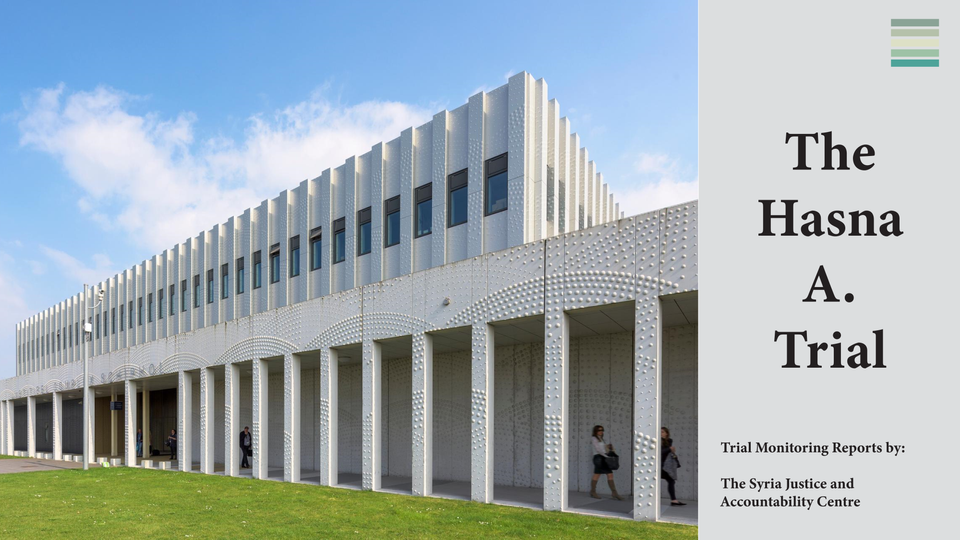
Inside the Hasna A. Appeal Trial #3: Defense’s Pleadings and (Sur)-Rebuttals
APPEAL TRIAL OF HASNA A.
The District Court of the Hague – Badhoevedorp, the Netherlands
Trial Monitoring Summary #3
Hearing Date: February 11, 2026
CAUTION: Some testimony may include graphic descriptions of torture, rape or other violent acts.
Note that this summary is not a verbatim transcript of the trial; it is merely an unofficial summary of the proceedings.
Throughout this summary, [information located in brackets are notes from our trial monitor] and “information placed in quotes are statements made by the witness, judges or counsel.” The names and identifying information of witnesses have been redacted.
[Note: SJAC provides a summary of the proceedings while redacting certain details to protect witness privacy and to preserve the integrity of the trial.]
For the trial monitoring reports of the first instance proceedings, please see the Hasna A. case on SJAC’s website. Trial Monitoring reports of the Hasna A. appeal trial are a result of a partnership between the Syria Justice and Accountability Centre and the Criminal Justice Clinic at the University of Amsterdam, the Netherlands.
SJAC’s 3rd trial monitoring report details day 3 of the appeal trial of Hansa A. in Badhoevedorp, the Netherlands. On this day, the Defense presented the pleadings, requesting acquittal of all charges against Hasna A., including participation in a terrorist organization, preparatory acts, child endangerment, and enslavement as a crime against humanity. The Defense argued that Hasna A. lacked intent to support ISIS, did not share or propagate its ideology, and questioned the reliability of Z.’s statements. Addressing the request for reparations, the Defense requested it to be considered inadmissible as it would disproportionately burden the current proceedings. Plaintiff and Prosecution provided rebuttals, followed by the Defense’s surrebuttal. Hasna A. delivered her final statement, expressing regret and a commitment to avoid similar circumstances in the future.
The final judgment was scheduled for March 25, 2026, at 10:00 AM.
Day 3 – February 11, 2026
On this trial day, the hearing started at 10:24 AM. The Presiding Judge opened the hearing by welcoming those present in the courtroom and online. He reminded the Accused of her right to remain silent. He further noted the presence of two new interpreters and noted that he would monitor the pace of the proceedings to ensure that interpretation could be carried out effectively. Plaintiff Z. was present at the courthouse. Plaintiff S. was attending the hearing online. The Presiding Judge proceeded to outline the agenda for the day. The hearing was to begin with the Defense’s pleading, followed by an opportunity for the Plaintiff’s Counsel and the Prosecution to respond. The Defense Counsel will then be given the opportunity to reply, after which the Accused would be invited to deliver her final statement.
Defense’s Pleadings
The Defense Counsel started her pleadings by stressing there are two life stories, that of Z. and that of the Accused Hasna A. These stories came together in May or June 2015 when the Accused was a guest at [redacted name], F3’s house. Z. was a sabiyya (slave) there. The Defense asserted that we are unlikely to find out the truth as there is no objective evidence in this case; there is no video footage of the acts of which Hasna A. is accused. The Defense Counsel requested acquittal of all charges.
Mild intellectual disability
Turning to her first argument, the Defense Counsel highlighted that no account had been taken of the individual characteristics of the Accused. The Prosecution had previously claimed that Hasna A. had two faces. The Defense alleged that, in making this statement, the Prosecution failed to recognize the individual characteristics of the Accused by presenting her as calculating. Furthermore, the Defense argued that the police – by not asking sufficient follow-up questions during the Accused’s interrogation – had also failed to consider her individual characteristics. The Defense asserted that Hasna A. has officially been diagnosed as an individual with a mild intellectual disability. The Accused is characterized as naive, impulsive, and unable to anticipate the consequences of her actions. Additionally, it was alleged that when Hasna A. experienced pressure or stress, she had the tendency to run away. The Defense argued that this was reflected in the Accused’s decision to travel to Syria without fully immersing herself in the religion or foreseeing what she was going to encounter in Syria. The Defense Counsel continued by stating that people with a mild intellectual disability understand things more slowly and not as well as others. She claimed that this is why it is necessary to approach and interrogate a person with an intellectual disability differently from someone without one [note: this invoked visible and audible emotional reactions among spectators present in the public gallery].
Moreover, the Defense Counsel stressed that ISIS lured vulnerable women through false promises of empowerment and a utopic image of life in the ISIS caliphate in Syria. Hasna A. was in search of a place where she could freely practice her religion, amongst people who aimed to do the same. ISIS often lured women through social media, the Defense held that this was also the case for the Accused. Hasna A. had clarified that she saw it as her religious duty to travel to the caliphate. She wanted to live in a caliphate analogous to the caliphate of the Prophet Muhammed. The Defense claimed that the Accused had an idea of the caliphate but that this was not grounded in the reality of the ISIS caliphate. Additionally, the Defense argued that Hasna A. wanted to get married eventually, but that this was not her objective when travelling to Syria. The Defense Counsel referred to research which had established three motives among women who had travelled to join the caliphate: religious, political, and romantic. According to the Defense, Hasna A. was a naive woman with religious motives who has since expressed regret about travelling to the caliphate. Furthermore, the Defense briefly commented that the Accused had not posted any ISIS propaganda online or otherwise. The Presiding Judge briefly interrupted the Defense Counsel, noting that she was citing extensively, and instructed her to limit herself to references and focus on drawing conclusions.
The Defense Counsel then went on to assert that the Accused did not play a clear role in ISIS. She based this on the role of women within ISIS. This was a role of taking care of the men, the household, bearing children, and obeying the men. Hasna A. had done this. The Defense held that, as a woman, the Accused did not have any decision-making authority. Furthermore, it was the women’s task to teach about jihad. Hasna A. had not done this. She did not hold a public function within ISIS, did not teach, and was not a member of the Hisbah. The Defense proceeded to state that escape from the caliphate was dangerous. She explained that women who tried to escape from the ISIS caliphate had been stoned, whipped, or even killed, referring “Bethnal Green trio” from the UK regarding the three ISIS women Kadiza Sultana, Amira Abase, and Shamima Begum.
Participation in a terrorist organization
Moving on, the Defense Counsel began by holding that participation alone is not sufficient to establish a structured joint enterprise relation between the Accused and ISIS as intended under Article 140a of the Dutch Criminal Code. This case must be considered in light of the Accused’s individual circumstances and characteristics. The Defense reiterated the Accused’s motives for travelling to Syria as above. She proceeded to argue that the Accused carried a weapon upon the insistence of her husband, to keep her safe from other men. Furthermore, the Defense highlighted that Hasna A. had never cared for her injured husband. Additionally, The Defense claimed that Hasna A.’s husband did receive a monthly salary from ISIS, but that the Accused did not receive money from ISIS nor did her husband give her the money. After her divorce from [redacted name], F4, in 2018, Hasna A. registered with ISIS to get food and diapers. Thus, she registered not for the purpose of supporting ISIS, but for basic necessities. Consequently, the Defense Counsel concluded that while the Accused may have numerically reinforced ISIS, she did not do so with the same terroristic intention or purpose as ISIS. Therefore, the Defense requested for the Accused to be acquitted of the charge of participation in a terrorist organization.
Preparatory actions
Before the Defense could move on, the Prosecution briefly interrupted, having lost track of the Defense’s position in her pleadings. The Presiding Judge confirmed on which page they were. The Defense continued by addressing the charge of preparatory actions and noted the WhatsApp messages Hasna A. sent to her classmates in March 2015. In these messages, the Accused said that she emigrated to Syria and that she was never coming back. However, at the time she sent these messages, Hasna A. had only been in the madafa and had not yet seen the caliphate from within. Furthermore, the Defense referred to the time that the police spoke to the Accused’s father in May 2015, who stated that Hasna A. had called him and that she had said to regret travelling to Syria. The Defense held that there are audio and written messages between the Accused and her father in which Hasna A. expressed regret about travelling to Syria. However, the Defense admitted that she was unable to obtain said audio and written messages.
The Defense Counsel proceeded to argue that the negative connotation associated with being a martyr had been imposed by the West. For Muslims, martyrdom was actually seen as good thing because, as a martyr, you go to Jannah (heaven/paradise). The Defense further submitted that this is also the case for the negative association with the word caliphate and that the original meaning of the word is quite neutral [note: this once again invoked emotional reactions and multiple people walked out of the public gallery]. The Defense Counsel then held that, for Muslims, this word related to the caliphate back in the time of Prophet Muhammed.
Moreover, the Defense addressed the testimonies made by witnesses [redacted name], W4, [redacted name], W1, and [redacted name], W2. She argued that W4’s testimony, in which he said that he had a bad feeling about Hasna A., was biased. W4 worked at the [redacted information] but made statements relating to what was taking place during the classes. The Defense held that it is unclear what his role exactly was, as he was not a teacher. In regard to W1, whom the Accused had told that she had acquaintances who had travelled to Syria and that life in Syria was good, the Defense remarked that Hasna A. was a depressed person who sought comfort through religion. The Accused did not travel to Syria with the purpose of supporting ISIS, rather she saw an Arab country that enforced Islamic rules. Finally, the Defense argued that W2 took what Hasna A. said too literal. For the Accused, dying as a martyr is a good thing as you go to heaven. Lastly, the Defense briefly submitted that posting pictures of ISIS was not enough to demonstrate that the Accused shared ISIS’s ideology. Therefore, the Defense Counsel requested for the Accused to be acquitted as she did not commit the acts with the same terroristic intention as ISIS.
Leaving her child in danger
The Defense Counsel then turned to the question of whether the Accused could be held responsible for leaving her child in danger. The Defense referenced a previous case of the court in which a woman, who had travelled to Syria with three minors, was found not to have deliberately left her children in danger. The court had, in reaching that conclusion, taken into account the context of how difficult it was to leave ISIS territory without putting oneself at risk of danger. The Defense argued that the Accused did want to leave the ISIS territory, but that she feared that she and her children might not survive if their attempt to escape failed. Hasna A. had asked her father and family to come to Syria for the purpose of helping her escape. According to the Defense, this was a cry for help, and not an invitation to come live in Syria. Therefore, the Defense Counsel requested that the Accused be acquitted of this charge.
***
[15-minutes-break]
***
Slavery as a crime against humanity
1. Contextual elements
[note: besides the material elements of the crime, one element of crimes against humanity is that the perpetrator must know that that the conduct was part of or intended the conduct to be part of a widespread or systematic attack directed against a civilian population (Elements of Crimes, ICC)].
The Defense Counsel argued that the Accused was unaware of the context as she did not know of the attack against the Yazidi. The Defense further submitted that Hasna A. knew of the Yazidi as a people but did not know that they were held as slaves. She did not encounter this until she was in F3’s house, where she first saw a Yazidi slave. Therefore, the Accused did not know that her acts were a part of the attack against the Yazidi, and the contextual element is not fulfilled.
2. Reliability of statements made by Z.
The Defense mentioned that when evaluating witness evidence, special attention must be paid to the reliability, supporting evidence, and linking evidence. The Defense Counsel argued that, in her statements and testimony, Z. accused Hasna A. of instructing her to clean, cook, and take care of her son. The Accused had denied these accusations. The Defense raised the question why the statements made by the Accused are viewed as less credible than the statements made by Z. The Defense submitted that the statements made by Hasna A. are in line with what we know of the situation and position of women in Syria.
a) Unreliable statements made by Z.
The Defense Counsel argued that Z.’s statements were unreliable. She did not claim that Z. was lying, but maintained that they were affected by false memory or external influences.
The Prosecution had submitted that Z. had made a nuanced statement, which is a sign of reliability. However, the Defense held that, according to the “best practices,” detailed statements are the ones that are considered reliable [note: the Defense referred to “best practices” commonly referred to in civil lawsuits when assessing witness evidence. It is unclear why the Defense resorted to civil law.].
The Defense continued by highlighting that Z. had made statements on three separate occasions, namely at CIGE [Commission for Investigation and Gathering Evidence], UNITAD, and the investigating judge. When Z. made her first statement before CIGE in 2016, she did not mention the Accused and only spoke of others who have hurt her. The Defense argued that this statement is the most reliable due to the little time that had passed between when the acts took place and when the statement was taken. Contrarily, in the statement made by Z. in 2024, the Accused was portrayed as the source of all atrocities. The Defense raised the question as to why Hasna A., if she truly was such a horror, was not mentioned in the statement of 2016. Furthermore, Z. had also made a statement to UNITAD in 2022. In this statement, Z. first mentioned the Accused. The Defense submitted that the way in which the questions were asked at UNITAD were guiding Z. She cited: “I assume you were taken to many places when you were captured, am I right?”, “he was gone for most of the time, right?”, “Was she ordering you around the house?”, and insinuating violence, thereby influencing Z.’s statement. The Defense further raised concerns that there was no audio or video recording of the interview at UNITAD, and that Z. was not sworn in before making the statement.
The Defense Counsel continued by suggesting that Z. may have an ulterior motive in seeking the Accused’s conviction. She submitted that Z. was traumatized and driven by a desire to see someone being held accountable for the harm inflicted upon her and her children. In that context, the Defense argued that Z.’s attribution of responsibility extended beyond the Accused, noting, for example, that Z. also held Hasna A. responsible for the death of her two daughters, despite the Accused having no involvement in those events.
Furthermore, the Defense Counsel alleged that Z.’s statements were inconsistent. This, according to the Defense, was due to the passing of time. She argued that the statements made by Z. were general and not detailed. She hereby referenced when the investigating judge in 2024 had asked Z. to explain certain things, but Z was unable to do so. Z. had stated that she had to cook and clean, but she did not detail what meals she had to cook, or what the house looked like. The Defense Counsel thereby held that the statements made by Z. were implausible. Additionally, the Defense submitted that the statements made by Z. were not corroborated by the statement made by [Plaintiff] S. The statement made by S. did not prove that the acts of which Hasna A. has been accused had actually happened.
Moreover, the Defense noted that Z. had stated at UNITAD that the Accused did not treat her badly but that she was lazy. However, at the investigating judge, nine years after the facts had taken place, Z. stated that she was the Accused’s servant and that Hasna A. would get angry if the instructed tasks were not carried out. The Defense Counsel remarked that Z. and the Accused did not speak the same language and that they communicated through hand gestures. She thereby questioned how much Z. could have truly understood or known about the Accused. Finally, the Defense submitted that the only reliable statement was the statement made at CIGE in 2016. After making this statement, Z. was in contact with others, which influenced her memory. The Defense Counsel held that [redacted name], F5, allegedly told Z. that Hasna A. was back in the Netherlands and that she was arrested, prior to the UNITAD interview in 2022. Due to this, the Defense concluded that the Court could not rule out that the statements made by Z. were not influenced, especially when there is a 10-year sentence on the line. The Presiding Judge then interrupted the Defense’s pleadings for one minute as the Defense Counsel had said the victims’ full first names, reprimanding her.
b) Lack of supporting evidence
The Defense Counsel submitted that there was no evidence in support of the statements made by Z. Neither S. nor N. made statements on the alleged acts inflicted upon Z. by the Accused. Their statements only addressed the general context. Furthermore, the statements made by S. were argued to have already been deemed unreliable in the first instance judgment. The Defense held that these can thus not be used as supporting evidence.
c) Lack of linking evidence
The Defense Counsel alleged that the Accused’s acquittal of the charges against S. is irrevocable. In the first instance judgment, S.’s statement was deemed unreliable. Consequently, stricter requirements apply for it to serve as linking evidence. The Defense argued that these requirements have not been met. Furthermore, the Defense held that no general pattern of the acts of the Accused could be found.
3. Ownership element
[note: an element of enslavement as a crime against humanity is that the perpetrator must have exercised any or all of the powers attaching to the right of ownership over one or more persons, such as by purchasing, selling, lending, or bartering such a person or persons, or by imposing on them a similar deprivation of liberty (Elements of Crimes, ICC)].
The Defense Counsel submitted that the Accused did not exercise any powers attaching to the right of ownership over Z. The Accused was a guest in the home of F3 and was not the person to enslave Z. The Defense argued that Hasna A. did not use Z. as a slave, relying on Z.’s statement that the Accused merely gave her more work due to laziness, an increased workload rather than new tasks. Furthermore, Hasna A. was also not in charge of whether Z. could leave the house or not. Z. had stated that Hasna A. did not help her and did not let her use her phone or laptop. To this regard, the Defense Counsel argued that the Accused was herself subject to F3, lacked decision-making authority, and would have faced consequences had she attempted to help Z. The Defense Counsel concluded that being lazy, not helping Z. escape and not helping Z. in the household does not entail enslavement as a crime against humanity as intended under the Dutch International Crimes Act.
***
[45-minutes-break]
***
Reparations
The Defense Counsel argued that the request for reparations should be declared inadmissible. She submitted that no causal link had been established between the acts of the Accused and the harm suffered by Z. According to the Defense, the Accused did not contribute to Z.’s suffering and was not responsible for separating her from her children. The Accused was present when Z. was already enslaved, but the damages claimed stemmed from a broader structural situation over which the Accused had no authority. It therefore remained unclear which part of the alleged harm could be directly attributed to her conduct.
The Defense further claimed that the amount of compensation sought was excessive and not grounded in Syrian law. Additionally, the alleged conduct of the Accused was argued to not meet the requirements of Article 164 of the Syrian Civil Code to establish fault. The Defense maintained that violations of customary international law could not automatically be qualified as fault under Syrian civil law. the Defense noted that international crimes are not codified in the Syrian Criminal Code and are prosecuted as ordinary offences. Consequently, crimes against humanity could not serve as a legal basis. Finally, the Defense argued that the Court lacked sufficient information to assess whether the Accused’s conduct would constitute fault under Syrian law or customary international law and undertaking such an assessment would disproportionately burden the proceedings.
Criminal responsibility
The Defense Counsel argued that the Accused’s criminal responsibility was diminished due to borderline personality disorder and mild intellectual disability. The Defense further submitted that, according to expert assessments, the Accused no longer held radical beliefs. The Defense emphasized that the Accused had made a serious mistake and had herself endured traumatic experiences while in ISIS-controlled territory. It was further argued that the potential revocation of her Dutch nationality, which could result in statelessness, would have severe consequences, particularly given her need for psychological and social support. Concluding the pleadings, the Defense Counsel requested that the pre-trial detention order be lifted as of the date of the final judgment.
Following the Defense’s pleadings, the Prosecution requested permission from the Presiding Judge to pose a clarifying question in response to the Defense Counsel’s pleadings, in particular concerning the issue of reparations. The Prosecution asked whether, in the event of a conviction for slavery, such conduct would constitute fault under Syrian law. The Defense Counsel responded that this would depend on the specific role attributed to the Accused and on whether the conduct in question would qualify as slavery under Syrian law. The Defense maintained that this could not be determined at this stage. The Prosecution further inquired at what point these legal questions had arisen for the Defense. In response, the Defense stated that the issues were too complex for the Court to assess within the current proceedings.
[Note: The hearing was briefly interrupted to allow the Plaintiffs’ Counsel and the Prosecution to prepare their response, as they indicated that the Defense had introduced arguments during the oral pleadings that had not previously been submitted in writing.]
***
[45-minutes-break]
***
Rebuttal by the Plaintiffs’ Counsel
The Plaintiffs’ Counsel confined her submissions to the issue of reparations. According to the Plaintiffs’ Counsel, the new arguments raised by the Defense during the pleadings were contrary to the proper conduct of proceedings. She maintained that the Defense had had ample opportunity to address the expert reports concerning Syrian law in the written phase of the proceedings, and that there was therefore no question of a disproportionate burden being placed on the Court.
Furthermore, the Plaintiffs' Counsel argued that it was unnecessary to assess whether the Accused’s conduct would also constitute a fault under Syrian law. If this Court convicted the Accused of co-perpetrating slavery as a crime against humanity, then that would constitute a fault under the Dutch International Crimes Act. Additionally, the Plaintiffs’ Counsel held that, in regard to causality, the Accused’s acts contributed to and worsened the harm suffered by Z. The Accused committed acts in the context of the horrific attack of ISIS, and she was aware of this. The acts committed by the Accused constituted a serious norm violation, which allowed for compensation for moral damages, as is provided in Syrian law. In regard to the amount of compensation sought, the Plaintiffs’ Counsel proceeded to state that the amount of compensation can be based on national and international sources as well as the Judges’ own sense of justice. The Plaintiffs’ Counsel based the amount of compensation sought on national Dutch jurisprudence on human trafficking and requested a higher amount of compensation due to the international nature of the crime.
Rebuttal by the Prosecution
The Prosecution began by noting that considerable attention had been paid to the Accused’s mild intellectual disability, but argued that, despite this, she ultimately ended up where she intended to be: in Syria. The Prosecution further emphasized that the Accused had admitted that she watched ISIS videos prior to travelling there to prepare herself and avoid getting into trouble. She spoke to the witnesses W2 and W4 about ISIS. The Prosecution claimed that Hasna A. carried the ideology of ISIS within and that she expressed this shared ideology through social media. Moreover, although the Defense stated that the Accused did not propagandize ISIS, the Prosecution firmly held that she did, specifically through her Facebook page. Additionally, the Prosecution noted the Defense’s failure to respond to the fact that the Accused had said that non-believers should be destroyed and that she supported the terrorist attack on Charlie Hebdo. These are not neutral terms, but evidence of the Accused’s shared ISIS ideology. Addressing the Defense’s claim that the Accused had told her father that she regretted travelling to Syria, the Prosecution contended that there were many messages that proved the exact opposite. In these messages, Hasna A. stated that she found living in Syria wonderful. The Prosecution further remarked that there is no evidence of the Accused attempting to escape the ISIS territory.
In regard to the charge of enslavement as a crime against humanity, the Prosecution argued that that the Defense’s claim that the Accused was unaware of the contextual elements was false. They referred to statements made by the Accused, in which she said that she knew Z. was a Yazidi slave. Furthermore, during the Appeal, the Accused told the Court that she had seen an item about Yazidi fleeing. The Prosecution argued that people do not flee without cause, implying that the Accused was aware of the attack. Moreover, Hasna A. had seen multiple Yazidi slaves and had heard from her neighbors about their situation. Additionally, she went to school with Yazidi, who had told her about the attack. Her awareness of the context was further reflected in her forcing Z. to pray, labeling her a non-believer, and remarking that it was good Z. was now practicing the “correct” religion.
Concerning the reliability of Z.’s statements, the Prosecution submitted that the Defense was selective. The statements of the Accused and Z. do not mutually exclude each other. The Accused’s statements correspond to the general knowledge of the situation in Syria, but this is also the case for the statements of Z. Furthermore, the statements of Z. are on a lot of points supported by the statements of S. and N. Moreover, the Prosecution alleged that the Defense had selectively looked at the statements of Z. when stating that they were not detailed. They referenced the situation with the Accused’s son and the eggs, and that Z. had recalled that the Accused could eat an entire chicken. The Prosecution added that they themselves are also very critical of the evaluation of witness statements. This is why, on Appeal, they did not pursue the case for S. However, this is not because S. herself was unreliable, but because there is insufficient supporting evidence from other sources. Therefore, the statements made by S. are still reliable and should be used as supporting evidence for the statements made by Z. Additionally, the Prosecution held that a witness being unclear about date, time, or distance does not negatively affect their credibility. Similarly, citing the German case against Taha Al-J., trauma in relation to what happened does not give doubt to the witness’s ability to testify. The fact that Z. did not talk about Hasna A. in her first statement does not mean that the subsequent statements where she does mention the Accused are unreliable. The short statement at CIGE in 2016 was meant as a basis on which following statements could be built. The Prosecution proceeded to argue that evidence provided by UNITAD has been admitted to many national, as well as international cases. This was, according to the Prosecution, a testament to their reliable methods of obtaining evidence. Moreover, UNITAD did not disclose the name of the Accused to Z. prior to her interview and Yazda did not speak of the case with Z. Thus, the Prosecution concluded that the statements made by Z. were not externally influenced.
In regard to the acts committed by the Accused, the Prosecution asserted that there was no such thing as consensual slavery. Z., afraid of F3, could not refuse the orders of the Accused due to the fear of the consequences that she would face. F3 had told Z. that she must do what the Accused said. The Accused knew that Z. was a slave. This indicated that, contrary to what the Defense argued, that the Accused did have decision-making authority. Concerning the reparations requested, the Prosecution shared the view of the Plaintiffs’ Counsel. Finally, the Prosecution opposed the Defense’s request for the pre-trial detention order to be lifted on the date of the final judgment.
Defense Counsel’s Surrebuttal
The Defense Counsel started by responding to the Prosecution’s claim that the Accused propagated the ISIS ideology. She held that it was not possible to equalize Islam with the ideology of ISIS. The Accused adhered to a stricter religious ideology, but not to the ideology of ISIS. Furthermore, the Defense addressed the contextual element of crimes against humanity, claiming that the communication between Z. and the Accused was mostly done through hand gestures as neither of them spoke fluent Arabic. The Defense contended that she deems it highly implausible that Z. could understand what Hasna A. said regarding non-believers. Additionally, the Defense Counsel stressed that evidence collected by UNITAD had indeed been admitted as evidence in many trials but that the current case is about the evaluation of the testimony and statements given by Z. Moreover, it was not about whether the Accused’s name was mentioned to Z. prior to the interview. Z. was informed about a Dutch woman, and Z. only knew one Dutch woman. This indicated, according to the Defense, that there were external factors influencing Z.’s statements. Finally, the Defense repeated that the statements made by S. were not reliable and that they should not serve as supporting evidence.
Final Statement of the Accused
Moving towards the end of the hearing, the Presiding Judge invited the Accused to give her final statement. Hasna A. said to regret the choices that she had made and that she never wanted to end up in such a situation again.
After the statement by the Accused, the Presiding Judge closed the hearing and announced that the judgment will be handed down on March 25, 2026, at 10:00 AM in the same courtroom.
The proceedings were adjourned at 5:34 PM
The judgment will be handed down on March 25, 2026, at 10:00 AM.
___________________________
For more information or to provide feedback, please contact SJAC at [email protected] and follow us on Facebook and Twitter. Subscribe to SJAC’s newsletter for updates on our work