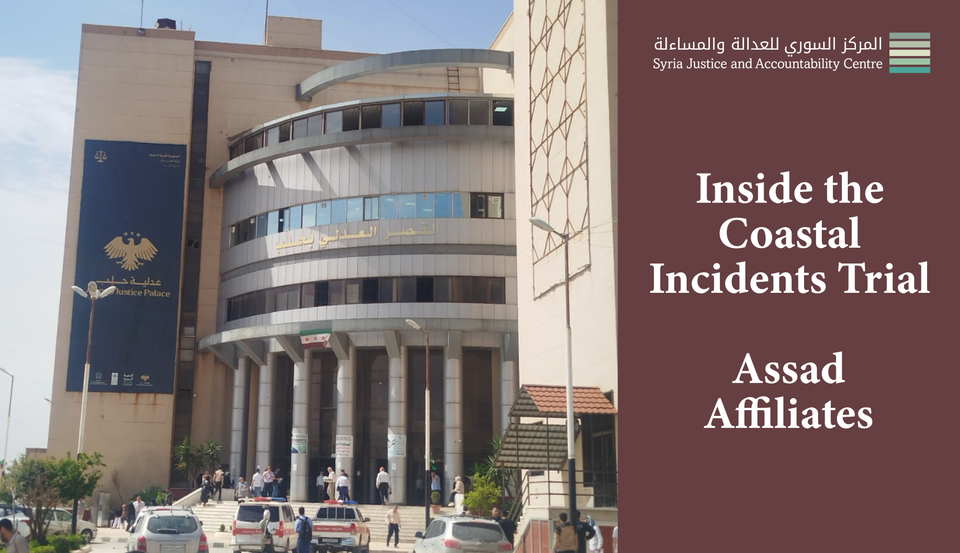
Inside the Coastal Incidents Trial – Assad’s Affiliates #7: What could be the Impact of the Fact-Finding Committee's Report?
TRIAL OF THE COASTAL INCIDENTS
Military Criminal Court – Aleppo, Syria
Trial Monitoring Summary #7 – Assad’s Affiliates
Hearing Date: June 18, 2026
CAUTION: Some testimony may include graphic descriptions of torture, rape or other violent acts.
Note that this summary is not a verbatim transcript of the trial; it is merely an unofficial summary of the proceedings.
Throughout this summary, [information located in brackets are notes from our trial monitor] and “information placed in quotes are statements made by the witness, Judges or counsel.” The names and identifying information of witnesses have been redacted.
[Note: SJAC continues to provide a summary of the proceedings while redacting certain details to protect witness privacy and to preserve the integrity of the trial.]
[Note: Following the first session of the trial, in which all the Accused — both Assad regime’s and Government’s affiliates — appeared before the Court, the Accused were severed into two groups based on their affiliations. Therefore, the Syria Justice and Accountability Centre (SJAC) decided to separate the trial reports according to the Accused’s affiliations.]
SJAC’s 7th trial monitoring report details day 8 in the trial of Assad’s affiliates pertaining to the coastal incident, taking place in Aleppo, Syria. On this trial day, seven Accused appeared before the Court. The Court examined two Accused regarding the technical expert analysis conducted on a video clip pertaining to them. One of them claimed that the head he was carrying in the video belonged to an ISIS member. A technical expert analysis was conducted on the voice of one of the Accused, and it was found to match the voice in the video by more than 72%; however, the Expert alleged that the Accused was uncooperative with him. Criminal records pertaining to one of the Accused were received, one of which relates to torture.
At the conclusion of the session, the Court received reports from the National Fact-Finding Committee on the coastal incidents. It may become clear later how their findings will impact the course of the trial.
Day 8 – June 18, 2026
The trial commenced at 10:00AM.
The First Case:
The Accused, Tahani S., was called. His ad hoc court-appointed Defense Counsel C3 [redacted name] appeared with him.
The Court stated that there is an error in the name of the Accused mentioned in the Prosecution's indictment.
The Prosecutor stated that he has no objection to correcting the name of the Accused to Tahani [redacted name] in accordance with the indictment, through the Military Public Prosecution.
The Court decided to adjourn the session for review until Thursday, July 9, 2026.
The Second Case:
The Accused, Maher O. and Maher A., were called. Defense Counsel C3 [redacted name] appeared with them. The Accused Al-Waddah I. was called. Counsel C8 [redacted name] appeared with him.
The Court decided to re-examine the Accused Maher A. and Al-Waddah I. following the receipt of the expert report concerning the video clips.
The Presiding Judge asked the Accused Al-Waddah I. regarding his statements before the Military Investigator. The Accused Al-Waddah I. responded that he does not remember saying "the zero hour has arrived" nor "you must join to attack the military posts."
The Court asked him whether there was coordination between him and Miqdad Fatiha, and whether he was receiving support from Israel to obtain weapons and sniper rifles. The Accused Al-Waddah I. denied that, adding that there is no truth to the statements included in the investigation regarding Miqdad Fatiha requesting the setting of ambushes for government forces, communicating with Israel, and receiving support from it.
The Court questioned whether the Accused communicated with Suhail Al-Hasan and obtained $3,750 from him. The Accused Al-Waddah I. conveyed that the statements, about him obtaining $3,750 to distribute to the families of militants, were incorrect.
The Court wanted to know who the Turkish officer was with whom the Accused was in contact. The Accused answered that communication took place between him and Suhail Al-Hasan through a Turkish officer named “Analyst,” as the communication was not direct.
The Court questioned the validity of the Accused's statements before the Investigative Judge that he blocked the Sinaw - Ain Shqaq road and the Maqta' Jableh road. The Judge followed by asking the Accused whether he acknowledges those statements of his. The Accused Al-Waddah I. denied that he blocked the road, adding that the alleged regiment consisting of 700 personnel is a fictitious regiment whose sole purpose was to obtain financial support.
The Judge noted that it was mentioned in the Accused's statements that he descended from the mountains [unspecified] on March 6, 2025, with groups to the Ain Shqaq village intersection to fight the army, and wanted to know the validity of these statements. The Accused Al-Waddah I. denied these statements, as well as that he had a Russian rifle with him, or that groups descended from the mountains with the intention of attacking state forces. Rather, the truth, according to the Accused, was that he returned to his home after his father called him.
In response to the Judge's question, the Accused Al-Waddah I. testified that he did not communicate with Suhail Al-Hasan and did not publish video clips for him on his page. Furthermore, The Accused denied his statements before the Investigative Judge that he was communicating with Miqdad Fatiha to provide him with army locations and the condition of fighters near Rami Makhlouf's villa or the military gas station.
When the Judge asked him about the name Sahyoon [note: in Arabic, it is phonetically close to zionist], the Accused Al-Waddah I. answered that the name referred to a Turkish officer, not an Israeli one. The Accused testified that his communication with Miqdad Fatiha was upon the request of the Turkish officer, and its purpose was to support the new state and the Syrian government. The Accused clarified that he learned this individual was a Turkish officer after communicating with the Russian officer with whom the Accused was in contact while working at the Russian base as a driver before the liberation. He added that the interview clip broadcast on Al Jazeera was created during his detention in August 2025, with the knowledge of the government and security forces.
When the Judge asked him about the video clip in which the Accused appeared carrying a severed head of a person, the Accused answered that it dates back to 2019, when he was an officer in the Syrian Arab Army fighting ISIS forces, spearheaded by Palestine Liberation Army forces, in the As-Safa Hills area in As-Sa'an. Regarding this killed person, they found a personal ID for him, and according to the Accused’s recollections, his nickname was Abu Al-Baraa, an Iraqi national from Anbar Governorate. Upon their arrival at Haditha Airport [name unclear], the head was already severed from the body. So, the Accused carried the head and took a picture holding it. The Accused recalled that the incident occurred in December 2019. The Accused testified that he did not commit the killing of that person nor sever his head; rather, the head was severed from the body when they reached the corpse. The Accused noted that he was discharged from the army at the end of 2019.
The Accused Al-Waddah I. requested an extension of time to prove his statements.
In response to the Judge's question, the Accused Maher A. denied creating any video clip other than the one in which he appeared with the Accused Maher O. and the juvenile [redacted name], which he had previously admitted to, adding that its purpose was to obtain money to earn a living. The Accused affirmed that he did not appear in any video clip confirming that he was waiting for army forces.
The Counsels stated that they have no updates.
The Court decided to grant the Accused Al-Waddah I. an extension of time to present his defense, particularly regarding the video clips. Subsequently, the Court adjourned the session until Thursday, July 9, 2026.
The Third Case:
The Accused, Mohammad S., was called. Defense Counsel C3 [redacted name] appeared with him.
The Judge noted that the six-page expert report regarding the voice identification of the Accused Mohammad S. was received by the Court. The report indicated that there was over 72% match between the voice in the video and of the Accused, noting that the Accused did not cooperate with the Expert.
The Accused Mohammad S. objected to the validity of the expert report and to the allegation that he was uncooperative with the Expert. He clarified that he was cooperative in providing voice clips to conduct the matching. He reiterated his statements regarding having no connection to the video clip that underwent expert analysis. He added that the individual named O4 [redacted name] is not his brother as was stated in a video clip and previous statements, but rather a member of the family, which is why they share the same surname.
Counsel C3 reiterated his statements.
In response to the Judge's question, the Accused testified that he does not remember the details of O4's identity, then reiterated his statements and concluded them.
The Prosecutor stated that he adopts the expert report submitted into the case file, and reiterated his statements.
The Court adjourned the session for review to Thursday, July 9, 2026.
The Fourth Case:
The Accused, Hasan H., was called. No Counsel appeared with him. Therefore, the Court appointed one of the attorneys who were present in the courtroom as his ad hoc Defense Counsel [the trial monitor could not identify the Counsel’s name.]
A copy of the ruling of the Second Criminal Court in Lattakia No. 266 of 2019, Merits 2005, dated 2019, was received by the Court, along with a copy of the ruling of the Military Criminal Court in Aleppo No. 32, Merits 95 of 2020, dated January 29, 2020, a copy of Ruling No. 122 related to the second ruling, and a copy of a judgment issued by the Military Criminal Court in Aleppo in Case 645 of 2018. The rulings were read and added to the case file.
At this point, the Accused’s mother intervened. Consequently, the Presiding Judge asked her to remain silent, explaining to her that these rulings pertain to car theft and one of them to torture.
The Accused testified that he was detained on the charge of car theft for three years before the Military Criminal Court in Aleppo, and then his sentence for the crime of car theft was merged through the judiciary.
The Court asked the Accused whether he knew [redacted name], which the Accused denied.
The Accused was asked whether he had any further statements. He answered that he was not carrying a weapon; did not participate in any military operation; nothing was found on his mobile phone; and no weapon was confiscated from him or his home. The Accused then requested acquittal, pointing out that he was in Lebanon during the coastal incidents, and used to return to Syria for a short period, crossing the borders through smuggling to avoid official crossing fees.
The ad hoc court-appointed Counsel reiterated his statements.
The Court adjourned the session for review to Thursday, July 9, 2026.
The Fifth Case:
The Accused, Hadi Q., was called. Defense Counsel C8 [redacted name] appeared with him.
Reports were received by the Court from the National Fact-Finding Committee on the Coastal Incidents.
Counsel C8 requested an extension of time to review the minutes and respond to them.
The Court decided to grant him time and adjourned the session to Thursday, July 9, 2026.
[The Presiding Judge announced a fifteen-minute recess, after which the trial of government’s affiliates would resume.]
The proceedings were adjourned at 11:30AM.
The next trial day will be on July 9, 2026, at 10AM.
___________________________
For more information or to provide feedback, please contact SJAC at [email protected] and follow us on Facebook and Twitter. Subscribe to SJAC’s newsletter for updates on our work