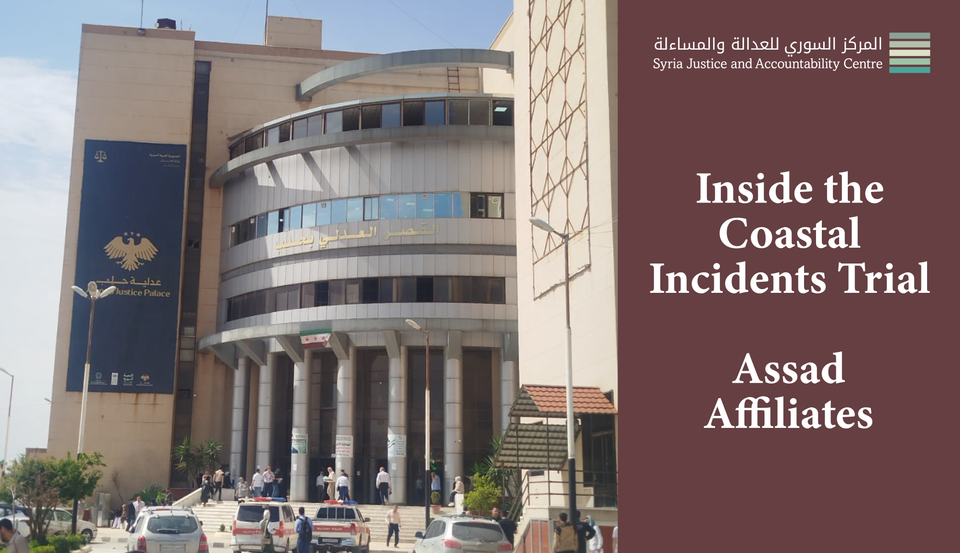
Inside the Coastal Incidents Trial – Assad’s Affiliates #6: Too Poor to Fund Terrorism
TRIAL OF THE COASTAL INCIDENTS
Military Criminal Court – Aleppo, Syria
Trial Monitoring Summary #6 – Assad’s Affiliates
Hearing Date: May 14, 2026
CAUTION: Some testimony may include graphic descriptions of torture, rape or other violent acts.
Note that this summary is not a verbatim transcript of the trial; it is merely an unofficial summary of the proceedings.
Throughout this summary, [information located in brackets are notes from our trial monitor] and “information placed in quotes are statements made by the witness, Judges or counsel.” The names and identifying information of witnesses have been redacted.
[Note: SJAC continues to provide a summary of the proceedings while redacting certain details to protect witness privacy and to preserve the integrity of the trial.]
[Note: Following the first session of the trial, in which all the Accused — both Assad regime’s and Government’s affiliates — appeared before the Court, the Accused were severed into two groups based on their affiliations. Therefore, the Syria Justice and Accountability Centre (SJAC) decided to separate the trial reports according to the Accused’s affiliations.]
SJAC’s 6th trial monitoring report details day 7 in the trial of Assad’s affiliates pertaining to the coastal incident, taking place in Aleppo, Syria. On this trial day, seven Accused appeared before the Court. One Accused denied all statements he had provided during the interrogation because he had been blindfolded. He added that he is of modest means, possessing no money to fund terrorist groups. Another Accused denied that the voice heard in a video clip was his own. Thus, the Expert was instructed to conduct an expert analysis on an audio clip recorded by the Accused. As for the third Accused, he claimed he was in prison at the time of his alleged crimes, and his Defense Counsel was instructed to deliver a case statement to that effect. The fourth Accused was interrogated regarding an individual who had died, however, he denied knowing the cause of death. Additionally, he stated that he engaged in stealing vehicles belonging to the former regime and military forces following the liberation of Syria. No new developments occurred regarding the last three Accused, as they remain awaiting the outcome of a technical expert analysis.
Day 7 – May 14, 2026
The trial commenced at 10:00AM. There were between 10 to 15 family members of the Accused and many media representatives present. The courtroom was nearly full. Numerous microphones were observed on the judicial bench. The detainees were inside the iron cage under the guard of military police personnel.
The First Case:
The Accused, Hasan H., was called. His ad hoc court-appointed Defense Counsel C2 [redacted name] appeared with him.
The Presiding Judge confronted the Accused with his statements to the Counter-Terrorism Branch regarding his supervision of and communication with groups of the “remnants of the former regime.” The Presiding Judge mentioned the names of certain individuals and asked the Accused to comment. The Accused denied any supervision of or communication with the aforementioned groups or individuals, claiming that everything in his prior statements was incorrect, as he was blindfolded during the interrogation. The Accused testified that the interrogator asked him to mention the names of a number of Shabiha, so he mentioned those names randomly. The Accused added that he believed some of them had died before the liberation.
The Prosecutor announced that he adopts all prior prosecutorial procedures, and requested the conviction of the Accused in accordance with the indictment and the imposition of the maximum penalties upon him.
Defense Counsel reiterated his prior statements.
The Presiding Judge sought to ascertain whether the Accused had any final statements. The Accused reiterated his prior statements and added that he is of modest means, possessing no money to fund terrorist groups.
The Court decided to adjourn the session for review to Thursday, June 18, 2026.
The Second Case:
The Accused, Mohammad S., was called. He appeared before the Court without his original Defense Counsel, C3 [redacted name], who was absent. Therefore, the ad hoc court-appointed Defense Counsel C2 [redacted name] appeared with him. Expert E1 [redacted name] was also present.
After review, the Judges decided to question the Accused regarding his familial relationship with O4 [redacted name] and his connection with Ali M. The Judges sought to identify who was speaking in the video clip included in the case file. The Accused denied any familial relationship with O4, explaining that although O4 is from his village, he did not live there. The Accused added that O4 is the brother-in-law of the Accused, Ali M. He denied that the voice heard in the video clip was his own, suggesting it was likely the voice of Ali M. The Accused affirmed that he did not know the individual who was shooting in the video clip.
The Court wanted to know whether E1 was able to identify the speaker heard in the video clip. The Expert responded that the clip in the case file is technically suitable for expert analysis, however, the voice therein did not match the voice of the Accused Mohammad S. Regardless, E1 added, it was still possible to conduct a voice analysis in order to determine the degree of match between the voice heard in the clip and the voice of the Accused Mohammad S. through an audio recording [that the Accused would provide].
The Court decided to instruct the Expert to complete the expert analysis and conduct the necessary voice matching. Consequently, the Expert requested an extension of time.
The Prosecutor declared that he adopts all procedures and the indictment.
C2 reiterated his prior statements.
The Presiding Judge sought to ascertain whether the Accused had any final statements. The Accused replied that he had nothing new to add.
The Court decided to adjourn the session for review to Thursday, June 18, 2026.
[Some noise inside the courtroom followed. The Presiding Judge instructed the attendees and media representatives to remain in their seats and not walk around the courtroom].
The Third Case:
The Accused, Hadi Q., was called. He appeared before the Court accompanied by Defense Counsel C8 [redacted name]. C8 submitted a one-page defense pleading attached to an official letter issued by the head of Harim Prison Branch, notifying that the Accused Hadi Q. was detained in a case related to counter terrorism from March 11, 2025, to August 9, 2025.
The Presiding Judge asked whether the interrogation conducted with the Accused was judicial or merely security-related. The Judge also inquired about the reason for the detention in Harim Prison. The Accused testified that he was arrested and interrogated about security related topics, then referred with a group of detainees to Sarmada where they were held for 40 days, after which he was referred to Harim Prison, where he was judicially interrogated and released on bail.
The Court decided to instruct the Defense Counsel to produce a case statement — if any exists — from the courts of Harim, and adjourned the session to Thursday, June 18, 2026.
The Fourth Case:
The Accused, Tahani S., was called. He appeared before the Court accompanied by his ad hoc court-appointed Defense Counsel C2 [redacted name].
The Presiding Judge confronted the Accused with his statements before the Counter-Terrorism Administration regarding the existence of an individual named O5 [redacted name], and wanted to know their relationship. The Presiding Judge also noted that the Accused mentioned something regarding a weapons storage facility, and requested that the Accused comment on that. The Accused denied knowledge of that individual and that matter.
The Presiding Judge sought to ascertain how Ali Salhab was killed and whether that individual engaged in antiquities trafficking. The Accused denied knowing how Ali Salhab was killed, whether he engaged in antiquities trafficking, and anything concerning the weapons storage facility. The Accused emphasized that his statements to the Counter-Terrorism Branch were inaccurate on the grounds that he was blindfolded and did not know what was recorded.
When asked about the reasons for his prior detention, the Accused replied that he was detained for the offense of vehicle theft. He was detained in Latakia on the charge of engaging in activity against the [former] regime, and was released from prison during the liberation. The Accused added that following the liberation, he worked in stealing vehicles belonging to the [former] regime and military forces.
The Prosecutor requested the conviction of the Accused in accordance with the indictment and adopted all prior procedures.
The Defense Counsel and the Accused reiterated their prior statements.
The Court decided to adjourn the session for review to Thursday, June 18, 2026.
The Fifth Case:
The Accused, Maher A., Maher O., and Al-Waddah ., were called. They appeared before the Court in the dock, accompanied by Defense Counsel C8 [redacted name].
The Court asked C8 whether the cost of the expert analysis had been paid, which C8 confirmed.
Expert E2 [redacted name] was called, but he failed to appear.
The Court decided to summon E2 to assume his assignment, and adjourned the session to Thursday, June 18, 2026.
The proceedings were adjourned at 12:00PM.
The next trial day will be on June 18, 2026, at 10AM.
___________________________
For more information or to provide feedback, please contact SJAC at [email protected] and follow us on Facebook and Twitter. Subscribe to SJAC’s newsletter for updates on our work