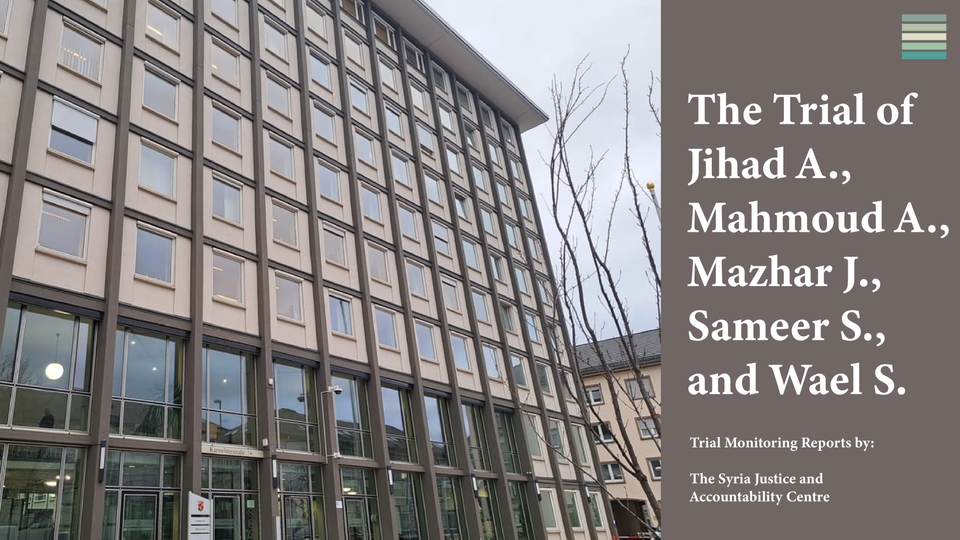
Inside the Al-Yarmouk Trial of Jihad et al. #8
TRIAL OF JIHAD A., MAHMOUD A., MAZHAR J., SAMEER S., AND WAEL S.
Higher Regional Court in Koblenz, Germany
CAUTION: Some testimony may include graphic descriptions of torture, rape or other violent acts.
This is an informal summary of the proceedings and not a verbatim transcript. CVT has chosen not to use the names of witnesses or detailed information that could be used to identify them.
For Trial Reports 1-6, please see the website of the Syria Justice and Accountability Centre (SJAC).
Trial Report 8: Summary
The trial day focused on testimony from German prosecutor W9, who recounted prior questioning of witnesses W4 and W5 about the July 13, 2012 demonstration and the general strike, including their allegations that several of the accused shot at demonstrators and participated in arrests. The defense teams challenged the legal basis and procedure of W5’s questioning abroad and sought to limit the use of his statements, but the court denied these requests.
Trial Day 14: February 11, 2026
This trial day was dedicated to the hearing of a new witness, W9, a German prosecutor who had examined two witnesses. W9 testified that the hearing with the witness W4 took place in Germany, that W4 had been instructed by a police officer, and that the witness confirmed that this instruction was understood. Furthermore, W9 testified that the re-translation of the protocol of the hearing followed on the second day. W9 recalled the information W4 had given regarding his presence at the demonstration on July 13, 2012: W4 was at the forefront of said demonstration and tried to motivate people with a drum. He recalled that regime-affiliated individuals started an attack on Palestine Street. The prosecutor said that W4 had stated that he tried rescuing several individuals who were shot at the demonstration. According to W4, the demonstrators were unarmed. W4 saw Moafak D. and Mahmoud A. shoot at the demonstrators. W9 further testified that the general strike was discussed during the hearing of W4, which had been emotionally challenging for him.
The presiding judge recalled that an important location in the general strike was near a biscuit factory and a bus stop. The judge asked whether these places were also mentioned in the hearing of W4. The prosecutor could not recall that such places were mentioned by witness W4, though he assumed this information to be right. As reported by W4, the names of Jumbas [nickname of Jihad A.] and Tamtam were mentioned, while the protocol of the hearing of W4 also contains the family name of Wael S. and Sameer S. Prosecutor W9 also repeated that W4 described his bonds with Mahmoud A. as not close and that he knew him from another occasion. W9 recapitulated what W4 had said when he was shown a picture of the five accused: W4 first was not able to identify any accused at first, and testified that he did not know any of the shown persons. W9 recalled that W4 then suddenly recognized Mazhar J. and said he remembered that he had seen him at the checkpoint.
On the second day of the questioning of W4, he was questioned about what he saw at the general strike, which he had helped to organize. Witness W4 told prosecutor W9 that he saw Mahmoud A. shoot. W4 mentioned that he knew the family of Wael S. and Sameer S. but he was often confused about the first names of the family members.
Prosecutor W9 was then asked about the questioning of witness W5, which took place in another country, together with three members of the Regional Criminal Police Office (LKA). W9 testified that members of the other country’s police followed the broadcast of the questioning from another room. Moreover, W9 recalled that at the beginning of the interview with W5, he presented himself. He mentioned his birthplace and what he studied, and said that he transported wounded in and outside of Yarmouk. W5 himself brought up the subject of the demonstration on July 13, 2012, where he lost one of his cousins, F23. W5 recapitulated that on that day, he saw people coming out of the mosque and that they were heading towards the Palestine roundabout in Yarmouk. He also recalled that he saw the militants shooting at the demonstrators while himself being at the edges of the demonstration. W5 mentioned that he tried saving several of the wounded demonstrators by going into the masses; by holding his hands up to signal that he was trying to provide medical aid. After heaving the body of a wounded demonstrator and driving the person to a nearby hospital, the witness W5 went back to the demonstration and tried helping other wounded persons in the same manner. Later, it was said that he helped three people in total, W9 recalled. After delivering the first wounded person to the hospital, he discovered that it was one of his cousins, who had already died by the time of arrival at the hospital. W5 said that he saw Mahmoud A. shoot. He also mentioned the family name of Wael S. and Sameer S.
On the second day of the interview of witness W5, he referred to Mazhar J. He also said that Sameer S. had been both present at the demonstration on July 13, 2012, as well as at the general strike. W5 told prosecutor W9 that he saw Mahmoud A. and Mahmoud S. change the magazine of their weapons. W5 also recalled that he saw a group of regime-affiliated persons arrest demonstrators and push them into a mini-van. Afterwards they were taken away. W5 told W9 that shop owners had closed their shops for the general strike and were punished by the regime by being beaten up and taken away. W5 had also brought a list of names, mentioning the names of Mazhar J., the family name of Wael S. and Sameer S., and Mahmoud A. to the prosecutor. Upon seeing a picture of Wael S. and Sameer S., W5 recognized the latter and mentioned that their family lived on the street opposite the hospital.
Defense counsel Baumgart and the counsel of Mazhar J. and Mahmoud A. objected, but the presiding judge rejected this. Then, a photo was shown which prosecutor W9 had shown to W5 during the interview. W5 was able to identify Sameer S. on the left side at the back of the picture as well as Jihad A.
Upon further questioning, W5 spoke about information he had concerning Wael S. and Sameer S. According to W5, the former had been arrested once because he possessed drugs. W5 described Wael S. as a regime-affiliated Shabiha who was involved both in the siege as well as the starvation of civilians and the suppression of the demonstration. According to W5, the same can be said for Sameer S. with the difference that he was even more brutal. W5 testified that he saw Sameer S. shoot at the demonstrators on July 13, 2012, as well as being involved at the checkpoint. At the checkpoint, W5 saw how Sameer S. pointed at a person who was later taken away. W5 also said that Mahmoud A. together with Mahmoud S. took a person to the Syrian Secret Services where the person was executed. W5 was familiar with Mahmoud A. because he had seen him in the hospital in the summer of 2012 together with F5. Upon questioning by prosecutor W9, W5 had mentioned that he himself had been near the passport and immigration office because he visited a friend.
The third session of the questioning of W5 took place again in the other country, and the process was similar to the prior hearings. W5 testified that he had seen both Jihad A. and Mazhar J. shoot. Moreover, according to W5, Mazhar J. formerly worked at a court where he helped people raising a concern. W5 claimed to see Mazhar J. point at a person who was later taken away by the Secret Services. W5 also remembered that Jihad A. had gotten the name Jumbas from his grandfather and that he had arrested a person W5 knew.
***
[75-minute break]
***
After the break, the defense teams had the opportunity to question prosecutor W9, starting with defense counsel Bodenstein on behalf of Wael S. He asked if prosecutor W9 knew how W5 and Wael S. knew each other. W9 replied that W5 knew where his family lived. The defense counsel of Sameer S., Dr. Baumgart, wanted to know how the hearing of W5 in the other country had been conducted precisely. W9 said that the disclosure of this information was not covered by his authorization to testify. Dr. Baumgart went on and asked on what legal grounds the hearing had been conducted. W9 once again said that his authorization to testify did not cover this type of information. Federal Prosecutor Ms. Graetsch repeated that the authorization to testify does not cover this type of information. Dr. Baumgart nevertheless requested that W9 be fined because he did not answer his questions. The court denied this request. W9, upon questioning by Dr. Baumgart, said that he had not heard the instruction of the witness by the other country’s police officers.
Defense counsel Grassel, on behalf of Mahmoud A., asked if W9 knew who was in charge of deciding which people were arrested in Yarmouk. W9 said that W5 had stated that both members of the Shabiha and the Syrian Secret Services had the authority to arrest people. According to W5, Mahmoud A. was not a civil servant of the Syrian government but cooperated with them. Defense counsel Grassel then asked about the relationship both witnesses had had with the Syrian government. Prosecutor W9 mentioned that W5 stayed close to the checkpoint and that W4 was happy when the Assad government had been overthrown. Dr. Flintrop, defense counsel of Mahmoud A., then asked whether W9 knew anything about a relationship of the family of the witness W5 with the Assad family, which the former denied.
Defense counsel Fratzky on behalf of Mazhar J. further asked about the process of the questioning of the witness W5 in the other country. W9 said that, during the interview there, there had not been an interpreter between German and the other country’s language. W9 testified that the witness was instructed according to both codes of procedure: that country’s and the German code. Colleagues from the other country confirmed that they had instructed the witness. Defense counsel Greisner, also on behalf of Mazhar J., asked whether W9 had talked with colleagues from the other country about the content of the instruction, and W9 responded that this had not been discussed. Further, he said that the re-translation was finished on the day after the second interview and that every change in its content had been supervised by him.
At the end of the session, defense counsel Dr. Baumgart on behalf of Sameer S. requested the court not to use the information given by the witness W5 nor the information given by W9 in relation to W5 as the questioning of W5 in the other country lacked a legal basis. He went on saying that during an interview in another European country, the witness had to know their right to refuse to provide information, which had not been done in the questioning of W5. According to Dr. Baumgart, a witness had to be informed by the prosecutor and this instruction was not given in the present case. Federal State Prosecutor Graetsch countered that the prohibition to use the statements by the witness was only given if the questioning of the witness had violated a sovereign right of Germany or if it had been in contravention of German criminal law. Neither of these conditions were met in the present circumstances according to Prosecutor Graetsch.
The court denied Dr. Baumgart’s request. Defense counsel Bodenstein further said that the information given by the witness W9 lacked relevant information concerning Wael S. because W5 had repeatedly confused Wael S. with F19.
The proceedings were adjourned at 3:41 PM
The next trial day will be on February 25, 2026, at 9AM.
___________________________
For more information or to provide feedback, please contact SJAC at [email protected] and follow us on Facebook and Twitter. Subscribe to SJAC’s newsletter for updates on our work