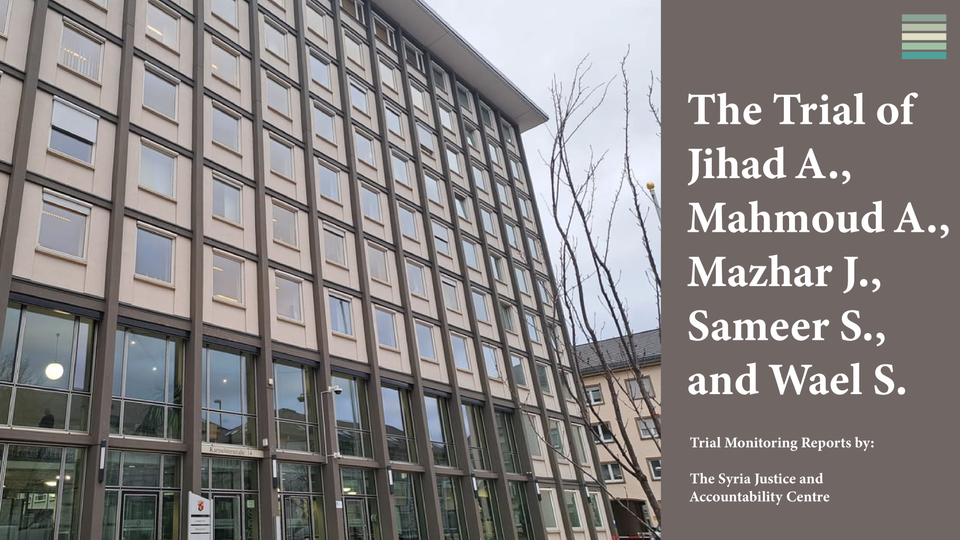
Inside the Al-Yarmouk Trial of Jihad et al. #9
TRIAL OF JIHAD A., MAHMOUD A., MAZHAR J., SAMEER S., AND WAEL S.
Higher Regional court in Koblenz, Germany
CAUTION: Some testimony may include graphic descriptions of torture, rape or other violent acts.
This is an informal summary of the proceedings and not a verbatim transcript. CVT has chosen not to use the names of witnesses or detailed information that could be used to identify them.
Trial Report 9: Summary
This week, the court heard extensive testimony from witness W5 about events in Al-Yarmouk, including alleged abductions near the passport and immigration office checkpoint and accounts of detainees being beaten and taken away. W5 described multiple individuals’ alleged involvement but repeatedly stressed uncertainty and confusion among different situations, prompting frequent rephrasing by the court and defense challenges. The proceedings were marked by security concerns and threats in the courtroom. The court also barred questions that could reveal identifying details linked to W5’s family due to witness-protection risks. The defense further challenged W5’s credibility, claiming contradictions and possible false testimony, while W5 maintained he sought “justice” and detailed significant personal harm and ongoing distress.
Trial Day 15: February 25, 2026
Presiding Judge Dr. Kerber opened the trial day acknowledging everybody's presence and allowing the change of defense counsel Goll for defense counsel Fratzky.
Witness W5 was brought in, accompanied by his legal counsel, F24, and four masked police officers.
The questioning from the court began with W5 tracing his biography in Al Yarmouk. From his childhood he knew Wael S., Sameer S., and their families because they were neighbors. Asked about his position on the Assad regime, he responded that at first he was loyal, but after the revolution he changed his mind and he opposed it.
Later he was imprisoned and tortured, and two of his brothers were killed after he left the military. His family received the death notifications but the corpses never came back.
The witness also testified that his family had an important military standing. One of his uncles, F25, was a General Major and commander of the Palestine Liberation Army, another uncle, F26, was commander of the Syrian Air Force from 2000-2008, and another uncle was also General Major. Those three were brothers.
Shown a picture that W5 claimed to have found on the Facebook account of Sameer S., W5 said he recognized F5, Jihad A., F27, F18, Moafak D. and Sameer S. and called him “the masked one” because he used to wear a scarf.
The court then quoted from the protocol of his questioning in another European country that W5 did not specifically mention the names of Sameer S. and Jihad A. W5 responded that he was not asked about them because in that country he was questioned about other accused, namely Moafak D. and Mahmoud S.
The court then inquired about the passport office. W5 was asked to write down place names, which resulted in a misunderstanding with the interpreter. Defense counsel Baumgart criticized this. W5 then described the building and its surroundings. To get there one had to pass a checkpoint of the Air Force's Secret Service. From there, W5 recalled, people were abducted and taken away. Moafak D., Mahmoud S., Sameer S., Mazhar J. and Mahmoud A. singled out people who were then disappeared. This became one of the tasks of the Shabiha, the witness added.
Asked by the court whether Mahmoud A. and Mazhar J. worked together, W5 testified that they were working on their own. He remembered that those disappearances took place from January to May of 2013, after the air-raid.
Reminded to be more specific about particular events, W5 told the court that he was quite uncertain about the details, but he distinguished at least three different situations he recalled to mind: Mahmoud S. and Moafak D. pointing out people, then Mahmoud A. accompanying them, then Mahmoud A. working alone and lastly, Mazhar J. being alone and Sameer S. being alone.
W5 then gave more precise information on those disappearances: after individuals who were singled out were detained, their t-shirts were pulled over their faces, and they were hit in the back of the head and kicked. While recounting the events, W5 mixed up several situations repeatedly, prompting the court to continuously reformulate questions. This was frequently interrupted because the defense counsel interjected with remarks.
[10-minute break]
Upon return from the break, W5 recounted that he saw Mazhar J. approaching armed men from the outside of the passport and immigration building. Mazhar J. then focused his attention on a 25–30-year-old man. This man was taken away while being beaten with the gun butts. The witness recalled the mother of this man crying next to them. She was kicked away.
Upon questioning by the presiding judge, W5 shared that Mazhar J. had a conflict with his brother, F28. To take revenge, he took on his own nephew.
Confronted by the court by the fact of his previous testimony that nobody had been hit, W5 clarified that sometimes people were hit and sometimes they were not.
The court often reminded W5 not to speak in general terms, but to focus on the specific questions and details, yet W5 kept repeating information and giving general explanations on how things went at that time.
Then W5 claimed to be threatened by “this side”, pointing to the defense counsel and the accused, which resulted in noisy conversation among the parties to the proceedings. Before the judges called for a break, and unclear who had uttered the phrase, the interpreter translated: “He who laughs last, laughs best.”
[75-minute break]
Upon return, the presiding judge referred back to the situation before the break, yet none of the parties wanted to comment further.
The court asked about F29. W5 testified that F29 lived in the same house as Sameer S. After Sameer S. left the house, a group from the opposition moved in. When F30, F29’s brother, left the house one day, Mahmoud S. [the accused in Sweden] took him, thinking that it was F29. W5 suspected that Sameer S. had handed over F29’s name. Once the misunderstanding was cleared, F30 was freed. Sometime later, F29 was abducted by Mahmoud S. and Sameer S. confirmed F29’s identity. Mahmoud A., since he was stronger, was then called to secure F29, who was then carried to a school, where he was shot, then put in a car called “The Butcher’s Car”. W5 obtained this information from a young man who had to put the corpse in the car. Later, W5 convinced the family to not get the official death certificate as there was the risk of being beaten and humiliated for being related to a “traitor.”
The court then displayed a picture. W5 recognized the construction worker F31. The accused, Mahmoud A., commented on this, yet the interpreter could not understand him. W5 then shouted, “under threat, I won't say anything more” claiming to have heard the sentence: “If you say anything more, we will throw you to him.” Jihad A. then started crying and the judges issued a break.
[10-minute break]
The court recalled the event mentioned before the break. Then W5 clarified: Sameer S., Mahmoud A., and Mahmoud S. were present. First, F29, and later, F31 were captured. Moreover, F10 was present. W5 recalled that around two years ago he learned that F31 was found dead in a pit near Al-Tadamon. The witness continued that two men were laying in the van, facing down. Beside them were F32, and F33.
Defense counsel Leymann then noted that he questioned W5’s reliability. W5 appeared exhausted, so the court issued a break.
[10-minute break]
Upon return, the defense then started their questioning. Counsel Baumgart wanted to know how W5 knew all these people. The witness explained that it was through his job.
Following this, defense counsel Baumgart, referring to the picture W5 claimed to have seen on the Facebook account of Sameer S., noted that this was impossible since the account of Sameer S. was private. W5 responded that his daughter showed the picture to him. Defense Counsel Baumgart then asked for the name of the daughter. At this, W5’s witness counsel interrupted, noting that W5 was part of the witness protection program and disclosing such information could create a risk for W5 and his family. All defense counsel requested that this be solved by an order by the court. Defense Counsel Leymann also added that there may be the possibility of a criminal charge due to lying in court, which was immediately criticized by the prosecutor, joined by the plaintiff’s counsel.
The court then decided that the question about the identity of the daughter may not be asked due to the risk to W5 and his family.
The proceedings were adjourned at 4:30 PM.
The next trial day will be on February 26, 2026, at 9 AM.
Trial Day 16: February 26, 2026
Before the proceedings started, Jihad A. was crying. The presiding judge then opened the hearing and recalled witness W5 into the courtroom. His legal counsel and four masked regional police officers [LKA] again accompanied him. The defense then resumed their questioning. W5 had his own Facebook account before 2013. The defense was interested in why the daughter visited Sameer S.’s Facebook profile, amd W5 responded that she only visited on other sites. The defense counsel highlighted the contradiction with W5’s testimony from the previous day [see trial day 15, above]. After the presiding judge rephrased the question, W5 told the court that he was unsure from where his daughter got the picture.
Following a comment by Mazhar J., saying: “Wait, you will see what happens!”, the courtroom became noisy with additional commentary. Defense Counsel Greisner, Mazhar J.’s Counsel, asked for understanding for his client, arguing that he was very tired due to the pre-trial detention. The presiding judge then reaffirmed the importance of heightened security for W5 due to repeated threats.
Then W5 conceded that he could have confused different events at the passport office. He recalled having always been at a distance of two or three meters of the accused and followed them whenever he could. Upon questioning, he explained that he did not consider himself politically engaged but rather a member of the opposition.
Asked whether the death of his brothers has influenced his view of the accused, he firmly replied: “No, I just want justice!”
W5 recalled that he had worked for a rich regime-sympathizing woman, which allowed him a comfortable life. This ended after he switched loyalty to the opposition. He added that his honor was more important to him than money. He also recalled that he went to jail after he drove one of his friends to the hospital. The friend had gotten shot at a place in Al-Yarmouk that was hit by a rocket, where they had gone to explore out of curiosity. He told the court that his friend was tortured, which is when the friend revealed his name. As to the consequences of his own experience, he explained that besides suffering cuts over his body, he had two broken ribs, needed entirely new teeth, and suffered from severe psychological distress until today from the corpses and severed body parts he had seen. He also noted that after each questioning, he is incapable of sleeping for three to four nights. He further explained that he is constantly threatened, had to move often in the past, and his children had to stop their studies when they entered the witness protection program.
Defense Counsel Leymann wanted to know when exactly W5 had entered the witness protection program. W5 replied that he did not recall. Counsel Leyman then requested the court to add to the official court transcript that he suspected the witness W5 to have lied to the court, and therefore to have committed a crime. Prosecutor Graetsch criticized the assumption. The court denied the defense request. Before the break, several defense counsel had a conversation, sharing different opinions on how the witness protection program works.
[60-minute break]
Upon return from the break, defense counsel Leymann asked the witness how often he passed the checkpoint and how long he worked at the hospital. W5 replied imprecisely, leading defense counsel Leymann to repeat his question several times. W5 then testified that he worked there from 2002 until 2013, adding that it was official from 2004.
Upon Leymann’s question how he still managed to leave despite being in opposition, W5 explained that the different checkpoints were organized by different groups, meaning one could leave through one checkpoint while being prohibited to leave from another.
Following further inquiry from defense counsel Leymann, W5 testified that he organized passports for friends and cousins, confessing that he profited a lot from it. W5 reiterated that the system was very corrupt at that time.
Asked if he followed the two trials of Mahmoud S. [in Sweden] and Moafak D., he confirmed that he is related to Moafak D. and knows about the trials from exchanging information with his children.
The proceedings were adjourned at 3:40 PM
The next trial day will be on March 4, 2026, at 10 AM.
___________________________
For more information or to provide feedback, please contact SJAC at [email protected] and follow us on Facebook and Twitter. Subscribe to SJAC’s newsletter for updates on our work