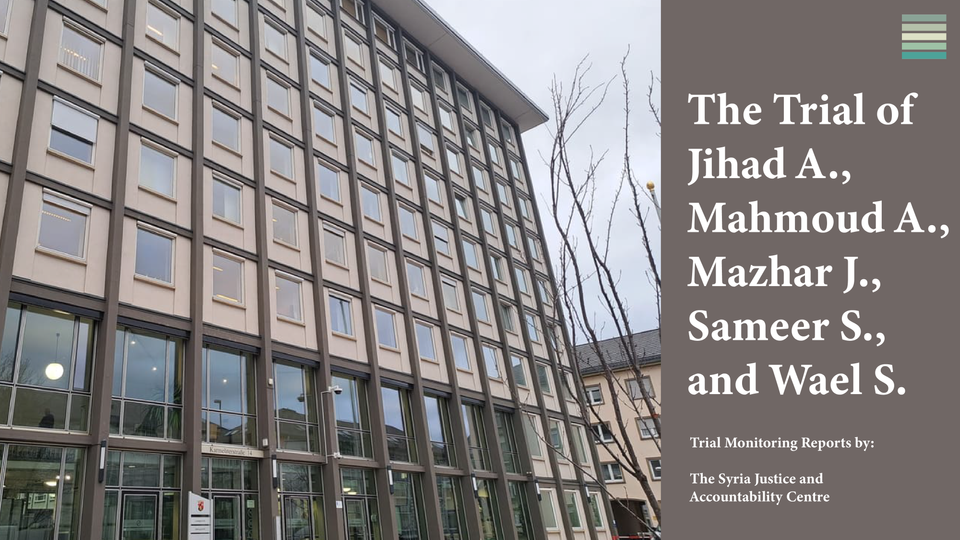
Inside the Al-Yarmouk Trial of Jihad et al. #17
TRIAL OF JIHAD A., MAHMOUD A., MAZHAR J., SAMEER S., AND WAEL S.
Higher Regional Court in Koblenz, Germany
The Center for Victims of Torture (CVT) provided support to SJAC to monitor this trial and prepare the first six monitoring reports. CVT has continued the monitoring of this trial from report seven onwards and has edited them according to its own style guidelines.
CAUTION: Some testimony may include graphic descriptions of torture, rape or other violent acts.
This is an informal summary of the proceedings and not a verbatim transcript. CVT has chosen not to use the names of witnesses or detailed information that could be used to identify them.
Trial Report 17: Summary
The first of the two hearings focused on W5’s testimony concerning events in Yarmouk, including his communications of July 13, 2012, his work as an ambulance driver, the use of and damage to hospital ambulances, and the treatment of wounded opposition members in field hospitals to avoid arrest by intelligence services. The witness also described demonstrations, killings, funeral processions, alleged arrests, the role of Sameer S. in identifying detainees, and a school incident involving gunfire and the transport of bodies. Defense counsel challenged his credibility, memory, relationships with the accused, alleged contradictions, and the basis for his claims about checkpoints, shootings, and a sniper incident.
The second trial day continued with W5’s cross-examination, focusing on checkpoints in Yarmouk, arrests by members of the General Command and Shabiha, the witness’s knowledge of named individuals, and his account of protecting his ambulance from gunfire. Defense counsel questioned him about the alleged sniper incident, the source of a list of “enemies,” and how publicly known his opposition views were in the camp. The court also addressed procedural disputes over video evidence submitted by the defense, adding the materials to the case file while prohibiting questioning about them until formally admitted.
Trial Day 29: May 20, 2026
At the outset of the hearing, the court questioned witness W5, age 56, who had previously testified, about a call he received on July 13, 2012. The witness testified that he did not initially recognize the caller, who identified himself and had apparently called from a mobile phone. When asked about the availability of mobile phone reception at the time, the witness explained that reception had previously been unavailable in Damascus, but not in Yarmouk. He added that, five months after the airstrike, internet access and electricity were still functioning in Yarmouk.
The witness was then asked whether he knew another named individual. He testified that he had also made calls and reported on demonstrations, as he had previously stated during an interview in another European country. Questioning then turned to the ambulance he had driven. The witness said it was a Mercedes resembling vehicles used by German police and was identifiable as an ambulance because it was equipped with sirens. He had used two ambulances in total. One, though not the Mercedes, bore the hospital’s name. On July 13, 2012, he believed he had used the white ambulance. The vehicle had originally belonged to the Syrian military before being painted white and marked with the hospital’s inscription. According to the witness, Basler Hospital in Syria did not own ambulances but borrowed them.
The witness described the situation between demonstrators and police forces as dangerous. He recalled that a person he named, F49, had been killed on September 13, although he had not known him personally. When asked how he knew that F55 was dead, the witness replied that the names of the deceased had been collected.
In 2021 or 2022, following the investigations, his uncle was asked whether he could file a complaint but refused because the regime still maintained a presence. At Palestine Hospital, the father searched for his son. Bodies and feces had been brought to the hospital, while others were taken to a mosque. In the camp, a friend or acquaintance greeted the witness. The witness cited an Arabic proverb, rendered by the interpreter as: “The one who sees with his own eyes is not like the one who merely hears about it.” Two other individuals had been killed: one immediately and the other the following day. Both were buried in the same grave. The witness did not attend the funeral and learned of the events at the hospital. He did not know what happened to one particular body, noting that there may have been no space in the cooling room. Many people brought children to the hospital to prevent intelligence services from discovering them. The funeral procession took place on a Saturday and drew approximately half the camp. According to the witness, it marked the first spark in the regime’s collapse, and no one died during the procession. The witness stated that he had seen shooting and had heard that one or two people were killed at every demonstration. In 2012, however, he personally saw only one demonstration during which shots were fired.
The witness confirmed that he had personally seen Sameer S. wearing a mask and added that he would recognize him among a thousand people. According to the witness, Sameer was brought in only to confirm whether the correct person had been identified, not to carry out the arrest himself. The witness repeatedly testified that Sameer’s act of pointing at an individual effectively led to that person’s death.
[15-minute break]
After the recess, the witness showed a photograph of the ambulance on his cell phone. The image depicted a white vehicle with orange stripes and a siren, identifiable as the hospital ambulance. Another photograph showed the same vehicle heavily damaged after an airstrike. The witness recalled that, on other days, he had also worked inside the hospital, including during surgical procedures, but that his primary role was ambulance driver.
Defense counsel Flinkdrop asked why the witness had clarified that the judge had reminded him of matters he no longer recalled. The witness explained that he wanted to ensure accurate interpretation and preserve a clear conscience. He did not remember August 28, 2023, which the defense counsel asked for [note: the background of this question and date remain unknown]. Asked whether the ambulance had been damaged only by the airstrike, he stated that it had sustained damage repeatedly during operations. He confirmed that he had driven the ambulance shown in the photograph on July 13.
The examination then returned to the telephone calls. The witness remembered that he used two telecommunications providers at the time: Ziliatell for one mobile phone and MTM for the other. One phone was private and the other work-related; the private phone was turned off during working hours. On July 13, both mobile phones were turned off, and he was reached on the landline. Hospitals outside Yarmouk handled sensitive cases, including neurosurgical procedures, when local capacity was unavailable. Opposition members, however, could be treated only inside the camp; outside it, they would have been arrested immediately because intelligence agents were present in every hospital. The witness denied ever participating in roadblocks. He had employed and paid a young man as a driver to take his wife and child shopping. They had no contact after the airstrikes. The witness testified that he takes medication for blood pressure. He learned of F55’s death only when the family arrived at the hospital. In 2023, he called F47’s paternal uncle and asked him to file a complaint. The uncle had not dared to do so while the Assad regime remained in power because, if the regime discovered the complaint, the family would be executed.
[80-minute break]
Upon return from the break, the witness testified that he first worked as an observer and later as a supervisor, a role for which he carried a notebook and documented events. Counsel Fratzky claimed that the witness had contradicted himself “from A to Z.” The witness and the accused were in conflict: Mazhar J. had allegedly threatened him. The judges then briefly interrupted the hearing.
[15-minute break]
After the interruption, the witness had not yet returned to the courtroom. Concerning the alleged threat, defense counsel stated that his client had testified that the witness had attacked him at home, beaten his wife and children, and made a sexually explicit insult concerning his sister. A difference in interpretation caused confusion. The accused Mahmoud A. stated: “It is obvious that the witness is lying, and you do not want to acknowledge it.” Fratzky resumed the examination and asked whether the witness had often visited Mazhar J.’s home. The witness confirmed that he had eaten and drunk there for years and that his brother had been in the same class. He denied knowing F56, F57, or F58. According to the witness, F59 had been killed and had lived opposite Sameer. The witness did not know F60, but thought that their families might be related by marriage. He had only heard the name P1 and did not know F28, the brother of the accused, Mazhar J. The witness recalled that he had driven the ambulance on the day of the demonstration against his superiors’ wishes and had never undergone a neurological examination.
Defense counsel Bodenstein asked whether patients had ever been treated outside hospitals. The witness confirmed that there had been two field hospitals, one beneath his house, where only surgical procedures were performed. From 2012 to mid-2013, he smuggled patients out of the camp to prevent intelligence services from seizing them. The white ambulance with an inscription had formerly been a military vehicle, and his identification card reflected a high-ranking position, enabling him to pass checkpoints more easily. At the demonstration, he saw individuals carrying first-aid bags. The witness testified that F28’s brother quarreled with another brother, after which F28 handed that brother’s son over to the intelligence services. This became known in the camp because handing over a relative to the intelligence services was considered extraordinary and effectively meant death. According to what the witness heard, the nephew was killed. He did not know the subject of the quarrel. In July 2013, the witness left the country and paid a large sum to do so. Asked how he could leave the camp as an opposition member, he replied that while his political position was known in the camp, it was not known at the checkpoints and he possessed the military identification card.
[10-minute break]
Asked by the defense whether confirmation by another person was always required even where identification documents were shown, the witness said it was not. In this instance, however, Sameer had given the name and pointed at the person. Regarding the school incident asked for by counsel Schönberger, the witness testified that he heard shots but did not see them. He followed a bus toward the school on foot, lost sight of it after one or two minutes, and had hoped to free someone or notify the family so they could secure the person’s release by payment. By then, however, the person was already dead. The bodies were brought to the school and then transported to the hospital in a “meat wagon.” The witness testified that he personally saw someone killed by gunfire. The weapons were Kalashnikovs, which he said he could identify by sound; presumably two people fired. Those who removed the bodies with the meat wagon had also performed forced labor.
The ambulance was hit several times between July 13, 2012, and April 2013; one projectile passed near the cushion. The witness believed a sniper had attempted to shoot him but missed. In April 2013, the ambulance stopped functioning, and he left it unrepaired. Defense counsel Flinkdrop asked whether he had personally met President Assad. The witness said he had seen Assad at close range, had driven Assad’s wife and sister, and had greeted Assad at a dinner. Only after that encounter, he said, did he become an opponent of the regime. Asked how he could pass checkpoints as an opposition member with a military identification card, he repeated that no one questioned such a high-ranking ID. He had support from people in Assad’s circle but severed contact with officers in early 2012. The witness reiterated that he went to the school hoping to save someone or notify the family so they could secure a release by payment, but it was too late. No one spoke to him except someone who told him to “get lost”; he did not show his military ID. He did not know F61. He knew F62, his former neighbor who also lived in Europe and had called him two or three years earlier to express condolences after F62’s brother died of cancer. After the airstrike, the witness no longer left the camp with the ambulance.
Regarding the sniper incident, the witness estimated the distance at approximately 700 meters. He believed the shooter was a sniper because the bullet passed through the windshield behind the writing and the cushion, which he said a Kalashnikov could not have done. He did not know the sniper’s identity, although he suggested it may have been F63. Asked whether he was a double agent, the witness denied it and asserted that he had not worked with the regime.
The proceedings were adjourned at 5:05 PM.
The next trial day will be on May 21, 2026, at 9:00 AM.
Trial Day 29: May 21, 2026
The trial day began at 10:05 AM with the continued cross-examination of W5. Defense counsel Tahmaz-Ahmadvand was expected to send the court links to several videos she intended to use as evidence, but the presiding judge had not received them. The issue appeared to be technical. The court received the materials at 10:30 AM and reviewed them. The delay caused tension in the courtroom because two court employees had been called in to present the videos, although the links had not yet arrived.
The witness examination continued. Defense counsel Fratzky began by asking how many checkpoints had existed in Yarmouk before and after the blockade. W5 replied that, during and after 2012, checkpoints were opened wherever F5 wanted them. In 2013, one main checkpoint was established near al-Hajar territory, at al-Bashir Mosque. Asked which checkpoint he had regularly followed members of the General Command to after they arrested people in the camp, the witness confirmed that it was this main checkpoint. He further explained that he followed the Shabiha after arrests every few days during the first four months of 2013. He said he did so out of interest and only when he happened to be nearby. He observed the arrests and the route to the checkpoint from a distance, often with neighbors, with whom he discussed the incidents.
The witness was then asked whether he knew that F28, the brother of accused Mazhar J., had been incarcerated. Initially, the witness understood the question to refer to the accused and replied that he had been imprisoned by Syrian forces in 2011 for fraud and embezzlement. After the misunderstanding was clarified, the witness noted that he did not know whether F28 had ever been imprisoned.
Bodenstein, defense counsel for Wael S., then asked about the previously mentioned protection added to the witness’s ambulance. The witness explained that he had found marble slabs in a destroyed house and attached two of them to the door and front of the vehicle to protect himself from gunfire, particularly when approaching checkpoints. He installed the slabs in late 2012 or early 2013. Bodenstein then asked what type of weapon had been used in the attempted shooting. The witness replied that it was of Russian origin and that the shot had come from approximately 700 meters away. Asked how he knew the distance, the witness explained that snipers regularly fired from the same building at Palestine Square. He and his colleagues had measured distances between buildings for fun by resetting the vehicle’s speedometer to zero and calculating the distances that way. He therefore knew the distance was about 700 meters. The witness recalled that he had not seen the sniper but that it was known shots were fired from that location. The presiding judge then declined a question from Bodenstein that had already been answered. Bodenstein next asked about the source of a list, previously mentioned by W5, containing the names of enemies. The witness explained that the list was compiled from information provided by the secret service, F5, other Shabiha members, and Sameer S. Finally, Bodenstein asked how publicly known the witness’s opposition views were in the camp. The witness said the Shabiha did not know of them, but his family and neighbors did, particularly because he had opened a makeshift field hospital in his basement.
Schönfelder, defense counsel for Sameer S., then posed several questions that were not admitted because they were repetitive.
After all defense counsel had concluded their questions, the court called a recess to review the evidence submitted by Tahmaz-Ahmadvand.
[15-minute break]
After the recess, the prosecutors objected to the videos submitted as evidence. They stated that they needed to review the new evidence before it could be admitted, or, alternatively, that the videos should not be admitted at all.
Schönfelder acknowledged the objection and stated that he wished to file a formal motion to use the videos as evidence in court. The court decided to add the materials to the case file but prohibited any questioning about the videos until they had been formally admitted.
Hedrich, defense counsel for Jihad A., asked whether the witness used TikTok to communicate with others. W5 replied that he sometimes used his daughter’s TikTok account to watch funny videos or cooking tutorials but did not use the platform to communicate online. Defense counsel Luth then asked whom the witness had treated in the field hospital in his basement and until when. The witness replied that he treated civilians, not FSA members, in the field hospital until mid-2013.
The witness was then dismissed from the courtroom.
The proceedings were adjourned at 11:20 AM.
The next trial day will be on May 27, 2026, at 10:00 AM.
___________________________
For more information or to provide feedback, please contact SJAC at [email protected] and follow us on Facebook and Twitter. Subscribe to SJAC’s newsletter for updates on our work