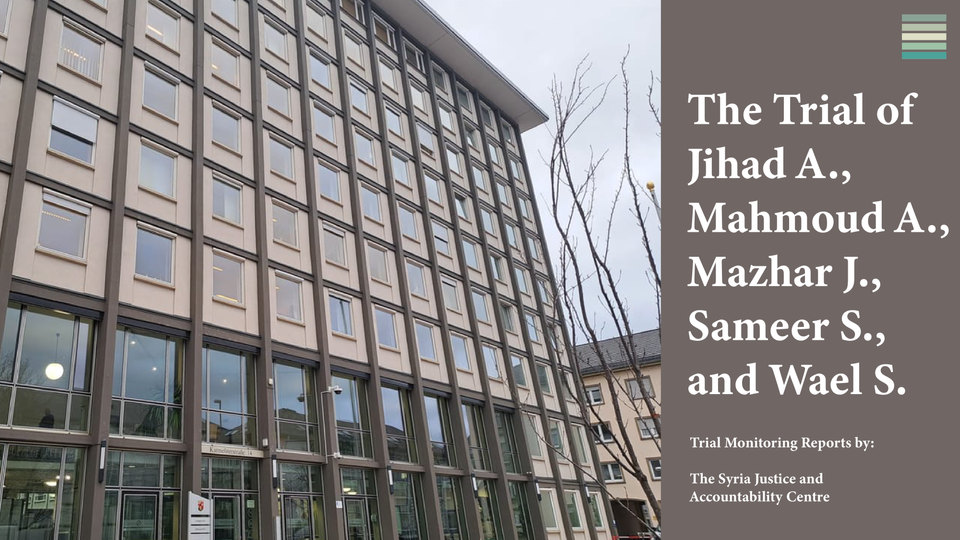
Inside the Al-Yarmouk Trial of Jihad et al. #16
TRIAL OF JIHAD A., MAHMOUD A., MAZHAR J., SAMEER S., AND WAEL S.
Higher Regional Court in Koblenz, Germany
The Center for Victims of Torture (CVT) provided support to SJAC to monitor this trial and prepare the first six monitoring reports. CVT has continued the monitoring of this trial from report seven onwards and has edited them according to its own style guidelines.
CAUTION: Some testimony may include graphic descriptions of torture, rape or other violent acts.
This is an informal summary of the proceedings and not a verbatim transcript. CVT has chosen not to use the names of witnesses or detailed information that could be used to identify them.
Trial Report 16: Summary
The session focused on witness testimony concerning demonstrations, shootings, medical response, and food distribution in Al-Yarmouk and nearby areas. The witness described participating in demonstrations, fleeing after gunfire, attempting to assist a fatally injured relative, and later helping injured civilians at a field hospital. She attributed the shootings to armed groups aligned with the regime but repeatedly clarified the limits of her direct observations, distinguishing between what she personally saw and what she had heard from others. The court reviewed maps, videos, and photographs to assess locations, routes, identities, and contextual details, while questioning also addressed prior statements, security concerns around naming sources, and the witness’s recollection of severe overcrowding and gunfire during food distribution. Proceedings were ultimately adjourned early due to health concerns involving one of the accused.
The second hearing this week centered on disputed witness testimony about a July 2012 demonstration and fatal shooting, with defense counsel challenging inconsistencies and the witness’s ability to identify those responsible. The court also examined surveillance indicating possible attempts by the accused Jihad A. to influence witnesses and remove social media evidence, while the defense disputed any threat. The allegations included that relatives acting on behalf of the accused sought to contact potential witnesses, shape or discourage testimony, and pressure individuals connected to the case. A photo expert concluded that apparent timestamp inconsistencies of several examined pieces of evidence were likely caused by time-zone differences rather than manipulation.
Trial Day 27: May 6, 2026
At the beginning of this session, presiding judge Dr. Kerber confirmed the presence of all parties and approved defense counsel Schönfelder for defense counsel Baumgart and defense counsel Kai-Uwe Fratzky for Fratzky. Jihad A.’s brother was also present in the public gallery.
Then witness W14, a nurse who lives in Germany, entered the courtroom and the questioning by the judges began. W14 lived in Tadamon where she worked in a hospital. She went to Yarmouk various times for demonstrations and explained that due to her job she knows the situation of the hospitals in Yarmouk quite well. W14 also participated in the demonstration that took place in Al-Yarmouk in 2012 from the Palestine roundabout to the biscuit factory. When the shootings began, she fled with her cousin, F48, who was shot in the neck and died after her attempts to stop the bleeding with her scarf. She put the corpse on a motorized tricycle and F48 was brought to the mosque “Mother of the Believers” before she informed his family of his death. She recalled that later she wanted to come back to the place to help other injured victims.
Upon further questioning about her location and whether she saw the shooters during the demonstration, W14 testified that she only stayed at the Palestine roundabout before she fled to the nearby mosque. She could not see the shooters as they were too far away, but she claimed the shooters were men of Ahmad Jibril and the regime. She added that the bullet that killed F48 was Russian and that the General Command used to have Russian weapons. W14 further testified that injured people were brought to her field hospital in Tadamon.
The court then displayed a map of Al-Yarmouk and asked the witness to contextualize what she saw. W14, after preliminary difficulties, showed different places: the Palestine roundabout, the mosque and the escape route she took with F48.
Upon further questioning, W14 testified that she obtained her information from the group that organized the demonstrations in which she participated, and said that the shooting began minutes after she arrived on scene.
W14 apologized many times for not remembering exact information as the events went back many years, being kindly reminded by presiding judge Kerber that this was normal and fine and that it was only important that she differentiate what she saw for herself from what she heard from others.
[15-minute break]
After a short break, the court asked W14 whether F48 was running in order to help other injured people, which W14 denied. She recalled that F48 wanted to flee.
Asked by the court about the name of F7, W14 answered that she knew the name. The witness made a connection between the [last] name and the regime. First, she worked in the Ahmad Fahad hospital before she was asked to transform a kindergarten the family owned into a field hospital.
Upon request, W14 affirmed that there were other demonstrations with victims before July 13 - other demonstrations had already taken place. She added that she spent more time in Tadamon as she lived there but she attended demonstrations in Al-Yarmouk as well.
Asked about the person F49, she could not respond.
The court then played a video, showing a large crowd demonstrating at the Palestine roundabout. The witness then explained where exactly she was standing and the route she took to flee with F48.
The court then asked about the funeral procession for F48. W14 recalled that the funeral procession was planned to take place the same day of the death but had to be delayed to another day due to the shooting.
The court then displayed two more pictures and noted that the content may be emotionally disturbing. The witness identified F48’s corpse twice. Upon questioning, W14 further testified that she knew the name of F22 only by reputation, and she told the court that the hospitals had ambulances. She also confirmed that she heard about shootings and injured people on Al-Quds Street that day.
The court then asked about food distribution in Al-Yarmouk. W14 remembered that she and others in Tadamon heard about food distributions and went there to get some food. There, she saw military figures in uniform. She recalled that it was so crowded that people were standing on top of each other. Shots were fired into the crowd and W14 fled in panic. Later she heard that the food was distributed to the people belonging to the military. W14 said with a clear voice: “Who survived the bullets, died from hunger.”
Upon questioning, she clarified that the uniforms were yellow-brown or green.
[80-minute break]
Following the break, the judges asked about the location of the food distribution. W14 indicated that it took place at 30th Street at the end of the Al-Yarmouk square.
The court then displayed another picture, showing several men wearing black and white scarves. W14 guessed that it was taken in Al-Yarmouk and identified Jihad A. W14 further added that she does not know him personally, only from pictures and by reputation, and just yesterday, on Facebook. The black and white scarves were used by the men of Ahmad Jibril or the General Command; she recalled seeing these symbols in Al-Yarmouk.
In another displayed picture, she recognized F5. She never met him but heard that he was at the checkpoints. Seeing the next picture, she remembered having already seen the displayed person but does not recall the name. [Note: the photo showed Sameer S.] The rapporteur judge then confronted her with a statement she had given in a previous interview, saying she made a remark on the Shabiha. The witness did not remember.
The court then asked whether she had already seen any of the accused in Syria. W14 pointed at Mahmoud A, but added that they had no contact. She also pointed at Mazhar J., but remained unsure.
The court then ended its questioning and the prosecution posed its questions. Prosecutor Gretsch wanted to know whether W14 knew people who were present in the public gallery, which W14 denied [Note: At this moment, only the monitor and Jihad A.’s brother, who gesticulated and murmured words, visibly agitated at several statements, were present in the gallery.]
Defense counsel Greisner then played a video from his laptop, showing W14 covered in a hijab, with only her eyes visible, talking about F48’s death and criticizing the regime, translated into German by the interpreter. Defense counsel Hedrich wanted to know why she was the one being interviewed and whether she went to the demonstration as a nurse. W14 replied that she was the closest one to F48 at the time of his martyrdom, and that she participated only to demonstrate.
Being confronted with an answer she gave in another interview, W14 reaffirmed that she heard a lot of shots and that she vaguely remembered sniper shots being fired as they make a specific whistling sound. She added that she is not sure about it. W14 further explained that if she had known the video would be displayed in a situation like the trial later, she would have said a lot more. Defense counsel Flintrop then wanted to know what W14 meant by that. The witness responded that she would have said more about the circumstances, the crimes, and the atrocities that took place in Al-Yarmouk. Asked about her earlier interviews, W14 explained that she spoke to Interpol in Germany; she went there twice.
Defense counsel Flintrop then asked from where she knew Mahmoud A. W14 testified that she talked to other people. In the following, Flintrop asked her to provide names, which W14 rejected out of concern that something could happen to those persons if she named them publicly. Presiding Judge Kerber reminded her that as a witness she had to answer this question. Prosecutor Gretsch interjected, saying that by looking “to this corner,” pointing to Jihad A., and given the danger for the witnesses in this trial, one had to be cautious about such information.
Defense counsel Hedrich added that the situation between the opposition and the regime continued to be under tension: “Both sides are not holding back on social media,” he added. Thus, presiding judge Kerber allowed W14 to write down the names. Defense counsel Leymann then criticized prosecutor Gretsch’s statement on the potential danger of Jihad A., as these were mere allegations. Defense counsel Schönberger and Hedrich suggested that W14 should have legal counsel on this question. This comment was recorded in the official court transcript.
The witness then asked if she could finish now and return the next day. She was dismissed and left the room.
[18-minute break]
After a short break, Mahmoud A.’s face started twitching, and defense counsel Flintrop asked for his client to be able to leave. Presiding judge Kerber accepted and adjourned the proceedings due to health concerns.
The proceedings were adjourned at 3:30 PM.
The next trial day will be on May 7, 2026, at 9:00 AM.
Trial Day 28: May 7, 2026
The presiding judge commenced the proceedings at 9:10 AM. The court confirmed the presence of all parties and approved a change in defense counsel for one accused. The witness from the previous trial day, W14, was seated, accompanied by a legal counsel. The counsel had been assigned to the witness. This was deemed necessary after the witness had refused to answer a question about the sources of her information in front of the court on the previous day. Defense counsel Flintrop repeated the question and the witness provided the names of F50 and F51. The witness proceeded to explain that those two informants had been normal civilians. Both of them are still living in Syria. The witness had not contacted them regularly but had known to ask them about certain matters as the witness had known they had the information needed. W14 had possessed both phone numbers for a long time, even before the war. Defense counsel Flintrop had asked the witness to share the information. The witness told the court that the five accused had been part of the General Command.
Defense counsel Hedrich then asked the witness to elaborate on the timeline of the event on July 13, 2012. At first, the witness had attended the demonstration; she had not been in the mosque beforehand. Her cousin on her mother’s side had walked in front of her and he was shot in the head. He then had been taken into a car and brought to the mosque where men covered him in a shroud.
When the defense asked who was in charge of the district of Tadamon in June and July of that year, the witness responded that in times of war, no one was really in charge. When asked more precisely about the Free Syrian Army, she confirmed that there had been a group and repeated that it was very chaotic. She confirmed defense counsel Hedrich's suggestion that Tadamon had been more of an opposition district. The witness did not recall whether the internet had been shut off on Fridays. As defense counsel Hedrich insisted on knowing how one learnt about the demonstrations planned, the witness explained that in Tadamon, everybody knew everybody and telephones were not needed. If they had known then that everything that happened would be brought to daylight one day, they would have made more videos.
The witness had been interviewed twice in one European country and once in another. Defense counsel Grassel pointed out that the father of the victim had said that his son had died by sniper fire, to which the witness responded that they could not have known with certainty as they could not look inside the victim’s head.
The presiding judge then closed the questioning of W14.
[10-minute break]
After a short break, defense counsel Luth pointed out that the witness had not recognized his accused, Wael S. Counsel Luth highlighted some inconsistencies between the witness’s descriptions of the situation at the demonstration and the loyalties of another family.
The presiding judge then read out the transcript of a telecommunications surveillance by the Berlin police. This transcript detailed several phone calls made from another inmate, a distant relative of Jihad A., at the time of Jihad A.’s pre-trial detention in 2024 and 2025. The protocol also mentioned that two phones had been secured in Jihad A.'s cell. Jihad A. allegedly ordered his brother, son, and wife to meet with possible witnesses for the prosecution to suppress evidence in the form of photos on social media platforms, for example one showing Jihad A, with F5, leader of the Free Palestine Army. Those phone calls showed that one family had already been contacted. Later, they were depicted as non-collaborators. According to the transcript, these witnesses were supposed to be asked to explain their former statements against Jihad A. by a private family dispute. In one phone call, the inmate had delivered the message to a relative, that the whole family with kids should show up at a potential witness’s house.
Moreover, Jihad A. supposedly asked his family to deliver the witness a message that they should fear God, and to mention a twenty year old story that was shameful to the family. He also advised the witnesses to tell the court that they were unsure and even asked the plaintiff to give testimony in Jihad’s favor.
In a phone call between the incarcerated relative, F52, and Jihad A.’s wife, they discussed removing a photo from a social media platform and in a call between F52 and the accused’s brother, F53, they mentioned another person, F54, who had posted a photo that they believed had to be removed.
Defense counsel Leymann reacted, saying that these protocols did not prove that witnesses had been threatened. The family had wanted to find a compromise and even took their children, to use their children’s wide eyes.
Jihad A., already visibly stressed by the detailed information, began speaking Arabic. The interpreter explained that he said he is being wronged.
The court then paused for 10 minutes in order to let the accused calm down.
[10-minute break]
Defense counsel Leyman explained that the accused had gotten emotional at reference to the children’s eyes.
The presiding judge then read out an expert analysis of several pictures. In this report, questions of whether the time and dates had been meddled with were addressed. The report concluded that the inconsistencies in time and date resulted from the difference in time zones.
The proceedings were adjourned at 11:05 AM.
The next trial day will be on May 20, 2026, at 10:00 AM.
___________________________
For more information or to provide feedback, please contact SJAC at [email protected] and follow us on Facebook and Twitter. Subscribe to SJAC’s newsletter for updates on our work