Inside the Al-Yarmouk Trial of Jihad et al. #13
TRIAL OF JIHAD A., MAHMOUD A., MAZHAR J., SAMEER S., AND WAEL S.
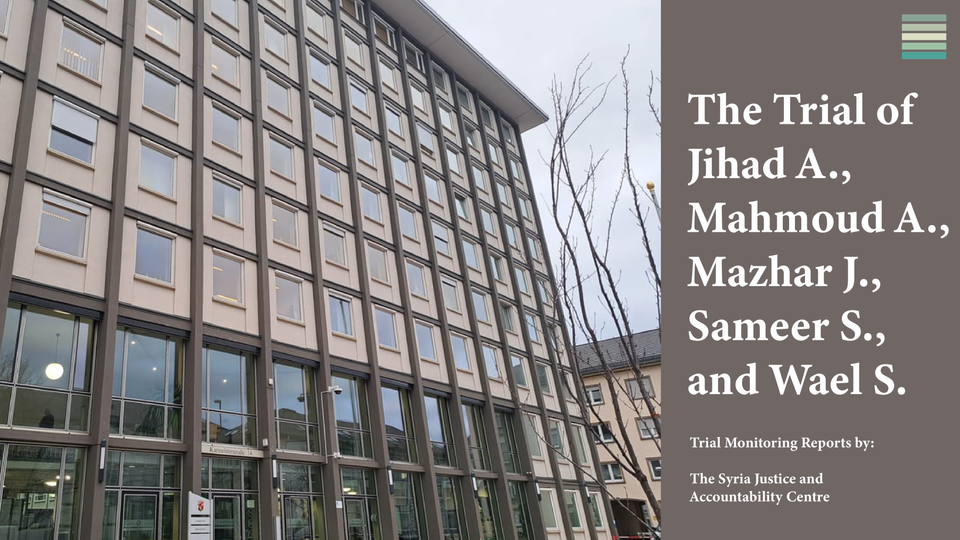
Higher Regional Court in Koblenz, Germany
The Center for Victims of Torture (CVT) provided support to SJAC to monitor this trial and prepare the first six monitoring reports. CVT has continued the monitoring of this trial from report seven onwards and has edited them according to its own style guidelines.
CAUTION: Some testimony may include graphic descriptions of torture, rape or other violent acts.
This is an informal summary of the proceedings and not a verbatim transcript. CVT has chosen not to use the names of witnesses or detailed information that could be used to identify them.
Trial Report 13: Summary
This week, plaintiff P1 testified about the events of July 13, 2012, recalling that his son was killed during the demonstration near Palestine roundabout and that, although he did not personally witness other deaths, he understood there had been further casualties and injuries. He also described the funeral circumstances, the checkpoint situation in the camp, and his observations linking individuals associated with the checkpoint to the events of that day. Defense questioning focused on alleged inconsistencies in prior statements, P1’s contacts with other involved persons and lawyers, and the origin of video and photo material later provided to police.
Trial Day 23: April 15, 2026
Today, the court resumed the questioning of plaintiff P1. The first line of questioning revolved around the events on July 13, 2012, when the plaintiff’s son was shot and killed during the demonstration close to Palestine roundabout. P1 elaborated that while he heard that there were other deaths and injuries besides his son’s, he personally did not witness them. Additionally, there were other demonstrations in 2012, not only the one on July 13. The plaintiff did not recall specific dates but recalled that they took place close in time to that demonstration. He explained that directly after the one on July 13 had ended, there was another demonstration to protest the deaths and injuries of multiple young men in the preceding one. The plaintiff also explained that he knew that there must have been more deaths and injuries at the demonstration on July 13 because the hospitals in Yarmouk were over capacity.
P1 was also asked about his son’s funeral after he was killed on July 13. P1 had mentioned during prior questioning that another young man was buried with his son. He could not identify this young man at the time, explaining that the corpses of many young men were brought to the funeral site of the funeral of his son, and P1 was asked if they could be buried together with his son. The unidentified man would have not received an adequate funeral otherwise, which is why P1 agreed to bury the man in the same grave as his son. P1 recalled that the day after the funeral, he met the Syrian woman who was mother of this one unidentified young man. The plaintiff did not recall how the mother of the man had found him at the time. He also mentioned that he met the father of the young man, F49, later in Europe during the preparation for trials at a lawyer’s office. There, the two fathers grieved their murdered sons together.
Questioning then turned to the security situation in the camp. The plaintiff was asked where exactly the checkpoints in Yarmouk were, which he identified as set up on Palestine roundabout, Batikha Square [watermelon square] and al-Zuhour street [unclear location]. He elaborated that the checkpoint in al-Zuhour street appeared towards the end of 2011 and beginning of 2012, at which point it was not clear that the General Command were collaborating with Shabiha. The plaintiff was asked whether he had seen Jihad A. at any of the checkpoints, to which he replied that Jihad A. and his family – as well as the convicted Moafak D. - were often seen at the Palestine checkpoint together. When asked to describe the Palestine checkpoint, P1 explained that it was not an official checkpoint, but more an assembly point for members of the General Command and the affiliated groups. On July 13 specifically, the people who usually stood at the checkpoint at Palestine roundabout had moved into Palestine street due to the demonstration. The plaintiff also identified the geographical locations of these checkpoints, streets, and hospitals on an image taken in birds-eye camera view and shown in court.
P1 then mentioned another detail of the demonstration on July 13. He testified that he had seen Jihad A. on a motor bike in the streets of the camp, speaking to a colleague about how they had only acted the way they had at the demonstration on orders by their bosses. P1 did not go into much detail about this event. The judges proceeded to show him a picture of his son for him to identify. P1 began crying and the judges called for a 20-minute break.
[20-minute break]
After the break, defense counsel began questioning the plaintiff. Defense counsel Leymann recalled the prior questioning, focusing on the plaintiff’s connection to other witnesses of this trial or other people potentially involved. The plaintiff was asked about how he got to a European city to be interviewed by the police multiple times and for multiple trials, to which P1 replied that the lawyer F40 had gotten in touch with him and invited him before the Covid-19 pandemic began. P1 did not remember further details, but explained that a contact he had in this European city had shown him around and explained to him how to get to the police station with the metro. After further questioning, the witness tried to explain how he was contacted by the police and different lawyers and consequently came to testify in this trial and others.
[60-minute break]
After the lunch break, defense counsel Hedrich began questioning the plaintiff, focusing again on the connections between P1 and other people involved in the trial. He then showed a picture of Jihad A., reminding the plaintiff of what he had said in a police interview. The protocol showed that P1 had stated that Jihad A. was part of the Shabiha - a collaborator and a murderer – but without specific mention that the accused was one of the shooters at the demonstration on July 13, 2012. Defense counsel Hedrich asked why P1 did not immediately say this during the police interview. The plaintiff responded that the police had asked a general question, to which he had provided a general answer. Defense counsel Hedrich also asked the plaintiff to clarify details about the incident with the motorcycle and Jihad A. P1 explained that he could not recall an exact time, but that it happened on a particular street and only Jihad A. and one other person, a man in his 20s, were there. Counsel Hedrich asked why P1 did not confront Jihad A. on that night when he allegedly knew that the accused was one of the shooters at the demonstration. The plaintiff replied that he was scared for his life and the lives of his family members.
Defense counsel Fratzky continued questioning the plaintiff. He asked how there could have been only two deaths on July 13, 2012, considering that the witness was alleging a situation of arbitrary shooting into a huge crowd of people. P1 specified that while he only knew two murdered men personally, the killing did not stop there that day. Defense counsel Fratzky proceeded to repeat questions about the connections of P1 to lawyer F40, the police, human rights organizations, and other potentially involved or affected people. The plaintiff was asked how he had encountered the materials he had presented to the police and what exactly the contents were. P1 explained that he had personally begun searching for videos and pictures on the internet after he found out about the prospect of a trial in Germany as well as still having pictures and videos from people living in the camp that he had not deleted.
[20-minute break]
Defense counsel Hedrich, Leymann, and Fratzky continued the questioning of the witness in a joint effort. Upon questioning whether he had been shown the videos that were presented to the police, P1 testified that he had found them himself, they had not been sent to him. Moreover, the plaintiff explained that he began properly researching and getting involved with the police when his family was completely evacuated from Yarmouk, having been fearful of repercussions prior to that. He did not recall exactly when this happened. When asked what was in the videos, P1 said that one can see some of the accused shooting around in Yarmouk and being proud of their role. These videos were not submitted to the judges, however, and must have been used in a separate trial, but the plaintiff did not know where. When asked about his method of research, P1 said that he primarily used the social media accounts of different active groups such as the General Command and the Free Palestine Movement to find material. The aforementioned shooting in the videos was, according to P1, not aimed at training targets, considering the commenting by peers in the background and existing documents from the other perspective from the demonstrations. The plaintiff clarified that he did not have a function or authoritative role on July 13, 2012.
At the end of the trial day, the witness was accused of having taken photos during the trial during his previous testimony, to which his counsel Sonneborn replied that these accusations had long been disproven.
The proceedings were adjourned at 4:40 AM.
The hearing scheduled for April 16, 2026 was cancelled.
The next trial day will be on April 22, 2026, at 10:00 AM.
___________________________
For more information or to provide feedback, please contact SJAC at [email protected] and follow us on Facebook and Twitter. Subscribe to SJAC’s newsletter for updates on our work