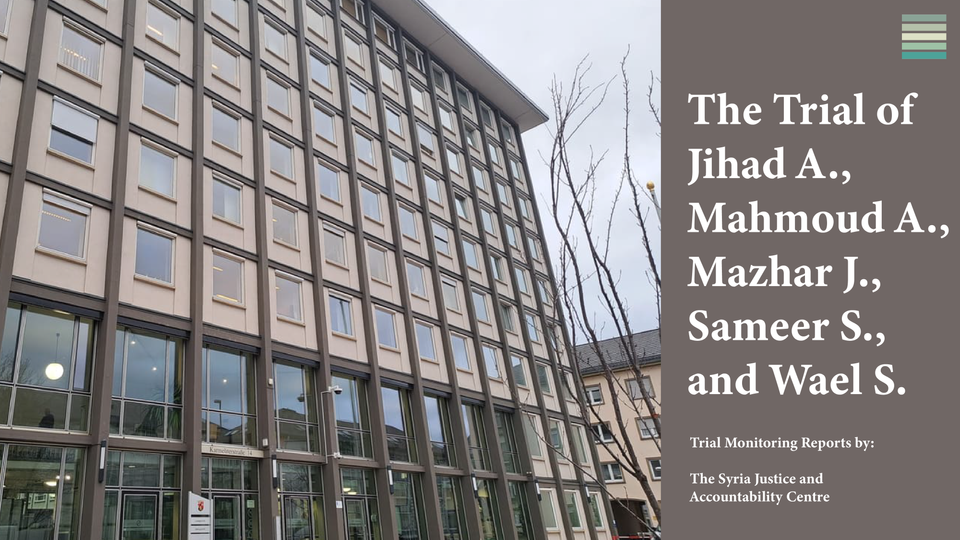
Inside the Al-Yarmouk Trial of Jihad et al. #11
TRIAL OF JIHAD A., MAHMOUD A., MAZHAR J., SAMEER S., AND WAEL S.
Higher Regional Court in Koblenz, Germany
CAUTION: Some testimony may include graphic descriptions of torture, rape or other violent acts.
This is an informal summary of the proceedings and not a verbatim transcript. CVT has chosen not to use the names of witnesses or detailed information that could be used to identify them.
Trial Report 11: Summary
On the first trial day this week, a new witness appeared, W10, who gave a detailed account of his life in Yarmouk between 2012 and 2014, describing detention, torture, starvation, and the constant threat of death under regime-affiliated forces. He also spoke about the violent suppression of demonstrations, and the fate of people close to him, including his friend F39. The hearing ended on a tense note when the witness refused to answer a question out of fear of incriminating himself, with the court deciding to continue the session once he has legal representation.
On the second day this week, the proceedings continued with the testimony of witness W10, addressing the 2012 Al-Yarmouk incidents and the logistical requirements for safe passage from the camp. While the defense emphasized discrepancies in the witness's visual recollection versus chronological recall, the court concluded the hearing by rejecting further motions regarding witness protection and clarifying the new conduct rules for courtroom observers.
Trial Day 19: March 18, 2026
Following the affirmation of the presence of all parties to the proceedings, the presiding judge called a new witness. W10 entered the courtroom and was informed of his rights and duties, before providing his personal information. W10 gave his age and described his current work. He confirmed that he is neither related nor connected by marriage to any of the accused.
Upon questioning by the judge, W10 explained that he was in the camp from 2012 until the end of 2014. As a young man, he had not thought much about politics. However, since he would not tolerate injustice towards himself or others, the witness remarked that he would have preferred to die rather than be enslaved. The judge continued by asking how the witness managed to stay alive and whether he could say anything about the General Command (GC) and the “prison”. W10 replied that in 2011 he had refused to perform military service. The reason was that a friend had previously served in the military and had very bad experiences. The friend’s accounts ultimately led him to decide to refuse military service. The friend had debated and tried to explain to others what criminal acts the regime was committing.
The witness then reported about someone who attacked him and his friend during a funeral procession but noted that he had not seen this person with his own eyes. The friend, F39, was injured and then shot dead.
When the witness said that Jumbas carried out the attack, a discussion unfolded between the accused, Jihad A., and W10. They only stopped after repeated requests. The presiding judge demanded that what was said be translated. The interpreter translated that the accused said, “I leave it to God to ensure justice.” The witness had replied that the accused was a servant of F5. Jihad A. then added that the interpreter had not translated that he had called the witness a pig.
[5-minute break]
Following a short break, the witness reported that he experienced detention in Yarmouk several times. While he was detained, forces attacked his family and his father; his money was also taken. W10 also said that the hostage-taking had been carried out by F5. The interpreter emphasized that the witness pronounced the [first] name of F5 in a way that means “servant of money” instead of “servant of God.”
W10 further recalled that he began turning himself in with his mother as more and more people died. He claimed that he said that the kidnappers should take him instead and release his brother, which was accepted, according to the witness. W10 then described that he and his brother planned for the brother to escape to another region. The witness recalled that he was then detained for 20 days, during which he thought he would die. The unit that imprisoned him was one that aimed to promote reconciliation with the regime. This meant they used torture to force a person to admit to killings or to submit to the regime.
Upon further questioning, the witness explained that he initially stayed in the camp because he was afraid to leave it. A few days later he nevertheless attempted to escape but failed. He agreed with his brother that the brother should escape if the witness did not contact him. Regarding his detention, he added that he remembered being held and tortured on Mistrin Street. He suffered from severe infections and starvation. W10 said that although he was almost dead, the forces of the former president “Bashar” sent the witness to the front for four months because they wanted him to die there for them. During this time, he managed to escape together with his young children.
Next, the presiding judge asked about his experiences in prison, what it looked like and whether there were food and beds. The witness answered that it was not even suitable for animals. The water was turned off for two whole days, and water was taken from flowerpots. The place was underground, and there were many diseases. The sweat of the prisoners covered the floor.
The presiding judge went into more detail and asked which specific people were killed and tortured. The witness replied that it was rather random. They always chose a new person under a new pretext. He once witnessed torture that lasted four months until the person admitted that he killed someone.
The witness recalled that the room size was about 15 m², and there was a toilet directly opposite the entrance door. There were also showers, but they were mainly used for torture as they were not hygienic and most people developed skin diseases afterward. In total there were 75–120 people in the room. They slept on the floor, with one person’s feet next to another’s head. There was also a dull yellow light. At one point, the witness said he had seen his captors. They were F30 and a maternal uncle of someone he knew. They had lived on the street and owned an internet café. W10 further added that he was blindfolded in detention and that almost no one came out of the cell alive. He remembered a man who was dying, still being relentlessly tortured and beaten. In general, the dead were carried out wrapped in a blanket.
W10 also recalled that there was a kind of bed, but it was only for the prison guard. The guard worked for (…) and had injuries himself. He tried to persuade the prisoners to confess so that they might be spared. When the witness was captured, he received a “welcome party,” which meant beatings with sticks and similar objects. He also heard women shouting, “A terrorist kills him.”
The presiding judge then shifted the discussion to the demonstration and asked about the mood in Yarmouk and further details. The witness repeated that F39 had been injured during the funeral procession. W10 had been with him and other friends at the demonstration. At some point, security forces arrived and began shooting. F39 was shot in the head. The witness fled and later received a call saying F39 was now dead. This later turned out to be untrue.
The presiding judge continued asking about the security forces, what they were wearing and how the witness and others fled from them. The soldiers wore military clothing: regular camouflage uniforms. The security forces wore olive-colored clothing. The Shabiha were completely different people. They belonged to the state but were not soldiers. They were criminals who had been recruited - civilians who had weapons and no specific uniform. They wore both military and civilian clothing. The witness reported that the Shabiha were far worse than the security forces.
[15-minute break]
After the break, the witness continued explaining which streets he had fled through during the demonstration and where he had seen security forces. He testified that shooting had already started near the biscuit factory. From that moment until F39 was shot in the head, only a few minutes passed.
After a detailed explanation using a map of where he ran and where everything happened, he added that he saw no vehicles and that the entire Palestine roundabout was empty. He also mentioned people who protected the demonstrators. The presiding judge asked for more details. The witness explained that some people at the demonstration had weapons intended to scare government forces so they would keep their distance.
[60-minute break]
Following a lunch break, the presiding judge asked whether the witness had seen an ambulance in Yarmouk and whether he knew W5. He answered that he did not know him, but he could imagine that ambulances were at the Palestine hospital.
When asked whether he had seen F39 again, he said he only saw him about a week later because F39 had gone to the hospital for treatment of his injury. After he was discharged, he was paralyzed and could no longer speak. W10 described F39 as formerly athletic and active, now unable to recognize him and only crying in his surroundings.
Later, he was asked whether he knew the family S. [family of the accused Wael S. and Sameer S.] and a brother, F21. He had already met Jumbas [Jihad A.] in Syria. Wael S. had a shop, and the brother, F21, owned a shop where he bred pigeons. However, he had never seen Wael in the shop himself. Brother F21 was known and had a bad reputation. He was a drug dealer and had a weapon. The witness added that the brother had once done him a favor and said to an accused: “I wish you were half as just as I am.” Regarding Wael S., W10 added that he suffered an injury shortly after or before the bombing in Yarmouk in May 2012.
The judges, prosecution and plaintiff counsel had no further questions, so the defense counsel questioned the witness. Counsel Hedrich noted that he had problems with the timeline. He asked the witness again when exactly he had met Jumbas. The witness answered: around early 2014, when he got out, he had met the accused, Jihad A. It was in summer (June–July), roughly at the time when the accused was granted amnesty and then went to the military.
The defense counsel added that the accused had stated that he had been outside of Syria at that time and had applied for asylum in Europe. The witness said he could remember the time exactly because it coincided with a major event in his life, and he provided a precise date in 2014.
Hedrich then asked when the witness had fled the camp and when he had been in Syria. W10 recalled that he fled the camp in early 2014 and Syria at the end of 2015.
Then a photograph of the accused, Jumbas, was shown. The counsel referred to a previous interview, where the witness was asked “What information can you provide about Jumbas?” W10 had stated that he had heard of Jumbas but nothing specific and did not know him personally. He was known in the camp and had a bad reputation. He did not know whether he belonged to the General Command.
At one point, following a question by one of the defense counsel, the interpreter explained that interviews, court proceedings, and police questioning are all referred to as “court proceedings” in Arabic, which can be somewhat confusing in the German context.
When shown the picture of the accused during the prior questioning, the witness had said, “I don’t recognize anyone.” The witness explained that this was because his memories came back gradually and he later informed himself more about who was who. At the time of the questioning, he did not know, but he began to take an interest because he wanted to know his “opponent.” When asked why he referred to the accused as an opponent, he said that he had killed many children and was partly responsible for deaths by starvation.
Next, defense counsel Fratzky began his line of questioning on behalf of Mazhar J. He recalled that the witness stated that during his escape at the demonstration, he claimed that the “SFA” had come from a certain direction. The counsel wanted to know how W10 knew that it had been the “SFA”. W10 replied that this was normal. He had not gotten the information from anyone else, but from himself, since it could not have been the regime. The regime would not kill anyone from its own ranks.
Following this, the defense counsel inquired whether the witness knew if Hamas had played a role. W10 answered that there had been individual members of a certain group with connections to Hamas.
Subsequently, the witness was asked to identify several individuals:
1. F41: Does not know him personally, has not written to him or had similar contact. Cannot remember.
2. P1: He had heard of the family, but does not know him personally.
The witness then admitted that he also obtained some information from TikTok after his memories returned.
3. F42: Knows him from TikTok. He first knew him from the internet and spoke with him about Shabihas. He recalled that, for instance, there were Shabihas who allegedly handed his father over to the regime.
4. F28 [brother of the accused, Mazhar J.]: Does not know him.
In the meantime, the witness was asked how he had become a witness. W10 replied that he does not know exactly. He was contacted one day. He assumed that another witness may have mentioned him. Asked whether he had previously communicated with other witnesses, W10 denied having done so.
5. F43: A relative; a military leader on the side of the SFA. He is not closely related to him. He is not his brother, nor his uncle, just a relative from his extended family.
6. F44: He knew that he was a lawyer. He saw him on social media after the fall of the regime but did not contact him.
7. F45: First, at the General Command, then split off and went to the SFA, and then to the regime; within about four months.
At the end of asking the witness about these individuals, he was asked whether he had to hand over a weapon when leaving the camp. The witness refused to answer the question, noting that he is afraid that his “opponents” want to set a trap for him and that he could incriminate himself as a result. The hearing was then adjourned for the day.
The proceedings were adjourned at 3:50 PM.
The next trial day will be on March 19, 2026, at 9:00 AM.
Trial Day 20: March 19, 2026
The proceedings resumed with the presiding judge Dr. Kerber verifying the presence of all parties, including the newly appointed witness counsel, F46. The witness, W10, was reminded of his duty to provide truthful testimony and his right to refuse testimony where there is a risk of self-incrimination under Section 55 of the German Code of Criminal Procedure (GCCP). Following his previous refusal to testify, the witness was warned about the legal consequences of perjury. Consequently, the witness corrected his prior statements, admitting that he had surrendered a Polish-manufactured firearm to regime forces upon exiting the Al-Yarmouk camp. He emphasized that the weapon had been purchased solely for the protection of his family and that surrendering it was a mandatory condition for safe passage.
[10-minute break]
During the subsequent questioning of the witness by the defense, the witness's cognitive recall was addressed. It was noted that while the witness reported significant memory lapses regarding chronological dates and specific timeframes, he maintained a high degree of visual recollection concerning certain events and individuals. The witness explained that his recognition of the accused was based on video footage he had viewed on social media rather than immediate personal experience at the time. He attributed the discrepancies in his chronological memory to "unnatural experiences" and psychological trauma suffered during his detention.
Regarding the events of July 13, 2012, the witness provided an account of the fatal shooting of his friend F39 on Al-Quds Street, noting that the gunmen approached from the Palestine roundabout in camouflage or olive-colored attire. A motion filed by Dr. Baumgart requesting the witness to produce a hand-drawn map indicating the shooters' positions was denied by the court. The presiding judge ruled that the relevant locations had already been identified using a laser pointer during the previous session and that a repetitive evidentiary demonstration was prohibited under procedural rules.
[13-minute break]
After the witness was dismissed at 11:20 AM, defense counsel for Sameer S. and Wael S. issued formal statements regarding the outcome of the testimony according to Section 257 of the GCCP. They argued that the evidence was exculpatory, primarily because the witness failed to identify the accused as the shooters and instead attributed the gunfire to regular military units rather than the Shabiha militia. Furthermore, the defense emphasized that the witness, a direct neighbor, explicitly said he had never seen Wael S. in possession of a firearm. The defense concluded that the described chaos involving masked individuals supported a lack of coordinated involvement by the accused, noting that the allegations seemed to stem solely from familial ties to F21 rather than evidence of actual criminal acts.
The session concluded with the reading of two judicial orders by the presiding judge. First, the court strictly prohibited the use of electronic devices by third parties in the courtroom effective March 3, 2026. The court justified this by citing the "press-like conduct" of SJAC, which interfered with the orderly conduct of the proceedings. [For the allegation raised against SJAC, please see Trial Report 10.]
Second, the court denied a motion by Dr. Baumgart regarding the protection of witness W5. The court saw no need for further inquiry into the circumstances of the witness protection measures, as the safety of the witness, who testified under police protection, took precedence and his status in the witness protection program was sufficiently established.
The proceedings were adjourned at 11:35 AM.
The next trial day will be on March 25, 2026, at 10:00 AM.
___________________________
For more information or to provide feedback, please contact SJAC at [email protected] and follow us on Facebook and Twitter. Subscribe to SJAC’s newsletter for updates on our work