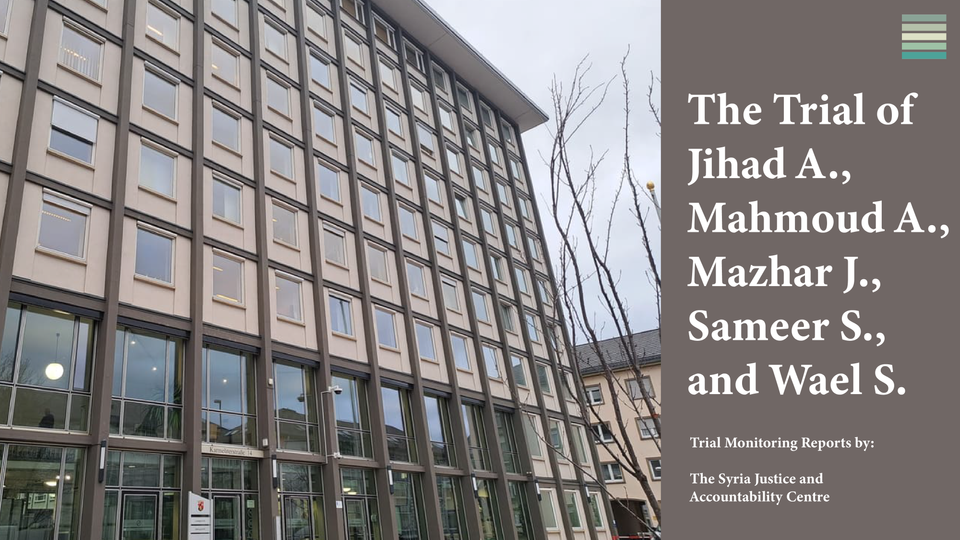
Inside the Al-Yarmouk Trial of Jihad et al. #10
TRIAL OF JIHAD A., MAHMOUD A., MAZHAR J., SAMEER S., AND WAEL S.
Higher Regional Court in Koblenz, Germany
CAUTION: Some testimony may include graphic descriptions of torture, rape or other violent acts.
This is an informal summary of the proceedings and not a verbatim transcript. CVT has chosen not to use the names of witnesses or detailed information that could be used to identify them.
For Trial Reports 1-6, please see the website of the Syria Justice and Accountability Centre (SJAC).
Trial Report 10: Summary
On the first hearing day, plaintiff P1 testified before the court. P1 identified several individuals and gave detailed information on the July 2012 demonstration and the fatal shooting of his son. He described armed actors opening fire on protesters, the immediate recovery of victims, and subsequent pressure on families to sign false death statements. P1 also referred to threats against him and maintained that multiple individuals were armed and involved in the shooting.
On the second hearing day, P1 clarified key locations in the camp and expanded on the shooting, testifying that gunfire began shortly after the demonstration started, caused panic, and led to multiple deaths. He also described threats and intimidation following the incident, recounted the pressure on him to agree to a false account of his son’s death, and provided further details on the role of armed groups, coercion, looting, and violence in the camp.
Trial Day 17: March 4, 2026
Today, the court heard from plaintiff P1. Before P1 entered the court, plaintiff counsel Sonneborn sought permission for the representative of the psycho-social support to join the plaintiff and sit next to him during his testimony. The judge approved and Dr. F34 entered the courtroom.
[Note: Until today, SJAC’s monitors had been permitted to bring digital devices to take notes during the hearings. On this trial day, the monitor was prohibited from entering the courtroom with digital tools.]
The court then briefly discussed that, as of March 3, 2026, SJAC’s monitors are no longer permitted to bring laptops and smartphones into the courtroom. The presiding judge noted that she suspected that audio-recordings were made during the hearings because the published trial reports on SJAC’s website were detailed to a degree that does not seem documentable by hand. She added that this endangers witnesses’ security. She explicitly stressed that she had no evidence to prove this, but said it was simply an assumption. [note: SJAC was neither informed of the revocation of the permission to bring digital devices in advance nor given the opportunity to comment on the allegations made. SJAC thus sent a statement to the court via email and firmly rejected the accusation that the monitors made audio recordings of the proceedings, stressing that all trial reports, even those based on hand-written notes only, were as detailed as the reports in the present case. It further highlighted that the highly speculative assumptions, accusing the monitors of unlawful behavior in court and leading to the revocation of the permit, appeared to be unfounded and insufficiently substantiated. SJAC did not receive a response.] [Further note: the Center for Victims of Torture (CVT) supported SJAC’s trial monitoring in this case up until and beyond this trial day, and continued to work directly with the same monitoring team after SJAC decided to refocus its efforts on domestic accountability in Syria.]
The court then started its questioning of P1, an older man. P1 was informed about his rights and duties, and then shown several photographs of different men. He identified Mahmoud A. as “Jumbas” in one of the photos. He also identified Jihad A. as well as another person as Abu (Mazher J.) of the family J.
P1 then identified the accused in the courtroom. When he recognized Mahmoud A., A. claimed that he was seeing P1 for the first time in his life. P1 became emotional. Mahmoud A. then mumbled: “He is lying.” The Judges requested Mahmoud A. to remain silent and reassured the plaintiff that he may take a break whenever needed. P1 then explained that Wael S. had a beard back when he knew him. P1 added that Wael S. and he had lived in the same area in Europe when he first arrived. P1 then explained to the judges that Wael S. moved at one point, and P1 speculated that he did so because he was afraid of P1. P1 then also identified the other Accused, namely Sameer S., Abu Sacher (Mazhar J.) and “Jumbas” (Jihad A.).
Upon further questioning, P1 testified that he had not really known Mahmoud A. before the “massacre.” He recalled the day after the demonstration on Friday, July 13, 2012 when Mahmoud A., together with several others, had come to his house to threaten him. P1 testified that he was asked to sign his son’s death notice at the police station to confirm a natural cause of death, namely a sickness, instead of the actions of the armed forces.
P1 also explained to the court that the family name S. was widely known in the camp [referring to the family name of Wael S. and Sameer S.].
Upon questioning, the plaintiff recounted that Mazhar J. had been working at court and was known for having ties with the security apparatus and “never made a secret of” it. Mazhar’s house had not been far from his own. Mazhar J. had also bought goods from P1 as he was a merchant. P1 recalled that Mazhar J.’s house was an “Arabic house” close to the Palestine roundabout and in a certain district.
P1 further testified that Jihad A. had lived in the same area as him and had made a living by selling cigarettes, “certain pills” and “smuggled goods.” P1 recalled that Jihad A. had a bad reputation.
Upon further questioning, the plaintiff stated his birthplace in Syria and said that his parents had moved to the camp when it had first been constructed. He described where he went to primary and secondary school. He described his studies following secondary school. He gave his street address and said that he spent most of his life in Al Yarmouk.
P1 also testified about the year that he left the camp, when he felt that his life was in danger because every family who had lost relatives at demonstrations was on the armed forces’ radar.
When asked about the death of his son, P1 expressed how hard it was talking about it, yet still wanted to testify about it in order to seek justice. He did not know where exactly the demonstration had started. He recalled that he and his son had left the house like many others to join in. Most of the protesters were young, and families had walked on the left and right side of the main masses, he remembered. When P1 joined the demonstration, he had never imagined it would turn bloody, he added.
One of the chants the protestors sang was: “One, one, one: Palestinians and Syrians are one.” P1 recalled that there was another calling against Ahmad Jibril [leader of General Command (GC)], who had sent young persons to the Syrian-Israeli border. They had been manipulated to cross it on March 15, 2011—Nakba day. P1 recalled that 25 persons had died during this action. People in the camp then understood that the GC was “playing with the blood of young people” and that the Palestinian cause had been just a pretense. The demonstration had been called “demonstration of the returned” and had been organized by the “Axis of Resistance.”
[10-minute break]
Upon return from a short break, P1 continued his testimony. He estimated that he had walked with his son in the first third or quarter of around thousand protesters. In Palestine Street, the protesters found themselves blocked by the Shabiha and security forces. They were near the mosque, with Al-Tadamon district on the right-hand side and the camp at the left side. The Shabiha present were mostly Shabiha members from the camp; they had been known from maintaining the checkpoints, for example the one in School Street. Some of the Shabiha were members of the GC and others were from the People’s Committee, led by F35.
P1 further recounted that people began fleeing into the alleys to the left and right. P1 followed his son instinctively as he ran into a smaller alley. His son had been the first victim of the shootings, after pulling out his camera to film the Shabiha. P1 recalled that even though several bullets were shot his way, he had been hit only once, in the cheek. P1 remembered his son falling onto the sidewalk. As soon as a person had been shot by the Shabiha, he said, the Shabiha would take that person’s body in order to extort relatives into signing a document stating that the cause of death was sickness. P1 explained that this was the reason why people always tried to rescue the body before the Shabiha took them.
P1 continued by adding that a 20-year-old man pulled at the body of his son but was shot in the stomach and fell in the middle of the street. P1 recalled placing his son’s head into his lap, his hands over his mouth, feeling what was probably his son’s last breath. P1 recalled being in a state of shock and unable to notice who had taken the body after that. He continued to search every hospital for him. As he returned home and he saw the crowd in front of his house, he realized he had lost his son. Young people had brought his body wrapped in a shroud. P1 started to mourn the dead. The plaintiff also remembered that the pharmacist across the street had also lost her son, F36, whose face had been completely disfigured. P1 explained that it was custom to post photos of disfigured victims on Facebook, but F36 was not classified fast enough and had been buried in Yalda.
P1 testified that he wanted to bury his son in a grave. In order to remain unnoticed, he held the death prayer on the street before the crowd instead of in a mosque. The 20-year-old man who had tried to reach for his son was also in a shroud. P1 buried both of them in one grave as he did not know the family of the other victim.
The court then asked P1 to go back to talk about the demonstration. P1 detailed that the Shabiha members had not worn uniforms, but a munition vest in black or olive, and that they carried a Kalashnikov or a “Polish rifle.” He also remembered that they had been unmasked, describing them as audacious.
P1 recalled that Shabiha members who were present included F37, Moafak D., and in total about a dozen other persons. P1 added that there were some motorbikes close to them. The court repeated the question of who was present, but P1 did not clearly reply. After several attempts, he listed the names and told the court that Mazhar J., “Jumbas”, Jihad A., Mahmoud A. and the four members of family S. (F21, F19, Sameer, and Wael) were present; some of them had guarded the checkpoint.
Upon further inquiry, the plaintiff testified that the Shahiba did not stay together but moved separately. P1 gestured in the air, explaining that Jihad A. normally had two guns. Jihad A. grinned and repeatedly looked towards the courtroom audience. P1 added that, during the demonstration, Jihad A. probably had only one weapon and maybe another one on his motorbike. P1 then described the accused, wearing vests and rifles. Sameer S. did not wear as clothing as light as the other members, he recalled.
[90-minute break]
Following the lunch break, P1 continued his testimony. He confirmed that all members had fired shots. At first, they shot in the air, but later in the direction of the protesters, while insulting them. During the police interview, P1 stated that Mahmoud A. had been especially vicious, which he confirmed in-court, clarifying that he referred to Mahmoud A.’s manner of insulting protesters.
During the testimony, the screens in the courtroom started flickering and then turned off completely. After a repair attempt failed, the judge adjourned the hearing, noting that the testimony would continue the following day.
The proceedings were adjourned at 3:12 PM
The next trial day will be on March 5, 2026, at 10 AM.
Trial Day 18: March 5, 2026
The second day of the week continued with testimony from the plaintiff, P1, begun the day before. The court asked P1 to draw on a map of Yarmouk camp. He located Al Quds Street, the Palestine mosque, his house as well as the place where the demonstrators and the members of the Shabiha had stood.
In tears, P1 then recalled how 15 minutes after the beginning of the demonstration the members of the Shabiha fired shots - to the surprise of the demonstrators. P1 recalled that the demonstrators fled in all directions. His son wanted to film the gunshots when he was hit by a bullet beneath his eye on Palestine Street. Another young man wanted to help his son but he was shot as well. Afterwards, his son was taken away and P1 began searching for him. On Al Bashir Street, P1 saw a corpse and recognized his son. Out of fear of the Shabiha, his son was buried shortly after the incident on a property belonging to the family. After the killing of his son, P1 collected videos of the shootings from social media from the day his son was killed. He showed these videos to the police when he filed the complaint against the accused.
The plaintiff then remembered how directly after the killing of his son, several men, including Moafak D., F38, and Wael S. came to see him and threatened him. According to P1, they wanted to force him into declaring that his son had died due to health problems. They also threatened him that should he refuse, they would kill another son of his. The presiding judge asked P1 what he knew about F4, who was shot at the demonstration as well. The plaintiff recalled that prior to the demonstration and the shooting of F4, there had been an incident which took place in front of P1’s house. The plaintiff and other inhabitants of the Yarmouk camp - amongst them F4 - saw how the Syrian Intelligence Service arrived in vans and under the false pretext of conducting a search, but they wanted to hide weapons in one of the houses. As the Syrian Intelligence Service was discovered by the members of the Yarmouk camp, they did not complete their mission. P1 recalled that F4 was one Syrian who filmed this incident and posted the video online. On the same day, F4 received threats and P1 testified that he was convinced that he was shot precisely because of the fact that he had both filmed and posted that incident.
Upon further questioning, the plaintiff testified about first seeing Wael S. at a grocery store in Europe. Shocked by the sight of Wael S., he was not able to confront him but shot fierce looks at him. P1 had to laugh when he was asked whether it was true that Wael S. and his wife had been invited to his other son’s wedding as Wael S. had claimed. In disbelief, P1 clarified that he could never invite the murderer of his son.
The plaintiff was further asked what he knew about the Free Palestine Movement (FPM). P1 said that he thinks it was founded in 2003 as an unarmed group. He added that it was funded by Iran and that it lacked meaning in the Palestinian scene. Later, according to P1, it had been transformed into a Shabiha by a supporter of the Assad regime. The plaintiff recalled that its military wing had been founded in 2012/13 by F5. Furthermore, P1 remembered that the FPM tried gaining new members by promising them both money and military documents. P1 explained that he could distinguish the FPM from the General Command (GC) by the leader of the FPM, F5. On the contrary, Ahmad Jibril was the leader of the GC in Yarmouk. According to the plaintiff, the accused were part of the so-called People’s Committee which was founded in 2011 as a part of the FPM. Further, P1 mentioned that Mazhar J. had a special position: relatives of prisoners regularly contacted Mazhar J. in the hope that their relatives would be shown mercy. P1 said that it sufficed for a person to be an “Arafati”—a person in sympathy with Yasser Arafat, who had made accords with Israel—to be imprisoned by the Syrian Intelligence Service.
Upon questioning by the court, P1 said that at his hearing concerning Moafak D., he had not recalled the details of the shooting at length because he was told that he should focus on telling what he knew about Moafak D. Moreover, the plaintiff explained that the general strike took place as a form of protest after the demonstration. Shop owners had closed their shops, but the GC forcibly opened them and stole their contents. Afterwards, the shop owners were forced to come back to their shops to prevent further theft. The presiding judge then asked P1 what he knew about a missile attack on Ramadan on August 12. The plaintiff remembered that people were shopping when the missile landed and that additional shots had been fired at people who wanted to help the wounded. The plaintiff witnessed how the wounded were transported in private cars.
[75-minute break]
After the break, Prosecutor Graetsch asked the plaintiff several questions. P1 testified that several of the accused tried contacting him after his arrival in Germany. According to P1, Jihad A. tried washing his hands in innocence and had contacted P1 via messenger. Jihad A. claimed that a report of Al Jazeera had mistakenly placed him in a wrong light. Both his father and brother as well as friends of Jihad A. tried contacting the plaintiff as soon as the court proceedings started, but the witness had refused any contact. P1 testified that, at the beginning of the Covid pandemic, he was told by a friend of Sameer S. that the latter had only worn a weapon because his wife had been threatened. Furthermore, P1 recalled that he had repeatedly been under attack on social media where he was presented with various insults such as “bastard” or “in the name of God, the price will be high,” meaning he will die.
Subsequently, defense counsel Dr. Baumgart questioned P1. The plaintiff testified that he had not received any help from the organization of Al Bunni, but that the latter had served as a mere catalyst for filing the complaints against the accused. P1 further told the court what he knew about the Shabiha. He qualified them as a gang of mercenaries, drug dealers, and criminals. Defense counsel Dr. Baumgart repeatedly asked P1 why, in the proceedings against Moafak D., he had not provided more information about the accused of the present case. P1 answered that he had focused on Moafak D.
During the questioning, counsel Baumgart was repeatedly reprimanded either by the presiding judge, other defense counsel, or the prosecutor for posing misleading and inadmissible questions. At one point, the interpreter informed the court that Mahmoud A. had whispered in Arabic that “only God may be the right judge” while P1 was speaking.
Upon further inquiry, P1 confirmed that the family name of Wael S. and Sameer S. had been known in Yarmouk. According to P1, it was a normal Palestinian family but that it had criminals and drug addicts among them. P1 added that he did not know the family well but that they were no strangers to him. The plaintiff also recalled that one member of the family of Wael S. and Sameer S. laughed every time they had shot someone. Further, the plaintiff said that people informed each other of information about criminals within the Yarmouk camp and clarified that this was the way he had also received information.
At the end of the session, P1 was dismissed and re-summoned for the hearings on April 15 and 16, 2026 to resume the questioning.
The proceedings were adjourned at 4:31 PM.
The next trial day will be on March 18, 2026, at 10 AM.
___________________________
For more information or to provide feedback, please contact SJAC at [email protected] and follow us on Facebook and Twitter. Subscribe to SJAC’s newsletter for updates on our work