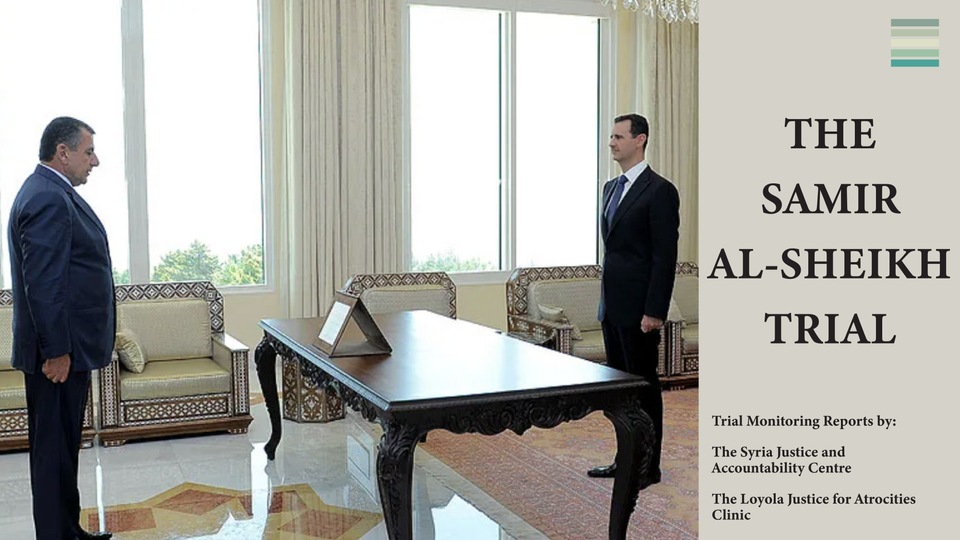
Inside the Al Sheikh Trial #8: Week Three – Closing Arguments and the Verdict
TRIAL OF UNITED STATES V. ALSHEIKH
United States District Court for the Central District of California – Los Angeles, USA
Trial Monitoring Summary #8
Trial Date: March 16, 2026
CAUTION: Some testimony may include graphic descriptions of torture, rape or other violent acts.
Note that this summary is not a verbatim transcript of the trial; it is merely an unofficial summary of the proceedings.
Throughout this summary, [information located in brackets are notes from our trial monitor] and “information placed in quotes are statements made by the witness, judges or counsel.” The names and identifying information of witnesses have been redacted.
[Note: SJAC provides a summary of the proceedings while redacting certain details to protect witness privacy and to preserve the integrity of the trial.]
Trial Monitoring reports of the Samir Al Sheikh trial are a result of a partnership between the Syria Justice and Accountability Centre (SJAC) and the Loyola Justice for Atrocities Clinic (LJAC) at LMU Loyola Law School (Los Angeles). Apart from trial monitoring, SJAC also supports authorities seeking to prosecute atrocity crimes committed in Syria by conducting investigative work and connecting witnesses with prosecutors (“case building”). SJAC's trial monitoring team does not share information with SJAC's case building team. Therefore, the latter only has access to the published reports available to the general public.
SJAC’s 8th trial monitoring report details the third week of the trial of Samir Al Sheikh in Los Angeles, USA. On the ninth trial day, the Prosecution and the Defense both presented closing arguments, and the Prosecution gave its rebuttal closing. The Court then instructed the 12-member jury as to the law and the jury began its deliberations. After a little over two hours of deliberation, the jury returned a unanimous verdict of guilty on all counts.
Day 9 – March 16, 2026
The trial day began at 8:47 am.
Outside the presence of the jury, the Defense moved for a mistrial with prejudice. The Defense argued that the Prosecution’s cross-examination of Defense’s expert witness H., during which the Prosecution read excerpts from French and Dutch court decisions in two separate Syrian asylum cases unrelated to this case, impermissibly substituted judicial opinions for jury fact-finding here. The Prosecution countered by pointing out the rules of evidence permitted attorneys to probe experts for their opinions, and that it was proper to ask H. whether she had seen the decisions. The Defense maintained that the Prosecution’s questioning left the jury with the impression that the issue they were meant to decide—whether the Defendant was guilty of torture while head of Adra Prison—had already been decided by other courts, applying a different burden of proof and relating to a different time period. The Defense argued that when the Prosecution read excerpts from the other decisions during questioning, it introduced inadmissible hearsay, even though the Prosecution stated at the time that the foreign case decisions were not evidence.
The Court noted its intention to issue a curative instruction, but Defense Counsel claimed that the instruction was insufficient. The Prosecution argued the Defense was grossly exaggerating the possibility of substituting judgment and noted it was, at most, five pages of testimony over seven days of testimony [note: Though the cross-examination in question occurred on the seventh day of testimony, it was the eighth day of trial, including jury selection.]. The Prosecution then argued they were allowed to impeach an expert witness on her lack of knowledge regarding public information. In the end, the Court denied the motion for a mistrial, decided to issue a curative instruction regarding H.’s lack of knowledge of the European asylum cases, and decided, at Defense Counsel’s request and with no objection from the Prosecution, to strike that portion of the Prosecution’s cross-examination questions and H.’s testimony regarding the two foreign judicial decisions.
Additionally, Judge Vera noted a few additional changes in wording to the jury instructions. The Defense requested that the final witness list be unsealed and confirmed which witness list was correct.
The jury entered into a full courtroom at 9:07 am. Several members of the Defendant’s family were present, as well as multiple U.S. government employees related to the Prosecution team, NGO and other observers, and what appeared to be members of the local Syrian community.
The Court issued a curative instruction regarding H.’s cross-examination. The Court told the jurors that foreign judicial opinions are not evidence, and the jurors must not give any weight to those conclusions, and told them the relevant portions of testimony had been stricken from the record.
Then, the Prosecution began their closing statement: Joshua Mausner presented the closing argument. The Prosecution started by emphasizing that the Defendant spent his long career working loyally for the Assad regime. The Prosecution outlined the ways the Defendant worked for the regime and referred to the Defendant as “the man” of the regime when it came to cracking down on dissidents. The Prosecution stated, “you should not find [the Defendant] guilty of being a member of the regime, you should find [the Defendant] guilty of being the man of the regime” and the member of the Assad regime who committed torture at Adra.
The Prosecution thanked the jury and said they appreciated their effort and attention.
The Prosecution stated it would then provide a “roadmap” to the evidence. The Prosecution discussed the ways in which Bashar al-Assad worked to crush dissent while still trying to maintain an image of fairness. For this reason, the Prosecution argued, political prisoners were sent to civil prisons, as the jury heard from their expert Dr. Leenders. The Prosecution then named some of the political prisoners housed at Adra.
The Prosecution argued the Defendant kept a close watch on the prison, using large video screens in his office to monitor the prison and performing inspections with his “underlings.” The Prosecution referenced some of the Defense witnesses’ testimony about prison inspection processes and pointed out the Defendant gave thousands of orders, including where prisoners were housed, what punishment they received, and what assignments they got within the prison. The Prosecution argued the Defendant specifically focused his attention on the political prisoners and tried to silence them.
The Prosecution discussed K.A.M., the Prosecution’s first witness. The Prosecution reminded the jury K.A.M. testified that the Defendant deputized him, the Defendant ordered him to be the head of the hospital wing, and the Defendant had photographs in his office of the Defendant’s family and the Assad family together. The Prosecution recapped K.A.M.’s testimony regarding his mistreatment at Adra, where he was held in a small, cold, dark isolation cell. K.A.M. testified he could hear the screams of other prisoners, and the Defendant personally pushed him into the magic carpet device while cursing at him.
The Prosecution went on to talk about Prosecution witness M.S. The Prosecution argued the jury heard from M.S. about the “consequences of refusing the Ameed.” [Note: “Ameed” was a title often used to refer to the Defendant.] The Prosecution quoted M.S. when describing the mistreatment he received at Adra saying, “[he] didn’t feel anything, [he] just wanted to die.” The Prosecution briefly went through M.S.’s continued medical issues as a result of the mistreatment he suffered.
The Prosecution then discussed Prosecution witness N.S. The Prosecution referenced N.S.’s testimony about guards needing to check with “Ameed” about what to do next. The Prosecution referenced N.S.’s testimony when he stated he thought he was going to die in Adra and referenced N.S.’s medical records. They told the jury to read for themselves what N.S. reported to doctors in 2011 about his time at Adra.
The Prosecution briefly talked about Assad personally calling the Defendant out of retirement to appoint him governor of Deir- z-Zor and linked it back to his work at Adra. The Prosecution also reviewed the Defendant’s immigration documents and emphasized that someone who had done what the Defendant was charged with would never have received a green card [i.e. a lawful permanent resident status] had he been truthful on his immigration forms.
The Prosecution then reviewed the elements of the charges beginning with Count 1, conspiracy to commit torture. The Prosecution told the jury that conspiracy was essentially an agreement between people, and that the Defendant’s co-conspirators included Syrian government officials, the Defendant’s three prison deputies, and other prison officials and guards. The Prosecution argued the Defendant knew that, on his orders, prisoners would be tortured. The Prosecution argued Defendant sometimes personally participated in torture and was a knowing participant and leader of the conspiracy and, as such, the elements for conspiracy to commit torture were fulfilled. Thus, the jury should find him guilty on that charge.
The Prosecution then reviewed the elements of torture relating to Counts 2-4. The Prosecution used a PowerPoint visual aid to show the jury each element of the charge. The Prosecution told the jury that the torture of K.A.M., M.S., and N.S. was incident to lawful sanctions in that it was illegal in Syrian law. the Defendant committed acts specifically to inflict severe physical or mental pain or suffering, did so under color of law by using or misusing the authority he possessed as head of Adra Prison, and acted against a person who was within his custody or physical control. Additionally, as required by the statute under which the Defendant was charged, the torture occurred outside the United States. The Prosecution pointed out that, with respect to Counts 3 and 4, the Defendant’s physical presence was not necessary; aiding and abetting torture or willfully causing torture to occur was equivalent to actually committing torture under the law.
The Prosecution then reviewed the elements relating to Count 5, fraud in the possession or use of a permanent resident card [green card], and Count 6, attempted naturalization fraud, which were both covered extensively through witness testimony. The Prosecution described each of the 12 false statements on the Defendant’s citizenship application alleged in the First Superseding Indictment and told the jury that a “material” statement was one which, had the Defendant answered it truthfully, would have either caused his application to be denied or triggered further investigation. The Prosecution told the jury they had to agree on at least one materially false statement.
The Prosecution asserted that it was not the entire Assad regime that was on trial, only the Defendant and his conduct at Adra. The Prosecution concluded by telling the jury that the only verdict consistent with all the evidence presented was to find the Defendant guilty on all counts.
***
[16-minute-break]
The Defense began their closing statement by thanking the jury on behalf of the Defendant, his family, his colleagues, and herself. Lead Defense Counsel Nina Marino presented the closing argument. The Defense called the members of the jury “exemplary jurors” and wanted them to get to the right decision. The Defense said the jurors heard two wholly different versions of what happened at Adra Prison twenty years ago in Syria, and that if the jurors believed both versions, reasonable doubt existed.
The Defense described the imprisonment of political prisoners at Adra, saying that the signatories of the Damascus Declaration were sentenced in open court to go to Adra. As such, Adra was closely watched by human rights organizations across the world, which were in constant contact with prisoners and their families.
The Defense asked the jury if, based on the scrutiny the Assad regime was under at the time, it would make sense to secretly torture prisoners at such a closely watched prison. Further, the Defense asked if it made sense that the regime would harm prisoners with the whole world watching.
The Defense said that, if the Prosecution’s narrative was correct and the regime’s “master plan” was to secretly harm only the two political prisoners Mr. al-Labwany and Mr. Al-Homsi and no one else, the Defendant failed at his job. The evidence showed that both Mr. al-Labwany and Mr. Al-Homsi were in touch with the outside world, so why would the Defendant take the risk of harming them when there were plenty of security branch facilities where torture did take place and no one was watching what happened there.
The Defense asked the jury if it would make sense that Michel Kilo would regularly play backgammon with the Defendant while torture was occurring at Adra, or that no one had ever heard of torture at Adra even though in prisons everyone talks, invoking a smirk among on of the jurors. The Defense asked where Mr. al-Labwany and Mr. Al-Homsi were and why they didn’t testify to corroborate the Prosecution witnesses’ testimony.
The Defense quoted her witnesses who said they were not afraid of Wing 13, had never even heard of Wing 13, and that they were not afraid of the Defendant. The Defense asked the jury if it made sense that people who were tortured in security branch prisons would be willing to testify in favor of a man who tortured people at Adra if torture had occurred there.
The Defense said the world was rewriting history and scapegoating the Defendant, who was one of the good guys. The Defense’s voice became soft, starting to become emotional.
Next, the Defense reviewed the Prosecution witness testimony and told the jurors it was up to them to decide the credibility of the witnesses.
The Defense referenced M.S.’s Syrian criminal record history and noted that he could have gotten the convictions expunged but did not, and also had three outstanding wanted notices. She submitted to the jury that the reason some of the charges were dated after M.S. had left Syria was because people had named names after the fact.
The Defense then questioned N.S.’s credibility regarding his criminal history and U.S. immigration records, where he said he had no firearms training or chemical weapons expertise, even though he also testified he had been in the Syrian military and worked for a human rights organization dedicated to banning chemical weapons and working with the victims of chemical weapons attacks. The Defense told the jury N.S. had an active interest in the case, that he had posted on social media about harrowing experiences in other branches of Syrian prisons on Facebook but never his experiences at Adra. She mentioned how he might have been confused on dates during his testimony and had told the U.S. government he wanted monetary compensation for his testimony.
The Defense then referenced K.A.M.’s testimony where he said he was not mistreated at any other prison except at Adra, stating that it was “just not possible.” She said K.A.M. could not possibly have heard screaming in the Defendant’s office from his posting in the hospital wing 200 meters away in a building made of concrete blocks, and argued K.A.M. had a vested interest in seeing the Defendant convicted based on his friendships with political activists al-Labwany and al-Homsi.
The Defense then said all the Prosecution’s witnesses were connected, that there was a “little group and they’re all connected.” She showed the jurors a Venn Diagram graphic on a PowerPoint slide of the perceived overlap between them all, including the Prosecution’s expert witness, Dr. Leenders, with al-Labwany and al-Homsi at the center. The Defense reiterated that the Prosecution witnesses were re-writing history and that it was happening everywhere. She told the jurors similar efforts were ongoing in the United States to erase slavery from school curriculums and paint it as a pleasant experience.
The Defense told the jury that the Prosecution had not established beyond a reasonable doubt that torture occurred at Adra because there was either an environment of secrecy and fear, or it was not, and it was not. If “everybody knew,” then the Damascus 12 would also have known. The Defendant was the scapegoat, “while the true criminals run free.”
The Defense briefly referred to the Prosecution’s questioning of the credibility of the Defense witnesses, reiterating that none of it impacted their core testimony and that they had no reason to lie.
The Defense said there was inconsistency in the Prosecution witnesses’ testimony, and asserted that, in fact, their mistreatment actually happened outside of Adra. She suggested that they were likely mistreated in security branch custody and stated she was sorry about that. The Defense claimed torture only happened at security prisons, not Adra. The Defense argued the Prosecution was complicit in the effort to re-write history, and that explained why they asked improper questions of witness H. the previous trial day.
The Defense then turned to the immigration charges, Counts 5 and 6. She said it was clear the Defendant did not read or speak English and, as such, the immigration charges were unfair. The Defense further argued there was circumstantial evidence to prove his immigration paperwork was submitted by his daughter, and that there was no fraud because it was a true statement that he did not commit torture.
The Defense then brought up the burden of proof in criminal trials: proof beyond a reasonable doubt. The Defense said it was the highest legal standard and said if any of the jurors were conflicted about the evidence, reasonable doubt existed, and they must find the Defendant not guilty.
The Defense showed a series of PowerPoint charts to the jurors comparing the “beyond a reasonable doubt” standard with other, lesser burdens of proof, such as “more likely than not.”
The Defense asked the jury how they could possibly be convinced beyond a reasonable doubt in this case. The Defense told the jury that the Defense witnesses had nothing to gain by testifying and that their words could be relied on to be the truth.
The Defense then said all the events of the case took place under foreign law in Syria twenty years ago. The Defense said only one version of events makes sense and withstood scrutiny, and that was the version in which there was no torture at Adra.
She ended by saying, “I know you will find Mr. Al Sheikh not guilty on all counts.”
The Prosecution then gave its rebuttal closing statement. Patrick Jasperse presented the rebuttal closing argument. The Prosecution asked the jury rhetorically if they believed the Prosecution witnesses and thought they would travel all the way to Los Angeles simply to make things up, or were confused about the “unforgettable” things that had been done to them because of the Defendant. Further, the Prosecution asked the jury why these witnesses would testify against the Defendant if he was not the one who tortured them. He described the fact witnesses as ordinary people and brought up K.A.M.’s positive identification of the Defendant in the courtroom. He asked why three people who did not know each other, all with similar injuries, would fabricate the same story. Mr. al-Labwany and Mr. al-Homsi were not at other prisons; they were at Adra. N.S. was not plotting against the Defendant 15 years ago when he told his doctor the full story of what happened to him at Adra.
The Prosecution called the Syrian legal system corrupt and argued that the Defense witnesses had said the same. The Prosecution further argued it was not them who chose their witnesses, but it was the Defendant who chose those that were tortured.
The Prosecution said the Defense was trying to fool the jurors and persuade them to believe in a vast conspiracy that even included the Prosecution expert, Dr. Leenders, hoping something would stick.
The Prosecution acknowledged that it bore the burden of proof and that the jury was meant to assess witness credibility, and that included the Defense witnesses. The Prosecution emphasized the Defense witnesses were the Defendant’s family friends, political prisoners who did not like to mix with the general prison population, and a husband-and-wife pair. The Prosecution said most of them hardly spent any time at Adra and none ever set foot inside Wing 13.
The Prosecution brought up one of the Defense witness’s testimony about how infrequently he was in Syria. The Prosecution said “he knows everything about Adra while in the U.S.” The Prosecution brought up another Defense witness, who testified he was turned down for a green card in the United States because he had bad moral character, and yet, the Prosecution argued, the Defense was still asking the jury to believe him. The Prosecution reiterated none of the Defense witnesses were in any position to know about torture in Adra, as per their own testimony. Further, he said that the husband and wife were both opposed to the new Syrian government and seemed to have come to testify because they were angry about the United States’ relationship with the new government.
The Prosecution stated the jury should be offended by the Defense asked them to believe the Defense expert, when she did not know the Prosecution evidence and had only interviewed 15-20 prisoners at Adra out of approximately 10,000. The Prosecution also argued it made sense that no prisoners talked about their experiences of torture with other prisoners because Adra was full of guards, cameras, and informants. He also mentioned that one of the Prosecution witnesses testified to people avoiding him after his torture. Additionally, the Prosecution reminded the jury of the “basic shame” of recounting their experiences.
The Prosecution emphasized that the whole point of torturing prisoners at Adra was to add a layer between the Assad regime and the torture, to shield the regime at a time of intense global pressure. If the torture occurred at Adra, it would just look like prisoner-on-prisoner violence, and nobody would be blamed. However, the Prosecution rhetorically asked, if there really was no torture at Adra, why have Wing 13, the solitary confinement cells, the shabeh, and the “” [note: a torture method described as inmates being put into a tire, with their bodies squeezed inside and then beaten]. The Prosecution told the jury that torture was used not only for purposes of extracting confessions and information, but also for humiliation, punishment, and setting an example for others. K.A.M., N.S., and M.S. were not political prisoners but rather ordinary people; on the contrary, the Defense witnesses were political and did have a point of view they wanted to inject into the trial.
The Prosecution argued the Defense blamed others for the Defendant’s immigration fraud. He said they were first trying to blame the United States for allowing the Defendant a visa, and now they were trying to blame his daughter.
Regarding the burden of proof beyond a reasonable doubt, the Prosecution said the Defense was trying to make it seem as though the burden was so high it was impossible to find anyone guilty, but reason and common sense dictated that beyond a reasonable doubt did not mean beyond all possible doubt.
Finally, the Prosecution told the jury that, while there was no justice for the Defendant’s victims in Syria, the Prosecution witnesses had the courage to seek justice for them. He thanked the jury for their service and quoted Dr. Martin Luther King, Jr. that “the arc of the universe is long but it leans towards justice,” noting that the jury had the opportunity to bend that moral arc towards justice. The Prosecution said it was not rewriting history, but seeking accountability. The Defendant had gotten away with what happened in Wing 13 for far too long, that he lied to come to the United States, and that he thought he could get away with it. In closing, the Prosecution said “now you [the jury] have the chance to do something about it. Now it’s your turn to speak. Find him guilty.” The Prosecution ended its rebuttal closing.
Judge Vera then told the jury they would be receiving their jury instructions. Judge Vera reminded the jury that lawyers are not witnesses, and that opening and closing statements were only meant to help interpret the evidence.
Judge Vera then read the jury instructions aloud. [On the previous trial day, the Court heard arguments about several disputed jury instructions. The reading of the jury instructions revealed which positions the Court had taken on those arguments.]
Of note, the Court used the Prosecution’s Proposed Jury Instruction 3 and the Defense’s Proposed Jury Instruction 2 to create Jury Instruction 29. This instruction laid out the elements the Prosecution needed to prove for a guilty verdict on the torture charges. The Court adopted the Prosecution’s definitions of “specific intent” and “severe physical pain or suffering” under the charged statute, but crafted its own definition of “severe mental pain or suffering” and adopted the Defense definition of “under the color of the law.” The Court also included the Defense’s version of the following statement in the instruction: “The term ‘torture’ is reserved for extreme, deliberate and unusually cruel and inhumane practices, and does not include lesser forms of cruel, inhumane or degrading treatment or punishment. The severity of the intended pain and suffering is the distinguishing characteristic of torture under the law.”
On the Prosecution’s Proposed Jury Instruction 4, the Court used only the first sentence to create Jury Instruction 30: “I instruct you that during the time period relevant to the First Superseding Indictment, torture was illegal under Syrian law.”
On the Prosecution’s Proposed Instruction 5, the Court adopted the Defense’s definition of “material” in creating Jury Instruction 34. [The previous trial day, the Court agreed with the Defense regarding unanimity. This meant that in order to be found guilty on Count 6, the jury needed to be unanimous as to at least one of the 12 allegedly false statements. Although this was not specifically noted in the jury instructions, the verdict form the jury received made this clear. On this form, the jury was required to identify which statements they unanimously agreed upon.]
After the reading of the Jury Instructions, Judge Vera informed the jury that if no verdict was reached by 5:00 pm that day, they would be called back for further deliberation the next day at 9:00 am. The bailiff led the jury out of the courtroom and was charged with ensuring the jury remained in the jury room without interference for deliberations.
***
[2.5 hours]
***
[At 3:05 pm, the Prosecution informed the trial monitoring team via email that the jury had reached a verdict. The trial monitoring team reached the courtroom at 3:10 pm. where the Prosecution and court clerks were waiting.] The courtroom gallery remained full, with local journalists, NGO representatives, additional members of the Prosecution team, and several of the Defendant’s family members and friends in attendance. The atmosphere in the courtroom was tense and very quiet. No one was talking or even whispering, with most individuals simply looking down or straight ahead. At 3:40 pm, Defense Counsel arrived in the courtroom. Lead Defense Counsel Nina Marino sat slumped over the counsel table with her head in her hands. Shortly thereafter, the Defendant and Judge Vera entered, followed shortly by the jury.
The jury foreperson handed the completed verdict form to the deputy court clerk. The clerk then read out the charges and findings as follows:
Count 1 – Conspiracy to Commit Torture: Guilty
Count 2 – Torture of K.A.M.: Guilty
Count 3 – Torture of M.S.: Guilty
Count 4 – Torture of N.S.: Guilty
Count 5 – Fraud in the Use of an Immigration Document: Guilty
Count 6 – Attempted Naturalization Fraud: Guilty
On Count 6 of the jury form, the jury was required to mark the false statements they unanimously agreed were made by the Defendant. The clerk read out each of these statements:
Statement 2: In response to the question: “Have you ever been a member of, or in any way associated (either directly or indirectly) with [a]ny … totalitarian party?”, Defendant answered “No.”
Statement 3: In response to the question: “Have you ever persecuted (either directly or indirectly) any person because of race, religion, national origin, membership in a particular social group, or political opinion?”, Defendant answered “No.”
Statement 4: In response to the question: “Were you ever involved in any way with … [t]orture?”, Defendant answered “No.”
Statement 6: In response to the question: “Were you ever involved in any way with … [b]adly hurting, or trying to hurt, a person on purpose?”, Defendant answered “No.”
Statement 7: In response to the question: “Were you ever a member of, or did you ever serve in, help, or otherwise participate in … [a p]olice unit?”, Defendant answered “No.”
Statement 8: In response to the question: “Were you ever a worker, volunteer, or soldier, or did you otherwise ever serve in … [a p]rison or jail?”, Defendant answered “No.”
Statement 9: In response to the question: “Were you ever a worker, volunteer, or soldier, or did you otherwise ever serve in … [a d]etention facility (a place where people are forced to stay)?”, Defendant answered “No.”
Statement 10: In response to the question: “Were you ever a part of any group, or did you ever help any group, unit, or organization that used a weapon against any person, or threated to do so?”, Defendant answered “No.”
Statement 11: In response to the question: “Have you ever given any U.S. Government officials any information or documentation that was false, fraudulent, or misleading?”, Defendant answered “No.”
Statement 12: In response to the question: “Have you ever lied to any U.S. Government officials to gain entry or admission into the United States or to gain immigration benefits while in the United States?”, Defendant answered “No.”
The Defendant was not visibly emotional during the reading of the verdict nor was anyone in the courtroom gallery. Additionally, Defense Counsel remained composed throughout this time.
After reading out these charges and findings, Judge Vera asked if either party wished to poll the jury. Defense Counsel said yes. The clerk then asked each individual juror if this was their verdict. Each juror answered yes.
After this, the Court lifted its order to the jurors when they were first sworn in requiring them not to speak with anyone, including each other, regarding the case and not to review any information about the case except the evidence they received in the trial. However, the Court informed the jurors that they nevertheless each had an expectation of privacy regarding their deliberations. Judge Vera then thanked the jurors and excused them from their service. The jurors were escorted out of the courtroom.
Judge Vera then had a brief exchange with the Defense and the Prosecution about setting a date for the sentencing hearing. The Court asked the parties to meet and confer and submit a proposed scheduling order.
Judge Vera left the bench and proceedings concluded at approximately 4:10 pm.
[Note: As of May 2026, the sentencing announcement is scheduled for September 9, 2026.]
___________________________
For more information or to provide feedback, please contact SJAC at [email protected] and follow us on Facebook and Twitter. Subscribe to SJAC’s newsletter for updates on our work