Inside the Al-Sheikh Trial # 6: Week 1 – Prosecution Presents its Case
TRIAL OF UNITED STATES V. ALSHEIKH
United States District Court for the Central District of California – Los Angeles, USA
Trial Monitoring Summary #6
Trial Dates: March 2-6, 2026
CAUTION: Some testimony may include graphic descriptions of torture, rape or other violent acts.
Note that this summary is not a verbatim transcript of the trial; it is merely an unofficial summary of the proceedings.
Throughout this summary, [information located in brackets are notes from our trial monitor] and “information placed in quotes are statements made by the witness, judges or counsel.” The names and identifying information of witnesses have been redacted.
[Note: SJAC provides a summary of the proceedings while redacting certain details to protect witness privacy and to preserve the integrity of the trial.]
Trial Monitoring reports of the Samir Al Sheikh trial are a result of a partnership between the Syria Justice and Accountability Centre (SJAC) and the Loyola Justice for Atrocities Clinic (LJAC) at LMU Loyola Law School (Los Angeles). Apart from trial monitoring, SJAC also supports authorities seeking to prosecute atrocity crimes committed in Syria by conducting investigative work and connecting witnesses with prosecutors (“case building”). SJAC's trial monitoring team does not share information with SJAC's case building team. Therefore, the latter only has access to the published reports available to the general public.
SJAC’s 6th trial monitoring report details the first week of the trial of Samir AlSheikh in Los Angeles, USA.
On the first trial day, a jury of laypersons was selected. Jury selection took the full day and included an intensive questionnaire that the parties reviewed with each individual juror. By the end of the day, the Court had seated twelve (12) jurors and three (3) alternates.
On the second trial day, Prosecution and the Defense gave their opening statements. Prosecution called their first fact-witness, who testified regarding his time in Adra Prison and his relationship with the Defendant, including the fact that he spent a significant amount of time with the Defendant prior to his mistreatment at Adra prison. He detailed the different methods of mistreatment that were applied to him and testified regarding his subsequent medical history.
On the third trial day, Prosecution’s first fact witness, completed his testimony. Prosecution then called an expert witness who testified as to the history of the Assad regime and the repressive tactics they used to maintain power in Syria, including severe mistreatment in prisons including Adra. Prosecution’s second fact witness testified regarding his time leading Friday prayers at Adra prison and his meetings with Defendant as the prison director. Prosecution’s third fact witness began his testimony about his time as a prisoner at Adra.
On the fourth trial day, Prosecution’s third fact witness testified regarding his time in Adra Prison and the different methods of mistreatment that were applied to him. He then faced cross-examination, which focused on the witness’s criminal record in Syria, his current occupation, and his motive for testifying in the case.
On the fifth trial day, Prosecution’s third fact witness finished his cross-examination. Prosecution called two expert witnesses to testify regarding visa applications and naturalization applications, including going through Defendant’s own application in depth. Prosecution’s fourth fact-witness testified to her years visiting her father at Adra Prison and her direct conversations with Defendant about worsening conditions under his leadership. Prosecution’s fifth fact-witness began his testimony regarding his treatment at Adra Prison, including favors Defendant had asked of him in regard to other prisoners.
Day 1 – March 2, 2026
Judge Vera entered the courtroom at 8:46 am and began the trial day with final logistical matters remaining from the pre-trial conference. He noted many outstanding motions would require follow-up for causal rejections. The Court denied as untimely Defendant’s blanket objection to Prosecution’s expert witness; Judge Vera stated he would consider objections in real time during witness testimony as warranted. The Court granted Prosecution’s December 29, 2025 request for judicial notice of foreign (Syrian) law, which the Court had converted into a motion at the January 6, 2025 status conference and heard at the February 19, 2026 final pretrial conference, though noted that it would allow Defendant to make further objections if needed to Prosecution’s reference to applicable Syrian law prohibiting torture during the relevant time period.
Due to concerns that some of the defense witnesses might have difficulty traveling to the United States due to the war in Iran that began on February 28, 2026, the Court allowed three alternate jurors instead of the usual two. [It was Ramadan throughout this trial, which Defendant observed. As such, he was fasting.]
***
[10-minute-break]
9:55 a.m. – 10:05 a.m.
***
The first 60 potential jurors out of a pool of 80 entered the courtroom. The potential jurors were randomly selected to be called for questioning and voir dire in groups of 20.
The jury pool was drawn from the United States Central District of California, Western District. Following the final pretrial conference on February 19, 2026, the parties agreed to a questionnaire to pre-screen potential jurors. The questionnaire included, inter alia, questions regarding each juror’s feelings towards Muslims and about prosecuting crimes that allegedly occurred 20 years prior, any potential concerns about prosecuting someone who committed crimes abroad, and a list of issues relating to the United States’ current immigration policies.
The Court showed the potential jurors a video presentation on the duties of a juror. The Court also showed the potential jurors the list of witnesses the parties expected to call and asked if they were familiar with any of the potential witnesses. None were. Thereafter, each potential juror was individually called to sidebar for questioning by the Court with counsel present, due to privacy concerns. The questions were based on the juror’s responses to the written questionnaire. [The court clerk was able to enable white noise during sidebar so none of the conversation was audible.]
Once all 20 of the first group of potential jurors were individually questioned, the Prosecution started their voir dire. The Prosecution focused on questions regarding immigration, noting the charges spanned two different U.S. Presidential administrations. The Prosecution asked the potential jurors if they had issues with immigration enforcement or prosecution. The jurors that did were excused. The Prosecution also asked if any jurors had problems prosecuting a crime that took place approximately two decades prior.
Defense Counsel then conducted voir dire. Defense asked the jurors if they had an issue if Defendant did not testify. Defense discussed the relevant burden of proof standard at length, asking if the potential jurors understood it or had issues with it, and engaged individual jurors for further questioning. Finally, Defense Counsel asked if any potential jurors were already prejudiced against the Defendant and believed him to be guilty. Those that did were excused. The Court explained to the potential jurors that the process of voir dire involved trying to determine if the potential jurors would follow the law, by filtering out biases and lived experiences that might influence the ultimate decision.
***
[57-minute-break]
11:53 a.m. - 1:00 p.m.
***
Counsel for the parties returned at 1:00pm. Potential jurors were scheduled to return at 1:30 pm.
Outside the presence of the potential jurors, the parties discussed for-cause challenges of potential jurors. [The air between Prosecution and Defendant seemed to be congenial and without rancor.] The parties requested and the Court granted for-cause challenges of 12 of the initial group of 20 potential jurors. In addition, the Prosecution and Defense Counsel each sought peremptory removal of one prospective juror. Thus, 14 jurors from the first group of 20 were excused, and the remaining six were locked in as jurors.
***
[13-minute-break]
1:17-1:30
***
The second round of voir dire continued according to the same process as the first, with a new set of prospective jurors brought forward to replace the 14 that had been excused. Defense Counsel’s standard of proof questions were reduced in number, as per the Court’s request. Defense Counsel also asked if any of the potential jurors had done any external research after receiving the jury questionnaire and before coming to court that day. Several prospective jurors were excused for this reason.
Outside the presence of the jury, the parties agreed on for-cause challenges for three potential jurors. In addition, the Prosecution and Defense Counsel each sought peremptory removal of two prospective jurors. Thus, seven jurors from the second group were excused. Of the remaining seven, six were locked in as jurors and one was locked in as an alternate.
The jurors returned to the courtroom at 2:50pm. The third round of voir dire continued according to the same process as the first two, with a new set of prospective jurors brought forward to replace the seven that had been excused.
***
[10-minute-break]
3:20 p.m. -3:30 p.m.
***
Outside the presence of the jury, the parties agreed on for-cause challenges for three potential jurors. In addition, the Prosecution sought peremptory removal of two prospective jurors and Defense Counsel sought peremptory removal of three prospective jurors. Thus, eight jurors from the second group were excused, and the remaining two were locked in as alternates.
The 12-member jury and three alternates were sworn in and empaneled. The jury panel comprised a nearly evenly mixed group of men and women and included jurors of many races, ethnicities, and ages, reflective of the demographics of the Central District. None were Syrian or Arabic speakers.
Counsel for the parties were instructed to return at 8:30am. Jurors were instructed to return at 8:45am for a 9:00am start. Proceedings adjourned at 5pm. The next trial day is March 3, 2026.
Day 2 – March 3, 2026
Counsel for both parties arrived at the courtroom at 8:30 a.m.
Outside the presence of the jury, Judge Vera noted that, in relation to Prosecution Motion in Limine #6 to Exclude Admission of Evidence of Bad Acts of Government Witnesses, which the Court had preliminary ruled on at the February 19, 2026 final pretrial conference, Defendant had made the required showing of authenticity for admitting criminal records [of Prosecution witnesses] from Syria. The records had sufficient indicia of reliability because they were requested through Syrian government channels and maintained in the regular course of government business. The Prosecution took the position that the records should only be used for witness impeachment but not admitted into evidence.
The Court also found that social media posts of Prosecution witnesses, including a witness’s ‘like’ of a third party’s post, was acceptable evidence to use on cross-examination to impeach witnesses. Conversely, the Court held that individual statements by groups could not be used for impeachment purposes unless there were indicia that the witness had some direct involvement in the statement.
Defense Counsel noted that some of the Defense witnesses might have difficulty traveling to the United States to testify in person due to the ‘fluid’ situation in the Middle East. The Prosecution said they expected to complete their case in chief by Friday, March 6 or Monday, March 9.
The jury was seated. Prosecution’s opening statement first briefly emphasized that their witnesses disrupted their lives and traveled across the globe because this trial was so important to them. Prosecution then described the alleged torture methods from Adra Prison and previewed some of their evidence. Prosecution also outlined Defendant’s role within the Assad regime, emphasizing that his service cemented his ties to Bashar al-Assad. [Throughout the opening statement, Prosecution remained solemn and appeared somewhat wooden. Various members of the public entered the courtroom, which distracted the jury, who were otherwise intently focused on the proceedings. Most public seats in the gallery were occupied. Several of Defendant’s family members were present, as well as several unidentified U.S. government agents, counsel for the Prosecution witnesses, at least two NGO representatives, at least two journalists, the bailiff, and LJAC monitors.] Prosecution discussed why prisoners were held at Adra as part of Bashar al-Assad’s repression, referring specifically to political prisoners Mohammad Mamoun Al-Homsi and Kamal Al-Labwani, named certain Prosecution witnesses and what they witnessed or were forced to participate in at Adra, and described the torture they were allegedly subjected to in Wing 13 (the “punishment wing”) during Defendant’s tenure there. [The Defendant laughed when the Prosecution mentioned some acts of alleged torture at Adra prison] [redacted information.] Finally, Prosecution touched on the immigration charges, indicating Defendant lied about his work on his immigrant visa application and application for U.S. naturalization without any addendum explaining why.
Defense Counsel began her opening statement by stating what an honor it was to represent Defendant. The Defense stated that it had an ‘entirely different’ description of Adra and fully denied any torture happened there; to the contrary, Defendant did his best to make Adra, a civil prison, a pleasant place. Defense Counsel said, ‘Alsheikh condemns torture.’ She didn’t dispute that the Prosecution witnesses were tortured, but argued they were tortured at places other than Adra. The Defense noted Defendant was defined by his intellect, humanity, and compassion. Defense Counsel emphasized that it was not the entire Assad regime that was on trial, but only the Defendant himself—and that he committed no wrongdoing because no torture occurred at Adra. [Defense Counsel gesticulated regularly during the opening statement and spoke emphatically.] Defense Counsel noted that Defendant could not read or write in English, making U.S. immigration forms more complex. Defense Counsel concluded by asking the jury to keep an open mind because this was a ‘he said, he said’ case, and felt confident that the jury would return a verdict of not guilty on all charges.
Prosecution’s first fact witness entered the courtroom using a cane. When he spotted Defendant, he took a long pause before stepping inside the bar and walking to the witness stand. [Other observers noted he seemed to be glaring.] The witness, [redacted name] (“K.A.M.”), had to use a chairlift to get up to the witness stand. K.A.M. spoke through a court-provided Arabic translator. [Two Arabic translators were present throughout the duration of the trial. One sat next to the witness and translated in real time while the other rested, and they periodically switched. The interpreters spoke Modern Standard Arabic whereas the Syrian witnesses’ first language was Levantine Arabic, which created some confusion over the course of their testimony] K.A.M. was born in Syria and now lives in Germany. He served in the Syrian police force for nearly a decade before abandoning his post because he was shot at by an Alawite officer. At the time of K.A.M.’s police training in the early 1990s, Defendant served as the Commander of the Cadets and Trainees at the police academy. The witness acknowledged Defendant would not have known him then as he was part of a large group of trainees. K.A.M. was arrested after he fled the police force and held under martial law. He was arrested again in 2003 on smuggling charges that he said were falsified. He was held by Syrian intelligence (Mukhabarat), as well as various military and political security branches before being transferred to Adra toward the end of 2004 or early 2005 two years after his arrest. He left Adra in 2008.
***
[10-minute break]
10:45 am – 10:55 am
***
K.A.M. described his time at Adra. He described how he became friends with another prisoner who was friendly with Defendant. K.A.M. was promoted to the head of the hospital wing; it was typical for prisoners to be given positions as head of the various wings. K.A.M. testified that, within his first month and a half at Adra, Defendant had issued over 2000 orders. The witness knew this because the order to install him as head of the hospital wing was Order #2133. K.A.M.’s responsibility in the hospital wing included supervising food and medication. He described theft of medication by guards. K.A.M. said all orders came from the manager of the prison, Samir Alsheikh, who everyone referred to as the ‘Ameed’ or Brigadier General. K.A.M. was in charge of the hospital wing for five months and met with Defendant two or three times a week in Defendant’s office. The witness described Defendant’s office in detail, including a wall of video monitor screens in the office with camera feeds of the whole prison. The witness also described Defendant’s official uniform, including the insignia denoting his rank as Brigadier General. At some point, Defendant asked K.A.M. to look after and befriend Mohammad Mamoun Al-Homsi, who was a political prisoner at Adra that they needed to ‘protect.’ While in prison, Al-Homsi published a human rights document, which allegedly caused Defendant to rage and call Al-Homsi a traitor working with the West to undermine Syria. K.A.M. testified that after the publication of the document, he saw Al-Homsi being dragged to Defendant’s office and heard screams coming from the office. K.A.M. testified that several of Defendant’s deputies, including [redacted names] were involved in the dragging. After, K.A.M. testified that Defendant asked him to monitor Al-Homsi, saying ‘even if he breathes, I need to know what he’s breathing.’ The last time K.A.M. and Defendant met in Defendant’s office, K.A.M. testified Defendant held up a small glass vial and asked him to put it into Al-Homsi’s food, stating that Al-Homsi would die slowly. In exchange, Defendant would help K.A.M. with Bashar al-Assad. K.A.M. refused, testifying he did not want to kill someone and did not want to commit a crime.
***
[1 hour break]
11:59am-1pm
***
K.A.M. continued his testimony after the break. He testified that after he refused to poison Al-Homsi, Defendant screamed at him and he yelled back. K.A.M. testified he asked to be transferred out of the hospital wing and went to warn Al-Homsi about the threat Defendant made. After about a week, K.A.M. said the interrogation squad stopped him and took him first to Wing 2 and then to Wing 13, which K.A.M. called the punishment wing.
K.A.M. testified there was a different interrogation squad for Wing 13 than for the rest of the prison. Wing 13 was underground and contained a 4m x 4m room. He said there was a camera in the corner of the room and torture devices in the closet. K.A.M. described the contents as handcuffs, shackles, the Magic Carpet, a metal chair, tires, clubs, metal cables, and chains. K.A.M. testified he was blindfolded with his hands and feet tied and strapped to the Magic Carpet the second day he was there. K.A.M. testified Defendant was there and dismissed the other guards. K.A.M. testified Defendant then pressed the Magic Carpet on him and after a while, he swore to Allah and lost consciousness. K.A.M. testified his body was folded between 45 and 90 degrees and that the pain felt as though he was being electrocuted. After he regained consciousness, he was carried with a blanket to a 180cm x 50cm cell with a hole in the ground for a toilet. The blanket had lice, cockroaches were crawling on the walls, and there were rats near the small opening in the door for food. He was given meager food.
K.A.M. testified in his second week in Wing 13, [redacted name] strapped him to the Magic Carpet while [redacted names] beat him severely with the wire cable, especially on his feet. Afterwards, K.A.M. testified he was suspended on a hook with handcuffs to metal pipes running along the ceiling for 11 days, which was referred to as the ‘shabeh’ position. He occasionally got very short breaks by a non-commissioned officer. K.A.M. testified those breaks only happened when Defendant was not at the prison and cameras were off. He was sleep-deprived with buckets of cold water thrown on him and not permitted to use the bathroom, causing him to soil himself. K.A.M. testified he felt like he was losing his mind during this time. K.A.M. testified he was beaten by metal chains, especially on his head, which felt like fire. K.A.M. testified that all prisoners who were hanging in this way got beaten in the same way.
K.A.M. testified he was moved to a group room with about 100 other inmates. K.A.M. stated he saw other inmates being put into a tire, with their bodies squeezed inside and then beaten, which was referred to as the ‘doulab,’ but this did not happen to him. K.A.M. testified Defendant went on inspection rounds and saw him dozens of times. The witness said there were cameras in the interrogation room, but the cells were too dark for them. K.A.M said he saw the order signed by Defendant to move K.A.M. to the interrogation room in Wing 13. Later in his time at Adra, K.A.M. said he was accused of orchestrating a sit-in in 2007 and was taken back down to Wing 13 a second time.
***
[20-minute break]
3:00pm – 3:20 pm
***
K.A.M. testified guards would walk on him during his second time in Wing 13, inflaming previous injuries. K.A.M. testified guards would throw cold water on them. K.A.M. testified guards would beat them with plastic sticks but he saw the electrocution of other prisoners. K.A.M. testified there was a lasting impact from what happened to him at Adra: [redacted information].] He only received medical care after he moved to Germany in 2019.
Prosecution reviewed and asked about K.A.M.’s medical records from Germany at length. [redacted information]. K.A.M. testified none of these existed before he went to Adra. Finally, he testified he had been in prison in Syria from 2003 through 2016, for 13 years.
K.A.M.’s cross-examination started at 3:53pm. He testified he legally entered Germany and that he is taking a number of medications, including [redacted information]. Defense Counsel asked if he was seized according to martial law, instituted in 1999. The witness reiterated he was not sure what he was charged with and had no criminal conviction. K.A.M. testified he was not tortured in any other prison, including criminal security prisons. K.A.M. testified that all the charges against him were false, that he was never told what he was charged with. Defense Counsel asked him about a firearms conviction from 2015. He answered he was still in prison in 2015. K.A.M. reiterated he was not mistreated in any other prisons, including the military security prisons, political branch prisons or Suwaydah, Homs, prisons. K.A.M. said no one would speak to him in any of the prisons after Adra because he was limping and sick. Defense Counsel introduced a diagram of Adra labeled in English, which the Court admitted into evidence, and asked if the layout was correct. K.A.M. started to correct it to the interpreter before the Court stopped him. [At this point, K.A.M. appeared to be visibly flagging, with his voice getting fainter.] Defendant and witness had a very long back and forth about the layout depicted on the diagram.
The cross-examination ended at 4:58pm, which signaled the end of the court day. After the witness and jury were dismissed for the day, Defense Counsel was questioned regarding the origin of the diagram of Adra she showed to K.A.M. Judge Vera stated he had been under the impression it was part of the authenticated Syrian government documents, but Defense Counsel said it was a diagram that her team had created. Judge Vera ruled the diagram would not be allowed into evidence and that he was going to issue a curative instruction to the jury.
Proceedings adjourned at 4:58pm. The next trial day is March 4, 2026.
Day 3 – March 4, 2026
Judge Vera entered the courtroom 8:47 a.m. Outside the presence of the jury, the Court informed both parties he would take responsibility for the error of admitting the diagram of Adra prison the Defense created, because it was his misimpression. Defense Counsel had not intentionally misled the Court as to the origin of the diagram and he did not want to prejudice Defense Counsel in the eyes of the jury.
At 8:53 am, the Defendant entered the courtroom. Shortly thereafter, K.A.M. entered the courtroom, [walking slowly with a cane]. The jury entered the courtroom at 9:05 a.m. Defense Counsel withdrew the diagram of Adra prison and the Court issued a curative instruction to the jury, by informing them that the diagram was not a part of the court record.
Cross-examination of K.A.M. resumed. Defense Counsel asked K.A.M. if he confirmed his testimony from the previous day that the hospital wing at Adra was 200m away from Defendant’s office and down a long corridor with many walls and other rooms in between. K.A.M. said yes. Defense Counsel asked if K.A.M. had shared the stories of his mistreatment in Adra with his fellow prisoners. He said yes. K.A.M. confirmed his testimony from the previous day that he was not physically mistreated anywhere besides Adra and that during the 2007 sit-in, the military entered the prison to restore order.
Defense Counsel asked if K.A.M. knew Mouaz Mustafa, who posted a video to social media claiming that he introduced the Prosecution witnesses to the Prosecution, or said hello to him in the courtroom the previous day. K.A.M. said he was merely ‘Facebook friends’ with Mr. Moustafa, and denied wanting ‘retribution’ or for ‘the regime to pay.’ [Shortly after the questioning, Mr. Moustafa entered the courtroom and sat with the spectators in the gallery.] Defense Counsel showed K.A.M. several of his social media posts commenting on the Assad regime and asked about his connections to Syrian opposition leaders, including Mamoun Al-Homsi and Kamal Al-Labwani. Defense Counsel asked if K.A.M. followed any of these individuals or liked their posts because he wanted the Assad regime to pay for what had been done to him. K.A.M. stated he believed in ‘American justice’ and wanted to see all those responsible tried for any crimes they committed and brought to justice, but that he was not seeking retribution. K.A.M. confirmed he had posted that it was a ‘triumph’ that Defendant had been arrested and denied release on bond and stated that he was ‘very joyful’ Defendant was being brought to justice. K.A.M. stated he was not receiving financial compensation in exchange for his testimony.
***
[18-minute-break]
10:30 a.m. – 10:48 a.m.
***
After the break, Defense Counsel asked if the witness saw Mr. Moustafa in the gallery. K.A.M. stood up to look for him. [K.A.M. had significant trouble standing and needed his cane to do so.] K.A.M. responded he was not sure: he only knew Mr. Moustafa on Facebook.
On re-direct, K.A.M. testified he did not know what charges were listed on his official criminal record in Syria, and that he was already in prison in Syria or in Germany when new charges were filed. K.A.M. testified that none of the men whose social media posts Defense Counsel asked him about had told him what to say at the trial. In response to questions about his own social media posts, K.A.M. stated that not all Assad officials were bad people, but that there was no justice in Syria and he was joyful that justice would be served in this case. He continued that he came all the way from Germany to speak truth on his own behalf but also on behalf of those prisoners who could not travel or who had died. The witness was dismissed.
Prosecution called Dr. Reinoud Leenders to the stand. Dr. Leenders is a professor of Middle Eastern Studies at King’s College in London. His main area of research is authoritarian regimes in the Middle East, especially the Assad regime. Previously he was a journalist working out of Beirut, where he traveled to Syria weekly. He had also worked for several NGOs focused on the Middle East and consulted on court cases. The Court ruled that Dr. Leenders was qualified as an expert.
In response to questions from Prosecution, Dr. Leenders discussed the political history of Syria when Hafez al-Assad took power. He discussed the regime’s use of mass repression, torture, imprisonment, and the killing of thousands of individuals from 1982. He described the optimism Syrians had following Hafez al-Assad’s death when Bashar al-Assad took over, during the Damascus Spring, which was quashed when political activists started to be imprisoned on false charges. In response, political activists published the Damascus Declaration and the Beirut-Damascus Declaration, which led to more arrests and higher government surveillance.
***
[1-hour-6-minute-break]
11:54 a.m. – 1 p.m.
***
Dr. Leenders outlined the Assad regime’s use of force before and during the Syrian civil war. In order to remain in power, Dr. Leenders told the jury about the Assad regime’s weaponization of intelligence agencies, prisons, and the judiciary in its campaign of repression, and described the relationship between these different ‘pillars of power’ of the Assad regime. Dr. Leenders noted that prisons were designed to ‘detain, punish, and isolate’ anyone who challenged the regime. He highlighted the terrible conditions of Syrian civilian prisons which were overcrowded, cramped, lacked sufficient beds, lacked proper sanitation, and failed to provide prisoners with adequate nutrition.
Dr. Leenders testified Defendant began his career working at the police academy, then became a member of the political security intelligence agency, then worked his way up to Brigadier General, before becoming the Director of Adra Prison between 2005 and 2008. Dr. Leenders testified the Director of Adra Prison was an important role for Bashar al-Assad because it required an individual who could balance al-Assad’s wish of looking like a reformer in response to pressure from Western countries, while simultaneously crushing political dissent; many political prisoners were held at Adra. He also testified that, as Director of Adra, Defendant would have had complete control over prison conditions, including who got beds, access to medical treatments, punishments, interrogations, and beatings. Dr. Leenders testified the Assad regime utilized a repertoire of torture techniques, including the Magic Carpet, beating individuals’ feet with electric cables, suspending individuals from the ceiling by their arms (the ‘shabeh’), and beating individuals while they were immobilized inside car tires (the ‘doulab’). He also stated that torture in all Syrian prisons was systemic and well-documented, including at Adra Prison during the sit-in of 2007.
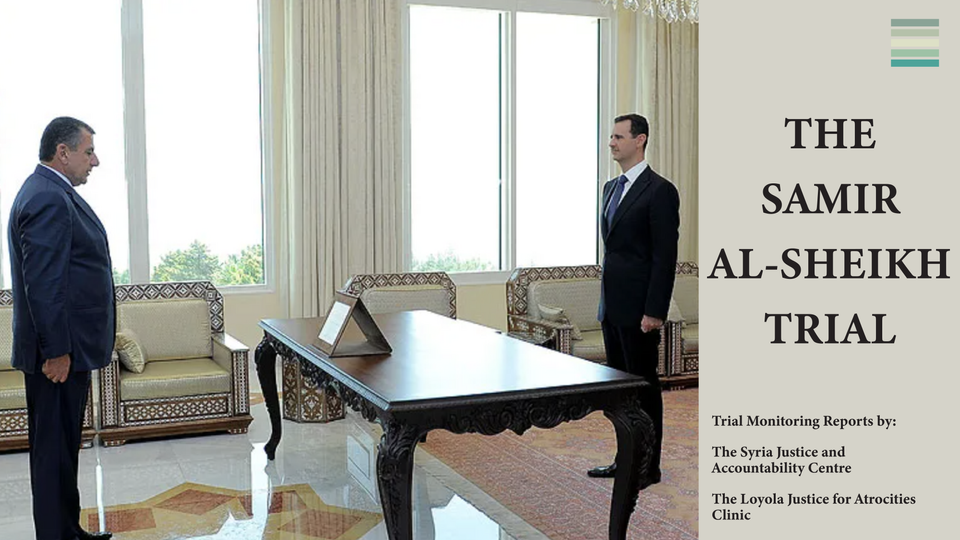
Dr. Leenders testified the Deir Ez-Zour region saw mass protests during the Arab Spring in 2011 and was important to the regime because of its oil fields. Dr. Leenders testified that only someone with proven loyalty to the regime would have been appointed to the position of Governor of Deir Ez-Zour. Referring to the photograph of Bashar al-Assad and Defendant in Assad’s office, Dr. Leenders stated only a role of special prominence would have an appointment ceremony directly from the President of Syria. Prosecution ended its direct questioning.
Defense Counsel began a short cross-examination of Dr. Leenders. Her questions focused on his specific knowledge of Syrian prisons and the Defendant himself. Dr. Leenders testified that he had specifically searched for and found no evidence to support the idea that there was another Brigadier General at Adra Prison alongside and more senior to Defendant. Defense Counsel pressed Dr. Leenders on the fact that he had not published any academic articles specifically about Adra Prison. Confronted with social media posts that he had shared, Dr. Leenders testified that he was only professional acquaintances with Mr. Al-Labwani and that his testimony was unbiased. [The witness lost his temper a bit and appeared flustered during the latter half of the questioning.] The Defense ended the cross-examination. Prosecution briefly questioned Dr. Leenders on re-direct before he was dismissed.
Prosecution called [redacted name] to the witness stand. He testified through an Arabic translator. Mr. Salha now lives in Germany and testified he led Friday prayers in Adra from 2000 to 2011.
***
[16-minutes-break]
3:01 p.m. – 3:17 p.m.
***
After the break, Mr. Salha testified he led prayer for thousands of prisoners at Adra. He testified he met with Defendant when he was appointed and met with Defendant in his office numerous times. Mr. Salha stated the office was very large, had pictures of both Hafez and Bashar al-Assad, and had large screens on which to view the prison camera feeds. Mr. Salha testified Defendant’s oft-worn uniform had an eagle and three stars to signify his rank of ‘Ameed’ or Brigadier General. He described Defendant as a very serious man with strict management of the prison. When they met, Defendant instructed Mr. Salha on the topics of his sermons and told him to avoid politics and controversial topics.
Mr. Salha testified he had been asked to witness executions at Adra but refused because he did not trust the judgments in Syria. He had negative experiences in the Syrian justice system because he was imprisoned for a year in 1999-2000. Mr. Salha testified he stopped preaching at Adra in 2011 after he was attacked by security forces for attending a conference aimed at overthrowing the regime. He fled Syria to Lebanon and then Turkey, before arriving in Germany in 2015. Prosecution ended its questioning.
Defense Counsel began her cross-examination of Mr. Salha. Mr. Salha testified Al-Homsi’s room in Adra prison was more luxurious than other rooms because it was not crowded and had books, a mini-fridge, and a television, but not nicer because he was completely alone. Mr. Salha testified he was not able to visit Al-Homsi because of “political unrest.” The Defense ended its questioning.
On re-direct, Mr. Salha testified that no rooms in Adra prison were luxurious, they were simple rooms, and Al-Homsi’s isolation was a clear punishment. The witness was dismissed.
Prosecution then called its third fact witness, [redacted name] (“N.S.”), to the stand. N.S. currently lives in Belgium. N.S. stated he was arrested in Syria twice. The first time, in 2000, was for conducting sporting activities; the second, in 2007, at the Lebanese border crossing, for a car accident that occurred in 2004. In 2004, he collided with a motorcyclist whose brother was a member of the Syrian security force. N.S. took the man to the hospital, paid him compensation, and then left. When he crossed the border from Lebanon into Syria in 2007, he was detained and sent to the security force, before being sent to Adra Prison.
N.S. said he was at Adra Prison for a few months and saw Defendant twice. The first time, he was in Wing 9 and stood on a box to look through a small window, where he saw Defendant in the prison courtyard. He could tell it was the Defendant because of the eagle and three stars on his shoulder, signifying the rank of ‘Ameed’ or Brigadier General. In the courtyard, he saw Defendant next to a prisoner wearing red overalls, a mark of someone sentenced to be executed. N.S. testified the second time he saw Defendant was in the main prison corridor while on his way back from seeing the prison dentist. This time, Defendant was surrounded by prison personnel wearing military berets, which only happened in the presence of a high-ranking officer.
N.S. testified that, before entering prison, he had heard that Al-Labwani was a political opposition figure but didn’t know him. N.S. testified a prison servant took him to meet Al-Labwani because N.S. wanted to tell him about the things he had seen in the prison, including torture. N.S. testified he met with Al-Labwani for about 15-30 minutes before he was taken back to his cell. N.S. testified he wrote Al-Labwani a letter (in English to avoid detection) that offered Al-Labwani support and told him he would write in the newspapers about what he had seen in Adra. He ended it with, ‘burn this letter’ and gave it to another prisoner to take to Al-Labwani. N.S. testified that the morning after he gave the other prisoner the letter, an enforcement squad entered his room and started beating him. He testified he was taken into an investigation room where Al-Labwani was already standing by the wall and other officers, including [redacted names] were present.
At this point, the Prosecution noted that the next portion of N.S.’s testimony would be ‘intense.’ The jury was dismissed. Outside the presence of the jury, the Prosecution confirmed the remaining witnesses it expected to call. Defense Counsel objected to the Prosecution’s use of the word ‘intense’ and requested a curative instruction.
Proceedings were adjourned at 5:04 p.m. The next trial day is March 5, 2026.
Day 4 – March 5, 2026
Judge Vera took the bench at 8:39 a.m. to discuss evidentiary issues from the prior day. Defense Counsel objected to the Prosecution’s introduction of evidence of N.S.’s recent clean criminal record, which Defense felt contradicted their separate exhibit of N.S.’s official criminal record from Syria. The Court ruled Prosecution could not introduce the record in direct examination but could use it to rebut the Defense’s criminal record.
Additionally, because the Defense had issued subpoenas for every U.S. government case agent that worked on this case and wouldn’t know which, if any, of them it would call, the Court excluded all U.S. government case agents from the courtroom despite the Prosecution’s argument that case law permitted government case agents to observe proceedings even if they had been noticed as witnesses.
***
[6-minute break]
8:57am-9:03am
***
After a short break, N.S. took the stand. The jury entered at 9:02 a.m. The Court instructed the jury to disregard the Prosecution’s comment made on the previous trial day that referred to N.S.’s testimony as ‘intense.’
Prosecution resumed direct examination of N.S. N.S. testified that inside the interrogation room were [redacted names], along with approximately eight to ten other unknown men wearing officers’ uniforms. N.S. testified his hands were bound and he was blindfolded. After he entered the room, someone asked him about the letter on the table. N.S. testified he told the officers he could not see the letter, so his blindfold was removed. N.S. saw the letter he wrote to Al-Labwani. N.S. testified he was scared, so he lied and said he did not write it but only translated the letter into English. [At this point, the jury appeared to be invested in N.S.’s testimony. All jurors turned in their chairs to face him and were clearly paying attention.]
N.S. testified [redacted names] and other unnamed officers slapped him and tied metal chains to his handcuffs, which were thrown through a broken window and pulled from the other side until N.S.’s hands were over his head, forcing him to his tiptoes. N.S. testified Bakru said he was going to see the ‘General,’ the Ameed. Bakru loosened the chains, moved N.S. to the side, and left the room for 15 minutes. When Bakru returned, he sent N.S. to a solitary cell. N.S. testified a guard took N.S. two floors underground, where N.S. observed three people in reddish-orange suits. Another unnamed guard gave N.S. a file, took his clothes, and gave him a reddish-orange uniform. N.S. testified these uniforms marked prisoners for execution.
N.S. testified he “lost his mind.” He said the other three prisoners were taken out of the room. A guard told N.S. to put a blindfold on. As N.S. bent to pick up the blindfold, he saw the three other prisoners hanged. N.S. entered the room and was hung by his hands by a guard. N.S. testified a guard whipped him with cables without any way to defend himself. N.S. testified that after the beating, a guard took N.S. to the solitary cell. N.S. recalled being alone at first, but more prisoners entered later. N.S. testified the cell was approximately 1.5m x 120cm and had no bed, but did have rats and a hole in the floor for a toilet.
[At approximately 9:27 a.m., N.S. looked at Defendant for the first time. N.S. appeared solemn but angry. Defendant watched diligently, turning his whole body to face N.S.]
N.S. testified he remained in the room for two days before guards took him again. [At this point, N.S. became emotional.] He testified he went to a room that had a wooden contraption on the floor with hinges at the middle. He testified a guard laid him on his back on the ‘Magic Carpet.’ The guards tied N.S. to the wooden slab on both sides of the hinges, and folded his body in half, creating a ‘V’ shape. N.S. testified the guards beat him while N.S. remained restrained, and that his body was still in pain from the beating two days prior. While in the Magic Carpet, he felt pressure in his legs and chest, and extreme pain in his lower back, with pain gradually increasing the longer he remained in the Magic Carpet. N.S. testified he remembered screaming. After the initial beating, the guards laid the Magic Carpet down and two men left the room. The last guard violently kicked the top of the Magic Carpet with his military boots so hard that N.S.’s feet hit him in the face. N.S. heard a loud cracking noise in his back, then lost consciousness. [At this point during his testimony, N.S. broke down in tears.] N.S. testified he screamed and the guard forced him to return to the cell. N.S. could not stand, so he crawled on his hands and knees. N.S. stated he did not receive medical treatment in Adra but later treated for [redacted information].
Prosecution introduced exhibits 19-24, which contained N.S.’s medical records that he provided from Belgium, along with English translations. Prosecution reviewed the medical records, which detailed years of treatment related to injuries sustained in Adra, including for severe back pain. N.S. confirmed his life drastically changed after Adra, and that he faces daily limitations due to ongoing pain.
N.S. testified that he also recalled seeing tires on the floor, big sticks with one a meter long, and a lot of wires, chains, and rope, all next to the Magic Carpet. N.S.’s solitary cell had a small opening: he saw people being dragged, heard prisoners screaming, and heard prisoners begging the guards to leave them alone. N.S. testified he believed he was in this cell for five to six days after he was on the Magic Carpet. After that time, guards took him back to the first interrogation room and gave him an ordinary prison uniform. Political security officers handcuffed and blinded him, put him in a car and took him to a political security facility outside Adra.
N.S. testified that after his time in the political security facility, he went to court, where he was ‘let go.’ N.S. testified he immediately left Syria in 2008 after his release. N.S. currently lives in Belgium and is a [redacted information]. The company [redacted information]. While the organization had received funding from the United States in the past, N.S. testified they were not currently funded by the United States and any past funding did not influence his testimony.
N.S. testified he obtained a visa to the United States in 2019 to visit his family. In the application, N.S. stated he did not have specialized skills or training in chemical weapons and had no prior convictions. N.S. testified he was last in Syria in November 2025 to obtain his criminal records so he could get a Syrian passport. The records he obtained stated he had no criminal record nor any outstanding warrants.
***
[17-minute break]
10:13am-10:30am
***
The Court reconvened at 10:35 a.m. Defense Counsel began the cross-examination by asking about N.S.’s prior military service. N.S. confirmed he served and received the standard firearm training for a pistol and a rifle, but did not consider that specialized, so he believed his visa application, in which he checked ‘no’ to the question asking if he had specialized firearms training, was truthful. N.S. did not recall the exact dates but confirmed meeting with various U.S. law enforcement agencies regarding testifying. N.S. confirmed he did not speak to any U.S. law enforcement agents after testimony began.
Defense Counsel asked several questions about N.S.’s job relating to [redacted information]. N.S. clarified he did not work with chemical weapons at all but collected evidence relating to their use in Syria. N.S. confirmed his military experience had nothing to do with [redacted information].
Defense Counsel turned to N.S.’s U.S. visa application. N.S. believed the application referred only to specialized training, not basic firearm training, and said he answered ‘yes’ to serving in military, which to him signaled he was being truthful that he had received basic firearm training. N.S. stated he denied having prior criminal convictions in Syria since he never received a trial, and that during the visa interview, he clarified that he was arrested but never convicted.
N.S. stated he did not recall telling the U.S. Department of Homeland Security (DHS) in a prior interview that he took a deal with the Syrian political security branch after the car accident, clarifying he took the deal only because they pressured him into it. When Defense Counsel showed N.S. Exhibit 62, a judgment for the crime of aggravated theft, N.S. said the judgment did not show his name or family number, only a similar name with a different family number. Defense Counsel withdrew the exhibit.
Defense Counsel asked if N.S.’s testimony was meant to further his work. N.S. replied his work related to defending human rights abuses anywhere in the world, not just Syria, and his job did not influence his testimony. N.S. stated he wanted anyone who commits human rights violations brought to justice; he did not have a personal vendetta against anyone involved in the Assad regime but sought only justice. [At this point, Defendant started getting flustered. Defendant appeared fidgety and kept staring at the jury.]
Defense Counsel introduced a series of Facebook posts, including a post where the Center for Certifying the Chemical Violations petitioned the French court to issue arrest warrants for Bashar al-Assad and Maher al-Assad, and another when N.S. referenced an arrest by the military intelligence directorate in 2000. A third Facebook post mentioned a 1999 arrest and facing the truth of the Palestine Branch under Hafez al-Assad and Hishama al-Assad. N.S. confirmed this post referred to a friend’s arrest, and his own experience in facing the regime’s truth. N.S. again confirmed that he wanted anyone who committed human rights violations or other crimes to be brought to justice and was not seeking to hold the entire Assad regime accountable. N.S. declared it was his right to seek compensation for the abuses he suffered. When Defense Counsel continued pressing, N.S. raised his voice and looked at both Defense Counsel and the Defendant, and stated, ‘I’m the one suffering, not you, not him.’ [Once calm,] N.S. stated that though it was his right to seek compensation, he did not expect any and that in no way influenced his testimony.
N.S. confirmed he spent five to six days in solitary confinement at Adra after his abuse, then spent several months in the Al-Maysat branch of the Political Security in Damascus before returning to Adra for four to five days. N.S. testified that during that second trip to Adra, prisoners refused to talk to him because he scared them and were afraid of associating with him, which is why he did not tell anyone about the harms he suffered. N.S. also stated he was scared to trust anyone with the truth after being betrayed by the person to whom he entrusted the letter he wrote to Al-Labwani. N.S. stated that ‘dogs were treated better than me.’ N.S. confirmed that though some details of his life had faded over the last twenty years, he would never forget the specific details of his mistreatment. Defense Counsel ended cross-examination at 12:19 p.m.
Prosecution began re-direct. N.S. confirmed that the details of his mistreatment at Adra in his medical records were recorded in 2011, a full decade prior to the U.S. government contacting him. N.S. became emotional again, confirming all the abuses he suffered. Prosecution confirmed that Al-Labwani was not held in any of the same prisons as N.S. except for Adra. N.S. stated he was not confused what prison he was in when he wrote the letter.
Proceedings were adjourned at 12:33 p.m. The next trial day is March 6, 2025.
Day 5 – March 6, 2026
The Court convened at approximately 8:45 a.m. with all attorneys and the Defendant present. At approximately 8:50 a.m., the Court addressed an interpreter correction from the previous day: the witness had said the Arabic word for ‘courtyard,’ not the phrase about looking out of a window. [This report uses ‘courtyard’ due to this correction.] The Court directed interpreters to provide the full context and timestamps of corrected statements so the jury could understand the word properly.
Defense Counsel objected to Prosecution’s plan to call witness [redacted name] (“J.S.”), arguing her testimony constituted improper character evidence because J.S.’s father—not J.S. herself—was incarcerated at Adra, and his time there predated the Defendant’s tenure. Prosecution countered that J.S. was on the witness list since the beginning, had flown in from Germany, and that Defense knew about her for weeks. He argued J.S.’s testimony was probative of the Defendant’s control over prison conditions under a previously granted motion in limine. The Court denied the motion in part, allowing the testimony but noting sensitivity to the Defense’s concerns, and confirmed the conversations at issue occurred while the Defendant headed the prison.
N.S. resumed testimony at 9:03 a.m. On re-direct, the Prosecution asked if anyone in the courtroom had done bad things to him. N.S. looked toward the Defendant and replied, ‘There is one person.’
On re-cross, Defense Counsel questioned N.S. about his movements between prisons. N.S. testified to the sequence: Adra, the political security branch, civil court, then military court—'the whole government didn’t know where to judge him. N.S. confirmed he left Syria in 2008 and had not been arrested since. Defense Counsel challenged N.S. with his prior statements to Homeland Security about attempting to sneak into Lebanon and being held at al-Khatib branch. N.S. stated those events occurred before Adra. [There appeared to be some confusion due to interpretation.] When Defense Counsel pressed further, N.S. erupted: ‘You keep pushing me to answer and say things that are incorrect.’ He said he could be confusing dates but not locations. Defense Counsel asked, ‘You weren’t tortured at Adra, were you?’ N.S. responded, ‘You don’t know that. You can’t decide what my body has been through. There was torture at Adra. I will never forget that.’
Prosecution called witness Robert Jachim, an employee at the U.S. Department of State for 27 years. The Court qualified him as an expert. He testified that Defendant’s DS-260 immigrant visa application asked whether the applicant had ever committed torture or participated in extrajudicial killings, and that the Defendant answered no. Mr. Jachim testified that affirmative answers would have resulted in denial, and that a second DS-260 contained the same answers. Mr. Jachim testified that conditions such as prisoners packed without space, strapped to the Magic Carpet, suspended by their hands, beaten, and denied medical treatment would have been relevant to the immigrant visa application.
***
[22-minute break]
10:25am-10:47am
***
Prosecution called to the stand J.S., who testified through an Arabic translator. J.S. stated she was born in Damascus, worked for approximately nine years as an advisor for the [redacted information], and confirmed she was present to testify about her father’s experiences, not in a professional capacity.
J.S. testified she visited her father at Adra once or twice a week for eight years. She testified her father was imprisoned more than twice—once between 2001 and 2006, and again between 2008 and 2010—for calling for political reform and the removal of Article 8 of the Syrian Constitution. J.S. said the first Damascus Forum was held in her father’s house as a space for national dialogue when Bashair al-Assad first came to power.
J.S. testified she knew the Defendant and that conditions at Adra changed under his leadership. J.S. testified her father was treated differently under the Defendant than he was under previous heads of Adra. She estimated she met with the Defendant approximately ten times over three years, all in his office.
J.S. testified the Defendant told her he had warned her father he would be arrested if he continued with the political dialogues and her father had said, ‘Okay.’ J.S. also testified the Defendant demanded a letter her father had given her, calling its contents a lie, and said he wanted it to conduct an investigation. J.S. added the Interior Minister visited her father in mid-2005 and wanted to release him but ultimately did not.
***
[79-minute break]
11:53am-1:22pm
***
After the break, Defense Counsel began her cross-examination of J.S. She asked if J.S.’s father was ever tortured at Adra, meaning the use of devices to cause extreme pain. J.S. confirmed that her father was also incarcerated at intelligence and security facilities between 2006 and 2008. When Defense Counsel asked if J.S.’s father was subjected to such devices at the other facilities, J.S. responded, ‘my understanding of torture is completely different than yours. It could be beatings by hands, verbal acts,’ and other forms. J.S. stated, “what I know about my father is that it was obvious that he was tortured, but my father did not want to talk about it at all.”
J.S. testified she knew Mr. [redacted name] very well, and that he and her father were tried in open court before being sent to Adra over a period of forty days, then sent to court. J.S. confirmed that her father had requested to be transferred to Kuwait for a medical procedure, but the request was not granted and instead he was moved with security to another location in Damascus.
On redirect, J.S. said the Interior Minister made his visit in the middle of 2005, and that conditions got much worse after the visit. Redirect ended here.
Prosecution called expert witness Jay Wesselman, a U.S. Citizenship and Immigration Services (USCIS) employee with over 20 years of experience. Mr. Wesselman testified the United States could not verify every piece of information on an immigration application. He confirmed the Defendant’s spouse filed an I-130 petition under penalty of perjury, and that the Defendant stated on both the I-130 and the N-400 naturalization documents that he had not participated in torture. Mr. Wesselman testified that an affirmative answer to that question would have resulted in denial. Mr. Wesselman also testified that the Defendant answered ‘no’ to a question regarding membership in a police unit, but should have answered ‘yes’ if he was a member.
On cross-examination, Defense Counsel introduced an email from the Defendant’s daughter to the State Department disclosing the Defendant was a police officer, governor, and warden of Adra Prison. Mr. Wesselman confirmed USCIS never received the email and acknowledged maintaining it was USCIS’s responsibility.
***
[12-minute break]
2:55pm-3:18pm
***
Prosecution began the direct examination of [redacted name] “(M.S.)”, who testified through an Arabic translator. M.S. stated he was born in Latakia, Syria. M.S. said most of his family had died during the war. Only three siblings remained.
In response to Prosecution questioning, M.S. testified he worked at the harbor of Latakia loading ships. M.S. said he left Syria around the time of the revolution in 2011, lived in Libya for two or three years, then went to Italy, and then to Germany, where he studied to become a nurse. M.S. testified he currently works as a nurse for elderly people and had done so for seven to eight years.
M.S. testified he was imprisoned in Adra and Latakia prisons for approximately one year, either in 2006 or 2007. He said he was transferred from Adra to Latakia for a transitional period. When Prosecution asked what he was in prison for, M.S. said, ‘Fighting, insulting, and cussing the president.’
Prosecution asked M.S. if he knew Kamal Al-Labwani. M.S. said yes—as a doctor who was in the opposition. When Al-Labwani came back to Syria from the United States, he was imprisoned. They were put in the same room and became friendly.
Prosecution asked if M.S. knew Defendant. M.S. said yes: he was the Director of Adra. M.S. said he had met Defendant twice, near the visitation area in Defendant’s office. M.S. testified Defendant was wearing a green suit with an insignia of three stars with an eagle and a red stripe, indicating a Brigadier General.
Prosecution asked if Defendant had instructed M.S. to harm a prisoner. M.S. said yes. When asked which prisoner, M.S. first answered ‘Mohsen Hossein Bakar,’ describing him as a ‘spoiled child.’ Prosecution repeated the question, and M.S. said then Al-Labwani. M.S. testified it happened in two phases: first, he was told to make Al-Labwani sleep by the bathroom with no blankets. In the second meeting, M.S. testified Defendant told him, ‘Break him.’ [At this point, the Court called a sidebar where he had all counsel come to him regarding hearsay concerns, which were prevalent throughout the trial. After approximately five minutes, testimony resumed.] Prosecution asked about Defendant’s demeanor when he gave the instruction. M.S. said, ‘I told him it’s not my job,’ and described Defendant making a dismissive motion with his hands. M.S. testified that, after the meeting, he went back to the room and told Al-Labwani in detail what happened, warned him to take care of himself, and said he would not harm him.
Prosecution asked if M.S. was moved from Wing 6. M.S. testified that guards came and put handcuffs on him. He felt like he had committed something heinous. He was taken to solitary confinement in another building about ten minutes away where beatings occurred, called Wing 13. M.S. said it was underground. When M.S. arrived, there was a sergeant named Mohammed Al-Sheikh. M.S. said he saw the order from Defendant sending him there while the sergeant was recording information.
M.S. described the underground area as a room or office with metal bars, with a corridor and cells on both sides. He said there were no less than eighty cells, each approximately 1.5m x 2m. M.S. added [speaking directly to the Prosecution attorney, who is over 6 feet tall], ‘If you were there, you wouldn’t be able to stand completely upright.’ M.S. confirmed he was placed in one of these cells, restrained with his hands behind his back. When Prosecution asked about the temperature, M.S. broke down crying and was unable to answer the question. The Court called for a break for the witness.
***
[12-minute break]
4:00pm-4:12pm
***
After the break, M.S. testified it was cold and guards threw water on prisoners at night. When asked about a bed, M.S. said, ‘What bed? There weren’t even blankets. We had to put a bottle over the hole in the ground to prevent rats from coming up.’
Prosecution asked if M.S. was physically mistreated. M.S. said, ‘A lot.’ When asked how, M.S. said, ‘In many different ways. The Magic Carpet, the ghost, tied up.’ M.S. described the ‘shabeh’: large pipes where guards would chain a person’s hands and suspend them with their toes barely touching the ground. M.S. clarified, ‘They didn’t do this to me — they did the Carpet to me.’
M.S. described the Magic Carpet as two pieces of wood where they would lay a person in the middle, with hinges in the center. They would start folding until the person’s back broke, or it caused a massive amount of pain and damage. M.S. demonstrated using a three-ring binder and his hands. M.S. said he ‘Didn’t feel anything, just wanted to die.’ M.S. testified he was tied by the legs, chest, and arms. He was beaten with sticks, but the beatings were nothing compared to the pain from having his back folded. When Prosecution directed M.S.’s attention to an exhibit that was a drawing, M.S. exclaimed, before the exhibit was named, that, ‘This is it. This is the Carpet.’ He confirmed it was an accurate depiction. Prosecution asked what happened to his back. M.S. said, ‘Since then, my back is broken, it’s damaged.’
M.S. confirmed he was placed in a ‘doulab’ many times. He described the doulab as a vehicle tire where the person was put inside, with metal bars. Prosecution directed his attention to another exhibit that was a drawing. M.S. exclaimed, again, before the exhibit was named, that ‘This is it! This is a doulab!’ He testified there were many sizes—some taller, some bigger—because some people were skinnier and others were larger. Prisoners were beaten while tied inside the tire. M.S. said if there was a doctor in the courtroom, they would be able to see that he still has marks on his feet. He testified that he was unable to walk on his left foot for a year and a half after the doulab. [During all of this testimony, Defendant appeared visibly anxious, shifting in his seat and playing with his hands.]
M.S. testified he was suspended from the ceiling more than two times, but he was not sure of the exact number. He said he could not tell exactly how long—'a second would feel like a year’— but estimated no more than ten minutes. M.S. said he was beaten with cables while suspended, mostly on the buttocks. Prosecution then directed his attention to Exhibit 26, to which M.S. said, ‘It is the shabeh.’ He described handcuffs attached to a chain over a pipe, and said, ‘It feels like your wrist would rupture.’ M.S. stated the illustration was about ‘80 percent accurate. The Court ruled that Exhibits 26 or 27 would not be shown to the jury.
M.S. said he was held underground for two months. He said he did not see Defendant visit the area. When asked about the feeling in his wrists while suspended, M.S. said, ‘What do you want me to say? I just wanted to die.’ M.S. testified that ‘The damage will be for the rest of my life. I don’t care about the effects on my body as much as my mind.’ He continued, ‘I wish one day I can be free from those bad dreams. I want them to go away.’ Prosecution asked what M.S. heard while underground. M.S. answered, ‘Screams. Screams, but only at night.’
Proceedings were adjourned at approximately 4:45 p.m. After the jury was dismissed, Prosecution stated they had social workers to take care of M.S. The Court instructed Prosecution to tell the witness to not talk about his testimony.
The next trial day is March 9, 2026.
___________________________
For more information or to provide feedback, please contact SJAC at [email protected] and follow us on Facebook and Twitter. Subscribe to SJAC’s newsletter for updates on our work