Honor the Victims Through Fair and Robust Trials
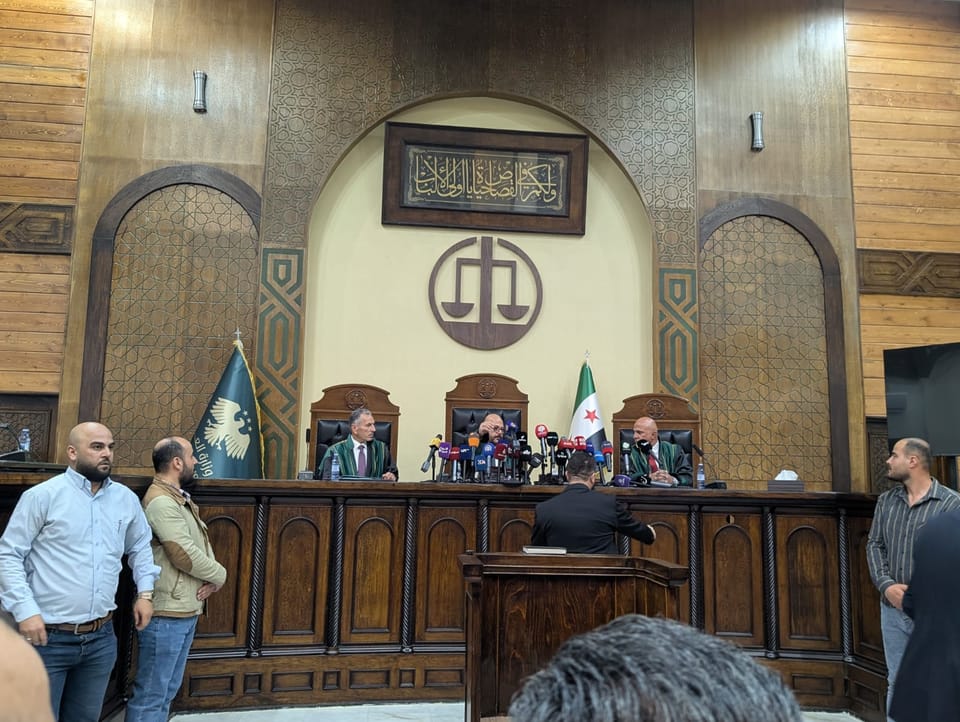
Originally published on August 12th, 2026, by SJAC’s Deputy Director, Aweiss Al Doboush, who attended several sessions of Atef Najib’s trial.
Today, before the verdict, I remember the victims.
The verdict issued today against Atef Najib is not merely a judicial ruling against a former regime official. Before discussing the sentence or the political and legal implications of the judgment, we must remember the victims and their families, foremost among them the children of Daraa, whose case became closely associated with the beginning of the Syrian tragedy.
They are the first to have a claim to justice, and they are the ones who paid the highest price through long years of repression, violence, and impunity.
On this occasion, I would like to thank Judge Fakhruddin Al-Aryan for presiding over the trial hearings and overseeing the case under difficult circumstances, with the available legal and institutional resources, and in the face of multiple challenges at different levels. My gratitude also extends to the many other esteemed judges and the members of the court; managing cases of this nature at such a sensitive stage in Syria’s history is no simple task, and I believe the effort invested deserves recognition.
Additionally, we commend the Ministry of Justice and our colleagues at the Directorate of International Cooperation, extending our sincere thanks to them, for facilitating and enabling civil society organizations and observers to attend trial hearings. Allowing independent monitoring to highlighting positive aspects, challenges, and legal and procedural observations, constitutes a vital form of transparency that needs to be fostered at this stage.
At the same time, however, we should not view this trial as an endpoint but as a starting point.
Much work remains to be done to develop the framework for trials concerning grave crimes, establish clearer and more consistent legal and procedural foundations, and provide a comprehensive framework for transitional justice.
We are awaiting the adoption of the transitional justice law, which should provide the framework within which these efforts are organized and ensure that accountability forms part of a broader national process encompassing justice, truth, reparations, and guarantees of non-recurrence.
In this context, it is important to emphasize that adherence to fair trial standards is not for the sake of the convicted perpetrator, Atef Najib, or any other accused person. Rather, it is for the victims and for the task of building a Syria governed by the rule of law.
Respect for fair trial guarantees does not diminish victims’ rights or lessen the gravity of the crimes committed. On the contrary, it is what makes justice stronger, more credible, and more sustainable.
A fair trial also means that victims’ families have the opportunity to know precisely what happened: how the crimes were committed, who made the decisions, who carried them out, and what responsibility each individual bears. For this reason, trials involving grave violations do not produce judgments alone; they can also create a judicial and historical record of what happened in Syria.
In this regard, experiences such as Argentina’s are instructive. Trials concerning crimes committed under the dictatorship became an important source for documenting the truth and building collective memory, alongside their role in advancing criminal accountability. Over the years, those proceedings also developed jurisprudence that became an important reference point for addressing crimes of the past.
Other experiences, including Argentina’s truth trials (juicios por la verdad), have likewise shown that judicial proceedings can serve a function that goes beyond punishment by creating space for survivors and victims’ family members to give testimony and help reconstruct the truth about what occurred.
Against this background, we commend the Ministry of Justice and our colleagues there for facilitating access to the trial hearings for civil society organizations and monitors, and we extend our thanks to them. Permitting independent trial monitoring and bringing attention to positive developments as well as challenges and legal and procedural observations is an important form of transparency that needs to be strengthened at this stage.
The first trials are not expected to be perfect or free of challenges. What matters is that we learn from them and continue developing institutions, laws, and procedures so that future trials are clearer, more fully aligned with legal standards, and better able to uphold victims’ rights and the guarantees owed to accused persons at the same time.
Transitional justice is not built through a single judgment, but through a series of procedures, institutions, and rules that lay the foundations for the rule of law.
Today, we commemorate the victims and reaffirm their rights, recognize the efforts of those responsible for conducting this trial, and welcome the steps taken toward accountability.
At the same time, however, we say clearly:
The road ahead remains long. The real work of building a credible Syrian transitional justice system has only just begun and will require substantial further efforts and development. It is a collective responsibility that rests with all of us.
___________________________
For more information or to provide feedback, please contact SJAC at [email protected] and follow us on Facebook and Twitter. Subscribe to SJAC’s newsletter for updates on our work