Introducing SJAC’s Arrests Tracker: Monitoring Detention and Criminal Justice Proceedings to Support Transitional Justice
In the post-Assad period, justice processes that address crimes committed by Assad government remnants are a relevant and pressing concern to the Syrian public. Despite commitments to carry out criminal justice proceedings against former government officials and affiliates, the Transitional Government has failed to create a transparent procedural framework to inform the public about what progress has been made to hold perpetrators responsible. Lack of visible progress in the transitional justice process has led to increasing domestic unrest and extrajudicial killing that threatens to destabilize the peacebuilding process.
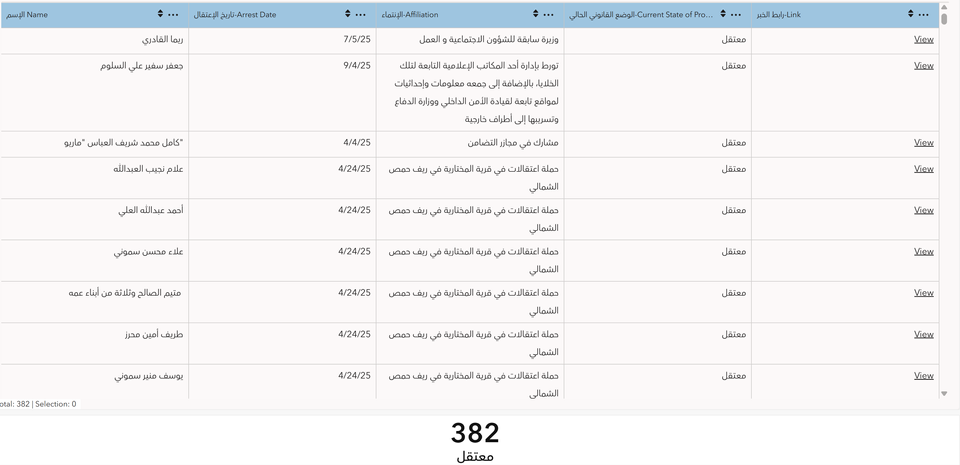
In order to address this lack of transparency, SJAC developed a public tracker that monitors arrests and justice proceedings involving Assad government officials and affiliated parties. The tracker is an effort to follow developments and trends on this issue and to support advocacy for improved public policies in Syria.
THE ARRESTS TRACKER: MONITORING DETENTION, ARRESTS, & CRIMINAL JUSTICE PROCEEDINGS
Since the end of 2024, SJAC has followed arrest and detention cases involving Assad government remnants during the transitional period. Due to the importance of third-party human rights monitoring on this matter and its commitment to supporting transitional justice in Syria, SJAC has compiled its findings on detentions, arrests, releases, and associated criminal justice proceedings through this tracker.
The content of the tracker was compiled by SJAC’s Investigations team through opensource data collected across multiple social media and news platforms. The tracker will be regularly updated to ensure it is a reliable source of information on detentions, arrests, releases and justice proceedings involving former government remnants. SJAC will also use this data to analyze trends and developments on this issue to evaluate the status of, and advocate for improvements to, justice processes regarding Assad government remnants, safe and human detention, and compliance with due process in Syria.
THE CONTEXT: ADDRESSING ASSAD GOVERNMENT REMNANTS – DECEMBER 2024 TO THE PRESENT
Although the figure may be in the several thousands based on media contributions by the Ministry of Justice Based, public listings from the Ministry of Interior, upwards of 350 former government affiliates have been arrested since December 2024. These arrests were framed as part of the transitional process to hold perpetrators accountable for crimes committed by the Syrian government and affiliated parties during the Assad era.
Parallel to arrests, the Syrian government has issued two waves of amnesties for former government-affiliated detainees since December 2024. The first was in June 2025, ahead of the Eid Al- Adha holiday, and was issued by the Supreme Committee for Preserving Civil Peace in Syria (more popularly known as the ‘Civil Peace Committee’). This wave of amnesties primarily released former military officers under the Assad Government. The Committee and Ministry of Interior congruently shared that the release of these detainees was justified, although no clear legal procedures were followed, because they were not proven guilty of involvement in serious war crimes; and their release would help pacify social tensions, particularly in the Syrian Coastal Region after the outbreak of violence in Latakia and Tartous. There was lack of clarity about how those released were originally arrested and the procedure by which their innocence from involvement in crimes was assessed. The release - involving around 300 members of the military and security forces from the Assad government - was allegedly brokered in a deal by Fadi Saqr, a well-known militia leader who participated in the 2013 Tadamon Massacre and, controversially, a member of the Civil Peace Committee itself.
The second wave of amnesty came in March 2026 by Presidential Decree. The decree outlined general amnesty for crimes committed prior to the decree, which would lower or eliminate prison terms. The proposed aim of the decree was to lighten the burden on the prison system and encourage national reconciliation. The general amnesty claimed to exclude detainees involved in serious crimes, including torture, human trafficking, and theft of public property. In addition to these two broader occasions of detainee releases, there were also ad hoc cases of Assad government detainees released through varying legal mechanisms.
Throughout this process, there has been an unclear procedural framework and lack of transparency around arrest and releases of former government-affiliated parties. Public authorities have failed to clearly detail the criteria for arrests and releases. It is also unclear with what legal authority different government bodies issued amnesties that allowed for releases, and questionable that these decisions were taken unilaterally by different government authorities without the involvement of the National Commission for Transitional Justice. There is opacity about the state of the detention system and whether detainees have access to due process. Furthermore, the legal procedural status of detainee cases is not publicly available, and most justice proceedings have not been publicized.
Transitional government bodies have justified this opacity due to the socially and politically sensitive nature of dealing with Assad government officials and affiliates. However, in turn, the lack of transparent justice processes to address former government remnants may itself be a contributing factor in the reprisal and sectarian violence that has plagued Syria throughout the transitional period. A transparent, cohesive justice policy that addresses the issue of former government-affiliated parties is central to realizing accountability for past crimes and progressing the transitional justice process in Syria.
CONCLUDING REMARKS & RECOMMENDATIONS
Addressing years of human rights violations and war crimes committed by public officials and affiliated parties under the Assad Government is central to the transitional justice process in Syria. It is important that the start of this process lays a strong foundation for government policies and practices that protect human rights, particularly in the context of detention and due process, and builds public confidence in the transitional justice process. Through effective policy changes and truth building, the government can counteract further reprisal violence against former government remnants and the Alawi community more broadly.
The Transitional Government in Syria should:
- Provide transparent information about detentions, arrests, and releases. This includes maintaining clear and consistent criteria for the detention and arrest of former government remnants. Further, detainees pathway after detention should be clarified and information about, and outcomes of, justice proceedings publicized.
- Comply with due process following clear judicial procedures for all detainees. This includes clarifying the basis for detention, bringing charges at the stage of arrest, ensuring detainees have access to legal representation, and bringing the accused to trial in a reasonable timeframe.
- Ensure detention conditions for all detainees are safe and humane. This is relevant because the prison system is itself in transition, with new administration and institutional protocols.
SJAC commits to continue monitoring developments in justice processes on dealing with Assad government crimes. In line with this commitment, SJAC is undertaking trial monitoring of cases before Syrian courts related to human rights violations to support accountability efforts. SJAC invites the Syrian public to follow this topic and to advocate for a transparency and good governance on this issue in near term.
___________________________
For more information or to provide feedback, please contact SJAC at [email protected] and follow us on Facebook and Twitter. Subscribe to SJAC’s newsletter for updates on our work