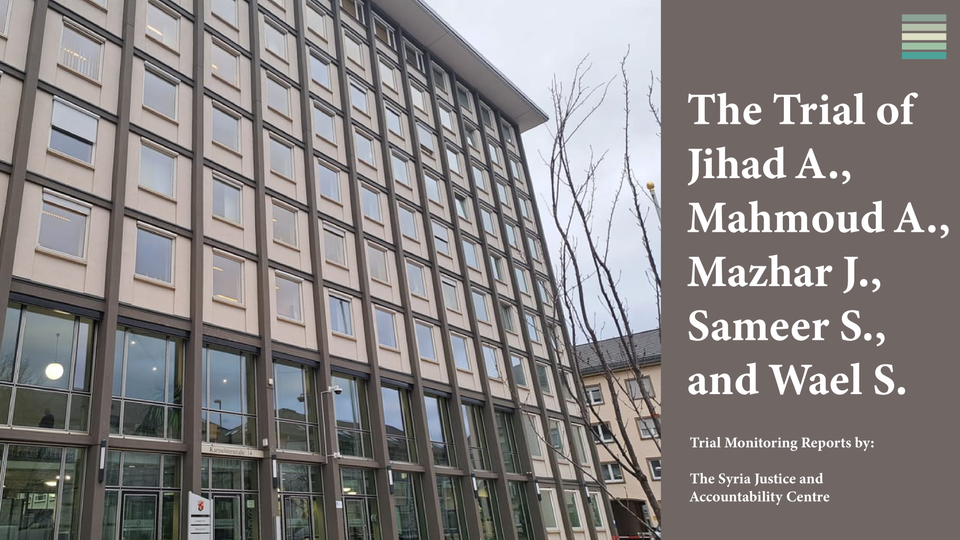
Inside the Yarmouk Trial of Jihad et al. #2: Setting the Stage
TRIAL OF JIHAD A., MAHMOUD A., MAZHAR J., SAMEER S., AND WAEL S.
Higher Regional Court - Koblenz, Germany
Trial Monitoring Summary #2
Hearing Date: December 3 and 4, 2025
CAUTION: Some testimony may include graphic descriptions of torture, rape or other violent acts.
Note that this summary is not a verbatim transcript of the trial; it is merely an unofficial summary of the proceedings.
Throughout this summary, [information located in brackets are notes from our trial monitor] and “information placed in quotes are statements made by the witness, judges or counsel.” The names and identifying information of witnesses have been redacted.
[Note: SJAC provides a summary of the proceedings while redacting certain details to protect witness privacy and to preserve the integrity of the trial.]
Trial Monitoring reports of the Jihad A., Mahmoud A., Mazhar J., Sameer S., and Wael S. trial are a result of a partnership between the Syria Justice and Accountability Centre and the Center for Victims of Torture (CVT).
SJAC’s 2nd trial monitoring report details days 2 and 3 of the trial of Jihad A., Mahmoud A., Mazhar J., Sameer S., and Wael S. On the first day of this week, the Court addressed key procedural questions, rejected motions by the Defense, heard detailed statements and personal backgrounds of the Accused, and presented an emotional video by witness W1 from Yarmouk Camp.
On the second day this week, police officer, W2, testified as a witness and presented Google Maps visualizations of Yarmouk and Tadamon, which were challenged by the Defense regarding their relevance to the year of 2012, in which the crimes were allegedly committed. Demonstration videos were viewed, and translation clarifications were made.
Day 2 – December 3, 2025
Following the opening of the hearing on November 19, 2025, the main hearing of the Yarmouk trial resumed on December 3, 2025 under the presidency of Judge Dr. Kerber. The Court confirmed the presence of all parties and approved a change in Court-appointed Defense Counsel for one Accused.
[Note: Before the formal opening of the session, two Accused briefly acknowledged their family members in the audience.]
The Presiding Judge then announced the agenda, which included the Accused’s statements, Defense motions, and the presentation of video evidence by a witness.
The Court rejected one Accused’s motion, Sameer S., submitted by his Defense Counsel on November 18 [for more details, see Trial Report #01] to dismiss the charges and to lift the arrest warrants. It ruled that there was sufficient suspicion of crimes against humanity and that Sect. 1 of the German Code of Crimes against International Law (GCCAIL) applied. Germany was deemed to have jurisdiction under the principle of universal jurisdiction because no functioning judicial system exists in Syria. Evidence from a related Swedish investigation was declared admissible, and the Court announced that expert witness [redacted name], E1, would be consulted soon to clarify this issue.
A separate Defense motion to digitally audio- and video-record the trial was denied. The Court held that the statutory requirements under a strict interpretation of Section 169 (2) of the Courts Constitution Act (CCA) were not met. In the Court’s view, the proceedings did not possess any particular historical or scientific significance that would justify an exception to the general prohibition of recording. The Court emphasized that numerous universal jurisdiction proceedings against Syrian nationals have already been conducted in Germany. Moreover, even if the legal prerequisites were fulfilled, the decision would still lie within the discretionary powers of the Court. The motion was further rejected on grounds of witness protection, as the Court identified a substantial risk that protected witnesses and their relatives could face serious repercussions. Given the already large number of participants in the proceedings, effective witness protection would be further compromised. The Court also expressed concerns that recording the trial could reinforce general mistrust toward state institutions. Additional objections included the lack of reliable transcription technologies, the risk of technical failures, and the potential for misuse of the recordings, even if access were to be limited exclusively to the Defense.
***
[5-minutes-break]
***
[Note: A Defense Counsel addressed the monitor regarding their affiliation, criticized the denial of his motion to audio-record as unjustified, referring to a forthcoming legal obligation by 2027, and noted that only the Defense motion—not any academic request—had been decided. For the background of the request by legal scholars, see Trial Report #01.]
Statements of the Accused
Following a break, the accused Sameer S. gave a detailed statement regarding the allegations against him. He is accused of having participated in acts of violence against civilians in Damascus in 2012. Sameer denied all charges. He stated that after completing his military service, he worked as a metal worker and later assisted in his uncle’s cellphone shop. He claimed that he never wore a uniform, carried a weapon, or received any orders. He denied any affiliation with armed groups. As a stateless Palestinian, he said he felt threatened by the Syrian regime himself and fled Syria in December 2012 out of fear of persecution. According to his account, the accusations against him were based on confusion, personal disputes, or deliberate false statements. He emphasized that exculpatory witnesses had not yet been heard and asked the Court to thoroughly review his statement.
Wael S. and Mahmoud A. also reiterated that they had lived as civilians and had not participated in any armed actions or combat activities.
The Court subsequently reviewed the personal histories, escape routes, and health information of several Accused based on their asylum and detention records by reading out their asylum interviews at the Federal Office for Migration and Refugees (BAMF) or asking background questions related to their interviews.
Sameer S. described his flight via Egypt and Italy to Sweden, where his asylum application was rejected, before ultimately arriving in Germany. He explained that he, as one of 70%, had possessed a checkpoint pass from his deceased uncle, which was required for movement through controlled areas. It was organized by the Palestinians in the refugee camp. He stated that he had not returned to Syria since his departure.
Wael S. stated that he is a stateless Palestinian who lived with his siblings in Yarmouk Camp, where he operated his own cellphone shop. He acknowledged a brief period of basic military training until 1997 but denied any involvement in hostilities. He stated that the accusations against him are largely based on the statements of the Plaintiff, even though he had previously invited him to his wedding. He emphasized that confusion arose because many individuals share the last name [redacted name], and that several witnesses deliberately conspired against him due to personal disputes. He described his dangerous flight through Sudan and Libya to Europe, during which he was abused and temporarily detained by smugglers. His wife and three children, he said, at first remained in Syria, one of whom is severely disabled and requires special care, so his family depend entirely on him. In Germany, he had worked as a packer and often had to act as an interpreter for his family in dealings with authorities due to his wife’s lack of German language skills.
Mazhar J. reported that he entered Germany via Turkey, North Macedonia, and Serbia. He financed his flight by selling his household belongings and incurring debts. In Syria, he had performed simple work and completed military service. He fled due to the ongoing war and airstrikes. He also stated that he suffers from memory problems as a result of medication for an eye surgery performed years earlier.
Particular attention was given to the health condition of Accused Mahmoud A., as documented in the detention records. Mahmoud stated that he suffers from serious physical ailments. He has undergone two spinal surgeries, received two cardiac catheter procedures, and had additional surgeries on his gallbladder and knee. Due to chronic heart problems, he must take permanent medication and use asthma inhalers. He explained that he had worked as a truck driver in Syria, had been detained for a period of time, and that his family fled to Turkey meanwhile. He denied any involvement in the alleged crimes.
Witness Testimony from Yarmouk Camp
A central element of the hearing was the presentation of a video containing the statement of witness [redacted name], W1, from Yarmouk Camp. In the recording, the witness appeared in a highly emotional state and described the killing of her son, years of siege, lack of food, and the destruction of humanitarian aid. She spoke about armed groups that had profited financially from the situation and named several individuals she considered responsible. The interpreters pointed out minor discrepancies between the video recording and the written translation. The Court announced that the witness would be summoned to testify in person.
Toward the end of the session, procedural issues regarding the formal handling of evidence motions were discussed. The Defense Counsel of Sameer S. insisted on flexible submission of evidence, while the Court emphasized strict adherence to procedural rules. A request allowing Jihad A. to briefly speak with his sister was denied for security reasons.
The proceedings were adjourned at 12:45 PM
The next trial day will be on December 4, 2025, at 9:00 AM.
Day 3 – December 4, 2025
At the beginning of this trial day, the Presiding Judge confirmed with one of the Accused that he approved of his appointed lawyer. Judge Kerber then announced that videos will be viewed following the testimony of the witness.
[Redacted information] -year-old police officer, Mr. [redacted name], W2, then appeared before the Court. He noted that he brought maps he had created to illustrate key locations in Yarmouk and the route of the demonstration. He confirmed that he had used Google Maps and public translation tools and compiled the information on May 16, 2025, noting that names and map details might not be perfectly accurate but should not have changed significantly. He first presented a map of the sixteen districts of Damascus, taken from Wikipedia, with visible names such as Al Faloujah الفالوجة, Hettin حطين and Al Kermel الكرمل. He then described streets and districts, occasionally becoming uncertain about correct spelling, one Accused helped clarify several names. He listed mosques, hospitals, roundabouts and streets relevant to the case. When the Judge asked about the UNRWA office, he explained that he could not pinpoint it precisely due to outdated satellite data. He also mentioned a Google review that referred to a military outpost or similar structure in the area.
Defense Counsel Bodenstein questioned whether the witness had compared current maps to those from 2012. The witness said he had not and relied solely on present-day references. Some map labels were difficult to read due to the formatting. The Judge asked about a site labelled “biscuit factory” (German: Keksfabrik), and the witness replied that it had once been an actual biscuit factory, according to Wikipedia.
A Judge asked how distances were measured, and the witness explained that a software tool was used. The Tadamon district was mentioned as a location associated with a massacre in Syria. The witness was further asked to clarify street name variations by the Defense. Following the uncertainty, the interpreter was asked to explain the differences between Arabic sun and moon letters. Defense Counsel Bodenstein asked again about determining the age of the maps available on Google. The witness repeated that he had documented everything in his May 2025 report. When asked why he had not created comparative maps showing 2012 and 2025, the police officer said he could only work with accessible contemporary maps.
When asked about his investigative role, the witness explained that he intended to provide an overview of the locations mentioned in the files and that no specific assignment had been given to him. The Judge intervened when the Defense asked about ongoing investigative matters, reminding them of restrictions. The witness clarified that he works in international criminal law and has completed several Syria-related cases.
The Defense challenged him by asking whether he was “just showing Google Maps“ or whether these locations matched where the demonstration actually took place. The witness maintained that the maps were created earlier this year and likely still accurately reflected the area. Defense Counsel Bodenstein then pressed again regarding an accurate historical comparison. A discussion unfolded until the Judge intervened, noting that the location description could help align the demonstrations written course with the maps.
The Defense emphasized that some institutions may have moved. The Court countered that the mosques had probably not changed significantly and could be used to reconstruct the demonstration route of July 13, 2012. He read out the route based on witness statements: from the Al-Wassim Mosque, to Schools street, to the Abdulqader Al-Huseini Mosque, toward Palestine Street, past another mosque, then north. Additional destinations such as Al-Quds street, Mahmoud Azimah street, a bus stop, and a festival hall were mentioned. When asked why shops were not included, the witness said he had intentionally excluded them.
A Defense Counsel then asked whether demonstrators might have used alleys shown on the map. The Judges responded that this would be determined by testimony and the videos the Court was about to watch. The Judges then opened Google Maps themselves, and interpreters identified several locations on the map, displayed in Arabic. One Accused claimed a bus stop was right next to the former biscuit factory. The Judge instructed this observation to be noted in the protocol. The witness confirmed that he had not matched videos to the map. As no other parties had questions, the police officer was dismissed.
Once the witness had left, the Court began reviewing videos evaluated by “[redacted information] and numbered accordingly. Video 3, a WhatsApp recording, showed a dense crowd chanting and moving, while loud bangs were audible. The interpreter and Defense pointed out the person filming, who was calling out references to security forces and attacks on people in the Palestinian camps. The Accused added that the person recording showed a soldier’s ID. Objects were also thrown. Chants included “Down with Assad!,“ referencesFriday, and “Takbir“were made, according to the interpreter.
Video 4 showed a large crowd clapping and chanting rhythmically. The interpreter identified the “Wassim Mosque“ on a sign. The next video depicted a chanting crowd once again. The interpreter translated phrases such as “you are declared free as a bird” and “Assad is the enemy of God.” “Al Yarmouk, July 13.” was further mentioned.
Video 9 displayed a demonstration with chants for Palestine and the Palestine roundabout. In a subsequent video, Palestine flags and banners related to Fatima's women’s clothing were visible; the interpreter noted such banners usually indicate nearby shops.
Video 11 showed a crowd whistling and a man waving a flag from an unprotected metal scaffolding on a roof. The interpreter recognized the Palestine Mosque.
Video 15 showed a demonstration passing through a narrow alley with chants such as “freedom forever, whether you want it or not, Assad!” The Defense pointed out a censorship effect in the video image and suggested analyzing it further.
Another video showed chants translated as “Dear God, we only have you!” The Accused added a comment regarding the rejection of reconciliation after a killing, however, it remained unclear what he meant.
***
[10-minutes-break]
***
After the break, another video showed a demonstration where the person recording called Assad a traitor. There was uncertainty as to whether the correct file reference was being read. Defense Counsel Bodenstein inquired why the videos had not been translated earlier. The Judge acknowledged the question but returned to the ongoing review.
The following video showed a crowd chanting; the interpreter translated “Palestine camp near the (...) mosque, July 13, 2012.” At the end, a Quranic opening verse was heard. A Defense Counsel asked whether the speaker matched an earlier video.
Video 24/27 showed a partly obscured demonstration with gunshots audible. The interpreter mentioned “Al-Yarmouk warehouse, Palestine Street, July 12.” Another video showed armed men filmed from a window and several white cars, including a limousine. The interpreter translated that on July 13, 2012, security forces and tanks assembled on Palestine Street, with references to the army and Shabiha. He explained, however, that video titles may lack verbs.
A Defense Counsel asked whether the videos were authenticated and whether the producers were known. The Judge referred to case law by the Federal Court of Justice (BGH) regarding verification. Notes from one Accused, about eighteen handwritten pages, were handed over.
The proceedings were adjourned at 11:55 PM
The next trial day will be on December 10, 2025, at 10:00 AM.
___________________________
For more information or to provide feedback, please contact SJAC at [email protected] and follow us on Facebook and Twitter. Subscribe to SJAC’s newsletter for updates on our work