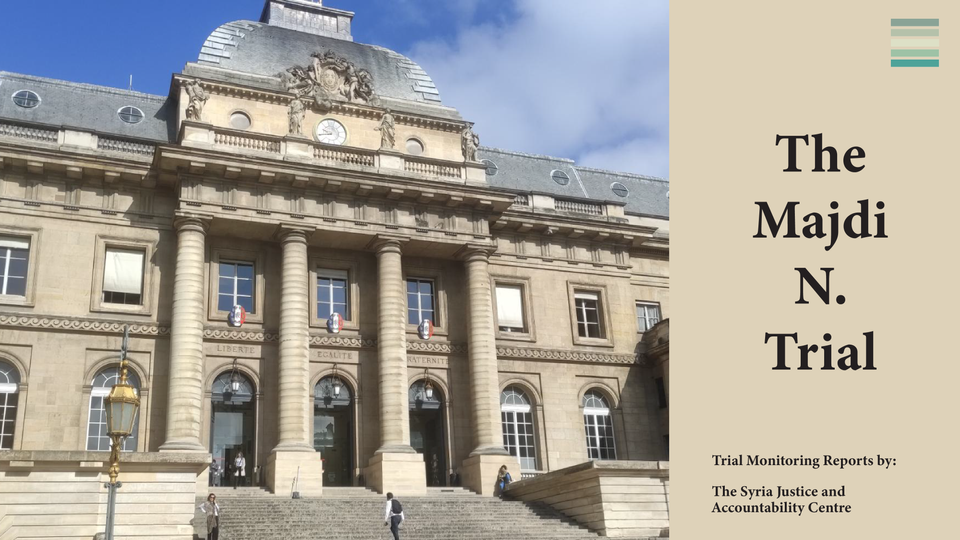
Inside the Majdi N. Trial #35: Closing Arguments of the Defense
TRIAL OF MAJDI N.
Court of Assize – Paris, France
Trial Monitoring Summary #35
Hearing Date: May 27, 2025
CAUTION: Some testimony may include graphic descriptions of torture, rape or other violent acts.
Note that this summary is not a verbatim transcript of the trial; it is merely an unofficial summary of the proceedings.
Throughout this summary, [information located in brackets are notes from our trial monitor] and “information placed in quotes are statements made by the witness, judges or counsel.” The names and identifying information of witnesses have been redacted.
[Note: SJAC provides a summary of the proceedings while redacting certain details to protect witness privacy and to preserve the integrity of the trial.]
[Note: Rather than publishing the trial reports of the Majdi N. case in chronological order, SJAC has organized them thematically and coherently based on the content of the hearings, making the material more accessible by highlighting key issues and connections across the proceedings.]
SJAC’s 35th trial monitoring report details day 17 of the trial of Majdi N. in Paris, France. On this trial day, Counsel Ruiz first criticized the insistence on organizing this trial in Paris even though France lacked the basic means to ensure high-quality justice. Both Counsels emphasized that the Geneva Conventions did not prohibit war, meaning that Jaysh Al-Islam had the right to exist and Majdi N. to be spokesperson of the group. Regarding the first charge related to child recruitment, Counsel Ruiz argued that French law did not ban the recruitment of children above the age of 15 and that no war crime could be committed by negligence or omission but had to rather be proved by positive acts. Discussing the evidence related to this charge, Counsel Ruiz argued that nothing proved the existence of training camps dedicated to children or the fact that new recruits of Jaysh Al-Islam were under 15 years old. Counsel Ruiz also criticized the Prosecution’s argument that the 2013 siege of Ghouta necessarily led to enforced recruitment of children. Counsel Ruiz then dismissed all evidence related to Majdi N.’s involvement in child recruitment.
Counsel Kempf requested that Majdi N. be acquitted of participating in a group or an agreement established to prepare for war crimes. Regarding the movement of the Accused between Syria and Turkey, Counsel Kempf said that nothing contradicted the fact that Majdi N. never went back to Ghouta after May 2013. Counsel Kempf argued that Majdi N. learned about events such as the exhibition of civilians in cages after it happened and legitimately believed in the justice system established in Ghouta. Counsel Kempf believed that convicting Majdi N. amounted to convicting members of armed groups who could be relied upon to promote international humanitarian law inside factions.
Day 17 – May 27, 2025
Proceedings resumed at 2:12 PM.
Closing Argument by Counsel Ruiz – on the charge of child recruitment
Counsel Ruiz declared that Majdi N. always fought for his truth to be heard. He criticized the Prosecution’s portrayal of the Accused the day before and emphasized that Majdi N. was a reflection of his country and time. Counsel Ruiz urged the Jury to not stop thinking when terms like “Jihad” were pronounced, and to rather focus on evidence.
Counsel Ruiz depicted the history of France’s “civilizing mission” in Syria and insisted that Syrians had felt betrayed by the international community in 2013. He insisted that France wished this trial to take place in Paris and considered it a political and diplomatic trial in which France’s international reputation was at stake. However, Counsel Ruiz noted, France’s judiciary refused to acknowledge its true capacities, such as the lack of digital devices and shortcomings in international cooperation. The only person who didn’t pretend and came without a mask was Majdi N.
Counsel Ruiz urged the Jury to pursue the work of the Court of Appeal, which had already dismissed several charges against Majdi N., including the disappearance of the ‘Douma four.’ He insisted that Majdi N. did not appear in the first organizational chart presented in the complaint by the Syrian Center for Media and Freedom of Expression (SCM). According to Counsel Ruiz, people kept casting Majdi N. in a role that was far too big for him.
Counsel Ruiz noted that the Syrian victims who came to this Court showed incredible resilience and restraint: none of them cried, none of them shouted. If Majdi N. also did not show his feelings, Counsel Ruiz believed, that did not mean he had no empathy or was manipulative. Majdi N. was not a cold monster who did not commit to anything, and his relationship with Zahran Alloush was not the only reason for his engagement against the Syrian regime.
Shifting to the context of war, Counsel Ruiz explained that the Geneva Conventions did not prohibit war, which means there is a right to kill and take prisoners, to recruit and target military objectives. Counsel Ruiz regretted that the debates did not address the intense bombings Ghouta was submitted to and rather focused on the compatibility between Jaysh Al-Islam and democracy in a country where a single party had held the reins of power since 1963.
Counsel Ruiz then criticized the way the evidence, including the execution of Abu Ali Khabiyeh, F34, was presented to the Court with the intent to construct a certain scenario. The Defense never pretended that the Unified Judiciary Council was perfect but only noted that it existed, and considering this, Counsel Ruiz opposed the view that Jaysh Al-Islam executed people summarily in the streets. The Defense tried to introduce a nuance that clearly seemed to frighten the Prosecution. Counsel Ruiz also criticized the way context witnesses were presented as experts but did not necessarily have sufficient and up-to-date knowledge of the Syrian situation.
Concerning the first charge of complicity in child recruitment, Counsel Ruiz said that even if the Jury considered Jaysh Al-Islam responsible of conscripting minors between the ages of 15 and 18, Majdi N. was not guilty. Counsel Ruiz said that complicity by negligence did not exist. On the contrary, complicity must be proved by positive acts. As such, the Court had to prove the existence of propaganda which precisely intended to recruit minors.
Counsel Ruiz argued against the Prosecution’s interpretation of Article 461-7 of the French Criminal Code on child recruitment and the Optional Protocol on the Involvement of Children in Armed Conflict. In Counsel Ruiz’s view, the latter must be set aside in favor of national law. As for the intention of the French legislature, it deliberately sought to go beyond the protocol signed seven years earlier [and thus lowered the age of possible recruitment to 15]. Counsel Ruiz further argued that the distinction between a regular army and an armed group does not exist.
Considering the alleged complicity of Majdi N., Counsel Ruiz argued that the Court first had to say who the perpetrator of the crime was. However, international criminal law does not permit prosecuting a legal entity or an armed group such as Jaysh Al-Islam but must focus on members and define the main perpetrator. Counsel Ruiz emphasized that Zahran Alloush, who Majdi N. supported, was not the main perpetrator of this offense. In addition to that, Majdi N. was not integrated in departments of Jaysh Al-Islam whose members were more directly involved in the crime.
Counsel Ruiz emphasized that different types of complicity existed in French law. The hierarchical complicity provided for in Article 462-7 of the French Criminal Code was the only type of complicity recognized in the Rome Statute. But in the present case, only the classical complicity from Article 121-7 of the French Criminal Code was retained. To Counsel Ruiz, this constituted an acknowledgment by the Prosecution that Majdi N. was not in a position of command. Counsel Ruiz also criticized the Civil Parties’ use of case law related to complicity by negligence, which derived from ordinary criminal law, to argue on a case related to the law of war. Counsel Ruiz argued that no war crime could be committed by negligence or omission.
The complicity had to be established by a prior agreement between the Accused and the perpetrator of the crime. But Counsel Ruiz claimed that no perpetrator had been identified, meaning it was not possible to prove the existence of any prior pact. As a result, no material act supported this charge. Counsel Ruiz asked the Court to answer 'no' to the questions related to the guilt of the Accused in complicity in child recruitment.
Shifting to the evidence presented to the Court, Counsel Ruiz quoted the chief investigator W6’s testimony that no element proved the existence of training camps for minors. He added that no element showed that Jaysh Al-Islam intended to target minors in their recruitment campaigns, and no element proved that the young men appearing in videos and photos were under 15 years old. Counsel Ruiz explained that in France, even bone tests used to determine the age of migrant minors were considered unreliable and argued that what could not be assessed by a scientific test could also not be assessed by the Jury’s sole eyes. Counsel Ruiz further stressed that the Arabic term “Ashbal”أشبال [a term which appears in documents related to training camps] only meant that the recruits were young, which was normal in war contexts.
Counsel Ruiz further argued that Zahran Alloush’s claim regarding his own son who allegedly joined Jaysh Al-Islam when he was 13 was probably false. Counsel Ruiz then said the Prosecution made a shortcut by pretending that the 2013 siege of Ghouta meant systematic and necessary coercion. He stressed that all factions paid combatants. Counsel Ruiz then mentioned several sources to conclude that, at that time, it was possible to choose other activities rather than enlist in Jaysh Al-Islam. Counsel Ruiz believed that the Court could not exclude the possibility that a minor who witnessed his parents' deaths in the bombings and who was starving could decide to fight the Syrian regime and did so voluntarily. He added that no one prosecuted Jaysh Al-Islam for starving the population, and the Accused has not charged with complicity in that crime, for the simple reason that the act of starving the population was attributable neither to the group nor to Majdi N.
Counsel Ruiz asserted that no evidence linked the Accused to the propaganda that targeted minors for recruitment. In the only videos in which Majdi N. was seen in front of young recruits, it was neither possible to say that the children were under 15, nor to say that minors above 15 were not there voluntarily. Counsel Ruiz also pointed to contradictions in the testimonies of [redacted name], who was 16 and not 14 years old when he joined the group. Counsel Ruiz further expressed his surprise that neither [redacted name] W20 nor [redacted name] W12 could bring evidence of the poster targeting minors that was allegedly plastered in Ghouta’s streets.
Regarding [redacted name], [redacted name] and [redacted name], F11, F12, and F13, Counsel Ruiz first argued that the fact that all three came from the same family diminished the probative value of their statement. He also pointed to contradictions in the statements of F12 and F13. Counsel Ruiz further emphasized that several specialists of the Syrian conflict never mentioned child recruitment. As a result, it was not possible to scientifically assert that young people among Jaysh Al-Islam were under 15 or were forcibly recruited. As such, the intention of Majdi N. could not be proved. By acquitting the Accused, Counsel Ruiz claimed that the Jury could at the same time recognize Jaysh Al-Islam’s liability without attributing it to the Accused personally.
Proceedings were suspended for 20 minutes.
Closing Argument by Counsel Kempf
Counsel Kempf listed the main assertions made by seven witnesses, namely that they did not know the exact role of Majdi N., and they said the Accused did not talk during their encounter and that they only knew Majdi N. through the media. The witnesses knew nothing about the Accused except through rumors, assumptions, or personal beliefs. Counsel Kempf argued that this was the very opposite of justice and of evidence examination.
Counsel Kempf relayed that when he first met the Accused, Majdi N.’s only concern was to know if he had been accepted at King’s College London. He was ambitious in the best sense of the word, and open to others. Counsel Kempf also emphasized that defecting from the Syrian regime in 2012 required courage, adding that Majdi N. risked being sentenced to death. As a reaction to the allegations that Majdi N. would be welcomed as a hero if he went back to Syria, Counsel Kempf asserted that the Syrian President Ahmed Al-Sharaa, who made an official visit to France in May 2025, when the trial was taking place, obviously did not care about the Accused. Counsel Kempf added that it was extremely rare for an Accused to have such long pretrial detention, and equally rare to have no contact with his loved ones, besides speaking to them on the phone.
Counsel Kempf reminded the Court of the importance of the Telegram messages that could not be retrieved and added to the case file. He praised the fact that Majdi N. was taking a transparent approach and relayed the Accused’s concern when noticing significant mistakes in translations during the proceedings. Counsel Kempf criticized the Investigative Judge’s refusal to hear 18 witnesses supporting the Defense and noted that in the huge number of documents, no orders and no preparatory acts by Majdi N. were found.
According to Counsel Kempf, this investigation went backwards after the complaint was filed to shed light on the fate of Razan Zeitouneh F21 and the ‘Douma four,’ following which a suspect was found, and a case was built.
Referring to the laws of war, Counsel Kempf insisted that Jaysh Al-Islam had the right to exist and Majdi N. to be spokesperson of the group, and even to lead a training camp. Counsel Kempf emphasized that "the question of the group’s ideology is therefore completely irrelevant, whether it is Salafist, refers to Sharia, or criticizes democracy.” Counsel Kempf recognized that [the West] might have preferred that these groups be perfectly secular, with no reference to Sharia. But, he argued, it was not possible to dismiss a legal system that was legitimate for millions of people around the world. Counsel Kempf added that Jaysh Al-Islam took into consideration the fact that the Syrian territory was home to diverse ethnic and religious minorities and that the group was not driven by the same level of expansionist or radical ambitions as ISIS or Al-Qaeda.
Counsel Kempf still believed that justice would have been better served in Syria, not because of considerations related to a fair trial, but because after half a century of dictatorship, witnesses had to be heard as close as possible [to their homes], so transitional justice could function effectively. That was what led the Defense to travel to Syria [in early 2025], Counsel Kempf argued, deploring that the investigation did nothing to support the Defense in these past five years.
Counsel Kempf requested that Majdi N. be acquitted for the charge of participating in a group or an agreement established to prepare for war crimes and argued on the existence of two distinct legal traditions regarding this offense. The first one, shared by France and Syria, was rather authoritarian, whereas the second one represented by international law was more flexible.
Regarding the ‘association of wrongdoers,’ [the appearance and evolution of this offense in the French legal corpus was subject to intense debates throughout the 19th and 20th centuries. Since the 1990s, legal reforms gradually broadened the scope of this offense and, in 1996, the offense of ‘association of wrongdoers in relation to a terrorist enterprise’ was created. In the wake of the 2015 terrorist attacks on French soil, the legal classification of the offense became more severe and the sentencing range higher] Counsel Kempf stressed that this offense was created by a law that was criticized by Francis de Pressensé, the first president of the French Human Rights League. Comparing this offense to the present charge of ‘participating in an agreement’ brought against Majdi N., Counsel Kempf emphasized that the term ‘agreement’ could justify prosecuting anything. He added that Syria had the very same incrimination in its own Criminal Code, at Article 325. Considering international law, Counsel Kempf argued that Article 25 of the Rome Statute [on individual criminal responsibility] did not punish the sole fact of being member of a group. As such, Counsel Kempf wondered how it was possible, legally speaking, to condemn someone who did not directly take part in the crimes, did not try to commit them, and was not the accomplice.
Reacting to the arguments brought by the Prosecution and the Civil Parties, Counsel Kempf relayed the ruling of the Court of Cassation [highest French Court] on the non-necessity to determine what crimes were committed in order to convict someone for its participation in an agreement that aimed at preparing such crimes. However, Counsel Kempf noted, this case law did not relate to Article 461-18 of the French Criminal Code [related to war crimes], but to antiterrorism. He claimed that the Court could not convict someone based on a case law which related to an inapplicable article [on terrorism].
Counsel Kempf repeated that the idea behind the charge of participating in a group or agreement formed to prepare for a war crime was to punish someone before the commission of the crime. Counsel Kempf deduced that the participation had to necessarily precede the crime and claimed that Majdi N. could not be convicted for acts he did not commit. Counsel Kempf criticized the Prosecution’s view that anyone involved in Jaysh Al-Islam should be convicted and claimed that this interpretation was contrary to Article 461-18 of the French Criminal Code. Quoting witness [redacted name], W13’s declaration that all factions committed war crimes, Counsel Kempf said that, according to such an interpretation, all members of all Syrian factions would have to be convicted. According to Counsel Kempf, it would be impossible for a country to rebuild itself if everyone who took part in factions were convicted regardless of what they did.
Counsel Kempf mentioned questions that would help the jury assess the ‘material element’ related to the offense of participating in a group or an agreement established to prepare for war crimes. Counsel Kempf first asked if Majdi N. was one of the members who committed the crimes, and then asked if evidence established that Majdi N. participated in preparatory acts. If the Jury was to respond in the negative to even one question, Counsel Kempf argued, Majdi N. had to be found not guilty. As for the ‘intentional element,’ Counsel Kempf believed that the Jury had to respond in the negative to the questions of whether Majdi N. knew about the preparation of crimes before their commission and participated in the agreement with the intent to commit such crimes.
Shifting to the timeline on Majdi N.’s movements between Syria and Turkey presented by the Defense, Counsel Kempf said that the additional information brought by the Prosecution on Majdi N.’s presence in Syria did not contradict the fact that he never went back to Ghouta. According to the witnesses, Majdi N. came back to Ghouta no fewer than four times in 18 months, which seemed not credible to Counsel Kempf, considering the Syrian situation at that time and the lack of any material evidence corroborating those testimonies. Counsel Kempf hoped that the Jury would take it as established that Majdi N. never returned.
As for the claims that Majdi N. had other duties besides being spokesperson of the group, Counsel Kempf argued that it could not be established that Majdi N. was giving orders. Counsel Kempf believed that for him to be convinced that he was doing his job well, and to deliver the message expected of him to diplomats, it was necessary that Majdi N. did not know what was really going on in Ghouta.
Counsel Kempf further argued that Majdi N. was not among the ones who prepared the attack on Adra Al-Omaliya and only knew about the exhibition of civilians in cages after it happened. Counsel Kempf argued that, perhaps somewhat foolishly or naively, Majdi N. believed what his superiors told him. Concerning the deliberate attacks against civilians, Counsel Kempf pointed to a publication by Majdi N. in which he denounced a violation during the battle of Sheikh Maqsood الشيخ مقصود in Aleppo and declared that the commander from Jaysh Al-Islam responsible was brought to court. Counsel Kempf argued that Majdi N. legitimately believed in the justice system established in Ghouta.
Regarding kidnapping and unlawful detention, Counsel Kempf argued that no one who had been arrested, prosecuted, or imprisoned by members of Jaysh Al-Islam made any reference to the Accused. Counsel Kempf added that there was a separation between the different branches of Jaysh Al-Islam, and between branches inside and outside Ghouta. According to Counsel Kempf, even though all now knew that it was not true, Majdi N. honestly had believed in Zahran Alloush’s view on a detention system that respected the rights of prisoners. Referring to inhumane treatment against [redacted name], F86, who died under torture committed by Jaysh Al-Islam, Counsel Kempf believed that Majdi N. was convinced that F86 belonged to ISIS. Counsel Kempf added that Majdi N. was certain that the investigator who was responsible for F86’s death would be brought before the Unified Judiciary Council.
Counsel Kempf argued that, regarding the pronouncing of convictions and execution of sentences without a prior judgment rendered by a regularly constituted court, Majdi N. believed that the ISIS member executed on a video dated July 2015 had previously been convicted. Counsel Kempf added that Majdi N. was not a lawyer and believed that courts had been established. A decision was also issued before the execution of Abu Ali Khabiyeh F34, and Counsel Kempf argued that the judicial system could appear legitimate and functioning to an external actor such as Majdi N.
As for the role of Majdi N. in the implementation of international humanitarian law, Counsel Kempf said that a way to defend such principles was to maintain a dialogue with factions at a time when potential violations could be committed. Majdi N. was a point of contact to spread those principles, and Counsel Kempf believed that convicting such actors amount to depriving ourselves of the very interlocutors who could help bring this approach into effect.
Even though Jaysh Al-Islam did not sign the deed of commitment with Geneva Call, Counsel Kempf argued, three documents showed the active role of Majdi N. in promoting international humanitarian law principles inside Jaysh Al-Islam. Counsel Kempf added that all three were working documents that Majdi N. did not communicate about. To convict Majdi N. was to convict the one person in armed groups who could be relied upon and might persuade his leaders to sign agreements.
Counsel Kempf claimed that the verdict could send a message to Syrians who are reflecting on justice, namely that armed groups have committed crimes, but that not everyone should be convicted. Counsel Kempf urged the Court to deliver justice by saying that Jaysh Al-Islam committed crimes, but that Majdi N. did not.
Proceedings were suspended at 6:12 PM.
___________________________
For more information or to provide feedback, please contact SJAC at [email protected] and follow us on Facebook and Twitter. Subscribe to SJAC’s newsletter for updates on our work