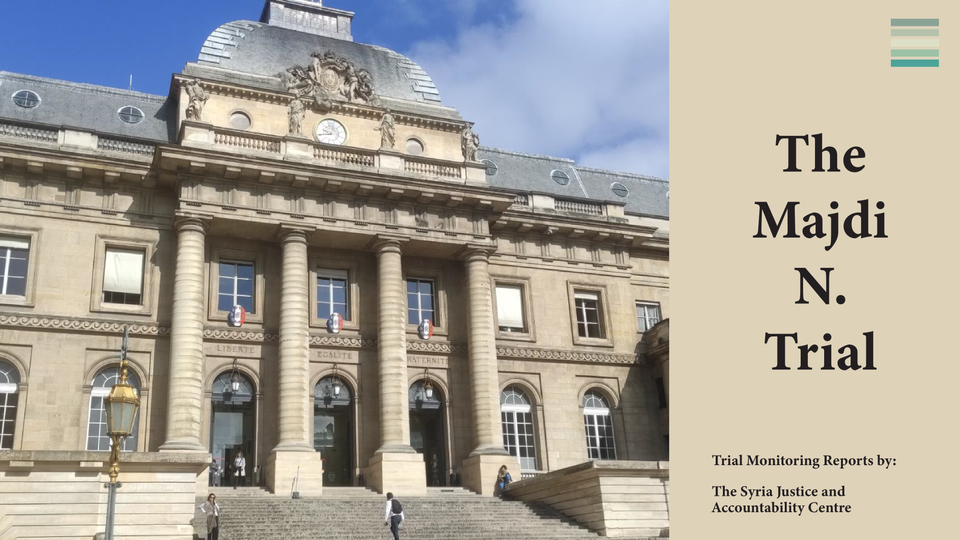
Inside the Majdi N. Trial #34: Closing Argument of the Civil Parties
TRIAL OF MAJDI N.
Court of Assize – Paris, France
Trial Monitoring Summary #34
Hearing Date: May 26, 2025
CAUTION: Some testimony may include graphic descriptions of torture, rape or other violent acts.
Note that this summary is not a verbatim transcript of the trial; it is merely an unofficial summary of the proceedings.
Throughout this summary, [information located in brackets are notes from our trial monitor] and “information placed in quotes are statements made by the witness, judges or counsel.” The names and identifying information of witnesses have been redacted.
[Note: SJAC provides a summary of the proceedings while redacting certain details to protect witness privacy and to preserve the integrity of the trial.]
[Note: Rather than publishing the trial reports of the Majdi N. case in chronological order, SJAC has organized them thematically and coherently based on the content of the hearings, making the material more accessible by highlighting key issues and connections across the proceedings.]
SJAC’s 34th trial monitoring report details day 16 of the trial of Majdi N. in Paris, France. On this trial day, Counsels Baudouin and Bailly emphasized why France was authorized to judge this case. Both Counsels criticized the confusion maintained by the Defense between the two offenses of ‘participation in a group or an agreement established to prepare for war crimes’ and ‘association of wrongdoers in relation to a terrorist enterprise.’ They clarified why they opposed the latter and what important distinction they made between both. Both Counsels argued that that Majdi N. did not have a minor role inside Jaysh Al-Islam and mentioned the evidence proving both the ‘intentional’ and the ‘material’ elements of his involvement in the crimes. Referring to other criminal proceedings, Counsel Bailly argued that complicity could be characterized by negligence or through subsequent acts committed by the accomplice.
Day 16 – May 26, 2025
Proceedings resumed at 3:40 PM.
Closing Argument by Counsel Baudouin
Counsel Baudouin presented the history of the French Human Rights League (French HRL) and the International Federation for Human Rights (IFHR). Referring to the trial of three Syrian officials that took place in France in 2024 [see trial reports here], he emphasized that the other side of the war was now on trial.
Counsel Baudouin criticized the Defense’s strategy of delegitimizing the trial and the Court and downplaying the role of the Accused. Referencing the legal basis of French universal jurisdiction, he insisted that transitional justice was not a substitute for individual criminal justice. Counsel Baudouin also asserted that no fair trial could take place in Syria, contrary to the Defense’s statement.
Concerning the deliberate confusion maintained by the Defense between the two offenses of ‘participation in a group or an agreement established to prepare for war crimes’ and ‘association of wrongdoers in relation to a terrorist enterprise,’ Counsel Baudouin first stressed that they related to different articles of the French Criminal Code. He explained why the French HRL always criticized the second offense and argued that the present case was not about terrorism, but about war crimes.
To convict the Accused, the Court had to prove the commission of war crimes by Jaysh Al-Islam and then the personal responsibility of Majdi N. Counsel Baudouin insisted that the executions committed in Ghouta resulted from a decision of a jurisdiction he considered illegitimate and not regularly constituted. As for the argument of cultural relativism, Counsel Baudouin stressed that the argument is a discourse of oppressors, but never that of the silenced civilian populations who suffer from these kinds of crimes.
Regarding the role of the Accused, Counsel Baudouin claimed that everything showed that Majdi N. did not have a minor role at all. He took the name of Alloush, which showed the absence of any disagreement with this leader who had a terrible reputation. The function of spokesperson was staggering in its violence, and in line with the most radical Jihadism. Counsel Baudouin expressed that he was appalled to hear this man, spokesperson for a group that committed so many atrocities, claim that he was there to ensure respect for international humanitarian law.
Counsel Baudouin emphasized that Majdi N.’s answers were convoluted and unclear, and when he did respond, he claimed that the questions asked were unclear. The Accused remained in denial and constantly vague, including about his movement between Syria and Turkey after he allegedly left Ghouta in May 2013. What Counsel Baudouin found the worst was that, given the evidence and whether he was guilty or not, Majdi N. did not express a single word of humanity toward victims of Jaysh Al-Islam.
Rejecting the Defense’s critique of an imperialist justice, Counsel Baudouin became emotional and said that the Court had been seized by Syrian victims and acted in accordance with the universality of rights and justice. This trial was part of a long and difficult struggle against the impunity of perpetrators, and Counsel Baudouin concluded that the behavior of the Accused was not unusual, since perpetrators were, despite everything, always in search of respectability.
Closing Argument by Counsel Bailly
Counsel Bailly addressed the Jury to say that they had been plunged into what is most exhausting about justice: the adversarial process. Majdi N.’s objective was for this trial to not take place. Counsel Bailly disputed the lack of legitimacy of the Court. Providing other historical examples of international justice in periods of transition, Counsel Bailly argued that justice in Syria was not coming anytime soon and that the transitional justice law [recently passed in Syria] only provided for the prosecution of crimes committed by the Syrian regime.
Counsel Bailly stressed that this trial was the outcome of an action initiated by the Syrian Center for Media and Freedom of Expression (SCM), which provided investigators with evidence. The difficulty lay in facing an Accused who admitted to nothing—and under such circumstances, Counsel Bailly considered it hard to completely rule out doubt. But he added that personal conviction did not amount to absolute truth or purely mathematical reasoning. “Personal conviction means refusing the comfort of eternal doubt.”
Regarding the offense of complicity in recruitment of children provided for in Article 461-7 of the French Criminal Code, Counsel Bailly agreed with the Prosecution on the interpretation that even voluntary enlistment in armed groups was prohibited. He added that the prohibition did not only concern participation in combat, but also other forms of involvement in armed groups.
Regarding the participation in a group formed or an agreement established with the intent to prepare for war crimes, Counsel Bailly insisted on the necessity to first qualify the armed conflict to then apply laws of war and international humanitarian law and define the crimes at stake. In contrast, the offense of ‘association of wrongdoers in relation to a terrorist enterprise,’ which Counsel Bailly indeed opposed, was different, since it encompasses very different cases.
Counsel Bailly further argued on the necessity to first prove the commission of crimes by Jaysh Al-Islam. Just like Jabhat Al-Nusra and ISIS, the fact that Jaysh Al-Islam fought against the regime was not a reason to not be convicted, he claimed. Addressing the group’s ideology, Counsel Bailly argued that Jaysh Al-Islam’s sought to establish Islamic law and did not really intend to overthrow the Syrian regime and liberate Damascus. Counsel Bailly referenced a note from the French Intelligence showing that Jaysh Al-Islam had no interest in the siege being lifted.
Addressing the evidence of children’s recruitment, Counsel Bailly mentioned the reports attesting to the presence of minors in Jaysh Al-Islam’s ranks, the speeches of Zahran Alloush, the corroborating witnesses’ testimonies and the economic situation in Ghouta, which forced young men and children to join the group. As for the participation in a group or an agreement established to prepare for war crimes, Counsel Bailly brought forward the massacre of Adra Al-Omaliya, the video of people exhibited in cages, and the prison system, as well as the violence and humiliation inflicted on people in detention. Concerning the crime of convictions and executions of sentences without a prior judgment rendered by a regularly constituted court, Counsel Bailly argued that Jaysh Al-Islam manipulated the Unified Judiciary Council to eliminate rival factions and pointed to the practice of summary executions.
Counsel Bailly asked the Court to convict the Accused for complicity in children’s recruitment and deduced the personal involvement of Majdi N. from its presence at key moments. Pursuant to Article 121-7 of the French Criminal Code, an accomplice to a crime is a person who knowingly, by aid or assistance, facilitates its preparation or commission.
To prove the ‘intentional element,’ Counsel Bailly asserted that Majdi N. knew about Jaysh Al-Islam’s practice of minors’ recruitment and added that the complicity could be characterized by negligence, omission, or inaction, if the person ought to have known about the group’s practices. A decision of the French Court of Cassation dated March 26, 1992 concluded that such acts could constitute a complicity, if it showed the intent to associate.
Counsel Bailly also referred to the notion of 'chain complicity,' when second-degree accomplices associate with first-degree accomplices, like in the case related to the 2012 campaign financial accounts of former French President Nicolas Sarkozy. Referring to the French Lafarge case [French cement company indicted for financing terrorism and complicity in crimes against humanity committed in Syria. The company will stand trial in November 2025 in France], Counsel Bailly further emphasized that a person could be an accomplice through subsequent acts, when the action served to cover or to help the main perpetrator escape. According to Counsel Bailly, this could relate to Majdi N.’s propaganda activities to obtain financial support. Summing up Majdi N.’s intentions, Counsel Bailly quoted the Accused, who believed that no one had made as much effort for the group as he had, and that he left solely for administrative reasons.
Shifting to the ‘material element,’ Counsel Bailly said that he disagreed with the Prosecution’s view that no sufficient evidence was available to prove Majdi N.’s involvement in child recruitment. To support his claim, Counsel Bailly referenced the statements of [redacted name] F67 and the evidence extracted from Majdi N.’s digital devices, which both showed Majdi N.’s efforts to mobilize new recruits. The statement of [redacted name] F13 on the trainings’ schedule and punishments of young recruits corroborated these material elements. Counsel Bailly also mentioned the testimony of [redacted name] W20, who attested to Majdi N.’s presence in a camp in northern Syria where children were being trained. Another testimony by [redacted name] W22 pointed to declarations of Majdi N.’s on children’s involvement in combat, and the statement of [redacted name] F12 to Majdi N.’s presence in training camps.
Counsel Bailly asserted that the Court had enough evidence to proceed with a conviction. However, he believed that the sentence should reflect the quality of the evidence.
Considering the participation in a group or an agreement established to prepare for war crimes, Counsel Bailly supported the idea that the ‘intentional element’ could result from the person’s claim to belong to a criminal group and from subsequent elements, such as loyalty. The ‘material element’ was easy to prove, since a genuine group was formed. As evidence of the intentional element, Counsel Bailly mentioned propaganda videos of executions that Majdi N. relayed on social media. Concerning the ‘material element,’ Counsel Bailly believed that various testimonies of W12, W20, or W22, as well as other audio recordings, were evidence of Majdi N.’s presence in Ghouta. Counsel Bailly also highlighted Majdi N.’s contributions in communications, Majdi N.’s reporting on crimes, such as the kidnapping of people, including the ‘Douma four,’ and the breakdown on members of Jaysh Al-Ummah.
Finally, Counsel Bailly depicted Majdi N. as a man from a stable and privileged environment that was conducive to personal growth and success. What drove the Accused was opportunity, since he saw himself as a man of influence. Majdi N. chose his side out of self-interest and had not been forced. Counsel Bailly believed that a conviction would destroy Islam Alloush and allow redemption for Majdi N.
Counsel Bailly concluded by expressing a few words for the Civil Parties, who could not receive compensation, and whose sole motivation was to be recognized as victims.
Proceedings were suspended at 7:01 PM.
___________________________
For more information or to provide feedback, please contact SJAC at [email protected] and follow us on Facebook and Twitter. Subscribe to SJAC’s newsletter for updates on our work