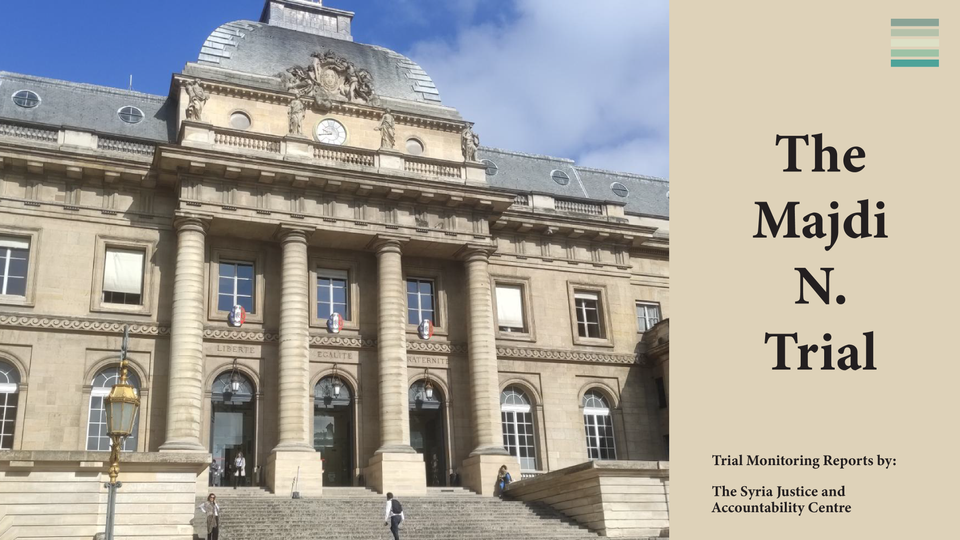
Inside the Majdi N. Trial #33: Requisition of the Prosecution
TRIAL OF MAJDI N.
Court of Assize – Paris, France
Trial Monitoring Summary #33
Hearing Dates: May 23 and 26, 2025
CAUTION: Some testimony may include graphic descriptions of torture, rape or other violent acts.
Note that this summary is not a verbatim transcript of the trial; it is merely an unofficial summary of the proceedings.
Throughout this summary, [information located in brackets are notes from our trial monitor] and “information placed in quotes are statements made by the witness, judges or counsel.” The names and identifying information of witnesses have been redacted.
[Note: SJAC provides a summary of the proceedings while redacting certain details to protect witness privacy and to preserve the integrity of the trial.]
[Note: Rather than publishing the trial reports of the Majdi N. case in chronological order, SJAC has organized them thematically and coherently based on the content of the hearings, making the material more accessible by highlighting key issues and connections across the proceedings.]
SJAC’s 33rd trial monitoring report details parts of days 15 and 16 of the trial of Majdi N. in Paris, France. On these trial days, the Prosecutor described the context of the Syrian war and the emergence of Jaysh Al-Islam in Ghouta. She then detailed the legal basis for the two charges of participation in a group formed or an agreement established with the intent to prepare for war crimes and complicity in the recruitment of children. The Prosecutor presented the evidence of Jaysh Al-Islam’s perpetration of such crimes and subsequently the evidence pointing to Majdi N.’s involvement in these crimes. The Prosecutor asked the Court to find the Accused responsible for participating in an agreement established to prepare five of the six war crimes Majdi N. was charged with. The Prosecution also requested the acquittal of Majdi N. on the charge of complicity in recruitment of minors as a war crime.
Day 15 and 16 – May 23 and 26, 2025
Proceedings resumed at 12:57 PM.
In an introduction, the Prosecutor emphasized that her role was not to argue on the guilt of the Accused at all costs, but to provide factual and legal reasoning. She then explained the source of France’s jurisdiction to judge crimes committed in Syria and argued that universal jurisdiction was not a sign of neocolonial justice. The difficulties related to accessing the Syrian territory and to obtaining physical evidence could be overcome with the numerous witnesses’ testimonies and the digital material gathered in the present investigation.
SYRIAN CONTEXT AND PRESENTATION OF JAYSH AL-ISLAM
The Prosecutor went over the different stages of the conflict since 2011 and noted that Syria experienced a non-international armed conflict (NIAC). She focused on Eastern Ghouta, birthplace of the Salafist group Jaysh Al-Islam, founded by Zahran Alloush. The Prosecutor explained how Ghouta constituted a region of strategic importance in the fight against the Syrian regime and witnessed conflicts between different armed factions. She further described the consequences of the siege, which started on April 24, 2013.
To understand the role of the Accused in the alleged charges, the Prosecutor presented the group Jaysh Al-Islam. Most notably, she argued that the group focused on a religious and sectarian Sunni narrative and distanced itself from the Free Syrian Army. She insisted on the duplicity in Zahran Alloush’s discourse, asserting that with the support of Majdi N., Jaysh Al-Islam developed a well-considered communication strategy. Through repeated examples, she argued that Jaysh Al-Islam operated in a quasi-state like manner. Majdi N. was deputy head of the Media Office, which employed a total of 200 people in Syria, including 90 in Ghouta itself.
Jaysh Al-Islam relied first on its military power as well as its control over the resources in Ghouta, the Prosecutor argued. The labor market was placed under the group's near-monopoly. The Unified Judiciary Council was used by Zahran Alloush, but he did not submit to it. The Prosecutor noted that the scale of arrests was undeniable and depicted a clear logic of control over the territory. According to her, all these elements demonstrated that the fight against the regime had taken a backseat and that the revolutionary dimension faded in favor of a hegemonic struggle.
To the Defense’s assumption that Majdi N. was merely a subordinate, the Prosecutor retorted that he held strategic functions. The Prosecutor argued that in 2012, Majdi N. could have left Ghouta rather than choosing to serve in Liwa Al-Islam. After that, Majdi N. aligned himself with Jaysh Al-Islam’s Salafist ideology and agreed with the political project of an 'authoritarian Sunni theocracy.'
Proceedings were suspended at 7 PM and resumed on May 26.
LEGAL DETAILS ON CHARGE 1: PARTICIPATION IN A GROUP FORMED TO PREPARE FOR WAR CRIMES
The Prosecutor explained that the charge of participation in a group formed, or an agreement established, with the intent to prepare for war crimes stems from the London Agreement of August 8, 1945, which established the Nuremberg Military Tribunal. This agreement stipulates that leaders, organizers, instigators, or accomplices who take part in the organization of a conspiracy to commit war crimes are responsible for acts committed by anyone carrying out this plan. The Prosecutor listed the tribunals which used this same charge and argued that this not only constituted a violation under French law, but under various other legal systems.
Characterizing the participation in a group formed or an agreement established with the intent to prepare for war crimes required demonstrating several elements of the offense:
1. The participation of the accused in a group or agreement, which is called the “material element.” The material element is automatically fulfilled when crimes are committed.
2. The resolution to act jointly, which is called the “intentional element." The intentional element is the deliberate decision to join the agreement, being aware of its criminal character.
The Prosecutor highlighted the non-necessity to prove that the group was formed with the unique objective of committing war crimes. Moreover, the existence of a formal or explicit agreement was not required. The Prosecutor believed that Jaysh Al-Islam was a well-structured group, and people who participated in it necessarily agreed on the commission of war crimes.
The Prosecutor then detailed the legal aspects of the six categories of war crimes that Jaysh Al-Islam allegedly committed, except for the crime of conscription or enlistment of children, which she addressed at a later stage.
(1) Deliberate attempt on life
This crime is punished by life imprisonment under Article 461-2 of the French Criminal Code. Common Article 3-1 of the Geneva Conventions also provides that persons taking no active part in the hostilities shall be protected, which also includes members of armed forces who have laid down their arms and people held in custody.
The Prosecutor claimed that a deliberate attempt on civilians’ lives occurred during the attack on Adra Al-Omaliya, which witnesses [redacted name] W15, [redacted name] W14, and [redacted name] W11 attested to. The Commission of Inquiry on Syria concluded Jaysh Al-Islam was involved in this attack. The Prosecutor also said that Jaysh Al-Islam executed civilians at other occasions.
The Prosecutor concluded that an agreement was established with the intent to prepare for the war crime of deliberate attempt on life.
(2) Deliberate attempt on physical or psychological integrity
This crime is punished under Article 461-2 of the French Criminal Code.
The Prosecutor referenced the judgment of Naser Orić, which stated that digging trenches caused great physical and psychological suffering and constituted inhumane treatment. The Prosecutor then mentioned the fate of the hostages of Adra Al-Omaliya, civilian opponents, and opponents of Jaysh Al-Islam in Ghouta, as depicted by W15, W11, [redacted name] W20, [redacted name] W17, [redacted name] W22, [redacted name] W21, [redacted name] W16, [redacted name] W12 and [redacted name], F44, among others.
The Prosecutor concluded that an agreement was established with the intent to prepare for the war crime of deliberate attempt on physical or psychological integrity.
(3) Pronouncing of convictions and execution of sentences without a prior judgment rendered by a regularly constituted court
This crime is punished by 20 years of criminal imprisonment or, when it results in the death of the person, by life imprisonment under Article 461-31 of the French Criminal Code. Common Article 3 of the Geneva Conventions also prohibits such convictions.
The Prosecutor explained that in case law, the notion of a ‘regularly constituted court’ refers to the principles of impartiality and independence. The minimum required legal guarantees were to inform the Accused on the offenses and to respect his rights to exercise defense, the principle of legality of prosecution, and the presumption of innocence. Moreover, the Accused cannot be forced to testify against themselves or to plead guilty.
The Prosecutor argued that Jaysh Al-Islam pronounced sentences outside of any legal framework, which in some cases led to the execution of people. She mentioned the testimony of [redacted name] W18 and two videos of executions of a woman and of ISIS members, among others. The Prosecutor also mentioned the significant example of Abu Ali Khabiyeh, F34’s execution and argued that the justice handed down by the Unified Judiciary Council was dictated by Jaysh Al-Islam.
The Prosecutor noted that in the Trial Judgment [points 1133 to 1137] of the International Criminal Court in the case The Prosecutor vs. Al-Hassan related to crimes committed in the Republic of Mali, the Court rejected the argument of cultural relativism.
The Prosecutor concluded that an agreement was established with the intent to prepare for the war crime of pronouncing of convictions and execution of sentences without a prior judgment rendered by a regularly constituted court.
(4) Kidnapping and unlawful detentions committed against persons protected under international law
This crime is punished under Article 461-2 of the French Criminal Code. Common Article 3 of the Geneva Conventions prescribes a minimum set of standards to be respected, including toward people detained by armed groups.
The Prosecutor believed that the investigation brought to light a systematic practice of arrests and abductions of opponents, fighters, and civilians by Jaysh Al-Islam in Ghouta, referring to the testimonies of W11 and W21. The Prosecutor added that their treatment of prisoners never respected the rules of international humanitarian law, contrary to the Accused’s assertion.
The Prosecutor concluded that an agreement was established with the intent to prepare for the war crime of kidnapping and unlawful detentions.
(5) Humiliating and degrading treatment inflicted on persons of the opposing party, seriously undermining their physical or mental integrity
This crime is punished by 15 years of criminal imprisonment under Article 461-5 of the French Criminal Code. Common Article 3 of the Geneva Conventions also prohibits such treatment.
The Prosecutor mentioned various acts that amounted to humiliating and degrading treatment, including the exhibition of officers from the Syrian regime in cages around Douma as well as the detention conditions of [redacted name], the former bodyguard of [redacted name] F36, who had a leg amputated after his car exploded and was detained by Jaysh Al-Islam.
The Prosecutor concluded that an agreement was established with the intent to prepare for the war crime of humiliating and degrading treatment.
(6) Deliberate attacks against civilians, particularly in Damascus
This crime is punished by life imprisonment under Article 461-9 of the French Criminal Code.
In certain limited circumstances, harm to civilian lives may be lawful if it is established that the intended targets were indeed military and that the perpetrator of the attack genuinely sought to avoid harming civilians. Regarding the bombing of neighborhoods in Damascus, the Prosecutor believed that the investigations could not precisely determine what the objectives were, and therefore, if Jaysh Al-Islam had the intent to harm civilians.
The Prosecutor requested the partial acquittal of the Accused on this war crime and concluded that an agreement had been established to prepare five war crimes, but not the sixth.
Role of the Accused
The Prosecutor noted that few witnesses were able to clearly define the prerogatives of the Accused, owing to a deliberate diffusion of responsibilities. Like other individuals occupying positions at the highest levels of the hierarchical structure, the Accused typically remained in the background.
The Prosecutor added that far from being a mere subordinate, Majdi N. held a key position within Jaysh Al-Islam and was in direct contact with the group’s military leaders and political leadership. He enjoyed the trust of his superiors and served as the public face tasked with polishing the group's image.
The Prosecutor referenced several pieces of evidence on the file pointing to Majdi N.’s role as policy and diplomacy advisor and in military operations through his participation in intelligence and surveillance. According to her, Majdi N. had a particularly high level of knowledge of the crimes committed.
Pointing to other evidence, the Prosecutor further argued that Majdi N. was the public face of the group. Majdi N. did not condemn the acts committed but rather endeavored to present them in such a way that they could not be seen as war crimes. She argued that he effectively exercised authority over Jaysh Al-Islam’s Media Office and only relayed a moderate discourse to obtain the military and financial support of the West.
On many occasions, such as the attack on Adra Al-Omaliya, the exhibition of civilians in cages, or the attacks against Jaysh Al-Islam’s opponents, Majdi N. publicly defended Jaysh Al-Islam and lied, ignored certain acts, or shifted the blame on enemies of the group. The Prosecutor listed several cases in which Majdi N. concealed and falsified facts, such as the killing of the Syrian regime’s pilot Nawras Hassan نورس حسن, the arrest of W21, or the death of [redacted name] F85 under torture. Majdi N. could not claim ignorance that these acts fell under the law. His close ties with Jaysh Al-Islam’s leader allowed him to have full knowledge of crimes that were committed by the group.
The Prosecutor added that several pieces of evidence proved that Majdi N. perfectly knew how to access the besieged area and indeed came back to Ghouta after he first left on May 28, 2013. Three interviews of the Accused with TV channels in October and November 2013 showed that Majdi N. was in Damascus’s suburbs, and four witnesses, W11, W12, W16, and W22, declared to have seen him in Ghouta between the end of 2013 and January 2015. The Prosecutor noted that the timeline of Majdi N.’s movements between Syria and Turkey presented by the Defense did not mention several trips by the Accused to Syria, even though they appeared in the case file. She added that no evidence contradicted the declarations of the four witnesses to have seen Majdi N. at different periods in Ghouta.
The Prosecutor deduced that Majdi N. witnessed the presence of detainees and the practice of torture in Jaysh Al-Islam’s prisons in Ghouta. The analysis of messages, press releases, and tweets proved his knowledge of Jaysh Al-Islam’s crimes, even though he did not regularly reside in Ghouta. Majdi N. fully embraced the actions committed by Jaysh Al-Islam and never questioned them. On the contrary, he acted with zeal. Given the Accused’s personality and the length of his involvement, such loyalty could not be attributed to naivety but rather to a deliberate desire for the group's success, which also meant personal success. Through his role as spokesperson, Majdi N. plainly contributed to achieving the goals of Jaysh Al-Islam, including to neutralize armed opponents and dissidents.
The Prosecutor asked the Court to find the Accused responsible for participating in an agreement established to prepare for the five war crimes under counts 1 to 5, and to convict Majdi N. of these charges.
LEGAL DETAILS ON CHARGE 2: COMPLICITY IN RECRUITMENT OF CHILDREN
Applicable Law
The Prosecution objected to separating the questions asked to the Court [see Trial Report #32] about children’s conscription according to whether it concerned minors above or under 15 because such distinction was contrary to the spirit of French law.
Article 461-1 of the French Criminal Code provides that crimes listed in Volume IV Bis of the same Code are considered war crimes when committed in a non-international armed conflict in relation to this conflict. Children conscription and enlistment is punished by 20 years of criminal imprisonment under Article 461-7 of the French Criminal Code. The same article states that these provisions do not constitute an obstacle to the voluntary recruitment of minors above the age of 15.
The Prosecutor argued that this possibility of voluntary recruitment was only applicable to armed forces [and not to factions such as Jaysh Al-Islam] and based her reasoning on France’s international commitments and the intention of the French legislature at the time this offense was codified into law.
The Prosecutor asserted that an international consensus existed on the absolute prohibition of recruiting children under 15 years old and added that the international Convention on the Rights of the Child defined a child as a person under 18. Regarding children aged 15 to 18, France ratified the Optional Protocol on the Involvement of Children in Armed Conflict, which states that armed groups should not, under any circumstances, recruit or use in hostilities anyone under 18. Syria ratified this Protocol on October 17, 2003, and incorporated it into domestic law under Article 488 bis of the Syrian Criminal Code. Jaysh Al-Islam was therefore under an obligation to comply with the provisions of this protocol, which Majdi N. perfectly knew.
As for the intention of the French legislature, it emerged from parliamentary debates that its objectives were twofold. First, the legislator intended to go beyond the Rome Statute, which only punishes the conscription of minors under the age of 15. Second, the legislature sought to preserve the possibility of educating minors over the age of 15 in military schools and of their enlistment in national forces. This law therefore concerns only regular armed forces and under no circumstances does it apply to armed groups, the Prosecutor argued.
Perpetration of the crime by Jaysh Al-Islam
The Prosecutor emphasized that the enlistment of children in Jaysh Al-Islam was documented by the UN, studies of researchers on the conflicts, internal documents of the faction such as propaganda videos, and various witnesses' testimonies.
In particular, the Prosecutor quoted two reports: by the Commission of Inquiry on Syria dated August 13, 2014; and by the General Secretary of the UN dated October 30, 2018. The latter mentioned 103 cases of children enlistment within Jaysh Al-Islam. The armed group never contradicted the findings of these reports.
The Prosecutor also mentioned statements by [redacted name] and [redacted name] that people had no other choice but to join, as well as a video of a speech by Zahran Alloush in front of minors, and other videos and photos in which children were visible on battlefields, training camps, or factories. The Prosecutor specified that in France’s criminal law, evidence is free, so that physical characteristics such as build, face, etc., can be considered to determine the age, just as much as identity documents.
The Prosecutor asserted that Jaysh Al-Islam exploited the revolutionary ideal and used religious imagery in its propaganda to overcome fear. For these minors, the ideal of martyrdom prepared them for death.
W20, W22, W12, and W16 reported enlistment and training of children and mentioned the high salaries given to families of recruits. Witness [redacted name] F12 and [redacted name] F13 alo state to have been recruited when minors. Another three testimonies provided by the Commission of Inquiry and transmitted by the International, Impartial and Independent Mechanism attested to the presence of underaged combatants and prison guards.
The Prosecutor required the Court to conclude the indisputable presence of minors among Jaysh Al-Islam’s ranks and to admit that the living conditions in Ghouta led many minors to have no other choice but to enlist, thus ruling out the possibility of voluntary recruitment.
Responsibility of the Accused in the agreement established to prepare for the war crime of child recruitment
The Prosecutor explained that pursuant to case law of the Court of Cassation [highest French Court], the offense of establishment of an agreement to commit war crime was autonomous and independent. [The principle of non bis in idem provides that a person cannot be charged twice for the same act. However, in the first charge, the crime is the participation in the group and the agreement, no matter which war crime was committed. This is why this charge is considered ‘autonomous and independent; it can be maintained even though the war crime of child recruitment is addressed in a second charge.] As such, this offense could be cumulated with the offense of complicity in the war crime of recruitment of minors, provided that they are established by distinct material acts.
The Prosecutor mentioned several pieces of evidence, such as the program of a training camp found on the Accused’s computer and a recording of a conversation about the necessity to check ID cards of parents of new recruits, demonstrating that Majdi N. was perfectly informed about recruitment of minors. The Prosecutor added that Jaysh Al-Islam was aware that this constituted a violation of international and Syrian law.
As for the material acts that proved the crime, the Prosecutor pointed to propaganda videos which unquestionably played a major role in the recruitment of minors and in which Majdi N. actively participated. According to the Prosecution, the contacts between Majdi N. and the organization Geneva Call concerning training and agreements on international humanitarian law remained a clear example of duplicity.
The Prosecutor asked the Court to find the Accused guilty of complicity in child recruitment.
Responsibility of the Accused in the complicity in recruitment of minors
The Prosecutor explained that an accomplice is someone who knowingly, by providing help or assistance, facilitates the preparation or commission of a crime. Again, it requires demonstrating the “material element” and the “intentional element," meaning that the accomplice needs to know that the perpetrators are going to commit the crime and that his own actions facilitate its commission.
Besides Majdi N.’s role in propaganda that was used to prove his participation in the aforementioned agreement, the Prosecutor based her reasoning for the charge of complicity on the testimonies of W12 and W20 and the statements of F12 and F13. However, W12 did not personally witness these events, and Civil Party W20 testified that he saw the Accused at a recruitment center but could not confirm Majdi N.’s involvement in these acts. As a result, the Court only relied on indirect testimonies.
As a result, the Prosecution requested the acquittal of Majdi N. on the charges of complicity in recruitment of children as a war crime.
Personality of the Accused
The Prosecution noted that very little information could be obtained on the Accused’s personality, as Majdi N. consistently avoided questions and remained silent. The psychological assessments of his personality did not provide further clarity regarding his background. Only the psychiatrist expert and witness Thomas Pierret W3 allowed for a better understanding of his personality.
After depicting the Accused’s background, the Prosecutor asserted that Majdi N. was confident in his abilities and self-worth and took pleasure in demonstrating them. By joining Jaysh Al-Islam, the Accused could expect to progress quickly to leadership positions. The Accused left Jaysh Al-Islam after the death of Zahran Alloush, not because of ideological disagreements but because he was no longer heard by the leader. After that, Majdi N. kept a role in external relations, and even after he truly resigned on June 2, 2017, he remained connected to the group and tried to take advantage of this network.
Although he resigned, he never questioned his involvement nor showed any remorse for the crimes. Instead, he adopted a sarcastic and disdainful attitude, which aligns with traits of an antisocial personality. Majdi N. kept avoiding direct answers, and in the end said he had no evidence of any violations committed by his group.
SENTENCE
The Prosecution requested that Majdi N. be convicted and sentenced to 10 years' imprisonment, accompanied by a two-thirds period during which the sentence cannot be adjusted, for his participation in a group formed or an agreement established with the intent to prepare for five war crimes.
The Prosecutor noted that other convictions were pronounced in France and Europe related to crimes committed in Syria or in Rwanda and considered them precedents for determining the level of sentencing.
Proceedings were suspended at 1:54 PM.
___________________________
For more information or to provide feedback, please contact SJAC at [email protected] and follow us on Facebook and Twitter. Subscribe to SJAC’s newsletter for updates on our work